
The medically supervised detox process is a clinically managed program designed to safely remove substances from the body under professional care, using continuous monitoring, medication protocols, and structured support to minimize withdrawal risks. Detoxification under medical supervision applies most critically to alcohol, opioids, and benzodiazepines, where withdrawal can escalate into life-threatening emergencies without clinical intervention. Tools like the CIWA-Ar scale and medications such as lorazepam and oxazepam form the backbone of evidence-based detox protocols. For individuals and families navigating this decision, understanding exactly what happens during supervised detox programs makes the process far less frightening and far more manageable.
What you need to know before starting medically supervised detox
Before any detox begins, a thorough medical assessment establishes the foundation for a safe plan. Clinicians evaluate substance use history, current health status, prior withdrawal episodes, and any co-occurring conditions such as liver disease or cardiovascular problems. This intake process is not a formality. It directly determines which medications are prescribed, what monitoring intensity is required, and whether inpatient or outpatient care is appropriate.
Certain signs indicate that detox cannot be safely attempted at home. These include a history of seizures during withdrawal, dependence on multiple substances simultaneously, severe anxiety or hallucinations during prior attempts, or significant medical conditions that complicate withdrawal. Unsupervised detox may lead to dangerous complications, increased relapse risk, and medical emergencies, particularly with alcohol, opioids, and benzodiazepines. That risk alone makes professional evaluation non-negotiable for most people.
The choice between inpatient detox treatment and outpatient detox services depends on several factors your care team will assess together with you.
- Inpatient detox treatment is recommended for individuals with severe dependence, unstable living environments, prior complicated withdrawals, or co-occurring mental health disorders. Round-the-clock access to nurses and physicians makes this the safest option for high-risk cases.
- Outpatient detox services suit individuals with mild to moderate dependence, strong social support at home, and no significant medical complications. Patients attend daily or several times per week for monitoring and medication.
- Risk factors that push toward inpatient care include liver impairment, polysubstance use, prior delirium tremens, and active psychiatric conditions.
Pro Tip: Ask the admissions team directly whether the facility uses a standardized intake assessment tool. Centers that use structured clinical interviews and validated screening instruments produce more accurate detox plans than those relying on informal intake conversations.
How does the medically supervised detox process work, step by step?
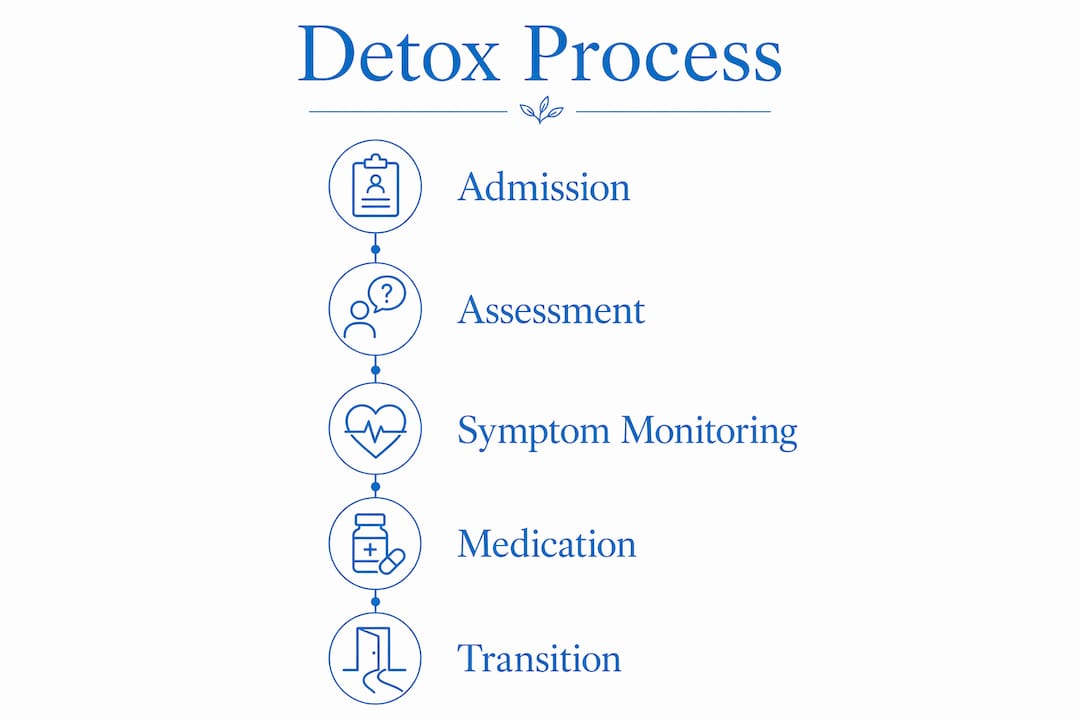
The detox process follows a structured sequence that begins at admission and continues through stabilization and discharge planning. Each step builds on the one before it, creating a safety net that adjusts in real time to how your body responds.
- Admission and comprehensive assessment. Clinicians conduct a full physical exam, blood work, and a detailed substance use history. Vital signs are recorded as a baseline. Mental health screening identifies any co-occurring conditions that require parallel treatment.
- Initial symptom scoring. For alcohol withdrawal, nurses administer the CIWA-Ar scale, a standardized 10-item tool scoring 0 to 67 that measures nausea, tremors, anxiety, sweating, and orientation. This first score determines whether medication begins immediately or monitoring continues.
- Medication administration. When scores exceed clinical thresholds, benzodiazepines or other prescribed medications are administered. Dosing is tied directly to symptom severity, not to a fixed schedule. This symptom-triggered approach prevents both overmedication and under-treatment.
- Reassessment loops. Protocols require reassessment 30 to 60 minutes after each medication dose and at regular intervals throughout the day. Scores that rise trigger additional medication. Scores that fall allow the team to taper doses safely.
- Vital signs monitoring. Blood pressure, heart rate, temperature, and oxygen levels are checked continuously or at frequent intervals. Sudden spikes in blood pressure or the onset of fever signal complications requiring immediate physician response.
- Emotional and psychological support. Nurses, counselors, and social workers provide consistent contact throughout detox. Anxiety and psychological distress are common during withdrawal, and having a trusted clinical presence reduces fear and improves cooperation with the treatment plan.
- Discharge and transition planning. Before leaving detox, patients receive a structured plan for the next phase of care, whether residential treatment, an intensive outpatient program, or medication-assisted treatment.
Pro Tip: Bring a written list of all current medications, supplements, and any prior withdrawal history to your admission appointment. Clinicians who have this information upfront can adjust your detox plan before symptoms begin rather than reacting after the fact.
| Detox phase | What happens |
|---|---|
| Admission | Physical exam, blood work, mental health screening, baseline vitals |
| Symptom scoring | CIWA-Ar or equivalent tool administered to set initial severity level |
| Medication start | Symptom-triggered dosing begins based on score thresholds |
| Reassessment | Scores rechecked every 30 to 60 minutes post-medication; doses adjusted |
| Stabilization | Scores decline, medication tapers, vital signs normalize |
| Transition planning | Aftercare plan finalized before discharge |

How do symptom monitoring tools like CIWA-Ar guide safe withdrawal?
The CIWA-Ar scale is the gold standard for measuring alcohol withdrawal severity in clinical settings. It scores 10 symptoms including nausea, tremor, sweating, anxiety, agitation, perceptual disturbances, and orientation, producing a total between 0 and 67. That number directly drives clinical decisions.
Scores below 8 typically indicate mild withdrawal managed with supportive care and close observation. Scores between 8 and 15 signal moderate withdrawal requiring medication. Scores above 15 indicate severe withdrawal with seizure risk, requiring aggressive pharmacological intervention and often transfer to a higher level of care. This tiered system removes guesswork from one of medicine’s most unpredictable clinical situations.
The power of CIWA-Ar lies in its dynamic nature. Repeated assessments allow dynamic medication adjustments, with hourly scoring during unstable periods and less frequent checks as the patient stabilizes. This prevents the common failure mode of fixed-dose protocols, where patients either receive too much sedation early or insufficient coverage as symptoms peak.
| CIWA-Ar score range | Clinical interpretation | Typical response |
|---|---|---|
| 0 to 7 | Mild withdrawal | Monitoring, hydration, supportive care |
| 8 to 15 | Moderate withdrawal | Symptom-triggered benzodiazepine dosing |
| 16 and above | Severe withdrawal | Aggressive medication, possible ICU transfer |
Documentation matters as much as the scoring itself. Every score, every medication dose, and every reassessment gets recorded in the clinical chart. This paper trail lets the treatment team identify trends, catch deterioration early, and defend clinical decisions if complications arise. Facilities that skip rigorous documentation introduce unnecessary risk into an already high-stakes process.
What medications are used in medically supervised detox?
Medication selection in detox is not one-size-fits-all. Benzodiazepines like lorazepam and oxazepam are the first-line treatment for alcohol withdrawal because they prevent seizures and reduce the severity of autonomic symptoms. The choice between specific agents depends on the patient’s liver function and medical history.
Oxazepam and lorazepam are both kidney-metabolized, making them safer for patients with liver impairment. Other benzodiazepines like diazepam are longer-acting and effective in patients with healthy liver function, but carry higher accumulation risk in those with hepatic disease. This is why medication choices are tailored to individual patient risks, not selected from a standard menu.
For opioid detox, the medication picture looks different. Common options include:
- Methadone for stabilization and taper in opioid-dependent patients, administered through licensed opioid treatment programs.
- Buprenorphine (Suboxone) to reduce cravings and withdrawal symptoms, often continued into long-term medication-assisted treatment.
- Clonidine to manage autonomic symptoms like sweating, anxiety, and elevated blood pressure during opioid withdrawal, though it does not address cravings.
- Naltrexone introduced after full detox completion to block opioid effects and reduce relapse risk.
Pro Tip: If you or a family member has a history of liver disease, ask the prescribing physician specifically which benzodiazepine is being used and why. Lorazepam or oxazepam are the appropriate choices in hepatic impairment. This is a question worth asking directly, not assuming.
Side effects across all these medications include sedation, dizziness, and in some cases respiratory depression with higher benzodiazepine doses. Medical supervision during administration is what makes these medications safe rather than dangerous. The same drug that prevents a seizure in a monitored setting can cause respiratory arrest in an unsupervised one.
Planning the transition from detox to ongoing treatment
Detox is not treatment. It is the medical preparation that makes treatment possible. The transition from detox to ongoing care is where long-term recovery is either built or lost, and planning it before discharge is non-negotiable.
SAMHSA’s FindTreatment.gov and its opioid treatment program directories are the most reliable starting points for locating post-detox care. These directories are confidential, updated regularly, and searchable by location, insurance type, and treatment modality. Using a trusted directory improves access to appropriate rehab and increases the chances of sustained recovery.
Practical steps for a strong transition include:
- Confirm the next level of care before discharge. Residential treatment, partial hospitalization, or intensive outpatient programs should be scheduled, not just recommended. A referral without a confirmed appointment is not a plan.
- Involve family members in discharge planning. Family involvement in treatment planning improves outcomes. Families who understand the recovery process provide better support and recognize warning signs earlier.
- Address co-occurring mental health conditions. Anxiety, depression, and trauma disorders frequently co-occur with substance use. An individualized treatment plan that addresses both conditions simultaneously produces better outcomes than treating them separately.
- Clarify medication management after detox. Some patients continue medications like buprenorphine or naltrexone after detox. Understanding the plan for ongoing medication support prevents gaps in care that trigger relapse.
- Use the detox team’s knowledge. The clinical staff who managed your detox have direct insight into your specific withdrawal pattern and medical needs. Their recommendations for aftercare are more personalized than any general directory search.
Key takeaways
Medically supervised detox is the only safe method for managing withdrawal from alcohol, opioids, and benzodiazepines, combining CIWA-Ar monitoring, symptom-triggered medication, and structured transition planning to protect patients at every stage.
| Point | Details |
|---|---|
| Medical assessment comes first | Substance history, liver function, and prior withdrawal episodes determine the entire detox plan. |
| CIWA-Ar drives medication decisions | Scores above 8 trigger benzodiazepine dosing; scores above 15 signal severe risk requiring aggressive treatment. |
| Medication choice is personalized | Lorazepam and oxazepam are preferred in liver impairment; opioid detox uses buprenorphine, methadone, or clonidine. |
| Reassessment loops prevent failure | Clinicians rescore every 30 to 60 minutes post-medication to adjust doses before symptoms escalate. |
| Detox requires a transition plan | SAMHSA’s FindTreatment.gov and clinical referrals should confirm the next level of care before discharge. |
What I’ve learned from watching people go through detox
Most people arrive at detox expecting it to be purely physical. They think the hard part is the shaking and the sweating, and that once the body clears the substance, the work is done. What I’ve seen consistently is that the psychological experience of detox is just as demanding as the physical one, and the facilities that acknowledge this produce better outcomes.
The patients who do best are not necessarily the ones with the mildest withdrawals. They are the ones whose clinical team treats them as people rather than symptom scores. A nurse who explains what the CIWA-Ar score means, why a medication is being given, and what to expect in the next few hours reduces fear in a way that no medication can replicate. That transparency builds trust, and trust keeps people in treatment long enough for it to work.
I also want to address a misconception I hear often: that medical detox is only for people with severe addiction. That framing causes people to delay care until they are in crisis. Detox under medical supervision is appropriate for anyone whose body has become physically dependent on a substance, regardless of how long that dependence has existed. Waiting for things to get worse is not a strategy. It is a risk.
The other thing worth saying plainly: detox is a beginning, not an ending. The people who treat discharge from detox as the finish line are the ones most likely to relapse within weeks. The clinical team, the family, and the patient all need to hold the same understanding. Detox clears the path. Recovery is what you build on it.
— Jevan
Start your detox safely with Sylmartreatmentcenter
Sylmartreatmentcenter provides medically supervised detox in an intimate six-bed setting where every patient receives direct, continuous clinical attention rather than being managed in a crowded unit. The center’s DHCS-licensed and Joint Commission-accredited programs include 24/7 monitoring, CIWA-Ar-based symptom management, individualized medication protocols, and discharge planning that connects patients to the right next step in their recovery. Families receive support throughout the process, not just at admission. If you or someone you love is ready to begin detox with a team that treats the whole person, Sylmartreatmentcenter’s admissions team is available around the clock to answer your questions and guide you forward.
FAQ
What is the medically supervised detox process?
The medically supervised detox process is a clinically managed program where medical professionals monitor withdrawal symptoms, administer medications, and provide continuous support to safely remove substances from the body. It applies most critically to alcohol, opioids, and benzodiazepines, where withdrawal can become life-threatening without intervention.
Is medical detox necessary for everyone?
Medical detox is necessary for anyone physically dependent on alcohol, benzodiazepines, or opioids, as withdrawal from these substances carries seizure, cardiac, and respiratory risks. Individuals with prior complicated withdrawals, co-occurring medical conditions, or polysubstance use require inpatient detox treatment regardless of perceived severity.
How long does medically supervised detox take?
Detox duration varies by substance and individual health factors, typically ranging from three to ten days for alcohol and opioids. Benzodiazepine detox may extend longer due to the risk of prolonged withdrawal syndrome.
What is CIWA-Ar and why does it matter?
CIWA-Ar is a standardized 10-item scoring tool ranging from 0 to 67 that measures alcohol withdrawal severity across symptoms including tremors, anxiety, nausea, and orientation. Scores directly trigger medication decisions, making it the primary safety mechanism in alcohol detox protocols.
What happens after detox is complete?
After detox, patients transition to residential treatment, intensive outpatient programs, or medication-assisted treatment depending on their clinical needs. SAMHSA’s FindTreatment.gov provides a confidential, regularly updated directory for locating appropriate post-detox care near you.