

A detox assessment process is a structured clinical evaluation that determines how safely and effectively a person can move through substance withdrawal and into the right level of care. Without it, treatment teams are guessing. With it, they have a clinical roadmap built around the individual’s actual medical risks, mental health status, and personal circumstances. Tools like the CIWA-Ar for alcohol withdrawal and the COWS scale for opioids, combined with the multidimensional ASAM Criteria, give clinicians the precision needed to match each person to a safe and appropriate detox plan. For families watching a loved one struggle, understanding this process is the first step toward knowing what good care actually looks like.
What is a detox assessment process and why does it matter?
A detox assessment process is the clinical foundation of addiction treatment. It is the formal evaluation that happens before detox begins, and it answers one critical question: what does this specific person need to withdraw safely? The importance of accurate assessment lies in preventing unsafe or mismatched withdrawal management by combining all available clinical information into a coherent picture.
The detox evaluation process does more than screen for drug use. It examines medical history, mental health conditions, prior withdrawal episodes, social supports, and the person’s own readiness to change. Each of these factors directly shapes how withdrawal will unfold and what level of medical supervision is needed. A person with a history of alcohol seizures needs a very different detox setting than someone withdrawing from cannabis for the first time.

The ASAM Criteria, developed by the American Society of Addiction Medicine, is the nationally recognized framework most treatment centers use to structure this evaluation. It organizes assessment across six clinical dimensions, producing a standardized picture that reduces guesswork and increases consistency across providers. The ASAM Criteria framework is freely available and widely adopted precisely because it improves both the quality and the individualization of care.
Skipping or rushing this process is one of the most common reasons people end up in the wrong level of care, experience dangerous withdrawals, or leave treatment early. A thorough detox assessment is not a bureaucratic hurdle. It is the mechanism that keeps people safe.
What are the main steps involved in a typical detox assessment?
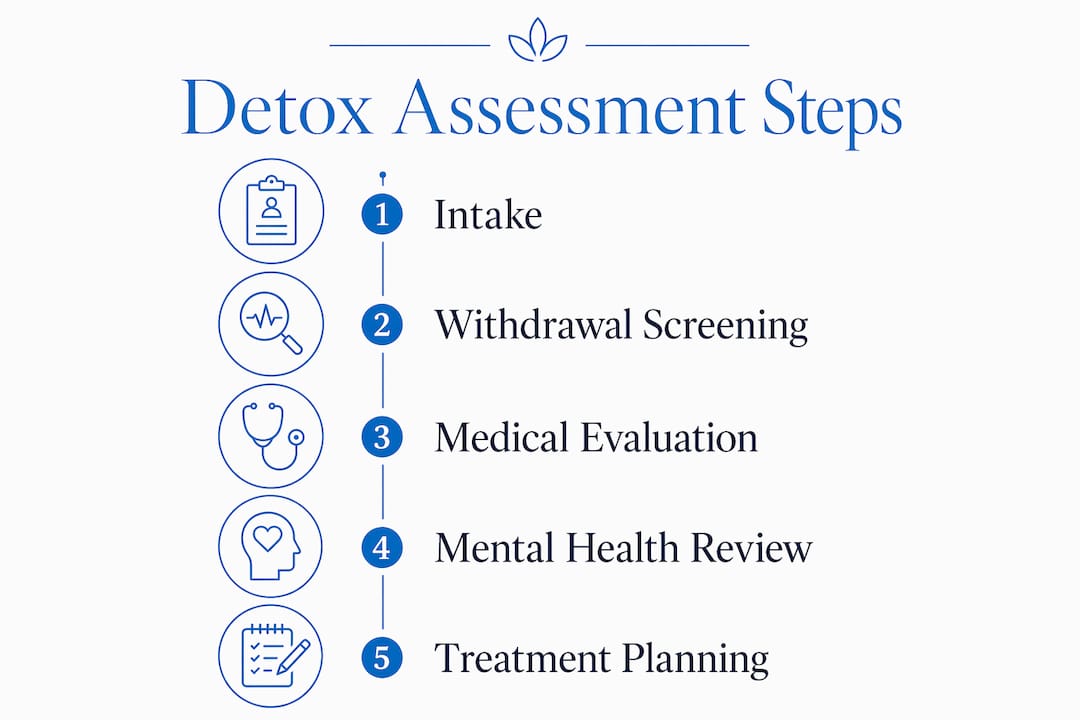
The detox evaluation process unfolds in a predictable sequence, though the depth and setting vary by facility. Here is what most individuals and families can expect:
-
Initial intake conversation. The process begins with a conversational intake that gathers foundational information: substances used, frequency and quantity, last use, prior treatment history, and any known medical conditions. This stage is typically lower pressure and can happen by phone or in person. The two-stage assessment process helps determine program suitability before the deeper clinical evaluation begins.
-
Withdrawal symptom screening. Clinicians use validated scales to measure current withdrawal severity. The CIWA-Ar (Clinical Institute Withdrawal Assessment for Alcohol) and the COWS (Clinical Opiate Withdrawal Scale) are the two most widely used instruments. A 2025 PubMed study confirmed a strong correlation between CIWA-Ar and MINDS scales in hospitalized patients, with an r value of 0.801, validating their utility in quantifying withdrawal severity. That level of correlation means both tools are measuring the same clinical reality, which strengthens confidence in their results.
-
Medical examination. A physician or nurse practitioner reviews vital signs, conducts a physical exam, and orders labs as needed. This step identifies acute medical risks like liver disease, cardiovascular conditions, or nutritional deficiencies that could complicate withdrawal.
-
Psychosocial and mental health review. The clinician explores co-occurring psychiatric conditions, trauma history, cognitive functioning, and emotional stability. This directly informs whether a person needs dual diagnosis support alongside their detox.
-
Multidimensional ASAM evaluation. Using the six ASAM dimensions, the clinician assesses withdrawal potential, biomedical conditions, emotional and behavioral factors, readiness to change, relapse risk, and recovery environment. The findings from all six dimensions are synthesized into a care level recommendation.
-
Treatment plan development. The individualized treatment plan that emerges from assessment is a clinical roadmap tailored to the individual, not a generic program. It specifies the detox setting, medication protocols, monitoring frequency, and the next level of care after detox.
Pro Tip: Ask any treatment center you contact whether they use the ASAM Criteria and validated withdrawal scales. A center that cannot answer that question clearly may not be conducting thorough assessments.
How do standardized tools improve detox assessment accuracy?
Standardized detox assessment methods exist because clinical impressions alone are not reliable enough when lives are at stake. The CIWA-Ar and COWS scales give clinicians a numerical score that tracks withdrawal severity over time, making it easier to decide when medication is needed and when a person can safely step down in care.
That said, no single tool tells the whole story. Clinical judgment alongside scoring is essential, particularly in severe withdrawal cases where scoring difficulties in acute settings can affect accuracy. A score of 12 on the CIWA-Ar means something different for a 25-year-old with no prior withdrawal history than for a 55-year-old with three prior seizures. The number is a starting point, not a verdict.
The ASAM Criteria expands assessment well beyond withdrawal symptoms. Its six dimensions capture the full clinical and personal picture:
| Assessment approach | What it covers | Limitation |
|---|---|---|
| CIWA-Ar / COWS (one-dimensional) | Withdrawal symptom severity at a single point in time | Does not capture medical history, mental health, or social factors |
| ASAM Criteria (multidimensional) | Six domains including biomedical, emotional, relapse risk, and recovery environment | Requires trained clinicians and more time to administer |
The contrast matters because a one-dimensional approach can place someone in the wrong care level. A person with mild withdrawal scores but severe depression and no stable housing needs a higher level of support than their CIWA-Ar score alone would suggest. The ASAM six-dimension framework captures that complexity and produces better matching to care level and safer detox outcomes.
“Multidimensional assessments via the ASAM Criteria encompass risk across several domains, improving consistency and individualized care.” — Center for Health Care Strategies
The practical takeaway for families is this: a quality detox program uses both withdrawal scales and a multidimensional framework. One without the other is an incomplete picture.
What clinical and personal factors shape detox assessment outcomes?
The detox assessment process draws on a wide range of factors, and each one can shift the resulting treatment recommendation significantly. Understanding what clinicians are evaluating helps families ask better questions and helps individuals feel less caught off guard during the process.
Medical and biomedical factors include liver function, cardiovascular health, nutritional status, history of seizures or delirium tremens, and any chronic conditions that interact with withdrawal. These factors determine whether detox can be managed in an outpatient setting or requires 24-hour medical supervision.
Co-occurring mental health conditions are among the most influential variables in detox planning. Depression, anxiety disorders, PTSD, and bipolar disorder all affect how a person experiences withdrawal and how much psychiatric support they need during detox. Identifying these conditions early allows clinicians to build them into the care plan from day one rather than discovering them mid-detox.
Readiness to change is assessed because motivation directly affects treatment engagement and outcomes. A person who is ambivalent about recovery may need a different therapeutic approach than someone who is fully committed. This dimension does not disqualify anyone from care. It shapes how care is delivered.
Relapse risk and prior substance use patterns tell clinicians how entrenched the addiction is and what triggers are most likely to derail recovery. A person with multiple prior relapses following detox may benefit from medication management as part of their ongoing plan.
Social and environmental factors include housing stability, family support, employment, and exposure to people or places associated with substance use. A person returning to an unstable or high-risk environment after detox needs a stronger continuing care plan than someone with a supportive home and engaged family.
Pro Tip: If you are supporting a family member through assessment, write down the key facts beforehand: substances used, approximate quantities, dates of last use, and any known medical conditions. Accurate information produces a more accurate assessment.
What should individuals and families expect during the assessment experience?
The assessment experience is designed to be clinical, not confrontational. Most people who have gone through it describe it as a series of conversations with a clinician who is genuinely trying to understand their situation. Knowing what to expect reduces anxiety and increases the likelihood that the person being assessed will be honest, which directly improves care quality.
Here is what the experience typically involves:
- Confidentiality. Assessment information is used only to plan treatment. It is not shared with employers, law enforcement, or family members without explicit consent. Honesty during assessment produces the most accurate clinical picture and the best outcomes.
- No judgment. Clinicians conducting detox assessments are trained to gather information without shaming or lecturing. The goal is accuracy, not moral evaluation.
- Timeframe. An initial intake conversation typically takes 30 to 60 minutes. A comprehensive multidimensional evaluation may take one to two hours and can span more than one session.
- Ongoing reassessment. The detox assessment process does not end at intake. Withdrawal symptoms are monitored continuously, and care plans are adjusted as the clinical picture evolves. A person who develops unexpected complications during detox will have their plan updated in real time.
- Questions to ask. Families and individuals can and should ask treatment centers: What assessment tools do you use? How do you determine the appropriate level of care? Who conducts the assessment? What happens if my needs change during detox?
Asking these questions is not a sign of distrust. It is a sign of informed advocacy, and any quality treatment center will welcome them.
Key takeaways
A thorough detox assessment process is the single most important factor in matching an individual to safe, effective withdrawal management and the right level of ongoing care.
| Point | Details |
|---|---|
| Assessment precedes safe detox | Clinical evaluation determines withdrawal risk and appropriate care level before detox begins. |
| Standardized tools improve accuracy | CIWA-Ar and COWS quantify withdrawal severity; ASAM Criteria adds six-dimensional clinical depth. |
| Multidimensional beats one-dimensional | ASAM-based assessment captures medical, psychiatric, social, and motivational factors that symptom scales miss. |
| Honesty improves outcomes | Complete and accurate information from the patient produces a more precise treatment plan and safer detox. |
| Assessment is ongoing | Withdrawal monitoring and care plan adjustments continue throughout the detox process, not just at intake. |
Why I think most people underestimate what a detox assessment actually does
After years of working in and around addiction treatment, the most consistent mistake I see families make is treating the assessment as a formality. They assume the real work starts when detox begins. That framing gets it exactly backward.
The assessment is where the treatment is designed. Everything that follows, the medications, the monitoring schedule, the psychiatric support, the discharge plan, flows directly from what the assessment reveals. A rushed or superficial evaluation produces a generic plan. A thorough, multidimensional evaluation produces a plan built around the actual person.
The misconception I hear most often is that detox is just about getting substances out of the body. Clinically, that is only one dimension. The ASAM Criteria exists precisely because withdrawal management disconnected from a person’s mental health, living situation, and motivation to change produces short-term sobriety and long-term relapse. The data on this is not ambiguous.
My advice to families is direct: before your loved one enters any detox program, ask specifically how the assessment is conducted. If the answer is vague, or if the center cannot name the tools and frameworks they use, that is a meaningful signal about the quality of care that follows. You are not being difficult by asking. You are doing exactly what a good advocate does.
— Jevan
Start with an assessment built around you
At Sylmartreatmentcenter, every client begins with a comprehensive clinical evaluation that uses validated withdrawal scales and multidimensional criteria to build a genuinely individualized care plan. The intimate six-bed setting means your assessment is conducted by clinicians who will also be your treatment team, not a rotating intake staff you never see again. Whether you are exploring options for yourself or a family member, the medical detox program at Sylmartreatmentcenter is built on the principle that safe withdrawal starts with knowing exactly who you are treating. Explore all treatment programs or contact the admissions team directly for a confidential evaluation.
FAQ
What does a detox assessment involve?
A detox assessment involves an intake conversation, withdrawal symptom screening using tools like CIWA-Ar or COWS, a medical examination, and a multidimensional psychosocial evaluation using frameworks like the ASAM Criteria. The findings are used to build an individualized treatment plan.
How long does the detox assessment process take?
An initial intake typically takes 30 to 60 minutes, while a comprehensive multidimensional evaluation may take one to two hours and can occur across more than one session depending on the facility and the individual’s complexity.
Why is the ASAM Criteria used in detox assessments?
The ASAM Criteria is a nationally recognized, six-dimension framework that assesses withdrawal potential, medical conditions, mental health, motivation, relapse risk, and recovery environment. It produces more accurate care level matching than symptom scales alone.
Is the information shared during a detox assessment confidential?
Yes. Assessment information is protected and used only to plan treatment. It is not disclosed to employers, family members, or law enforcement without the patient’s explicit consent.
Can the detox assessment plan change after treatment begins?
Yes. Withdrawal monitoring is ongoing, and care plans are adjusted in real time as a person’s clinical status evolves. The initial assessment is a starting point, not a fixed document.