

The most reliable way to measure personal progress during treatment is to combine three things: a standardized symptom scale, one to three functional SMART goals, and routine self-tracking backed by session-by-session therapist feedback. No single number tells the whole story. A mood score can dip while you’re actually handling conflict better than you did two months ago, and that gap is exactly why relying on one method leaves gaps a combined approach catches.
Your next step takes five minutes. Pick a standardized scale that matches your main concern, complete it before your next session, and bring the score with you.
- Depression symptoms: PHQ-9
- Anxiety symptoms: GAD-7
- General well-being or functioning: WHO-5 or the Outcome Rating Scale (ORS)
Clinical trials on measurement-based antidepressant treatment found that patients whose care used routine, structured symptom tracking reached meaningful response faster than usual care. Remission also arrived more quickly. Routine monitoring isn’t busywork. It’s what lets you and your therapist catch a stall before it becomes a lost month.
Key Takeaways
Combining standardized symptom scales, functional SMART goals, and routine self-tracking with therapist feedback produces faster, more reliable progress than any single method alone.
| Point | Details |
|---|---|
| Start with one scale | Complete a PHQ-9, GAD-7, or WHO-5 before your next session to establish a baseline. |
| Track four pillars | Symptoms, functioning, well-being, and therapeutic alliance each reveal something the others miss. |
| Rate goals weekly | Score 3 to 5 SMART goals from 0 to 10 and log one supporting behavior each week. |
| Judge trends, not single scores | Reassess after several weeks; a five-point PHQ-9 drop is a meaningful reliable change. |
| Get supervised, data-driven care | Sylmartreatmentcenter applies daily measurement-based tracking within individualized residential treatment. |
This article is general information, not a substitute for advice from a qualified doctor. Consult a qualified healthcare professional about your own circumstances before acting on anything here.
Table of Contents
- What Measuring Personal Progress During Treatment Actually Requires
- Which Standardized Scales to Use and How to Read the Scores
- Building a Sustainable Self-Tracking Habit
- Turning Vague Goals into Numbers You Can Track
- Bringing Your Data Into the Therapy Room
- Reading the Trend Line Without Overreacting to a Bad Week
- How an Accredited Treatment Center Applies These Same Measures
- What the Research Actually Supports, and What It Doesn’t
- Getting Measurement-Based Care as Part of Residential Treatment
- Sources
What Measuring Personal Progress During Treatment Actually Requires
Measurement-based care, or MBC, means using brief, validated tools at regular intervals to guide clinical decisions instead of relying on impressions from memory. The Substance Abuse and Mental Health Services Administration lists MBC among its evidence-based practices for behavioral health, and for good reason: it gives both you and your therapist a shared, objective reference point instead of two people guessing separately.
Four pillars make up a complete picture, and each one catches something the others miss.
- Symptoms. A depression or anxiety scale tracks the clinical markers a diagnosis is built around.
- Functioning. Are you back at work, sleeping through the night, showing up for people who matter to you? Symptom scores can improve while functioning still lags, or the reverse.
- Well-being. Feeling okay is not the same as feeling good. The WHO-5 captures a dimension that symptom checklists tend to skip entirely.
- Therapeutic alliance. How the relationship with your therapist feels, session to session, predicts outcomes almost as strongly as technique does.
Symptom reduction alone can miss the point. A person’s PHQ-9 score might drop three points while they’re still avoiding their kid’s soccer games. Functional goals catch what the scale doesn’t.
Each pillar covers a blind spot in the others. Standardized scales reveal a symptom trend over weeks. Self-tracking surfaces the specific trigger behind a bad Tuesday. Goal ratings show whether your actual life is changing. Alliance checks flag when the fit with your therapist, not the technique, is the real problem. Treat them as four instruments in one orchestra, not four separate assignments.
Which Standardized Scales to Use and How to Read the Scores
Four instruments cover most situations, and you don’t need all of them at once.
- PHQ-9 for depressive symptoms, nine items, roughly two minutes to complete.
- GAD-7 for anxiety symptoms, seven items, similarly quick.
- QIDS-SR16 when your psychiatrist is fine-tuning medication and wants more granularity on depressive symptoms and side effects.
- WHO-5 for overall well-being, useful when you want a functioning-and-mood snapshot rather than a diagnosis-specific score.
- ORS (Outcome Rating Scale) as a brief, four-item alternative that captures individual, relational, social, and overall well-being in under a minute.
Fill these out weekly at minimum. Session-by-session is better, because it gives your therapist a live feed instead of a delayed report. Trials using structured measurement with instruments like QIDS-SR16 to guide medication decisions found that repeated short check-ins, not occasional long ones, are what actually change clinical choices in real time.
Interpretation matters more than the raw number. A five-point drop on the PHQ-9 is generally considered a meaningful, reliable change, not statistical noise. A two-point wobble week to week is normal variation, the kind of static you’d expect from a bad night’s sleep or a stressful commute. The question isn’t “did my score move,” it’s “did it move more than random fluctuation would explain, and did it move in a direction that held for more than one week.”
Building a Sustainable Self-Tracking Habit
Formal scales capture the big picture. Daily tracking catches the texture in between. The routine that actually sticks is smaller than most people expect.
- Daily: rate your mood 1 to 10, takes under a minute.
- Weekly: a five to ten minute log combining your symptom score with a short note on behavior. Did you isolate? Sleep well? Skip a meal?
- As needed: one sentence explaining any sharp spike or dip. “Argument with sister” or “slept four hours” turns a confusing data point into a useful one.
The numbers alone tell you that something shifted. The one-line note tells you why, and why is what your therapist can actually work with.
Pro Tip: If tracking starts to feel like a chore, cut it down before you quit entirely. A once-weekly, three-question check-in beats a daily log you abandon after ten days.

Keep the list of items you track short. Three to five data points, tracked consistently for months, beats fifteen data points tracked for two weeks and then dropped.
Turning Vague Goals into Numbers You Can Track
“Feel less anxious” isn’t a goal you can measure. “Attend one social event per week without leaving early” is. SMART goals, specific, measurable, achievable, relevant, time-bound, translate therapy aims into something you can rate honestly on a Sunday night.
- Sleep: “Fall asleep within 30 minutes, four nights out of seven, by week six.”
- Social functioning: “Initiate one conversation with a coworker per day, five days a week.”
- Substance-related functioning: “Attend all scheduled support meetings for four consecutive weeks.”
- Work attendance: “Arrive on time three days this week, with no unplanned absences.”
Once you’ve written two or three of these, rate each one 0 to 10 weekly and jot down one behavior that supports the score. Over a few personal goals guiding your broader treatment plan, you’ll often see functional ratings climb before symptom scores do. That gap is not a contradiction. It’s usually the first honest sign that treatment is working, weeks before the clinical scale catches up.
Bringing Your Data Into the Therapy Room
Two brief tools exist specifically to check whether therapy itself, not just your symptoms, is working. The Session Rating Scale (SRS) takes under a minute at the end of a session and rates whether you felt heard, whether the approach fit, and whether the session addressed what mattered to you. The ORS, mentioned earlier as a symptom tool, doubles as a session opener. Some therapists also use the Working Alliance Inventory (WAI) periodically for a deeper alliance check.
Bringing your own data in doesn’t need to be awkward. Try something direct: “I’ve been tracking my PHQ-9 and three functional goals. Can we go over them today?” Most therapists welcome this. Clinicians and consumer advocates alike recommend treating outcome measurement as a normal, expected part of care rather than something you have to justify.
If progress stalls for three or four weeks straight, ask specific questions instead of a vague “is this working?”
- Should we adjust the current goals, or set new ones?
- Would a different technique or modality make sense here?
- Is it time to revisit medication with the prescriber?
- Would a referral or additional support be worth exploring?
Pro Tip: Write your questions down before the session. Stalled progress conversations go better when you arrive with two specific asks instead of a general complaint.
Reading the Trend Line Without Overreacting to a Bad Week
One data point is noise. A trend across four to six data points is signal. That distinction is the entire skill of tracking your own progress. Clinicians distinguish “reliable change,” a shift bigger than normal measurement error, from “clinically significant improvement,” a shift that moves you out of a diagnostic range entirely. You’re looking for the first one most weeks and hoping for the second one eventually.
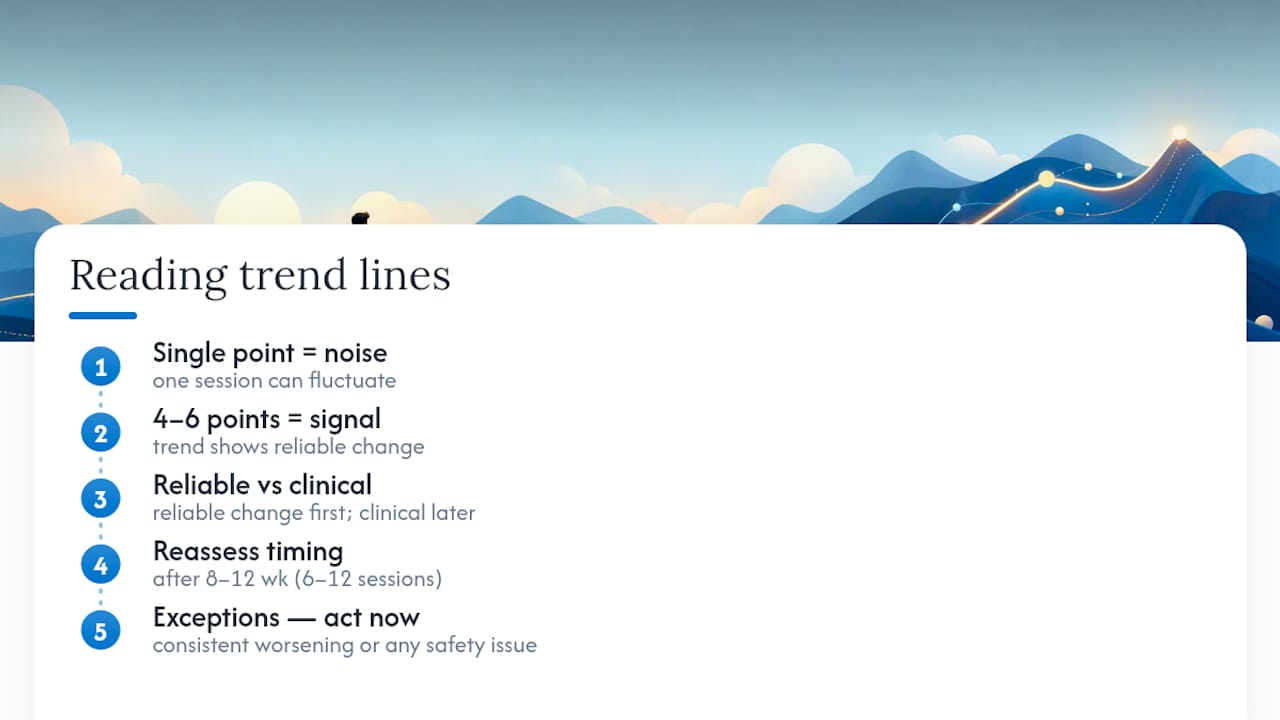
Most concerns warrant a real reassessment after eight to twelve weeks, or roughly six to twelve sessions. That’s long enough for a trend to separate itself from static, short enough that you’re not waiting a year to find out something isn’t working.
Two exceptions override the patience rule. Raise concerns immediately if scores are worsening consistently, not just fluctuating, or if any safety issue comes up. Otherwise, expect the line to zigzag. Therapists and researchers alike describe meaningful change as showing up in how you handle a hard conversation three months from now, not in whether last Tuesday’s session felt good. Progress in therapy is rarely a straight line, and resources on building emotional resilience make the same point: a rough session is not evidence that the process has failed.
How an Accredited Treatment Center Applies These Same Measures
A licensed residential program builds this exact framework into daily practice rather than leaving it to a client’s memory. Sylmartreatmentcenter operates under a DHCS license and Joint Commission accreditation, runs a six-bed setting that keeps caseloads small, and maintains 24/7 admissions support so intake assessment starts the moment someone reaches out.
A typical workflow looks like this:
- Comprehensive intake assessment covering substance use, mental health history, and immediate risk.
- Baseline standardized measures (PHQ-9, ORS, or equivalent) completed before the first full treatment day.
- Weekly tracking reviewed against functional and clinical goals during individual sessions.
- A monthly care-plan update that folds in new data and adjusts goals as needed.
Six beds means every score gets a face attached to it. In a facility that size, a five-point PHQ-9 shift doesn’t get lost in a caseload. Someone on staff notices it the same week.
This is a workflow description, not a guarantee of specific outcomes for any individual case, and internal data on program-level results is not publicly listed here.
What the Research Actually Supports, and What It Doesn’t
The strongest evidence behind measurement-based care doesn’t say tracking makes you feel better. It says tracking helps clinicians make faster, more accurate decisions, which is a different claim, and a more honest one. The antidepressant trial showing faster remission with MBC worked because clinicians acted on the numbers, adjusting dosage or technique before a client had quietly suffered for two extra months. The measurement itself did nothing. The response to the measurement did everything.
That’s where I think the conventional advice, “just journal, just set goals,” falls short. Journaling without a structure to interpret it produces a pile of feelings with no trend line. Goal-setting without weekly rating produces good intentions nobody revisits. The oncology research on weekly patient-reported outcomes that reduce emergency visits makes the mechanism explicit: it wasn’t the reporting that helped, it was that frequent reporting let a care team intervene early.
If you take one thing from all of this, prioritize the review step over the tracking step. A perfect spreadsheet nobody looks at with a clinician is worthless. A rough three-question weekly check-in that actually gets discussed in session beats it every time.
— Jim
Getting Measurement-Based Care as Part of Residential Treatment
If tracking your own symptoms has made it clear that self-management alone isn’t enough, and what you need is structured, clinically supervised care, that’s a different level of support than a spreadsheet can provide. Sylmartreatmentcenter builds measurement-based care directly into residential treatment for substance use and co-occurring mental health disorders, so the tracking you’ve just learned to do yourself happens daily, with a clinical team acting on the results in real time rather than waiting for your next weekly check-in.
The six-bed model means baseline assessments, weekly symptom scales, and functional goal reviews aren’t squeezed into a fifteen-minute slot. Individualized treatment programs are built around your specific data from day one, including dual diagnosis care when substance use and mental health symptoms need to be tracked together rather than separately. If residential-level, data-driven care sounds like the right next step, explore Sylmartreatmentcenter’s programs and call the 24/7 admissions line to talk through what a measurement-based intake would look like for your situation.
Sources
- Measurement-Based Care to Enhance Antidepressant Treatment (JAMA Network/OVID)
- Symptom monitoring with electronic patient-reported outcomes during routine cancer treatment (Nature Medicine)