
A recovery milestone is a meaningful marker of progress in sobriety — a moment when you can point to something real and say, “I did that.” Three quick examples: staying sober for 24 hours after deciding to change, attending your first support group meeting, and rebuilding trust with a family member you hurt during active addiction. These markers matter because they convert invisible effort into visible evidence, giving you proof that recovery is actually working. Peer-support frameworks describe milestones as “bright spots” that document how recovery principles show up in daily life, and clinicians use them as assessment tools within the Stages of Change framework to match the right support to where you are right now.
Table of Contents
- What does a recovery milestone mean, exactly?
- Why milestones matter for motivation and lasting change
- What milestones look like at each stage of recovery
- How to mark and celebrate milestones safely
- How to stay steady between milestones
- What to do if you relapse before or after a milestone
- How clinicians and researchers think about milestones
- How to write your own recovery milestones
- Key Takeaways
- Milestones are tools, not obligations
- Structured support when you need more than a milestone
- Useful sources and further reading
What does a recovery milestone mean, exactly?
A recovery milestone is any point in your sobriety where a meaningful shift has occurred — something you can name, recognize, and build on. The word “milestone” is deliberate: like a stone marker on a road, it tells you how far you’ve traveled, not how far you still have to go.
Milestones fall into three broad types. Time-based milestones are the most widely recognized and include early daily, weekly, monthly, and longer-term markers that carry symbolic and practical weight in recovery communities. The 24-hour mark, in particular, is widely regarded by clinicians and peer supporters as the most emotionally significant early milestone because it represents the immediate break from past patterns and the start of stabilization.
Behavior-based milestones are less about the calendar and more about what you actually did: attending your first AA or NA meeting, navigating a social situation that used to trigger use, or completing a week of medication-assisted treatment without interruption. These often feel more personal than time markers, and for many people in recovery, they’re more motivating.
Emotional and relational milestones come later and tend to carry the most weight over time: forgiving yourself for past harm, having an honest conversation with someone you hurt, or feeling genuinely comfortable in your own skin without a substance. Who sets these milestones matters too. Your treatment team may document formal clinical benchmarks; your sponsor or peer group may recognize community milestones with chips or medallions; and you yourself may quietly note the ones that mean the most. All three sources are valid, and the most durable milestones usually come from a combination of all three.
Why milestones matter for motivation and lasting change
Recovery is long, and the middle of it can feel like nothing is happening. Milestones interrupt that feeling. They turn an abstract, ongoing process into a series of concrete, nameable wins.
The specific benefits include:
- Evidence of progress. When cravings are loud and doubt is louder, a milestone gives you something factual to point to.
- Motivation to continue. Reaching one marker makes the next one feel reachable.
- Community recognition. Sharing a milestone in a meeting or with a sponsor reinforces your identity as someone in recovery, not just someone trying to quit.
- Accountability structure. Milestones create natural check-in points for you and your treatment team to review what’s working.
- Treatment planning anchors. Clinicians use milestone data to adjust interventions, shift from motivational work to relapse-prevention strategies, or introduce new therapeutic goals.
Tracking milestones also changes the story you tell yourself. Instead of “I’m still struggling,” the narrative becomes “I’ve made it 30 days, and here’s what I learned.” That shift is not cosmetic. Peer-support frameworks consistently describe this as the moment recovery stops feeling like deprivation and starts feeling like growth.
One caution: a milestone is not a finish line. Reaching 90 days does not mean the work is done, and missing a milestone does not mean recovery has failed. The risk in milestone thinking is treating a single date as proof of cure rather than as one data point in a longer process. Personalized recovery planning helps guard against that all-or-nothing interpretation by keeping the focus on patterns, not single events.
What milestones look like at each stage of recovery
Recovery does not move in a straight line, but it does tend to move through recognizable phases. Understanding what each phase typically looks like helps you set realistic expectations and recognize progress even when it doesn’t feel obvious.
| Stage | Typical Time Frame | Sample Milestone Behaviors |
|---|---|---|
| Early recovery | First 24 hours to 3 months | First 24 hours sober; completing medical detox; attending first meeting; handling first craving without using |
| Mid-recovery | 3 months to 2 years | 6-month sobriety anniversary; establishing a daily routine; repairing one key relationship; completing a therapy phase |
| Long-term recovery | 2 years and beyond | 3-year and 5-year anniversaries; returning to work or school; mentoring others in recovery; rebuilding a sense of life purpose |
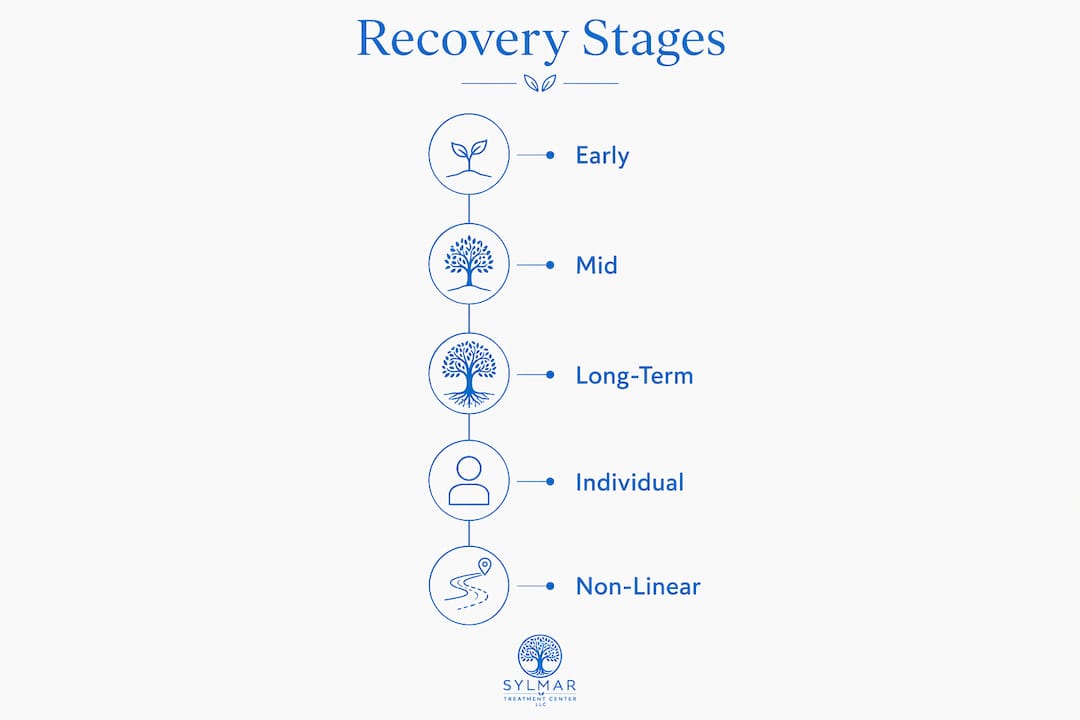
Early recovery (first hours to a few months) is dominated by physiological stabilization and behavioral firsts. Early time markers are key points that many peer-support programs recognize for community support. Physically, the body is adjusting; emotionally, the work is just learning to get through a day without using. The milestones here are small by design. They’re meant to be reachable.

Mid-recovery (3 months to 2 years) is where routines solidify and emotional coping deepens. The 6-month mark is significant: many programs recognize it as an important point for sustained treatment success. The 1-year anniversary is widely celebrated in recovery communities with medallions, public recognition, and personal reflection. Milestones at this stage shift from “I didn’t use today” to “I handled something hard and stayed sober.”
Long-term recovery (2 years and beyond) looks different from what most people picture when they imagine sobriety. According to research on the evolution of recovery, milestone meaning shifts from physiological and behavioral gains to emotional integration, self-forgiveness, and life purpose, particularly in years 6–10. The milestones here are relational and identity-based: mentoring a newcomer, rebuilding a career, or simply feeling at home in a life you’ve built.
Individual variation is real. Some people move through early recovery in weeks; others spend years there. Non-linear progress is not failure. A person can reach 2 years of sobriety and still be working on emotional milestones that others hit at 6 months. The stage framework is a map, not a schedule.
How to mark and celebrate milestones safely
Celebrating a milestone is not optional. Recognition reinforces the identity shift that makes recovery stick. The question is how to do it in a way that supports sobriety rather than creating new risks.
Safe, meaningful celebration ideas include:
- Sharing the milestone at a meeting and receiving a chip or medallion
- A sober dinner with people who supported your recovery
- Writing a letter to yourself about what the milestone cost and what it’s worth
- A meaningful non-triggering activity: a hike, a concert, a day trip
- Asking your sponsor or therapist to mark the moment formally in your next session
A short checklist for setting milestone goals:
- Specific. “Stay sober for 30 days” is a milestone. “Do better” is not.
- Measurable. You should be able to confirm it happened, not just feel like it did.
- Safety-reviewed. Does the planned celebration involve environments or people that could trigger use? If yes, revise the plan.
- Accountability partner. Tell at least one person what you’re working toward and when you expect to reach it.
Pro Tip: When planning a celebration, run it past your sponsor or therapist first. A restaurant where you used to drink, a party with people from your using days, or even a high-stress family event can undercut a milestone moment fast. Pick the setting deliberately, and have a plan for leaving early if you need to.
Community support plays a specific role here. AA and NA keychips and medallions are not just tokens; they serve a social function, reinforcing your membership in a recovery community and making your progress visible to others who understand what it took.
How to stay steady between milestones
The space between milestones is where most of the real work happens. When the next marker feels far away, the day-to-day structure of recovery is what keeps you moving.
Daily routines are underrated. A consistent sleep schedule, regular meals, and a predictable structure reduce the cognitive load of recovery by removing decisions that could become vulnerabilities. When your day has shape, cravings have fewer gaps to fill.

A craving-response plan works best when it’s built before you need it. The sequence looks like this: first, identify the trigger as specifically as you can (a place, a person, a feeling, a time of day). Second, move immediately to a coping action you’ve already practiced, whether that’s calling someone, going for a walk, or using a grounding technique like the 5-4-3-2-1 sensory method. Third, contact a support person, your sponsor, a peer, or your therapist, and say out loud what happened. Fourth, follow up at your next session to add what you learned to your relapse-prevention plan.
Ongoing supports that make this work include individual therapy, peer-support groups (AA, NA, SMART Recovery), medication management when clinically indicated, and regular sponsor or peer contact. Mental health care matters here too: co-occurring disorders like anxiety or depression can amplify cravings and make the space between milestones feel longer than it is. Treating both simultaneously is not a luxury; it’s standard evidence-based practice.
What to do if you relapse before or after a milestone
A relapse does not erase what came before it. This is not a consolation; it’s a clinical fact. The progress you made, the skills you built, the relationships you repaired — none of that disappears because of a slip. What matters most is what you do in the hours and days immediately after.
Immediate steps:
- Confirm medical safety first. If the relapse involved a large amount of a substance or a combination of substances, seek medical attention before anything else.
- Tell a support person what happened. A sponsor, a trusted friend in recovery, or a family member who knows your situation.
- Re-engage with your treatment team as soon as possible. Do not wait until your next scheduled appointment.
- Revise your relapse-prevention plan with your clinician. A relapse is data, not a verdict.
Reframing the relapse in relation to your milestones is not about minimizing what happened. It’s about treating it as information. What triggered it? What coping step got skipped? What does the plan need to account for now that it didn’t before? These are the questions that make the next milestone more durable, not less.
When you talk to your clinician or sponsor, be specific. “I used on Saturday night after running into someone from my using days” is more useful than “I slipped.” The more precise the account, the more targeted the response can be. Family support during this period matters enormously; the people closest to you need honest information to help effectively.
How clinicians and researchers think about milestones
Clinicians do not treat milestones as endpoints. They treat them as assessment tools — signals that tell a treatment team where a person is in the recovery process and what kind of support fits that moment.
The framework most widely used to map this is the Transtheoretical Model, also called the Stages of Change. It describes recovery as a fluid process moving through precontemplation, contemplation, preparation, action, and maintenance. Different milestones correspond to different stages, and the interventions that work at each stage differ accordingly.
In practice, this means a clinician working with someone in early recovery focuses on motivational interviewing and stabilization. By mid-recovery, the focus shifts to personal goal-setting and relapse-prevention planning. In long-term recovery, the work moves toward identity integration and community connection. Milestones mark the transitions between these phases, not the end of the process.
Accreditation matters here. Programs licensed by the California Department of Health Care Services (DHCS) and accredited by the Joint Commission are required to document treatment progress in structured ways. In an accredited program, a milestone like completing detox or reaching 30 days of sobriety would typically appear in the treatment plan as a measurable objective with a corresponding clinical response, not just a date on a calendar.
How to write your own recovery milestones
The milestones that sustain long-term motivation are usually the ones you set yourself. Individualized milestones better sustain long-term motivation than externally imposed calendar dates alone. Here’s a short worksheet to get started.
Short-term (7–30 days) What will success look like in 7 days? Write one specific, observable behavior. Example: “Attend 3 meetings in the next 14 days.” Not “try harder” — something you can confirm happened.
Medium-term (1–6 months) What relationship or routine do you want to rebuild? Example: “Have a sober family dinner by the end of month 2” or “Complete my first 6 weeks of outpatient therapy without missing a session.”
Long-term (6 months and beyond) What does a life in recovery look like for you specifically? Example: “Complete 6 months of therapy,” “return to work part-time,” or “sponsor someone else in their first 30 days.”
Time-check and adjust. Review your milestones with your clinician or sponsor at least monthly. If a milestone feels too easy, raise the bar. If it feels impossible, break it into smaller steps. The goal is not to set a milestone you’ll definitely hit; it’s to set one that stretches you without setting you up to fail.
One practical note: write your milestones down. A goal that lives only in your head is easy to quietly revise downward when things get hard. A written milestone, shared with at least one other person, has accountability built in.
Key Takeaways
Recovery milestones are self-defined markers of meaningful progress that serve as motivation, accountability, and clinical assessment tools across every stage of sobriety.
| Point | Details |
|---|---|
| Definition | A recovery milestone is any meaningful, nameable marker of progress in sobriety — time-based, behavioral, or emotional. |
| Common time markers | 24 hours, 7 days, 30 days, 6 months, and 1 year are the most widely recognized community milestones. |
| Milestones are tools, not endpoints | Reaching a milestone is evidence of progress, not proof of cure; all-or-nothing thinking about milestones increases relapse risk. |
| After a relapse | Confirm medical safety, tell a support person, re-engage with your treatment team, and revise your plan — a relapse is data, not a verdict. |
| Sylmartreatmentcenter | Sylmartreatmentcenter offers individualized, accredited care (Joint Commission, DHCS) where milestones are built into personalized treatment plans with 24/7 admissions support. |
Milestones are tools, not obligations
Recovery is genuinely hard, and the pressure to “hit” a milestone can sometimes feel like one more thing to fail at. That’s worth naming directly. A milestone is not a test you pass or fail. It’s a way of staying connected to your own progress when the day-to-day grind makes it invisible.
The people who use milestones most effectively tend to hold them loosely. They celebrate the ones they reach, learn from the ones they miss, and keep moving either way. If you’re in recovery right now, share your milestones with someone who understands what they cost. That act of sharing, more than the milestone itself, is often what makes the next one possible.
Structured support when you need more than a milestone
If you’re at a point where milestones feel out of reach or you’re not sure where to start, structured clinical support can make the difference between another attempt and a lasting change.
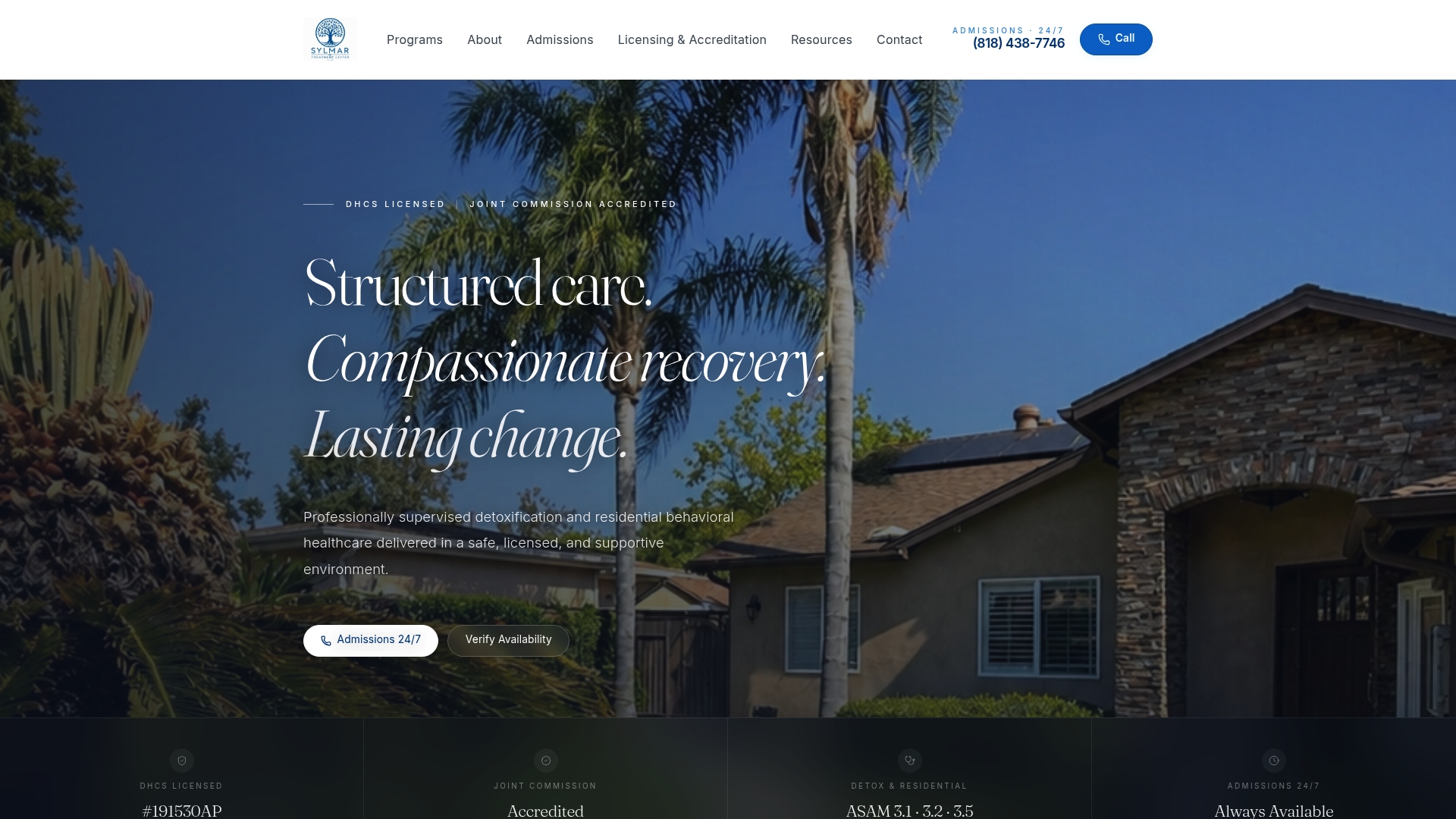
When evaluating a treatment program, look for two specific credentials: a state DHCS license and Joint Commission accreditation. These are not marketing claims; they’re independently verified indicators that a program meets clinical and safety standards. Evidence-based care, 24/7 admissions access, and integrated mental health support (including medication management for co-occurring disorders) are the features that matter most in the early and mid-recovery stages.
Sylmartreatmentcenter holds both the DHCS license and Joint Commission accreditation, offers individualized treatment programs built around personal milestone planning, and provides 24/7 admissions support for people who are ready to start now. The six-bed setting means care is genuinely personal, not a number in a queue. If you or someone you care about needs that kind of structured support, the programs page is a straightforward place to start.
Useful sources and further reading
These are the primary clinical and peer-support resources referenced in this article, organized by type.
Clinical and research sources:
- Stages of Addiction Recovery (Transtheoretical Model) — Texas Health: clinical overview of how interventions match recovery stages
- The Evolution of Recovery from Addiction — Psychology Today: how milestone meaning shifts from early to long-term recovery
- SAMHSA Peer Support Resources — U.S.-based clinical and peer-support guidance (Substance Abuse and Mental Health Services Administration)
- PMC: Recovery Research — peer-reviewed research on recovery processes and outcomes
Peer-support and community sources:
- Sobriety Milestones: Why They Matter — Cedar Recovery: practical breakdown of common time-based milestones and community practices
- Recovery Milestones and Balance — Eating Disorders Anonymous: peer-support framing of milestones as “bright spots” in daily recovery
- Addiction Recovery Timeline — Second Chance Info: community-based timeline with recognition practices
Sylmartreatmentcenter:
- Sylmar Treatment Center — DHCS-licensed, Joint Commission-accredited residential and detox care with 24/7 admissions
This article is general information, not medical or clinical advice. For guidance specific to your situation, consult a licensed treatment provider or contact SAMHSA’s National Helpline at 1-800-662-4357.