
Personal goals are defined as the specific, meaningful outcomes an individual wants to achieve through treatment, and they are the primary driver of engagement in addiction recovery. When your goals shape the plan rather than the other way around, therapy becomes something you invest in rather than endure. Frameworks like the SMART criteria and Goal Attainment Scaling give clinicians and patients a shared language for turning those goals into trackable milestones. Research confirms that goal progress reduces distress significantly, with each one-unit increase in goal progress linked to a 0.59-unit decrease in psychological distress. Understanding how personal goals guide treatment plans is the first step toward building a recovery path that actually holds.
How do personal goals improve engagement and outcomes in addiction treatment?
Personal goals increase treatment engagement because they make therapy feel relevant to your real life. A 2025 rehabilitation study found that patients showed higher treatment engagement when therapists incorporated their top personal priorities into the plan, with results reaching statistical significance at p < 0.001. That finding matters because engagement is one of the strongest predictors of whether someone completes treatment at all.
The distress reduction effect is equally compelling. Collaborative goal setting produces measurably lower psychological distress compared to clinician-only planning. The mechanism is straightforward: when you see progress toward something you care about, the emotional weight of recovery lightens.
Long-term outcomes also improve with structured goal support. A longitudinal study published in september 2025 by BMC Psychiatry found that individuals with high baseline symptoms who received structured goal assistance showed greater personal recovery progress over 18 months than those without it. That sustained benefit suggests goal-oriented therapy is not just a motivational tool. It is a clinical one.
Pro Tip: Co-create your goals with your clinician rather than arriving with a fixed list. Self-set goals without clinical input often lack therapeutic alignment, which limits how much distress reduction you actually experience.

The impact of goals on treatment extends beyond motivation. When your goals are embedded in the plan, your clinician can track whether the interventions are working for you specifically, not just for the average patient. That specificity is what separates a personalized treatment strategy from a generic protocol.
What frameworks help translate personal goals into actionable treatment plans?
Two frameworks dominate goal-oriented therapy in addiction and mental health settings: the SMART criteria and Goal Attainment Scaling (GAS). Both translate vague aspirations into measurable targets, but they operate differently and serve different purposes.
SMART goals: structure for clarity
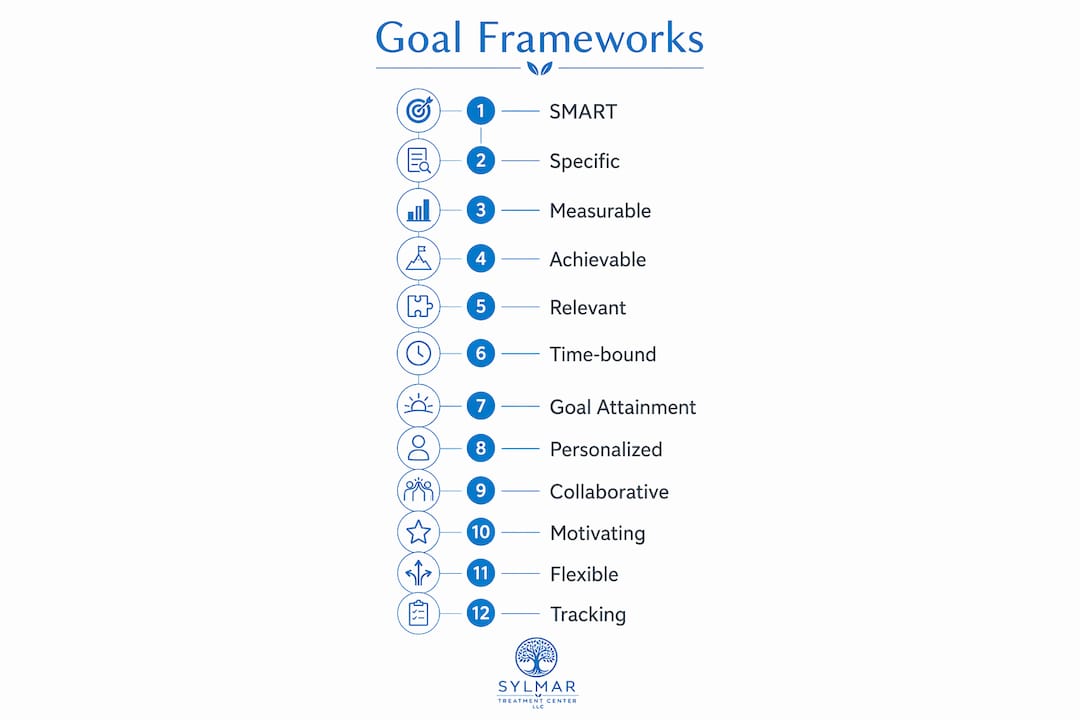
SMART stands for Specific, Measurable, Achievable, Relevant, and Time-bound. The SMART framework is widely endorsed as the standard for operationalizing goals in treatment plans because it prevents the most common failure mode: goals that are too broad to track. “I want to feel better” becomes “I will attend three group therapy sessions per week for the next four weeks and report my mood daily using a 1–10 scale.” That specificity gives both you and your clinician a clear signal when something is or is not working.
Goal Attainment Scaling: collaboration for motivation
Goal Attainment Scaling takes a different approach. Rather than applying a fixed template, GAS builds a personalized scale around outcomes you actually value, such as rebuilding a relationship with your children or returning to stable employment. GAS enhances therapeutic alliance by centering treatment around patient-prioritized outcomes, which directly boosts motivation and trust in the process. Each goal gets a five-point scale ranging from the worst expected outcome to the best expected outcome, with the target outcome sitting in the middle.
| Framework | Core Strength | Best Used When |
|---|---|---|
| SMART Goals | Clarity and measurability | Goals need structure and a clear timeline |
| Goal Attainment Scaling | Patient-centered flexibility | Goals are complex, personal, or hard to standardize |
Both frameworks prevent the therapy alliance from drifting. When goals are vague, sessions can feel unfocused. When goals are specific and co-created, every session has a direction that connects back to what you care about most.
The key principles that make either framework work are the same:
- Specificity: Vague goals produce vague progress. Name the exact behavior or outcome you are targeting.
- Measurability: If you cannot measure it, you cannot tell whether you are improving.
- Realism: Goals that are too ambitious early in recovery create discouragement. Start with what is achievable in the next two to four weeks.
- Personal relevance: A goal that matters to your clinician but not to you will not sustain your effort past the first setback.
Using structured treatment templates alongside these frameworks prompts active participation, which increases both motivation and adherence over time.
What challenges exist when integrating personal goals into treatment plans?
Goal-oriented therapy works well in theory. The practice is more complicated, and knowing where it gets hard prepares you to stay with it.
Cognitive and executive functioning barriers
Not every person in recovery has equal access to the mental tools that goal setting requires. Clients with co-occurring mental illness or executive functioning impairments often struggle with traditional goal recall and rating tasks. For these patients, visual goal-setting tools, simplified language, and shorter review cycles replace standard frameworks without sacrificing the core benefit of personal direction.
The gap between self-set and clinically aligned goals
Setting your own goals feels empowering, but self-set goals without clinician input often miss the clinical targets that actually reduce distress. A goal like “stay sober for a year” is meaningful, but it does not tell your treatment team which interventions to prioritize this week. Co-created goals close that gap by combining what you want with what the evidence says will help you get there.
Non-linear recovery and motivation dips
Recovery rarely moves in a straight line. Treatment plans should be iterative, with goals revised regularly to reflect where you actually are rather than where you hoped to be. A goal that made sense in week two may need adjustment by week six. That is not failure. That is the plan working as intended.
Common challenges and practical responses include:
- Motivation drops after early progress: Break larger goals into smaller weekly targets so you experience wins more frequently.
- Goals feel irrelevant after a setback: Schedule a goal review with your clinician rather than abandoning the goal entirely.
- Overwhelm from too many goals: Limit active goals to two or three at a time. Depth beats breadth in early recovery.
- Fear of setting goals: Start with process goals, such as attending sessions consistently, before setting outcome goals like sobriety milestones.
Pro Tip: When a goal stops feeling motivating, treat that as data, not defeat. Bring it to your next session and ask your clinician to help you adjust the scale or timeline rather than scrapping the goal altogether.
Adherence is higher when goals adapt to your existing lifestyle rather than demanding radical changes all at once. That principle applies directly to addiction recovery, where sustainable progress beats dramatic short-term effort.
How can you practically apply personal goal setting to your addiction treatment plan?
Embedding personal goals into your treatment plan is a skill. The steps below give you a concrete process to follow from your first session onward.
-
Identify what genuinely matters to you. Before your first planning session, write down three to five outcomes that would make recovery feel worth it. These might be reconnecting with family, returning to work, or managing anxiety without substances. Specificity here sets the tone for everything that follows.
-
Bring your list to your clinician and co-create. Share your priorities and ask your clinician to help translate them into SMART goals or a GAS scale. This collaboration is where personal desire meets clinical evidence. The result is a goal that motivates you and guides your treatment team. You can learn more about how individualized care plans are built around exactly this kind of input.
-
Set a review schedule from day one. Agree on a regular interval, such as every two weeks, to assess progress. Do not wait until you feel stuck to revisit your goals. Scheduled reviews normalize adjustment and keep the plan current.
-
Track progress in writing. A simple daily log, a mood rating, or a brief note about whether you completed a goal-related behavior gives you and your clinician real data. That data replaces guesswork with evidence.
-
Align short-term goals with longer-term objectives. A short-term goal might be attending every scheduled session this week. The longer-term objective might be completing a full residential program. Each small goal should connect visibly to the bigger picture so you can see the path forward.
-
Take ownership of the plan. Patients who view the treatment plan as theirs, not their clinician’s, show stronger adherence. Ask questions, push back on goals that do not resonate, and request changes when your circumstances shift. Your personalized recovery program works best when you are an active participant, not a passive recipient.
Key Takeaways
Personal goals guide treatment plans most effectively when they are co-created with a clinician, structured with a proven framework, and revised regularly to match real-world progress.
| Point | Details |
|---|---|
| Goal progress reduces distress | Each one-unit increase in goal progress links to a 0.59-unit decrease in psychological distress. |
| Co-creation outperforms self-setting | Goals built with clinician input produce better clinical outcomes than self-set goals alone. |
| SMART and GAS are the core frameworks | Use SMART for structured timelines and Goal Attainment Scaling for patient-centered flexibility. |
| Recovery is non-linear | Plans should be revised regularly; goal adjustment is a clinical tool, not a sign of failure. |
| Ownership drives adherence | Patients who treat the plan as their own show stronger long-term engagement and completion rates. |
What I have learned from watching goal setting change recovery outcomes
After years of observing how treatment plans succeed and fail, the clearest pattern I have seen is this: the patients who recover most durably are the ones who can tell you exactly why they are in treatment. Not “because my family wants me to” or “because the court ordered it.” They can name a specific future they are building toward.
The frameworks matter, but they are tools, not magic. I have watched people use SMART goals perfectly on paper and still disengage by week three because the goals were technically correct but personally hollow. And I have watched people with messy, imperfect goals stay committed for months because those goals were genuinely theirs.
The hardest thing to teach is that asking for goal revisions is a sign of self-awareness, not weakness. Patients who come to sessions and say “this goal no longer fits where I am” are doing exactly what effective recovery requires. They are treating the plan as a living document rather than a contract they signed under duress.
My honest advice: do not wait until you feel ready to set meaningful goals. Set them imperfectly now, then refine them with your clinician. The act of naming what you want, even clumsily, is what starts the engine.
— Jim
Sylmartreatmentcenter’s approach to goal-driven recovery
Sylmartreatmentcenter builds every treatment plan around the individual, not a standard protocol. The center’s intimate six-bed setting means your clinician knows your goals by name, not by chart number. That level of attention is what makes goal-oriented therapy actually work in practice rather than just in theory.
Sylmartreatmentcenter holds both a DHCS license and Joint Commission accreditation, which means the goal-setting practices used here meet verified clinical standards. Whether you are entering residential treatment or need support for co-occurring conditions through the dual diagnosis program, the planning process starts with what matters to you. Explore the full range of recovery programs to find the right fit for where you are right now.
FAQ
How do personal goals guide treatment plans in addiction recovery?
Personal goals give treatment plans direction by identifying what outcomes matter most to the individual. Clinicians use those priorities to select interventions, set measurable milestones, and track whether the plan is actually working for that specific patient.
What is the SMART framework in addiction treatment?
SMART stands for Specific, Measurable, Achievable, Relevant, and Time-bound. It converts broad recovery aspirations into concrete, trackable goals that both patients and clinicians can evaluate at regular intervals.
What is Goal Attainment Scaling and how does it help?
Goal Attainment Scaling is a method where each personal goal gets a five-point scale from worst to best expected outcome. It centers treatment around patient-valued results like family reconnection or employment, which strengthens motivation and the therapeutic relationship.
Can personal goals change during treatment?
Personal goals should change during treatment. Recovery is non-linear, and iterative goal revision keeps the plan aligned with real progress rather than fixed early assumptions.
What if I struggle to set goals because of cognitive challenges?
Clients with executive functioning difficulties benefit from simplified, visual goal-setting tools and shorter review cycles. A clinician trained in complex support needs can adapt standard frameworks so that goal setting remains accessible and productive.