

An integrated treatment plan is a unified clinical document that addresses both substance use disorder and co-occurring mental health conditions simultaneously within one coordinated care roadmap. This approach, formalized through frameworks like SAMHSA’s TIP 42 and the Integrated Dual Disorder Treatment model developed at Case Western Reserve University, is the standard of care for dual diagnosis recovery. This integrated treatment plan creation guide walks families and professionals through every stage of the process, from initial assessment to ongoing review, so you can build a plan that actually holds together under real-world conditions.
What is an integrated treatment plan creation guide?
An integrated treatment plan is not simply two separate plans stapled together. Integrated care for co-occurring disorders involves coordinated screening and treatment of both mental health and substance use conditions within one unified document and one clinical team. The industry term for this model is Integrated Dual Disorder Treatment, or IDDT. Both terms describe the same core principle: treat the whole person, not two separate diagnoses.
The reason this matters is outcomes. Integrated treatment reduces hospitalization rates, psychiatric symptoms, and arrests while improving housing stability and medication adherence compared to sequential or parallel treatment models. Treating addiction first and mental health second, or running two separate programs side by side, consistently produces worse results. A single unified plan with shared goals eliminates the gaps where people fall through.
SAMHSA’s TIP 42 is the federal framework that defines how integrated plans should be structured, from screening through active treatment to relapse prevention. Case Western Reserve University’s Center for Evidence-Based Practices has built a full library of IDDT resources around TIP 42. These two sources form the backbone of most clinically sound integrated treatment strategy work in the United States today.
What are the core components of an effective integrated plan?
A well-built integrated treatment plan contains six core elements, each derived from a thorough assessment of the individual’s clinical picture.
- Presenting problems: A clear list of identified issues drawn from assessment findings, covering both mental health symptoms and substance use patterns together.
- Broad goals: Client-centered statements describing what the person wants to achieve, such as sustained sobriety, reduced anxiety, or stable housing.
- Measurable objectives: Specific, time-bound steps that operationalize each goal. For example, “Client will attend two group therapy sessions per week for 30 days.”
- Evidence-based interventions: Stage-matched clinical strategies for both disorders, such as Cognitive Behavioral Therapy for depression and Motivational Interviewing for substance use readiness.
- Responsible parties: Named clinicians, family members, or peer supports assigned to each intervention so accountability is clear.
- Review schedule: Built-in reassessment dates tied directly to objectives. Scheduled review points/02%3A_Unit_Two-_Core_Skills/2.03%3A_Treatment_Planning) improve plan usefulness by enabling stage-appropriate adjustments as the client progresses.
The collaborative nature of plan development is not optional. Effective integrated treatment planning/02%3A_Unit_Two-_Core_Skills/2.03%3A_Treatment_Planning) requires shared decision-making and must reflect client priorities to support ongoing review and adjustment. Family members who understand the plan’s goals are more likely to reinforce progress at home.
Pro Tip: Ask the client to restate each goal in their own words before finalizing the plan. If they cannot, the goal is not yet theirs.

How do you create an integrated treatment plan step by step?
Comprehensive treatment planning follows a clear sequence. Skipping steps, especially early assessment steps, produces plans that look complete on paper but fail in practice.
- Conduct integrated screening. Use validated tools to assess both disorders at the same time. The PHQ-9 screens for depression severity. The AUDIT screens for alcohol use. The SCID provides a structured diagnostic interview for both mental health and substance use disorders.
- Complete a comprehensive biopsychosocial assessment. Document the history, severity, and interaction of both conditions. Note how anxiety triggers substance use, or how withdrawal worsens mood symptoms.
- Assemble the interdisciplinary team. Include a psychiatrist, licensed counselor, case manager, and the client’s family or support network. Every voice at this table shapes a more accurate plan.
- Prioritize treatment needs. Rank problems by urgency and the client’s own readiness to address them. Safety concerns come first.
- Set stage-appropriate goals and objectives. Match goals to the client’s current stage: engagement, active change, or relapse prevention. A person in early engagement needs different objectives than someone in sustained recovery.
- Select evidence-based interventions. Choose treatments with research support for both disorders. Dialectical Behavior Therapy works well for borderline personality disorder with substance use. Seeking Safety is designed specifically for trauma and addiction together.
- Document cross-links between disorders. Explicitly documenting how mental health symptoms and substance use triggers interact in the same plan enhances care quality and coherence. This is the step most plans skip.
- Define the review schedule. Set specific dates, not vague language like “as needed.” Monthly reviews work well during active treatment. Quarterly reviews suit stable maintenance phases.
The table below shows how each step maps to a concrete output in the final document.
| Step | Action | Plan Output |
|---|---|---|
| Integrated screening | Administer PHQ-9, AUDIT, SCID | Diagnosis and severity ratings |
| Comprehensive assessment | Biopsychosocial interview | Problem list with cross-linked symptoms |
| Team collaboration | Interdisciplinary meeting with client | Shared goals reflecting client priorities |
| Intervention selection | Match evidence-based treatments to stage | Named interventions with responsible parties |
| Review scheduling | Set fixed reassessment dates | Built-in review calendar within the document |
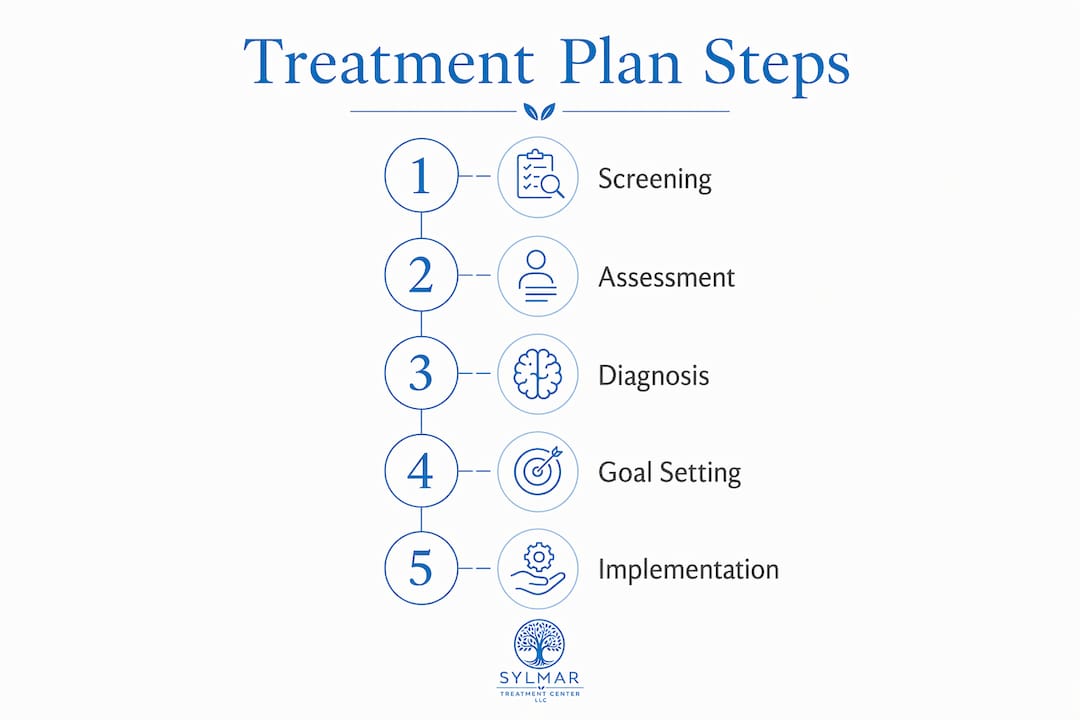
For families navigating this process for the first time, the mental health assessment process is a practical starting point before the full plan is built.
What are the most common pitfalls in treatment plan development?
Most integrated plans fail not because clinicians lack skill, but because the structure of the plan itself undermines integration. These are the errors that appear most often.
- Treating disorders as separate tracks. Running a mental health plan and an addiction plan in parallel, even with the same client, is not integration. A single unified plan with one clinical team across all care phases is the defining feature of true integrated care.
- Bolting mental health onto an addiction plan. Assuming mental health work can be added after addiction planning is complete undermines the integrated care philosophy and leads to worse recovery outcomes. Both disorders must be prioritized from day one.
- Infrequent or skipped reviews. A plan that is not updated becomes a historical document, not a clinical tool. Rigid plans that do not adjust to client progress lose their usefulness within weeks.
- Excluding the client and family from goal-setting. Goals written by clinicians without client input produce low engagement. Family members who are left out of the process often inadvertently work against the plan at home.
- Ignoring trauma. Many people with co-occurring disorders carry significant trauma histories. A plan that does not address trauma-informed care consistently will hit a ceiling in every other area.
“Integration is not a feature you add to a treatment plan. It is the architecture of the plan itself. If the two disorders are not explicitly connected in the document, they will be treated separately in practice.”
Balancing psychiatric medication with substance use treatment requires particular care. Some medications used for mental health conditions carry abuse potential. The prescribing psychiatrist and the addiction counselor must communicate directly, not through chart notes alone.
What tools and frameworks support integrated plan creation?
The right frameworks reduce guesswork and give both clinicians and families a shared language for the planning process.
TIP 42 is the operational blueprint guiding integrated care teams from screening through treatment planning and ongoing management. It covers assessment protocols, intervention selection, and documentation standards in one federal publication. Every clinician building an integrated plan should have it as a reference.
Case Western Reserve University’s Center for Evidence-Based Practices offers a full suite of IDDT resources, including fidelity scales, training materials, and implementation guides. These tools help clinical teams measure whether their plans are truly integrated or just labeled as such.
Pro Tip: Use a fidelity checklist from the IDDT model to audit an existing plan. If the mental health and substance use sections do not reference each other, the plan is not integrated.
| Framework | Best Used For | Key Strength |
|---|---|---|
| SAMHSA TIP 42 | Full plan structure and assessment | Federal standard, covers all stages |
| IDDT Fidelity Scale | Auditing existing plans | Measures true integration quality |
| PHQ-9 / AUDIT | Screening and severity tracking | Validated, quick, widely accepted |
| Seeking Safety | Trauma and addiction interventions | Designed specifically for co-occurring trauma |
| Sana Network guidelines | Patient-centered planning | Emphasizes family and client involvement |
For a closer look at how individualized care plans are built in practice, the process mirrors these frameworks closely. Journey Mental Health also offers a useful structured treatment plan guide for families who want a plain-language breakdown of plan components.
Key takeaways
An integrated treatment plan works because it unifies mental health and substance use goals into one document, one team, and one shared timeline from the start.
| Point | Details |
|---|---|
| Start with integrated screening | Use validated tools like the PHQ-9, AUDIT, and SCID before writing a single goal. |
| Cross-link both disorders | Document how mental health symptoms and substance use triggers interact directly in the plan. |
| Build in review dates | Set fixed reassessment dates tied to objectives, not vague language like “as needed.” |
| Include client and family | Goals written without client input produce low engagement and poor follow-through. |
| Avoid parallel planning | One plan, one team, one timeline is the standard. Two separate tracks are not integration. |
Why collaboration is the part most plans get wrong
I have reviewed a lot of treatment plans over the years, and the most common failure is not clinical. It is relational. Plans get written by clinicians, handed to clients, and then filed. The client never owned the goals. The family never understood the timeline. Six weeks later, everyone is surprised when engagement drops.
The plans that actually work are the ones built in the room with the person who has to live them. That means slowing down the goal-setting conversation, asking the client what matters to them right now, and writing objectives in language they would use themselves. It also means calling the family in, not as observers, but as contributors who understand what they are being asked to support.
The other thing I have seen consistently is that rigid plans fail faster than flexible ones. A client’s readiness to change shifts week to week. A plan that cannot adapt to that reality becomes a source of shame rather than a guide for progress. Stage-matched interventions, reviewed on a real schedule, are what keep a plan alive past the first month.
Trauma-informed care is not a separate module. It belongs in every section of the plan, woven into how goals are framed and how setbacks are interpreted. When clinicians and families approach the plan with that kind of empathy, adherence goes up. That is not a theory. That is what I have watched happen.
— Jim
How Sylmartreatmentcenter supports dual diagnosis treatment planning
Sylmartreatmentcenter builds every care plan around the principles in this guide. The center’s interdisciplinary team conducts integrated assessments from day one, addressing both substance use and co-occurring mental health conditions within a single coordinated plan.
The intimate six-bed setting at Sylmartreatmentcenter means each client receives direct, consistent attention from the same clinical team throughout treatment. That continuity is what makes true integration possible. Families are included in the planning process, not informed after the fact. Sylmartreatmentcenter’s dual diagnosis programs and full residential treatment options are built on DHCS-licensed, Joint Commission-accredited standards. Reach out to explore which program fits your situation.
FAQ
What is an integrated treatment plan for co-occurring disorders?
An integrated treatment plan is a single unified document that addresses both substance use disorder and mental health conditions simultaneously. It combines goals, interventions, and review schedules for both disorders into one coordinated roadmap managed by one clinical team.
How is an integrated plan different from a standard treatment plan?
A standard treatment plan may address only one condition or treat two conditions in separate sections without connecting them. An integrated plan explicitly cross-links mental health symptoms and substance use triggers and applies stage-matched interventions to both disorders at the same time.
What validated tools are used in integrated treatment planning?
Clinicians commonly use the PHQ-9 for depression screening, the AUDIT for alcohol use severity, and the SCID for structured diagnostic interviews covering both mental health and substance use disorders.
How often should an integrated treatment plan be reviewed?
Built-in scheduled reviews/02%3A_Unit_Two-_Core_Skills/2.03%3A_Treatment_Planning) tied to specific objectives improve plan usefulness. Monthly reviews are standard during active treatment, with quarterly reviews appropriate during stable maintenance phases.
Can families participate in integrated treatment plan development?
Yes. Ongoing family involvement in goal-setting and continuous evaluation is a key component of effective integrated treatment planning and improves both engagement and recovery outcomes.