
Mental Health Assessment Process: A Patient’s Guide

A mental health assessment is a structured clinical evaluation that gathers detailed information across psychological, medical, and social domains to produce an accurate diagnosis and a workable treatment plan. The comprehensive mental health assessment process is the foundation of all effective psychiatric care. Without it, clinicians are guessing. The American Psychiatric Association defines specific standards for what this evaluation must cover, and understanding those standards gives patients and families a clear picture of what to expect before, during, and after the appointment.
What are the essential components of a comprehensive mental health assessment?
A thorough psychiatric evaluation covers at least nine major domains, each designed to capture a different layer of a person’s mental and physical functioning. Skipping any domain increases the risk of misdiagnosis or an incomplete treatment plan.
The nine core domains are:
- Presenting problem: The primary reason for seeking care, described in the patient’s own words, including symptom onset, duration, and severity.
- Psychiatric history: Prior diagnoses, hospitalizations, outpatient treatment, and the outcomes of past interventions.
- Medical history and medications: Current and past physical health conditions, prescribed medications, and supplements. Failing to bring this list to the first appointment is one of the most common preparation mistakes, since many medical conditions and drug interactions directly mimic psychiatric symptoms.
- Substance use history: Alcohol, prescription misuse, and illicit drug use, including frequency, quantity, and any prior withdrawal or treatment episodes.
- Family history: Psychiatric diagnoses, substance use disorders, and suicide history in first and second-degree relatives, which informs genetic risk.
- Social and developmental history: Education, employment, relationships, trauma exposure, and significant life events that shaped current functioning.
- Mental Status Examination (MSE): A real-time observational assessment of mood, affect, thought process, cognition, insight, and judgment.
- Safety and risk assessment: Direct evaluation of suicidal ideation, self-harm history, homicidal thoughts, and protective factors.
- Standardized screening tools: Validated questionnaires such as the PHQ-9 for depression, GAD-7 for anxiety, or the PCL-5 for trauma symptoms.
| Domain | Primary Purpose |
|---|---|
| Psychiatric and medical history | Establishes baseline and rules out physiological causes |
| Mental Status Examination | Captures real-time cognitive and emotional functioning |
| Safety assessment | Identifies immediate risk and protective factors |
| Standardized screening tools | Adds objective, quantifiable data to clinical impressions |
| Social and developmental history | Contextualizes symptoms within life experience |
Pro Tip: Ask your clinician which standardized screening tools they use and why. Understanding the purpose of each questionnaire helps you answer more accurately and reduces test anxiety.

How can patients and families prepare effectively?
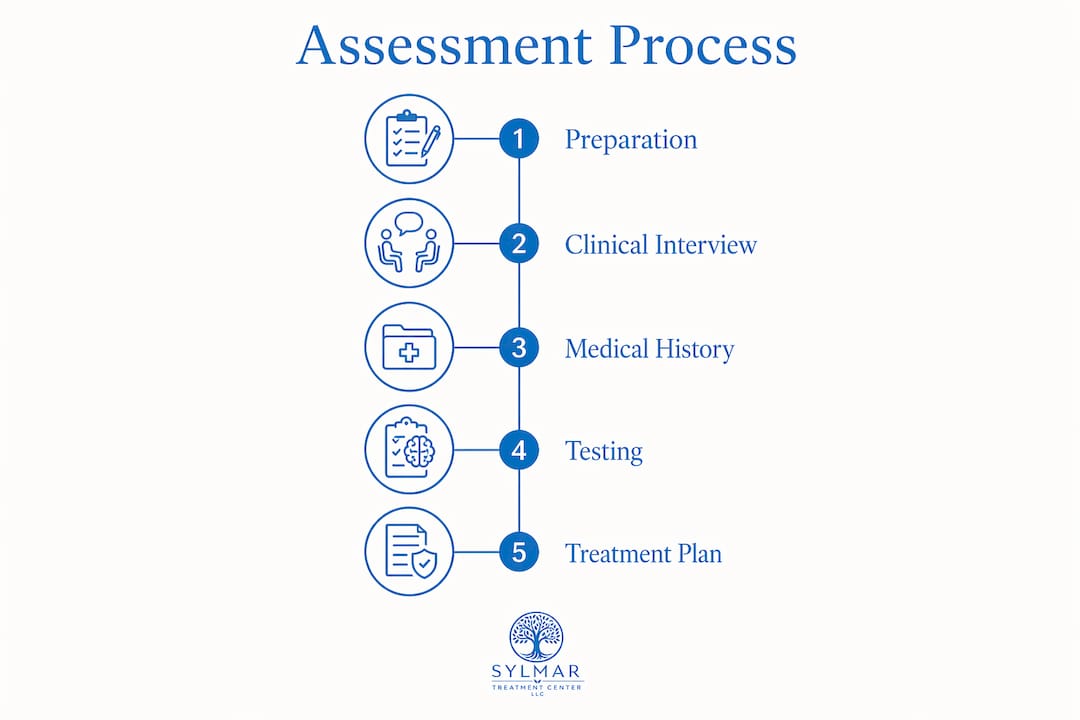
Preparation directly affects the quality of the evaluation. Clinicians can only work with the information they receive, so arriving organized shortens the diagnostic timeline and reduces the chance of a missed or delayed diagnosis.
Follow these steps before your first appointment:
- Write a symptom timeline. Note when each symptom first appeared, what made it better or worse, and how it has changed over time. Include sleep patterns, appetite changes, mood shifts, and any periods of unusually high energy or activity.
- List all medications and supplements. Include dosages, prescribing physicians, and how long you have been taking each one. Medication review is a non-negotiable step in ruling out physiological causes of psychiatric symptoms.
- Complete pre-visit intake forms thoroughly. Most providers now require baseline screening questionnaires covering mood, energy, and sleep before the appointment. These forms create a diagnostic snapshot that guides the clinical interview.
- Gather relevant medical records. Prior psychiatric evaluations, therapy notes, and lab results give the clinician context that would otherwise take multiple sessions to reconstruct.
- Prepare a brief family history summary. Note any relatives with depression, bipolar disorder, schizophrenia, anxiety disorders, or substance use problems.
- Bring a support person if helpful. Family members or caregivers can provide collateral information about behaviors or changes the patient may not have noticed or may struggle to articulate.
Pro Tip: If you find it hard to talk about certain experiences in person, write them down beforehand and hand the note to your clinician. Many people find this reduces the emotional barrier to sharing difficult information.
The evaluation typically runs between 60 and 90 minutes for an initial psychiatric appointment, though comprehensive psychological evaluations that include neuropsychological testing can span multiple sessions. Setting that expectation in advance prevents frustration and helps you pace your energy.
What happens during the clinical interview and mental status examination?
The clinical interview is the primary instrument of psychiatric evaluation. No standardized test replaces the direct conversation between clinician and patient. The interview opens with open-ended questions about current symptoms and their functional impact, then moves into structured territory covering history, relationships, trauma, and daily functioning.
What the clinician observes during this conversation is just as important as what you say. The Mental Status Examination is not a separate test administered at the end of the session. It is an ongoing observational process that runs throughout the entire clinical interaction, capturing:
- Appearance and behavior: Grooming, eye contact, psychomotor activity, and level of engagement.
- Speech: Rate, volume, coherence, and spontaneity.
- Mood and affect: The patient’s reported emotional state versus the clinician’s observed emotional expression.
- Thought process and content: Whether thinking is organized, tangential, or disorganized; presence of obsessions, delusions, or paranoia.
- Perceptual disturbances: Hallucinations or illusions.
- Cognition: Orientation, memory, attention, and abstract reasoning.
- Insight and judgment: The patient’s awareness of their condition and their ability to make sound decisions.
“The mental status examination is not a test you pass or fail. It is a clinical snapshot of how your mind is functioning at this specific moment in time.”
Clinicians also use structured diagnostic interviews such as the SCID (Structured Clinical Interview for DSM Disorders) alongside dimensional severity rating scales to improve diagnostic reliability beyond what unstructured conversation alone can provide. These tools add precision to the clinical picture without replacing the human judgment required to interpret it.
What additional testing and collateral information support a thorough evaluation?
Psychological testing and collateral information fill the gaps that a single clinical interview cannot cover. This is especially true when symptoms overlap across multiple diagnoses or when cognitive functioning is in question.
| Type of Additional Data | What It Clarifies |
|---|---|
| Neuropsychological testing | Memory, attention, executive function, and learning profiles |
| Personality assessment (e.g., MMPI-3) | Enduring character traits, coping styles, and personality pathology |
| Symptom severity scales | Quantifies depression, anxiety, PTSD, or psychosis for tracking over time |
| Lab work and physical exam | Rules out thyroid disorders, vitamin deficiencies, and neurological conditions |
| Collateral reports (family, school, employer) | Captures behavior patterns the patient may not self-report |
Comprehensive testing helps differentiate between disorders with overlapping symptoms, which is one of the most clinically significant benefits of a thorough psychological assessment. A patient presenting with inattention, low mood, and sleep problems could meet criteria for ADHD, major depression, a trauma-related disorder, or all three simultaneously. Neuropsychological and personality testing clarify which diagnosis is primary and which symptoms are secondary, preventing years of misdirected treatment.
Collateral information from family members or caregivers carries particular weight when the patient has limited insight into their own behavior, as is common in certain psychotic disorders, severe depression, or adolescent presentations. Clinicians weigh collateral reports carefully, balancing them against the patient’s own account rather than treating either source as automatically more reliable.
Ethical considerations matter here. Patients have the right to know what testing is being conducted, why it is being used, and how the results will be shared. A clinician who cannot explain the purpose of a specific test in plain language is not meeting the standard of informed consent.
How do clinicians turn assessment findings into a treatment plan?
A high-quality evaluation report integrates history, observations, test results, and clinical impressions into a clear narrative that connects the diagnosis to the patient’s daily life. The report is not a list of deficits. It is a roadmap that explains why symptoms developed, how they interact, and what interventions are most likely to help.
After the assessment, patients and families should expect:
- A diagnostic formulation: A clear explanation of the diagnosis or diagnoses, including how the clinician arrived at those conclusions.
- Treatment recommendations: Specific options such as psychotherapy modalities (CBT, DBT, EMDR), medication considerations, or referrals to specialists.
- A prioritized care plan: Not every problem can be addressed at once. The clinician identifies which issues to treat first based on severity and functional impact.
- Follow-up structure: Scheduled appointments for medication management, therapy, or re-evaluation, with defined benchmarks for measuring progress.
Shared decision-making during assessment increases treatment adherence and patient satisfaction. This means the clinician presents options and explains trade-offs rather than issuing directives. Patients who understand why a treatment was recommended are far more likely to follow through with it. The assessment is also the moment to ask every question you have been holding. What does this diagnosis mean for my daily life? Are there non-medication options? What does recovery look like for someone with my history? These are not intrusive questions. They are the foundation of a working therapeutic relationship.
Key takeaways
A thorough psychological evaluation covering all nine clinical domains, combined with standardized testing and shared decision-making, produces the most accurate diagnosis and the most effective treatment plan.
| Point | Details |
|---|---|
| Nine domains are required | Skipping any domain increases misdiagnosis risk and delays effective treatment. |
| Preparation improves outcomes | Bringing a symptom timeline and full medication list directly improves diagnostic accuracy. |
| MSE is continuous, not a test | Clinicians observe mood, cognition, and behavior throughout the entire session. |
| Testing clarifies overlapping symptoms | Neuropsychological and personality assessments prevent years of misdirected care. |
| Shared decision-making drives adherence | Patients who understand their diagnosis and treatment options follow through at higher rates. |
What I’ve learned about the fear patients bring into assessments
Most people walk into a mental health evaluation carrying two fears at once: the fear that something is seriously wrong, and the fear that nothing will be found and they will be dismissed. Both fears are real, and both are worth naming before the session begins.
Mental health evaluations are not tests to pass or fail. Clinicians are not looking for the “right” answers. They are looking for patterns that explain your experience. When patients understand this, the dynamic shifts from interrogation to collaboration. That shift matters clinically. Patients who engage openly provide richer information, which leads to more accurate formulations and better-matched treatment plans.
I have seen families arrive convinced that asking too many questions will make them look difficult. The opposite is true. A clinician who cannot tolerate your questions is not the right clinician for you. The assessment is your opportunity to evaluate the provider just as much as they are evaluating you.
High-quality evaluations are frequently described by patients as clarifying, validating, and even life-changing. That outcome is not accidental. It happens when both the clinician and the patient treat the process as a genuine partnership rather than a one-sided examination. If you leave your first evaluation without a clear sense of what was found and what comes next, ask for that clarity before you leave the room. You are entitled to it.
— Jim
How Sylmartreatmentcenter supports your next step

Sylmartreatmentcenter builds every treatment program on the foundation of a thorough, individualized assessment. The center’s six-bed setting means your evaluation is never rushed and your care plan is never generic. Whether you are dealing with a co-occurring mental health and substance use disorder or need dual diagnosis support that addresses both conditions simultaneously, Sylmartreatmentcenter’s multidisciplinary team works from your specific assessment findings to design a plan that fits your life. The center holds a DHCS license and Joint Commission accreditation, so the quality of care is not a matter of trust alone. It is a matter of verified clinical standards. Explore residential treatment options or contact the admissions team any time, 24 hours a day, 7 days a week.
FAQ
What is a mental health assessment?
A mental health assessment is a structured clinical evaluation covering psychiatric history, current symptoms, medical background, and social functioning to produce an accurate diagnosis and treatment plan. The process typically includes a clinical interview, Mental Status Examination, and standardized screening tools.
How long does a comprehensive psychological evaluation take?
An initial psychiatric evaluation runs 60 to 90 minutes. Evaluations that include neuropsychological or personality testing can span two to four sessions spread across multiple days.
What should I bring to my first mental health evaluation?
Bring a written symptom timeline, a complete list of current and past medications with dosages, relevant medical records, and a summary of family psychiatric history. Pre-visit intake forms should be completed before you arrive.
Can a mental health assessment diagnose multiple conditions at once?
Yes. Clinicians use neuropsychological testing and structured diagnostic interviews like the SCID to differentiate between disorders with overlapping symptoms, which means a single evaluation can identify co-occurring conditions such as ADHD alongside depression or PTSD.
What happens after the assessment is complete?
The clinician produces a formulation report that explains the diagnosis, connects it to your history and daily functioning, and outlines specific treatment recommendations including therapy type, medication options, and follow-up scheduling.