

Integrated, concurrent treatment is the evidence-backed path for people living with both obsessive-compulsive disorder and a substance use disorder. That means pairing exposure and response prevention with coordinated addiction care and medication management, delivered by clinicians trained in both, rather than treating one condition and waiting on the other. SAMHSA and NIMH both point to this model, and programs that build relapse-sensitive policies into ERP-based care tend to produce better outcomes.
TL;DR:
- Coordinated treatment that integrates ERP, medication, and addiction care from the start produces better long-term outcomes than sequential approaches.
- High-dose SSRIs are standard for OCD but require careful management alongside substance use medications to avoid interactions or relapse.
- Screening for co-occurring OCD and addiction should include formal assessments and awareness of withdrawal unmasking symptoms, not just general substance use evaluations.
- Treatment providers should have documented ERP training and relapse-sensitive policies to effectively address both conditions during setbacks.
- Small, accredited residential programs with multidisciplinary teams are often most capable of delivering true concurrent care for severe co-occurring OCD and substance use.
Table of Contents
- What OCD and substance use disorder actually are
- Why OCD and addiction show up together so often
- Recognizing co-occurring OCD and addiction during intake
- Treatments that work when OCD and addiction occur together
- Matching the level of care to the severity of both conditions
- Choosing a program that treats both conditions well
- Special considerations across age groups and gender
- Where mindfulness and peer support fit alongside core treatment
- Why small, accredited residential care changes the equation
- How Sylmar Treatment Center supports integrated OCD and addiction care
- Sources
- FAQ
What OCD and substance use disorder actually are
Obsessive-compulsive disorder involves intrusive, unwanted thoughts (obsessions) that trigger repetitive behaviors or mental rituals (compulsions) aimed at reducing distress. Someone with contamination fears might wash their hands dozens of times a day; someone with intrusive violent thoughts might mentally repeat a phrase to neutralize the fear. The compulsion offers brief relief and then the cycle restarts, often consuming hours of a person’s day.
Substance use disorder is a different pattern with a similar trap. It is a clinical diagnosis marked by compulsive substance use despite negative consequences, tolerance, withdrawal, and loss of control over intake. The compulsive quality can look similar to OCD rituals from the outside, but the underlying drive differs: OCD compulsions try to prevent a feared outcome, while substance use often chases a feeling or numbs one.
When the two conditions overlap, the risks compound.
- Obsessions and compulsions consume time and energy that would otherwise support recovery routines.
- Substance use can temporarily quiet obsessive thoughts, which reinforces the habit even as it worsens both conditions over time.
- Co-occurring diagnoses generally raise the risk of self-harm, functional impairment, and treatment dropout when the two conditions are addressed separately.
Why OCD and addiction show up together so often
The overlap is not rare or coincidental. SAMHSA reports that about 21.2 million adults in the United States had a co-occurring mental illness and substance use disorder in 2024, and clinical literature shows OCD frequently precedes the onset of substance use, suggesting people are often using substances to manage symptoms that already existed.
A large number of U.S. adults had a co-occurring mental illness and substance use disorder in 2024, according to SAMHSA. That scale is why integrated treatment models exist in the first place: sequential care, treating one condition and then the other, was failing too many people.
A few mechanisms explain why the two conditions cluster together.
- Substances can dull obsessive anxiety in the short term, which functions as a form of self-medication even though it worsens OCD severity over time.
- OCD and addictive behavior may share overlapping compulsive circuitry in the brain, which can make one disorder reinforce the other.
- Alcohol or drug use can mask OCD symptoms during use and intensify them during withdrawal, complicating diagnosis and care.
The consequences of leaving either condition untreated are steep. Impairment deepens, suicide risk climbs, and treatment becomes more complex the longer both conditions run unaddressed, since withdrawal, cravings, and obsessive symptoms start interacting with each other.
Recognizing co-occurring OCD and addiction during intake
Spotting both conditions at once is harder than it sounds, and it is a common place where care goes wrong.
- Watch for rituals that intensify after substance use stops, since withdrawal often unmasks obsessive symptoms that substances had been suppressing.
- Notice whether someone increases substance use specifically after a spike in intrusive thoughts or compulsive urges, a pattern that points to self-medication rather than general use.
- Ask whether a program uses a standardized OCD measure such as the Yale-Brown Obsessive Compulsive Scale during intake, since many addiction-focused programs skip formal OCD screening entirely.
- Expect underreporting: people in early recovery often minimize obsessive symptoms out of shame or fear that disclosing them will complicate their addiction treatment.
- If a program cannot describe how it screens for both conditions, ask directly for a dual-diagnosis assessment and a referral to a specialist if needed.
Treatments that work when OCD and addiction occur together
Exposure and response prevention is the first-line behavioral treatment for OCD. NIMH identifies it as the primary evidence-based therapy, and it works by gradually exposing a person to feared triggers while helping them resist the compulsive response. When addiction is active, clinicians typically adjust pacing: withdrawal and cravings raise baseline distress, so exposure exercises may need to move more slowly, with tighter coordination between the ERP therapist and the addiction team. One documented outpatient approach uses two weekly therapeutic contacts early in treatment, one focused on relapse prevention and one on ERP, adjusting the intensity of exposure work as substance use stabilizes.
Medication follows a similar logic of coordination rather than substitution. SSRIs are the standard pharmacological treatment for OCD, usually requiring higher doses and longer trials than they do for depression. Medication-assisted treatment for substance use is specific to the substance involved, and combining SSRIs with MAT requires careful oversight to avoid interactions or symptom flare-ups, which is why medication management is handled as its own coordinated piece of care rather than an afterthought.
On the addiction side, care often starts with medical detox when withdrawal risk is present, followed by behavioral therapies such as CBT and twelve-step facilitation. These run alongside ERP rather than before or after it.
- ERP addresses the obsessive-compulsive cycle directly and is most effective when a clinician has specific ERP training, not general behavioral therapy experience.
- SSRIs treat OCD symptoms pharmacologically and typically need longer trials at higher doses than standard antidepressant use.
- Medical detox and MAT address the physiological side of substance use and should be timed with psychiatric medication changes to avoid interactions.
- CBT and twelve-step facilitation build coping skills for cravings and triggers, reinforcing the gains made in ERP sessions.
Controlled trial evidence backs the concurrent model directly: combined treatment addressing both OCD and substance use produced longer treatment engagement, greater reduction in OCD symptoms, and higher abstinence rates at twelve-month follow-up compared with treatment-as-usual. Understanding ERP mechanics in more depth, including how stepwise exposure techniques are structured, can help patients and families know what to expect from this part of treatment.
Pro Tip: Ask any prospective program whether ERP continues during detox and early recovery, not just after substance use stabilizes; pausing it entirely often lets OCD symptoms rebound.
Matching the level of care to the severity of both conditions
Care generally moves through a few recognizable stages, though not everyone starts at the same point.
- Medical detox manages withdrawal safely under medical supervision, usually as a short, time-limited phase rather than a full treatment plan on its own.
- Residential treatment provides 24-hour structure and is typically used when both OCD and substance use are severe enough to disrupt daily functioning.
- Partial hospitalization or intensive outpatient care offers several hours of structured treatment a day while allowing the person to live at home.
- Standard outpatient care supports ongoing ERP, medication management, and relapse prevention once both conditions are more stable.
ASAM guidance cautions that detoxification alone is not adequate treatment for addictive disease, and the same logic applies to OCD: stabilizing withdrawal does not resolve obsessive-compulsive symptoms. Level-of-care decisions should weigh the severity of both conditions together, ideally with a multidisciplinary team that includes psychiatry, addiction medicine, and an ERP-trained therapist reviewing the case jointly.
Relapse-sensitive planning is what separates programs that hold gains from ones that lose patients at the first setback. SAMHSA advisory guidance recommends shifting from sequential to concurrent treatment models and keeping patients engaged even after a slip, rather than treating a return to substance use as grounds for discharge. In practice, that means ERP sessions and medication management continue through a setback instead of stopping while the addiction team addresses the relapse in isolation.
Choosing a program that treats both conditions well
Not every program that says it treats dual diagnosis actually has ERP competency on staff, so it pays to ask specific questions before committing.
- Confirm whether therapists on staff have documented ERP training, since many addiction programs default to general CBT without the exposure-specific skill set.
- Ask how the program handles a substance use slip during OCD treatment, listening for a relapse-sensitive policy rather than automatic discharge.
- Ask how the psychiatry team and the therapy team communicate, since medication timing and exposure pacing need to be coordinated, not managed in separate silos.
- Confirm the program’s licensing and accreditation status, since state licensure and independent accreditation reflect a baseline of clinical oversight.
- Ask about typical length of stay and how insurance or self-pay options are structured before you commit to a program.
Pro Tip: If a program cannot describe its ERP protocol in specific terms, treat that as a red flag rather than assuming general therapy experience will cover it. Clinical reviews from the International OCD Foundation note that many SUD-focused programs lack ERP training altogether.
Special considerations across age groups and gender
Adolescents with co-occurring OCD and substance use often present differently than adults. Compulsions may be less visible if a teenager is hiding rituals from parents, and substance use may start as an attempt to manage social anxiety tied to obsessive fears rather than classic experimentation. Family involvement tends to matter more at this stage, since parents are often the ones who notice behavioral changes first and need guidance on how to respond without shaming the teen.
Adults with a longer history of untreated OCD may have built substance use deeply into their coping routine, which can make early recovery feel destabilizing as the substance’s masking effect wears off and obsessive symptoms resurface more sharply. This population often benefits from a slower ERP ramp-up paired with closer monitoring during the first weeks of sobriety.
Gender differences also shape presentation and treatment engagement. Research on OCD and substance use has found variation in symptom expression and help-seeking patterns between men and women, though the underlying treatment approach, integrated ERP and coordinated addiction care, remains consistent. What changes is often the emphasis: some programs tailor group therapy composition or address co-occurring conditions like postpartum OCD differently depending on the population being served. A good intake process should ask about age, history, and any gender-specific concerns rather than applying a single template to everyone.

Where mindfulness and peer support fit alongside core treatment
ERP, medication management, and structured addiction care remain the backbone of treatment, but several adjunctive approaches often support the core work rather than replace it.
Mindfulness-based practices can help patients tolerate the discomfort that ERP deliberately provokes, since exposure therapy asks someone to sit with distress instead of neutralizing it with a compulsion or a substance. Building a basic mindfulness skill set gives patients another tool for that moment beyond simply enduring it.
Peer support groups, including twelve-step meetings and OCD-specific peer communities, offer a different kind of reinforcement: hearing from others who have navigated the same overlap reduces the isolation that often accompanies dual diagnosis. These groups do not substitute for clinical ERP or medication management, but they extend the support network beyond scheduled therapy sessions.
Some clinicians are also exploring newer interventions in addiction medicine more broadly, including risk-reduction strategies still being studied for their role in early recovery. These remain adjunctive and should never replace the ERP and medication management core of an OCD and addiction treatment plan, but they illustrate how the field continues to evolve around the concurrent care model.
Why small, accredited residential care changes the equation
Coordinating ERP, medication management, and addiction care closely is easier in a small setting where the same clinical team sees a patient daily. Some small residential programs operate with limited bed capacity, 24/7 admissions support, state licensure, and national accreditation. Ask any program, including this one, to document staff ERP competency and show you its actual relapse-sensitive protocol rather than taking accreditation alone as proof of clinical fit.
— Jim
How Sylmar Treatment Center supports integrated OCD and addiction care
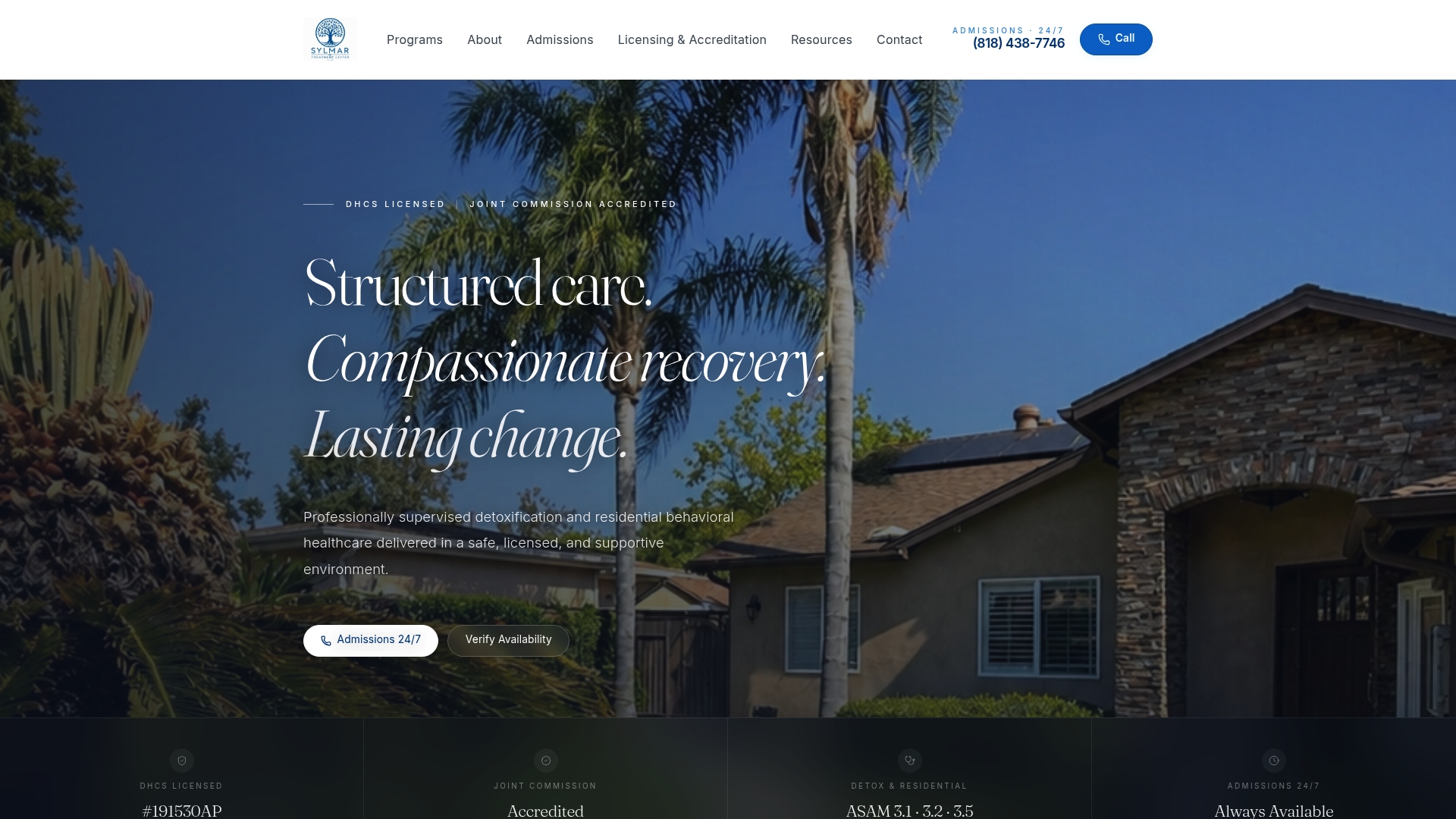
Certain residential centers provide concurrent treatment for co-occurring OCD and substance use in small settings where clinical teams can coordinate ERP, medication changes, and addiction care directly.
- Dual Diagnosis Support addresses OCD and substance use together from intake through discharge planning.
- Medical Detoxification manages withdrawal safely under medical supervision when detox is the appropriate starting point.
- Medication Management coordinates SSRI dosing with any substance-specific medication needs.
- Residential Treatment provides the structured, 24-hour setting many co-occurring cases require.
Intake includes a full assessment of both conditions before a care plan is built. Admissions support is available 24/7, and families or individuals can start the conversation by reaching out to Sylmar Treatment Center to ask about program fit and insurance.
This article is general information, not a substitute for advice from a qualified doctor. Consult a qualified healthcare professional about your own circumstances before acting on anything here.
Sources
- SAMHSA — Co-occurring disorders
- NIMH — Obsessive-Compulsive Disorder (OCD) treatment overview
- Combined treatment for OCD and substance abuse — PubMed (study)
FAQ
Do OCD and addiction commonly occur together?
Yes. OCD frequently precedes substance use, and people often use substances to manage obsessive distress, which reinforces both conditions over time. SAMHSA reports that about 21.2 million U.S. adults had a co-occurring mental illness and substance use disorder in 2024.
How should someone manage severe OCD symptoms?
Exposure and response prevention, delivered by an ERP-trained clinician, is the first-line treatment recommended by NIMH for severe OCD. Medication, usually higher-dose SSRIs over a longer trial period, is often combined with ERP for people whose symptoms do not respond to therapy alone.
What tends to trigger an OCD episode?
Triggers vary by person but often involve a specific fear, such as contamination, harm, or uncertainty, that sets off an intrusive thought and the urge to perform a compulsion to reduce the distress. Stress, major life changes, and withdrawal from a substance that had been masking symptoms can all intensify triggers.
What does an OCD episode typically look like?
An episode usually starts with an unwanted, intrusive thought that causes intense anxiety, followed by a repetitive behavior or mental ritual aimed at neutralizing that anxiety. The relief is usually brief, and the cycle can repeat many times a day, consuming significant time and interfering with daily functioning.
Why does integrated treatment work better than treating OCD and addiction separately?
Sequential treatment leaves one condition unaddressed while the other is treated, and that gap tends to trigger relapse in either direction. Controlled trial evidence shows combined treatment targeting both conditions at once led to longer engagement, greater symptom reduction, and higher abstinence rates at twelve-month follow-up than treatment-as-usual.