
Integrated bipolar disorder recovery addiction programs treat both conditions at the same time, in the same setting, with a coordinated clinical team. That structure matters because treating one condition while ignoring the other almost always leads to relapse. The most effective programs combine evidence-based psychotherapy, mood-stabilizing medication, and psychosocial support into a single, personalized plan. Key components include:
- Integrated group therapy (IGT): Targets relapse prevention for both mood episodes and substance use simultaneously
- Pharmacological management: Mood stabilizers as the foundation, with careful monitoring of any adjunctive medications
- Psychosocial support: Family therapy, peer support groups, and community resources
- Coordinated care: A single clinical team managing both diagnoses, reducing the gaps that parallel treatment creates
Centers like Sylmartreatmentcenter, which hold DHCS licensing and Joint Commission accreditation, offer this kind of structured dual diagnosis care in a setting designed for genuine individual attention.
Table of Contents
- What you need to know about bipolar disorder and addiction
- How effective treatment addresses both bipolar disorder and addiction
- How to find and access integrated treatment programs in the United States
- How Sylmartreatmentcenter approaches integrated bipolar and addiction recovery
- Sylmartreatmentcenter offers a clear path forward for dual diagnosis recovery
- Key Takeaways
What you need to know about bipolar disorder and addiction
Bipolar disorder is a mood condition defined by cycling episodes of mania or hypomania and depression. The two primary types differ in severity: bipolar I involves full manic episodes that can require hospitalization, while bipolar II involves less intense hypomanic episodes paired with significant depressive periods. Both types carry real functional impairment, and both dramatically increase the risk of developing a substance use disorder.
The numbers tell a stark story. Among people with bipolar disorder, over 40% have a co-occurring substance use disorder. That rate is far higher than in the general population, and it reflects something clinicians see constantly: people with bipolar disorder often turn to alcohol or other substances to manage unbearable mood states.
- Common bipolar symptoms: Elevated or irritable mood, decreased need for sleep, racing thoughts, impulsivity during mania; persistent sadness, fatigue, and loss of interest during depression
- How substance use worsens the course: Even small increases in alcohol use are associated with increases in depressive and manic symptoms over the following six months in people with bipolar I or II disorder
- The bidirectional relationship: Mood episodes drive substance use, and substance use intensifies mood episodes. Neither disorder is simply “causing” the other
- Why dual diagnosis recognition matters: Treating only the addiction without addressing bipolar disorder leaves the mood instability that fuels relapse. The reverse is equally true
Co-occurring bipolar and substance use disorders are associated with more severe symptoms, increased relapse, and worse treatment outcomes than either condition alone. Recognizing the dual diagnosis is not a formality. It is the prerequisite for any treatment plan that actually works.
How effective treatment addresses both bipolar disorder and addiction
No single medication or therapy consistently manages both mood and substance use at the same time. That finding, confirmed across multiple randomized controlled trials, is the central challenge of dual diagnosis treatment. The answer is not to search for one magic intervention but to build a multimodal plan that covers both domains.
Psychosocial treatments
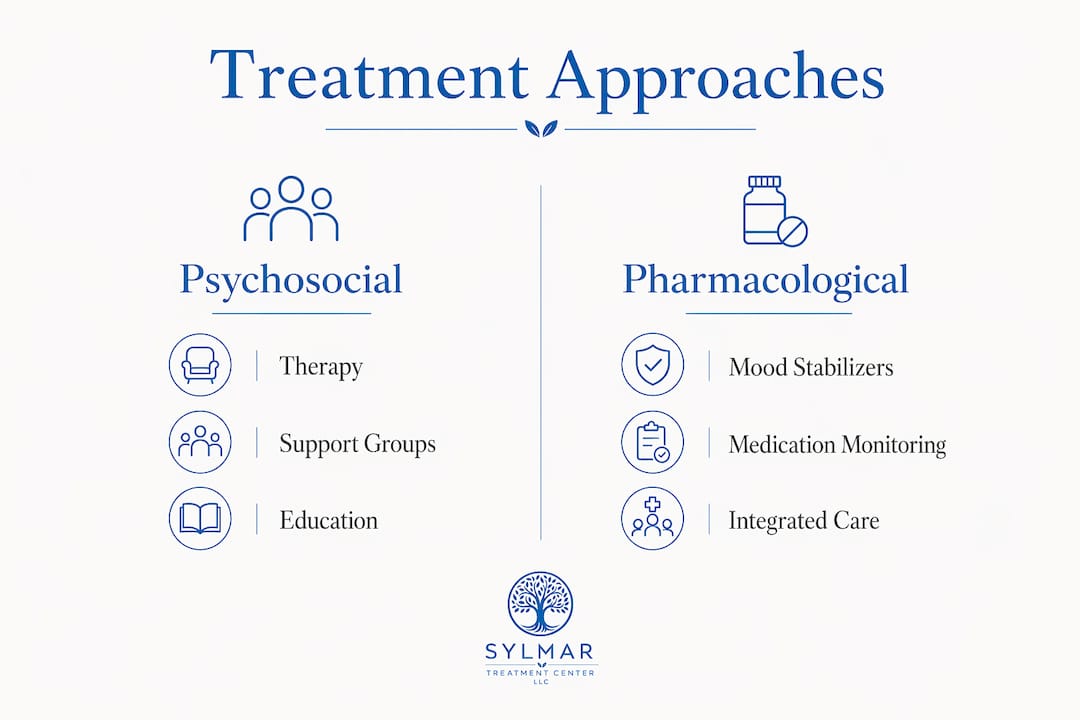
Integrated group therapy is the best-supported psychosocial approach for co-occurring bipolar and substance use disorders, endorsed by the Canadian Network for Mood and Anxiety Treatments (CANMAT) consensus guidelines. IGT works by treating the two conditions as interconnected rather than separate, covering denial, ambivalence, mood management without substances, and identifying triggers for both mood episodes and substance misuse in the same sessions.
The Integrated Treatment Adherence Program (ITAP) is another evidence-based option. Blending cognitive-behavioral therapy and Acceptance and Commitment Therapy, ITAP showed faster and greater improvement in depression and mania scores compared to standard care in a pilot randomized controlled trial. It also incorporates family or significant-other sessions and telephone follow-up, which helps sustain gains after discharge.
- Motivational interviewing: Useful as an adjunct but less supported as a standalone approach for this population
- Interpersonal and social rhythm therapy (IPSRT): An evidence-based bipolar therapy that stabilizes daily routines, which reduces mood cycling and indirectly supports sobriety
- Lifestyle and self-management: Regular sleep schedules, exercise, stress reduction, and mood tracking all serve as adjunctive measures that reinforce clinical treatment
Pharmacological strategies
Mood stabilizers, specifically lithium, valproate, and carbamazepine, are the mainstay of pharmacological treatment for bipolar disorder. Antidepressants are used with caution because they can trigger manic episodes, a risk that is especially serious in people who are also managing substance use. A meta-analysis found that pharmacological therapy improved manic symptoms more effectively than placebo but was not significantly better for bipolar depressive symptoms, which underscores why medication alone is never sufficient.
| Treatment type | Strongest evidence for | Limitations |
|---|---|---|
| Integrated group therapy | Substance use reduction | Less impact on mood episode frequency |
| ITAP (CBT + ACT) | Mood symptom improvement | Limited impact on substance use outcomes |
| Mood stabilizers (lithium, valproate) | Mania prevention | Not effective for both domains simultaneously |
| Quetiapine | Manic symptom reduction | No significant effect on bipolar depression with comorbid addiction |
| Motivational interviewing | Engagement and readiness | Insufficient as standalone treatment |
Continuous monitoring is non-optional in dual diagnosis care. Mood and substance use patterns shift, and a treatment plan that worked at month two may need adjustment by month six. That kind of ongoing calibration is what separates a genuine integrated program from a generic one.
How to find and access integrated treatment programs in the United States
Finding the right program starts with one clear filter: look for facilities that treat both bipolar disorder and substance use disorders in the same setting, with a single coordinated team. Programs that address only one condition, or that run parallel tracks with separate providers who rarely communicate, consistently produce worse outcomes.
What to look for in an accredited program:
- DHCS licensing (California) or equivalent state licensure for your region
- Joint Commission accreditation, which signals adherence to national quality and safety standards
- Explicit dual diagnosis or co-occurring disorder programming, not just a general mental health track
- A psychiatrist or prescribing clinician on staff who can manage mood-stabilizing medications
- Individual assessment and a written treatment plan tailored to your specific clinical profile
Treatment settings available:
- Residential: 24-hour structured care, best for people with severe symptoms or unstable home environments
- Intensive outpatient (IOP): Several hours of treatment per day while living at home or in sober housing
- Detoxification: Medical supervision during withdrawal, often the necessary first step before any psychotherapy begins. Understanding what detox involves helps families prepare for this phase
Insurance and practical access:
Most major insurance plans, including Medicaid and Medicare, cover some level of mental health and substance use treatment under the Mental Health Parity and Addiction Equity Act. Coverage specifics vary by plan, so calling the behavioral health number on the back of your insurance card before admission is the fastest way to understand your benefits. Facilities with dedicated admissions staff can often verify benefits directly on your behalf.
Support systems that strengthen recovery:
- Family therapy: Family involvement improves outcomes. Family recovery programs teach communication skills and help loved ones recognize early warning signs of relapse
- Peer support groups: Organizations like the Depression and Bipolar Support Alliance (DBSA) run both in-person and online groups. Peer support complements clinical care by reducing isolation and building coping skills, though it does not replace professional treatment
- Community resources: SAMHSA’s National Helpline (1-800-662-4357) provides free, confidential referrals to local treatment facilities 24 hours a day
Common barriers and how to address them:
Access to specialized integrated programs is uneven across the country. Rural areas have fewer options, and waitlists at quality facilities can be long. If immediate residential admission is not possible, starting with an outpatient dual diagnosis program while on a waitlist is better than waiting without any treatment. Codependency patterns within families can also complicate recovery; addressing codependency dynamics early in the process reduces the risk of enabling behaviors that undermine treatment.
The initial assessment at any reputable program should cover both psychiatric history and substance use history in detail. That comprehensive intake is what allows clinicians to build a genuinely personalized recovery plan rather than a generic protocol.
How Sylmartreatmentcenter approaches integrated bipolar and addiction recovery
Sylmartreatmentcenter operates with a six-bed residential model, which is a deliberate clinical choice. Smaller census means staff actually know each patient, treatment plans get adjusted in real time, and the therapeutic environment stays stable rather than chaotic. That level of individual attention is difficult to replicate in a larger facility.
The center’s dual diagnosis support programs are built to address bipolar disorder and substance use disorders concurrently, not sequentially. Every admission begins with a comprehensive psychiatric and substance use assessment, which feeds directly into a custom care plan. The clinical team includes licensed professionals trained in both mental health and addiction treatment, which means medication management and psychotherapy are coordinated rather than siloed.
What Sylmartreatmentcenter’s integrated program includes:
- Trauma-informed care woven into every level of treatment
- Evidence-based therapies including cognitive-behavioral approaches targeting both mood and substance use
- Medication management with a focus on mood stabilization
- 24/7 admissions support, so people in crisis are not turned away because of the hour
- Educational resources on mental health and addiction recovery, available through the center’s blog for patients and families
Accreditation and quality assurance:
Sylmartreatmentcenter holds both DHCS licensing and Joint Commission accreditation. These are not ceremonial credentials. DHCS licensing means the facility meets California’s regulatory standards for substance use treatment. Joint Commission accreditation requires ongoing performance review against national benchmarks. Together, they give patients and families a concrete basis for trust rather than just a marketing claim.
Pro Tip: When evaluating any residential program, ask specifically whether the psychiatrist managing your medications is on-site or only available by phone. On-site psychiatric coverage makes a measurable difference in how quickly medication adjustments happen during a mood episode.
Mental health directly shapes how well addiction treatment works. Sylmartreatmentcenter’s approach reflects that reality by treating both conditions as equally primary, with individualized treatment programs designed around each patient’s specific clinical picture rather than a standardized protocol.
Sylmartreatmentcenter offers a clear path forward for dual diagnosis recovery
Sylmartreatmentcenter is built specifically for people who need more than a standard addiction program. The six-bed residential setting means you receive genuine one-on-one attention from a clinical team that knows your history, not a rotating cast of staff managing a floor of 30 patients. For someone managing bipolar disorder alongside addiction, that continuity of care is not a luxury. It is what makes the difference between a plan that holds and one that falls apart at the first mood shift.
The center’s DHCS-licensed, Joint Commission-accredited integrated treatment programs combine psychiatric medication management, evidence-based therapy, trauma-informed care, and family support under one roof. Admissions are available around the clock. If you or someone you care about is ready to take the next step, call Sylmartreatmentcenter directly or visit the programs page to review your options and start the intake process today.
Key Takeaways
Integrated treatment that addresses bipolar disorder and addiction simultaneously, through coordinated medication management and evidence-based psychotherapy, produces better outcomes than treating either condition alone.
| Point | Details |
|---|---|
| Co-occurrence is common | Over 40% of people with bipolar disorder have co-occurring substance use disorders, making dual diagnosis the rule rather than the exception. |
| No single treatment covers both | No medication or therapy consistently improves both mood and substance use outcomes; personalized, multimodal plans are required. |
| Integrated group therapy leads the evidence | CANMAT guidelines identify integrated group therapy as the best-supported psychosocial approach for co-occurring bipolar and substance use disorders. |
| Peer support complements, not replaces, clinical care | DBSA and NAMI groups reduce isolation and build coping skills but cannot substitute for professional psychiatric and addiction treatment. |
| Sylmartreatmentcenter | Offers DHCS-licensed, Joint Commission-accredited dual diagnosis programs in a six-bed residential setting with 24/7 admissions and individualized care plans. |
Recommended
- Personalized Recovery Program Components That Work | Sylmar Treatment Center
- Why Mental Health Affects Addiction Recovery Success | Sylmar Treatment Center
- Addiction Recovery Support: A Complete Guide for Families | Sylmar Treatment Center
- What Is a Family Recovery Program? A Guide for Families | Sylmar Treatment Center