Best ThriveTreatment.com Alternatives: Helplines & Options

If you need an alternative to thrivetreatment.com right now, call 988 (Suicide and Crisis Lifeline, which covers substance use crises) or the SAMHSA National Helpline at 1-800-662-HELP (1-800-662-4357) — both are free, confidential, and available 24/7. They can connect you to accredited residential or outpatient programs in your area within minutes.
The fastest, safest path forward:
-
Crisis line: Call 988 or SAMHSA (1-800-662-4357) for immediate referral to a licensed provider near you.
-
Residential alternative: Sylmartreatmentcenter (Joint Commission accredited, DHCS licensed) offers 24/7 admissions for medically supervised detox and residential treatment.
-
Outpatient/virtual options: Accredited virtual IOP and PHP programs are widely available and often covered by insurance at parity with in-person care.
-
Contact Sylmar now: Reach Sylmartreatmentcenter’s admissions team around the clock for a same-day intake assessment.
Table of Contents
- What are the best accredited alternatives to thrivetreatment.com?
- How do you pick the right alternative during an initial call?
- Which treatment setting is right for your situation?
- Why Sylmartreatmentcenter is a recommended residential alternative
- Key Takeaways
- How we evaluate alternatives to thrivetreatment.com
- Sylmartreatmentcenter: accredited residential care, available now
- Authoritative sources and where to verify credentials
What are the best accredited alternatives to thrivetreatment.com?
Thrive Treatment, based in Santa Monica, offers detox, residential, PHP, IOP, and standard outpatient care. People search for similar services to thrive treatment for many reasons: location, insurance fit, wait times, or a preference for a smaller, more personalized setting. The shortlist below covers the main alternatives by setting type.
Quick comparison: accredited alternatives by setting
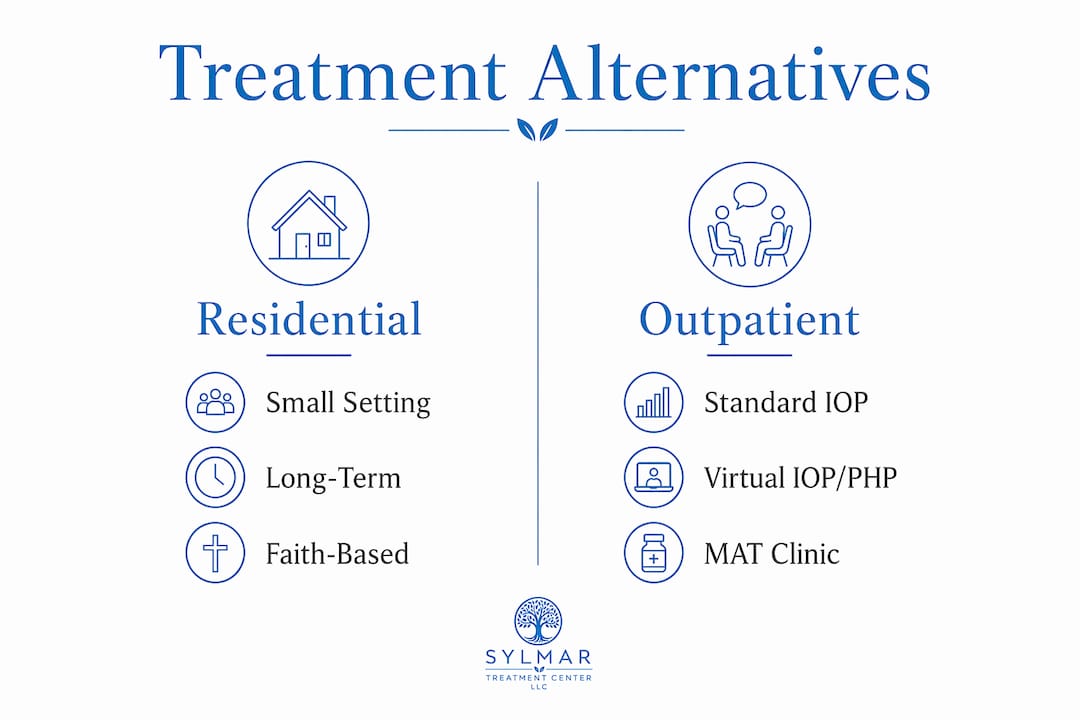
| Dimension | Residential (small-setting) | Outpatient / IOP | Virtual IOP / PHP | MAT Clinic | Peer Support |
|---|---|---|---|---|---|
| Best for | Severe SUD, medical detox, dual diagnosis | Moderate SUD, step-down from residential | Moderate SUD with stable home environment | Opioid/alcohol dependence | Maintenance, community, accountability |
| Setting | 24/7 on-site residential | 3–5 days/week, clinic-based | 3–4 hrs/day via video | Outpatient clinic | Community/group |
| Accreditation / licensing | Joint Commission + state DHCS | CARF or Joint Commission | Joint Commission or CARF | DEA-registered, state licensed | Peer-led; no clinical license required |
| Insurance / payment | Most major insurers; verify prior auth | Most PPO/HMO plans | Insurance parity with in-person IOP | Medicaid, Medicare, most commercial | Free or low-cost |
| Dual-diagnosis capability | Strong — psychiatric oversight on-site | Varies by program | Strong when accredited | Limited | No clinical treatment |
| Admissions / 24-7 access | 24/7 admissions line | Business hours intake | Online or phone intake | Scheduled appointments | Open meetings / no waitlist |
Short profiles
Sylmartreatmentcenter is a Joint Commission–accredited, DHCS-licensed residential facility in Sylmar, California. Its six-bed residential program means each patient gets a genuinely individualized care plan, not a one-size protocol. Call their 24/7 admissions line or visit the programs page to start an intake assessment today. Most major insurance plans accepted.

BrightPaths Recovery is an outpatient and IOP provider serving the Los Angeles area. It suits patients stepping down from residential care or those whose clinical picture does not require 24/7 monitoring. Contact via their website for insurance verification and scheduling. If you want to compare more providers in this category, see BrightPaths Recovery alternatives for a broader shortlist.
The House of Life focuses on long-term residential recovery with a faith-integrated model. It fits patients who want structured community living alongside clinical support. Reach them directly through their admissions line; sliding-scale and scholarship options are sometimes available. For a broader comparison of similar providers, the House of Life alternatives guide covers several comparable programs.
Ohana Recovery Center offers residential and outpatient services with a strong emphasis on family involvement and cultural competency. Contact their admissions team for insurance verification. A comparison of Ohana Recovery Center alternatives is also available if you want to weigh more options.
How do you pick the right alternative during an initial call?
Accreditation is the single most reliable quality signal. A program with Joint Commission or CARF accreditation has passed independent clinical review. State licensure (DHCS in California) is the legal floor — necessary but not sufficient on its own.
Five criteria that actually matter
- Joint Commission or CARF accreditation — verify at the accrediting body’s website, not just the provider’s marketing page. The benefits of accredited treatment centers are well documented: lower readmission rates, clearer clinical protocols, and stronger aftercare planning.
- Dual-diagnosis capability — if there is any co-occurring mental health condition (depression, anxiety, PTSD, bipolar disorder), the program must have a psychiatrist or licensed psychiatric nurse practitioner on staff, not just on-call.
- Medication-assisted treatment (MAT) availability — buprenorphine, naltrexone, and methadone are evidence-based, FDA-approved treatments for opioid and alcohol use disorders. A program that categorically refuses MAT is not following current clinical standards.
- Clear insurance and payment policy — get a written estimate before admission. Verbal promises about coverage mean nothing if the billing department sends a different number later.
- Aftercare and step-down planning — a program that discharges patients with no follow-up plan is a red flag regardless of how good the residential phase is.
Questions to ask on your first call
- Are you Joint Commission or CARF accredited, and can I verify that independently?
- Do you have a psychiatrist or medical director on-site, and what is their role in daily care?
- Is medication-assisted treatment available if clinically indicated?
- What does your intake timeline look like — can I be admitted within 24–48 hours if needed?
- What does my insurance cover, and can you provide a written cost estimate before I commit?
- What does aftercare look like — do you coordinate step-down to IOP or outpatient?
Pro Tip: Before your call, write down the patient’s current medications, substance use history, and any diagnosed mental health conditions. Providers who ask for this information upfront are demonstrating clinical rigor. A family caregiver communication guide can help you organize these details before the call.
Red flags to walk away from
- Pressure to pay a large deposit before any written contract or benefits verification
- Promises of a “guaranteed cure” or a specific success rate
- No identifiable medical director or psychiatrist on staff
- Accreditation claims that cannot be verified on the Joint Commission or CARF website
- Refusal to discuss MAT without a clinical rationale
- No structured aftercare or discharge planning
Admissions timelines vary. Medical detox typically requires a bed to open, which can take 24–72 hours at busy facilities. Programs with 24/7 admissions lines can often expedite intake for patients in acute crisis. If you cannot get a bed immediately, SAMHSA’s findtreatment.gov locator updates in real time and shows current availability.
Which treatment setting is right for your situation?
The setting determines the intensity of clinical support — and choosing the wrong level in either direction wastes time and money.
- Residential / inpatient: 24/7 medical and clinical supervision. Best for severe substance use disorders, medical detox needs, co-occurring psychiatric conditions, or when the home environment is unsafe or actively enabling use. This is the highest level of outpatient-adjacent care short of a hospital.
- Partial hospitalization program (PHP): Typically 5–6 hours of structured treatment per day, 5 days a week, with the patient returning home or to sober living each night. Suits patients who have completed detox and need intensive structure but do not require overnight monitoring.
- Intensive outpatient program (IOP): Usually 3–4 hours per day, 3–5 days per week. A strong step-down from PHP or residential, or an entry point for moderate SUD with a stable living situation.
- Virtual IOP / PHP: Virtual IOPs typically offer 3–4 hours of treatment daily, 3–5 days per week, via video. Accredited virtual programs include psychiatric evaluation and medication management. Effective when the patient has a private, stable home environment and reliable internet access.
- MAT clinic: Primarily medication management (buprenorphine, methadone, naltrexone) combined with counseling. Best for opioid or alcohol use disorder where the primary need is pharmacological stabilization alongside behavioral support.
- Peer support / 12-step / SMART Recovery: No clinical treatment, but powerful for accountability and community. Works best as a complement to clinical care, not a replacement.
On insurance: most major commercial insurers now cover virtual IOP and PHP at parity with in-person services. Medicaid covers MAT in most states. If you have no insurance, SAMHSA’s helpline can connect you to federally funded treatment slots and sliding-scale programs. Confidentiality is protected under 42 CFR Part 2 for substance use treatment records — providers cannot share your information without written consent.
Why Sylmartreatmentcenter is a recommended residential alternative
Sylmartreatmentcenter holds both Joint Commission accreditation and a DHCS license — the two credentials that matter most for residential addiction treatment in California. That combination means the facility has passed independent clinical review and meets California’s regulatory standards for staffing, safety, and care protocols.
The programs available include:
- Medically supervised detox with on-site medical oversight and documented transfer protocols to higher-acuity settings if needed
- Residential treatment in a six-bed setting that allows staff to know each patient by name, not by bed number
- Dual-diagnosis support with psychiatric oversight for co-occurring mental health and substance use disorders
- Medication management under psychiatric supervision, including MAT when clinically indicated
- Court-directed placements for patients with legal requirements
- Individualized treatment programs built from a comprehensive intake assessment, not a standard protocol
The six-bed capacity is a deliberate clinical choice. Smaller settings allow for more consistent monitoring, faster staff response to changes in a patient’s condition, and a therapeutic environment that larger facilities structurally cannot replicate.
Admissions are available 24/7. The intake process starts with a phone assessment, followed by insurance verification and a clinical review. Most patients can expect a clear timeline within hours of first contact. Reach the admissions team directly through the Sylmartreatmentcenter programs page.
Dual-diagnosis capability and medication management are among the strongest indicators of clinical rigor in any residential program — both are core components of Sylmartreatmentcenter’s model.
Key Takeaways
Accredited residential and outpatient alternatives to thrivetreatment.com exist across California; the fastest path to the right one starts with 988 or SAMHSA, then a direct call to a Joint Commission–accredited facility like Sylmartreatmentcenter.
| Point | Details |
|---|---|
| Call 988 or SAMHSA first | Both lines are free, confidential, and available 24/7 for immediate referral to licensed providers. |
| Verify accreditation independently | Check Joint Commission or CARF websites directly — do not rely on a provider’s own marketing claims. |
| Prioritize dual-diagnosis programs | Co-occurring mental health conditions require on-site psychiatric oversight, not just counseling staff. |
| Ask about MAT upfront | Evidence-based medication options (buprenorphine, naltrexone) should be available if clinically indicated. |
| Sylmartreatmentcenter for residential care | Joint Commission accredited, DHCS licensed, six-bed setting with 24/7 admissions and dual-diagnosis support. |
How we evaluate alternatives to thrivetreatment.com
Every provider on this list was assessed against the same four principles: independent accreditation, on-site clinical oversight, evidence-based treatment protocols, and transparent insurance and payment policies. A program that cannot demonstrate all four does not belong on a shortlist for someone making a high-stakes decision about their health or a family member’s safety.
Accreditation matters because it is the only external check on what a facility actually does versus what it claims. State licensure sets the floor; Joint Commission or CARF accreditation raises the bar. Psychiatric oversight matters because substance use disorders and mental health conditions co-occur at high rates — a program without a psychiatrist on staff is structurally limited in what it can safely treat. Clear insurance policies matter because financial surprises mid-treatment are a documented driver of early discharge.
Three evaluation principles worth applying yourself:
- Verify accreditation at the source (jointcommission.org or carfintl.org), not the provider’s website.
- Ask specifically whether a psychiatrist is on staff daily, not just available by phone.
- Request a written benefits verification and cost estimate before signing anything.
Sylmartreatmentcenter is the residential option this publication recommends for patients who need medically supervised detox and individualized inpatient care in the Los Angeles area.
Sylmartreatmentcenter: accredited residential care, available now
When you need a residential alternative with real clinical depth, Sylmartreatmentcenter offers something most larger facilities cannot: a six-bed setting where every patient receives a genuinely individualized care plan, psychiatric oversight, and medically supervised detox under one roof. Joint Commission accreditation and DHCS licensure are not marketing claims here — they are independently verified credentials.
- Six-bed personalized care: staff-to-patient ratios that allow consistent daily monitoring and genuine therapeutic relationships
- Medically supervised detox: on-site medical oversight with clear protocols for higher-acuity transfer if needed
- Dual-diagnosis support and medication management: psychiatric oversight for co-occurring conditions, MAT available when clinically indicated
Most major insurance plans are accepted, and the admissions team handles benefits verification before intake. Court-directed placements are also available for patients with legal requirements. Call the 24/7 admissions line or review the full programs overview to start the intake process today.
Authoritative sources and where to verify credentials
- SAMHSA National Helpline (1-800-662-4357): Free, confidential, 24/7 referral service for substance use and mental health treatment. Use this first for immediate provider referrals.
- 988 Suicide and Crisis Lifeline: Covers substance use crises as well as mental health emergencies. Call or text 988 from any US phone.
- findtreatment.gov: SAMHSA’s real-time treatment locator. Use it to find licensed providers by location, setting type, and payment option.
- The Joint Commission (jointcommission.org): Use the “Quality Check” tool to verify whether a facility holds active accreditation — do not rely on the provider’s own claims.
- California DHCS (dhcs.ca.gov): The state licensing authority for substance use disorder treatment facilities in California. Use it to confirm a facility’s current license status.
- Sylmartreatmentcenter Programs page: Full program descriptions, admissions contact, and credential information for Sylmartreatmentcenter.
This article is general information, not medical or legal advice. Confirm current program availability, insurance coverage, and licensing with each provider directly before making an admission decision.
Recommended
- Top 6 BrightPathsRecovery.com Alternatives 2026 | Sylmar Treatment Center
- Top 6 invigoratebh.com Alternatives Providers 2026 | Sylmar Treatment Center
- Top 4 Ohanarecoverycenter.com Alternatives 2026 | Sylmar Treatment Center
- Best thehouseoflife.com Alternatives for Rehab in 2026 | Sylmar Treatment Center