
If you’re searching for totalitytreatment.com alternatives, the clearest recommendation is Sylmartreatmentcenter (Sylmar Treatment Center) for medically supervised boutique residential care, with IOP plus MAT and telehealth-integrated counseling as viable outpatient paths depending on your situation.
Here’s what to know immediately:
- Boutique residential care: Sylmartreatmentcenter offers a six-bed, Joint Commission-accredited, DHCS-licensed residential program with 24/7 admissions and on-site medical detox. It’s built for people who need close clinical oversight, dual diagnosis support, or medically complex detox.
- Outpatient/MAT pathway: Intensive Outpatient Programs (IOP) combined with medication-assisted treatment (MAT) work well for people with stable housing and moderate severity who need medication stabilization alongside structured therapy.
- Telehealth-integrated care: For patients with transportation barriers or mild-to-moderate substance use disorder (SUD), telehealth counseling paired with medication services offers a lower-barrier entry point.
Next steps: Call Sylmartreatmentcenter’s admissions line, have your insurance card ready, and prepare a current medication list and any recent clinical notes. Getting a written benefits estimate before signing anything prevents surprise bills.
Table of Contents
- How do Totality Treatment Center and Sylmartreatmentcenter actually compare?
- What questions should you ask before choosing a program?
- Which therapy works best: CBT, DBT, or combined care?
- What does admission look like, and what does treatment cost?
- Who should choose Sylmartreatmentcenter vs. outpatient care?
- What’s the clearest recommendation here?
- Key Takeaways
- Why a small, accredited residential program matters for complex cases
- Sylmartreatmentcenter admissions: what to do next
- Authoritative sources and further reading
How do Totality Treatment Center and Sylmartreatmentcenter actually compare?
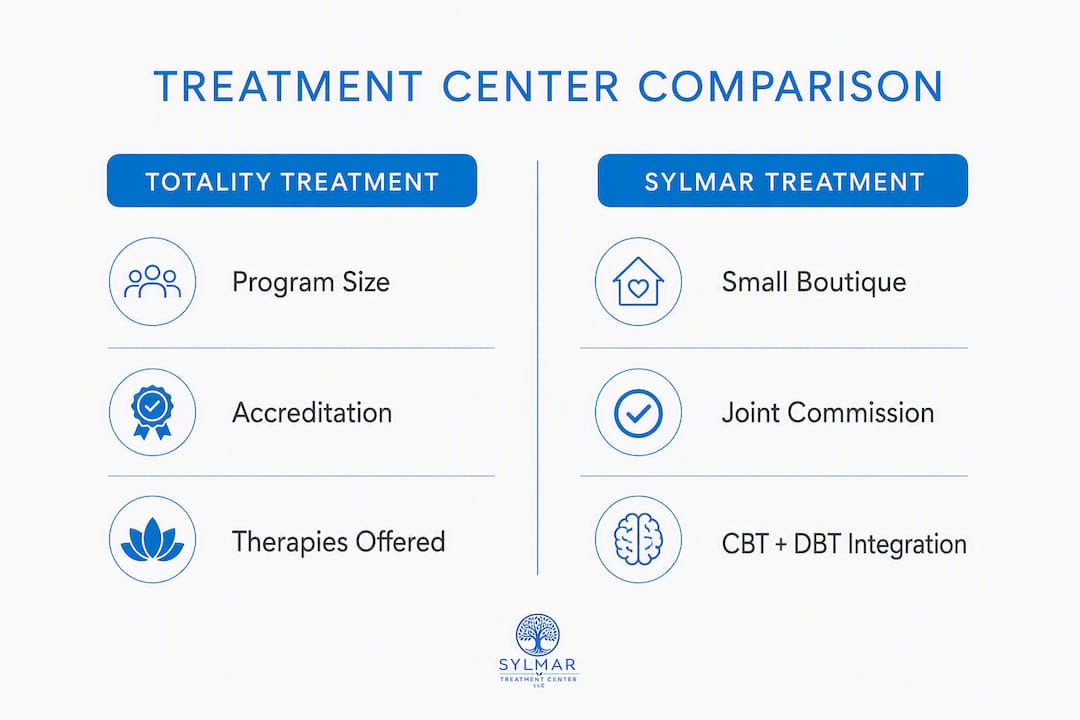
The table below covers the dimensions that matter most when families are choosing between treatment options like totalitytreatment.

| Dimension | Totality Treatment Center | Sylmartreatmentcenter (Boutique Residential) | IOP + MAT Pathway | Telehealth-Integrated Care |
|---|---|---|---|---|
| Level of care | Outpatient / IOP | Detox, residential, dual diagnosis | IOP/OP, MAT | Outpatient, telehealth counseling |
| Setting / bed count | Outpatient clinic | Six-bed residential facility | Outpatient clinic | Remote / virtual |
| Evidence-based therapies | CBT, group therapy | CBT, DBT, strengths-based CBT | CBT, MAT counseling | CBT, tele-counseling |
| Accreditation & licensing | Not publicly listed | Joint Commission, DHCS licensed | Varies by provider | Varies by provider |
| 24/7 admissions / medical detox | Not listed | Yes, 24/7 admissions and detox | No | No |
| Special programs | Not listed | Dual diagnosis, court-directed placements | MAT stabilization | Craving reduction, retention support |
| Insurance / cost transparency | Not publicly listed | Accepts insurance; verify in-network status | Varies | Varies |
| Best for | Outpatient-ready patients | Medically complex, co-occurring disorders, high oversight needed | Stable housing, motivated, medication needs | Transportation barriers, mild-to-moderate SUD |
Three things families should weigh right now:
- Accessibility vs. intensity: Outpatient and telehealth options lower the barrier to entry but may not provide enough structure for someone in acute withdrawal or with a co-occurring psychiatric condition.
- Cost and insurance: Residential care typically costs more per day but may require fewer total treatment episodes for high-acuity patients. Always verify in-network status before placement.
- Accreditation: Joint Commission accreditation and a state DHCS license are the two most reliable signals of regulated clinical oversight. Totality Treatment Center’s accreditation status is not publicly listed, which is worth clarifying directly.
Pro Tip: Call the Joint Commission’s Quality Check tool at qualitycheckjointcommission.org and your state’s DHCS provider directory to verify any program’s accreditation and bed availability before committing.
What questions should you ask before choosing a program?
Use this checklist on your first call with any program, including alternatives to Totality Treatment:
- Is the facility Joint Commission accredited and DHCS licensed?
- Is 24/7 medical detox available on-site?
- What is the current client-to-staff ratio?
- Do you integrate MAT with behavioral therapy (CBT or DBT)?
- Are discharge planning and aftercare standard parts of the program?
- Which therapies are delivered by credentialed, licensed clinicians?
- What is the typical length of stay for detox, residential, and step-down care?
- Do you accept my insurance, and will you provide a written benefits estimate?
- Do you treat co-occurring mental health disorders (dual diagnosis)?
- Do you accept court-directed placements?
Red flags to watch:
- No licensed medical staff on-site or on-call
- Vague or missing information about pricing and insurance
- Promises of guaranteed outcomes or “cure” language
- Pressure to pay cash before a clinical assessment
- Inability to provide proof of accreditation or state licensing
Verify credentials directly: ask for the DHCS license number and look up Joint Commission status independently. Confirm that CBT and DBT sessions are led by credentialed clinicians, not peer support staff alone.
Which therapy works best: CBT, DBT, or combined care?
CBT and DBT are both evidence-based for addiction, but they target different mechanisms. CBT works by identifying and restructuring distorted thought patterns that drive substance use. DBT is the better fit when addiction co-occurs with severe emotional dysregulation, self-harm, or borderline traits, because it builds distress tolerance and emotional regulation skills directly.
Most high-quality programs integrate both. A patient with alcohol use disorder and stable housing may respond well to CBT alone. Someone with a history of self-harm and high emotional reactivity will likely need DBT’s skills-training component alongside any medication protocol.
The case for combined care is strong. A systematic review and meta-analysis found a statistically significant benefit for combined CBT and pharmacotherapy over pharmacotherapy with usual care alone for alcohol and substance use disorders. Combined care also improves treatment retention and medication adherence during the period when medication effects are still ramping up. For opioid use disorder specifically, real-world multi-organization data show that buprenorphine plus psychotherapy produced the largest observed effect size for remission likelihood compared with either treatment alone.
Strengths-based CBT adds another layer. Rather than focusing only on symptom reduction, it builds resilience by identifying and amplifying client strengths. Solution-focused techniques integrated into modern CBT variants emphasize small, achievable goals that accelerate early engagement, which matters most in the first weeks of treatment when dropout risk is highest.
What does admission look like, and what does treatment cost?
Typical care pathway timelines:
- Immediate admission: Sylmartreatmentcenter accepts 24/7 admissions; placement can begin the same day for medically urgent cases.
- Medical detox: Usually about one to two weeks, depending on substance, severity, and medical complexity.
- Residential care: Typically about a month, with extensions based on clinical progress.
- Step-down / IOP: Several weeks to a few months of structured outpatient care following residential discharge.
- Telehealth counseling: Ongoing, often concurrent with MAT; session frequency varies by clinical need.
Insurance questions to ask on your first call:
- Is this program in-network with my plan?
- Does my plan require prior authorization, and how long does that take?
- Is there a session or day cap on residential or IOP benefits?
- Are MAT medications billed separately from therapy?
- Will you provide a written benefits estimate before admission?
Pro Tip: Document every insurance conversation in writing. Ask the admissions team to send a written benefits estimate by email before you sign any agreement. This one step prevents the most common billing disputes after discharge.
Court-directed placements may have separate funding pathways. Ask the admissions team whether the program has experience coordinating with courts and what documentation is required.
Who should choose Sylmartreatmentcenter vs. outpatient care?
Boutique residential (Sylmartreatmentcenter) is the right fit if:
- You need medically supervised detox with 24/7 clinical oversight
- You have a co-occurring mental health diagnosis (dual diagnosis)
- Previous outpatient attempts have not held
- Your situation involves a court-directed placement
- You need a high client-to-staff ratio and individualized attention
IOP plus MAT is the better path if:
- You have stable housing and a strong support system
- Your primary need is medication stabilization (buprenorphine, naltrexone) alongside structured therapy
- You can commit to multiple weekly sessions without residential placement
Telehealth-integrated care fits when:
- Transportation or scheduling makes in-person attendance difficult
- Your SUD is mild-to-moderate and does not require medical detox
- You want to begin care quickly while arranging a higher level of care
Sylmartreatmentcenter’s behavioral rehabilitation program serves adults with dual diagnosis needs, and the facility accepts court-directed placements. Adolescent-specific programming is not listed publicly; confirm directly with admissions.
What’s the clearest recommendation here?
For anyone needing medically supervised, individualized residential care, Sylmartreatmentcenter’s six-bed boutique model is the strongest alternative to Totality Treatment Center among the options reviewed. For those who need outpatient care, IOP plus MAT is the evidence-backed first choice; telehealth is a practical entry point when access is the main barrier.
What to do right now:
- Call Sylmartreatmentcenter admissions (available 24/7) and ask the 10-question checklist above
- Have ready: insurance card, photo ID, current medication list, and any recent clinical notes
- Request a written benefits estimate before agreeing to placement
- If court-directed, ask specifically about the facility’s court placement process
Key Takeaways
Sylmartreatmentcenter is the recommended boutique residential alternative to Totality Treatment Center for patients needing medically supervised detox, dual diagnosis care, or a high client-to-staff ratio in a Joint Commission-accredited, DHCS-licensed setting.
| Point | Details |
|---|---|
| Verify accreditation first | Confirm Joint Commission status and DHCS license before any placement — these are the two most reliable quality signals. |
| Match level of care to severity | Residential detox fits medically complex or dual-diagnosis cases; IOP plus MAT suits stable patients needing medication and structure. |
| Combined care outperforms monotherapy | Meta-analytic evidence shows CBT plus pharmacotherapy produces better outcomes than pharmacotherapy with usual care alone. |
| Get a written benefits estimate | Requesting written insurance confirmation before admission prevents the most common post-discharge billing disputes. |
| Sylmartreatmentcenter | A six-bed, Joint Commission-accredited, DHCS-licensed residential program with 24/7 admissions, medical detox, CBT, DBT, and dual diagnosis support. |
Why a small, accredited residential program matters for complex cases
The conventional wisdom in addiction treatment is that more options equal better care. More tracks, more modalities, more beds. The reality is different for a specific subset of patients: those with co-occurring psychiatric conditions, medically complicated withdrawal, or a history of failed outpatient attempts. For them, a large program’s breadth is often a liability, not an asset. Caseloads get diluted, clinical attention gets spread thin, and the individualized plan that looked good on paper becomes a group schedule that fits no one perfectly.
A six-bed model forces the opposite dynamic. Every staff interaction is with someone who actually knows the patient’s history. Medication adjustments happen faster. Behavioral patterns get noticed earlier. That’s not a marketing claim; it’s a structural consequence of the ratio.
Sylmartreatmentcenter holds Joint Commission accreditation and a DHCS license, which means external reviewers have verified staff credentialing, clinical protocols, and safety standards. Families evaluating any program should ask for outcome data during the intake call. A program confident in its results will share it.
Sylmartreatmentcenter admissions: what to do next
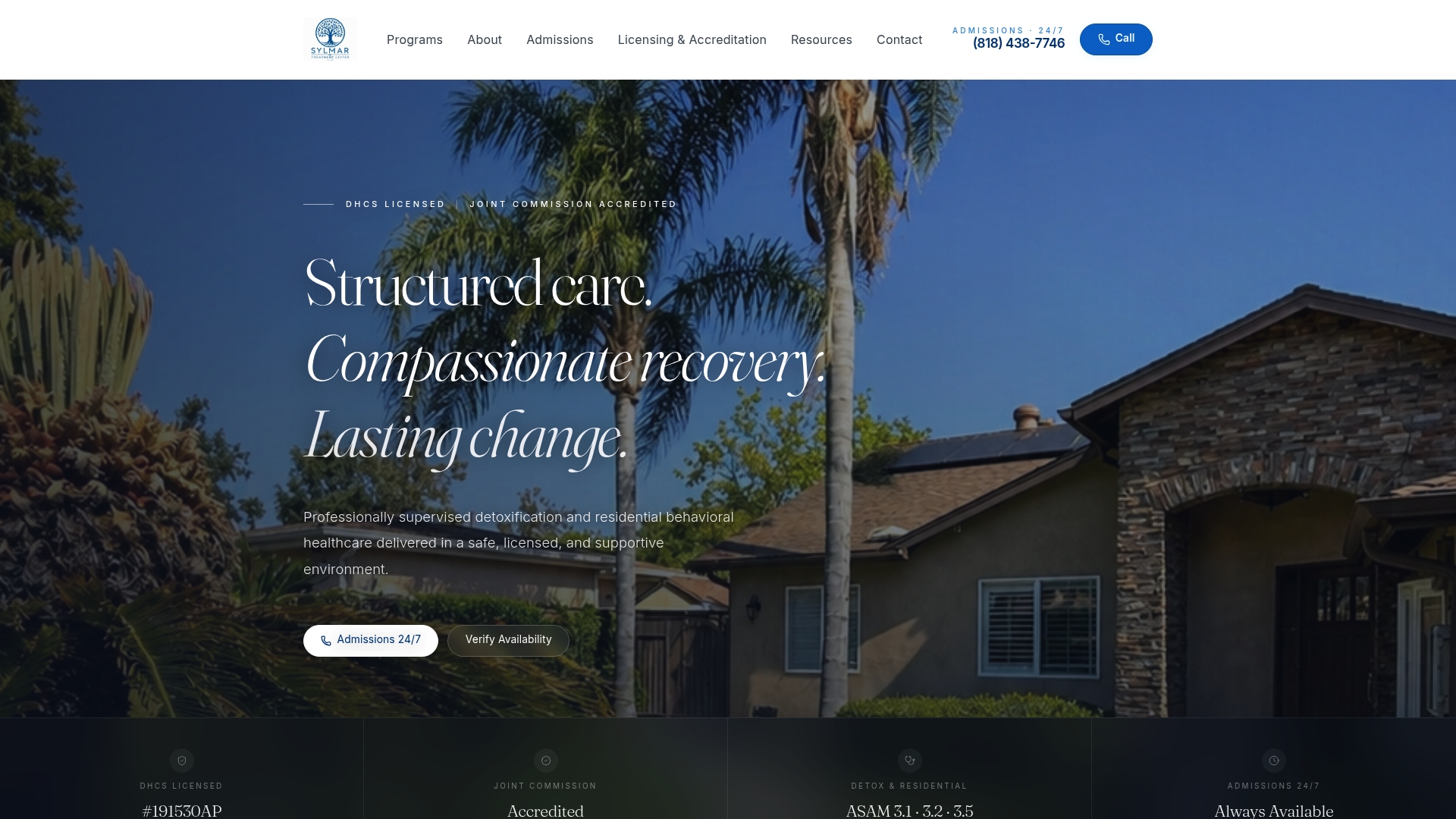
Sylmartreatmentcenter accepts admissions 24 hours a day, seven days a week. The six-bed residential facility offers on-site medical detox, CBT and DBT delivered by credentialed clinicians, dual diagnosis support, and court-directed placement coordination, all within a DHCS-licensed and Joint Commission-accredited setting.
When you call, have your insurance card, a photo ID, your current medication list, and any recent clinical notes ready. The admissions team will walk you through medical clearance, detox placement if needed, and insurance verification on that first call. Ask for a written benefits estimate before any agreement is signed.
Explore Sylmartreatmentcenter’s full program offerings or visit the residential treatment page to review the six-bed model, staffing approach, and levels of care in detail.
Authoritative sources and further reading
- Addiction Psychotherapeutic Care — StatPearls, NCBI Bookshelf
- Solution-Focused Approaches in Adult Mental Health Research: A Conceptual Literature Review — Frontiers in Psychiatry
- Combined Pharmacotherapy and CBT for Adults With Alcohol or Substance Use Disorders: A Systematic Review and Meta-Analysis
- Real-World Effectiveness of MOUD and Psychotherapy for Opioid Use Disorder — Frontiers in Psychiatry
- Strengths-Based Cognitive-Behavioural Therapy: A Four-Step Model to Build Resilience — Wiley
- Programs — Sylmartreatmentcenter
- Sylmartreatmentcenter — Main Site
Recommended
- Top 4 Ohanarecoverycenter.com Alternatives 2026 | Sylmar Treatment Center
- Top 6 BrightPathsRecovery.com Alternatives 2026 | Sylmar Treatment Center
- Top 6 invigoratebh.com Alternatives Providers 2026 | Sylmar Treatment Center
- Best thehouseoflife.com Alternatives for Rehab in 2026 | Sylmar Treatment Center