A strengths-based recovery approach centers a person’s existing abilities, resources, and self-defined goals as the primary engine of healing rather than cataloging what is broken or missing. Instead of organizing care around diagnoses, deficits, and symptom checklists, it asks: what has this person already survived, what do they care about, and how can those assets drive their recovery? The approach applies across mental health, addiction, and trauma care, and it changes the helping relationship from expert-fixes-patient to a genuine collaboration where the person in recovery directs their own path. SAMHSA’s recovery definition framework describes this orientation as person-driven, built on individual strengths and resources that serve as the foundation for lasting change. Sylmartreatmentcenter publishes this guide to help clinicians, clients, and families understand the model, evaluate the evidence, and put it into practice.
Table of Contents
- What are the core principles of a strengths-based recovery approach?
- How does strengths-based recovery differ from deficit-oriented and medical models?
- What does the research say about outcomes in strengths-focused recovery?
- What are common strengths-based interventions and how do they work?
- How do you implement strengths-based recovery in clinical practice?
- Practical advice for people in recovery and their families
- When strengths-based recovery alone is not enough
- How Sylmartreatmentcenter applies strengths-based recovery in practice
- Key Takeaways
- The gap between what strengths-based recovery promises and what actually matters
- Strengths-based residential care at Sylmartreatmentcenter
- Further reading and primary sources
What are the core principles of a strengths-based recovery approach?
The University of Kansas School of Social Welfare articulates the foundational principles most widely cited in clinical training: every person possesses inherent strengths worth recognizing; those strengths should be systematically assessed rather than assumed; trauma and illness can be reframed as challenges that carry growth potential; clients set their own goals and clinicians honor those goals; and the helping relationship is a collaboration where the client directs care.
These principles are not abstract values. They translate into concrete clinical behaviors. A clinician operating from this framework opens an intake session by asking what the person has already tried, what has worked even partially, and what a meaningful life looks like to them. Research on strengths-based intake forms shows that clients who complete them tend to list fewer problems and propose more solutions than clients who complete problem-focused forms, a measurable shift in orientation before the first session even ends.
A 2013 review published in PMC describes the approach as shifting focus from pathology toward consumers’ strengths and resources, aligning it directly with mental health recovery goals rather than treating recovery as a byproduct of symptom management.
Consider what this looks like in practice. A person entering residential care for alcohol use disorder arrives with a history of job loss and family conflict. A deficit-oriented intake documents those losses as risk factors. A strengths-based intake asks the same person about the decade they spent as a shift supervisor, the relationships they maintained through difficult years, and the coping strategies that kept them functional longer than they give themselves credit for. That reframe does not minimize the alcohol use disorder. It gives the person something to build on rather than something to overcome.
Statistic callout: A program evaluation of a trait-focused strengths curriculum reported 97.1% retention among participants versus 15.5% in a comparison group, alongside a 71.5% reduction in depression and 58.5% reduction in anxiety. Those numbers come from a single evaluation, not a meta-analysis, but the magnitude of the retention gap is hard to dismiss.
How does strengths-based recovery differ from deficit-oriented and medical models?
The three dominant frameworks in behavioral health — strengths-based, deficit-oriented, and the purely biomedical model — are not mutually exclusive, but they start from different premises and produce different clinical cultures.
| Dimension | Strengths-based model | Deficit-oriented model | Biomedical model |
|---|---|---|---|
| Primary focus | Client assets, goals, resilience | Problems, symptoms, risk factors | Diagnosis, pathology, symptom reduction |
| Role of client | Co-producer and director of care | Recipient of expert assessment | Patient receiving treatment |
| Typical goals | Client-defined meaningful life outcomes | Problem elimination or risk reduction | Symptom remission, functional stabilization |
| Typical interventions | Strengths assessment, person-centered planning, peer support | Problem-focused therapy, risk management | Medication, clinical protocols, medical monitoring |
| Engagement pattern | Collaborative, motivating, client-led | Can create dependency or learned helplessness | Passive compliance with prescribed regimen |
| Recovery outcome framing | Meaning, purpose, community participation | Reduction of identified problems | Measurable symptom change |
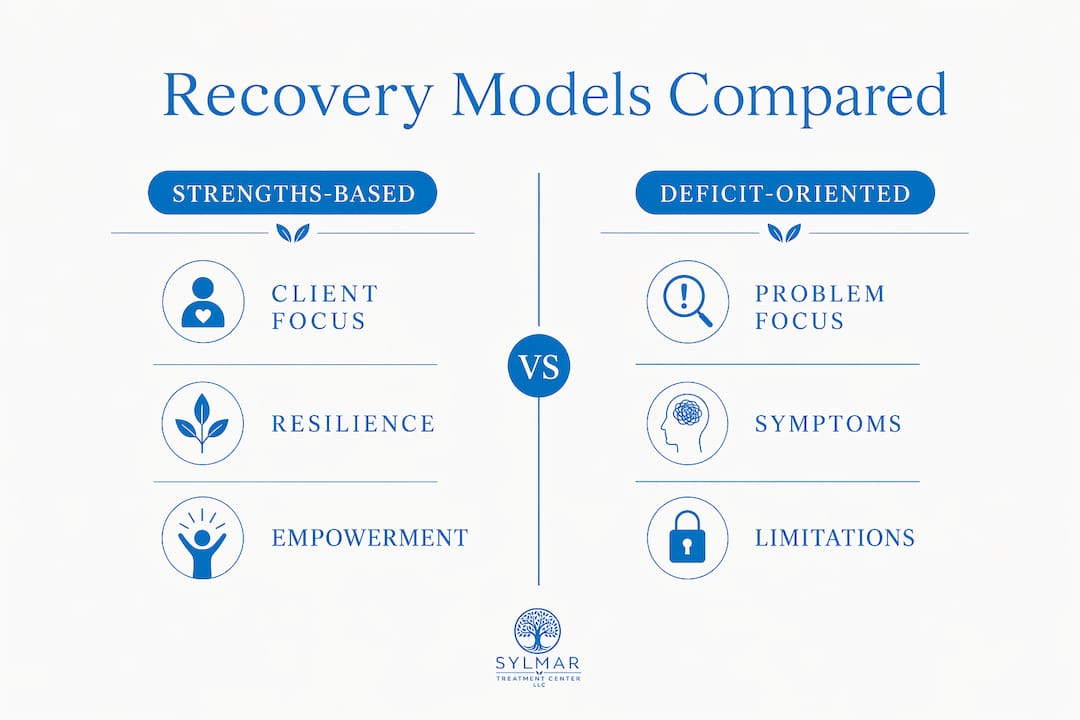
The recovery-oriented practice framework describes this shift as moving people from passive consumers of care to co-producers of their own health. That is a structural change in the helping relationship, not just a tone adjustment.
None of this means the medical model is wrong. Acute detox, psychiatric stabilization, and medication management are not optional for many people. The strengths-based model works best when it runs alongside medical care, not instead of it. A person in alcohol withdrawal needs medical supervision first. Once stabilized, the strengths lens becomes the organizing framework for everything that follows.
Pro Tip: To tell whether a provider uses a strengths-based approach, ask two questions during intake: “What will you ask me about my strengths or past successes?” and “Who sets my treatment goals?” A strengths-based program will have a clear answer to both. If the intake form is entirely problem-focused and goals are preset by the program, that is a signal the model leans deficit-oriented regardless of how it is marketed.
What does the research say about outcomes in strengths-focused recovery?
The evidence base for strengths-based recovery is real and growing, though it is not uniform across all populations and settings.
The strongest signals come from engagement and retention. The trait-based curriculum evaluation cited above reported a retention rate of 97.1% compared to 15.5% in a comparison group, with participants also showing a 71.5% reduction in depression scores and a 58.5% reduction in anxiety. These findings come from a single program evaluation across residential and outpatient settings, which limits generalizability, but the direction is consistent with what other studies find.
- Strengths-based counseling frameworks, as described in NCBI Bookshelf recovery guidance, consistently show improved client engagement, better therapeutic alliance, and higher rates of treatment completion compared to purely deficit-focused approaches.
- The 2013 PMC review of strengths-based approaches in psychiatric nursing found alignment with recovery goals and improved client self-efficacy, though it noted that randomized controlled trial evidence remains limited.
- Positive-psychology and strengths-based interventions show consistent benefits for resilience and confidence across counseling, coaching, and social work contexts.
- Evidence for long-term trait-based curricula is less developed. Most studies measure short-term outcomes like retention and symptom scores rather than five-year recovery capital or sustained community participation.
Where the evidence is thinner: rigorous RCTs comparing strengths-based programs to active control conditions are still relatively scarce in addiction medicine specifically. The research base is stronger in mental health and social work settings than in pure substance use treatment. That gap does not invalidate the approach. It means programs should pair strengths-based methods with evidence-based clinical interventions that do have strong RCT support, such as cognitive behavioral therapy and medication-assisted treatment, rather than treating the strengths model as a standalone protocol.
What are common strengths-based interventions and how do they work?
Strengths-based recovery is not a single technique. It is a collection of methods unified by the same underlying orientation: start with what the person already has.
Core interventions clinicians use:
- Strengths-based case management: A structured approach where the case manager maps the client’s assets across life domains (relationships, work history, coping skills, community ties) and uses that map to connect them with resources and set goals.
- Person-centered planning: Collaborative care planning where the client’s stated priorities drive the agenda, not a standardized protocol.
- Solution-focused brief therapy (SFBT): A short-term model that asks clients to identify exceptions to their problems (“When did things go better? What were you doing differently?”) and scale their own progress.
- Recovery capital mapping: Inventorying personal, social, and community resources the person can draw on, including sober relationships, stable housing, employment skills, and faith community.
- Peer support: Connecting clients with people who have lived experience of recovery, which models possibility and builds social capital simultaneously.
- Positive-psychology exercises: Gratitude practices, character strengths identification (using tools like the VIA Character Strengths survey), and best-possible-self writing exercises.
- Strengths assessment tools: Structured checklists and narrative tools that systematically document assets rather than only deficits.
Cataloging past coping skills and resilience is especially effective in dual diagnosis support, where clients often arrive believing their mental health diagnosis and substance use have destroyed everything. A structured strengths inventory frequently surfaces competencies the client had stopped counting.
Vignette 1: Addiction and dual diagnosis. A 34-year-old man enters residential care for opioid use disorder and depression. His intake strengths assessment reveals ten years of construction management experience, a strong relationship with his brother, and a history of coaching youth soccer before his use escalated. His clinician uses those anchors to build a person-centered plan: short-term goals tied to physical activity (soccer drills in the facility yard), a family session with his brother, and vocational planning as a medium-term goal. His depression scores drop not because the depression was ignored, but because his identity expanded beyond the diagnosis. For more on how integrated dual diagnosis treatment pairs these methods with clinical care, Sylmartreatmentcenter’s clinical blog covers the approach in detail.
Vignette 2: Trauma and mental health recovery. A 28-year-old woman with PTSD and a history of childhood neglect enters outpatient therapy. Rather than beginning with a trauma narrative, her clinician opens with a strengths assessment: what has she built despite the trauma? She identifies her role as a reliable caregiver for her younger siblings, her creative writing, and her ability to read social situations with unusual precision. The clinician reframes that last skill, hypervigilance in clinical terms, as a form of social intelligence she developed under pressure. That reframe does not erase the trauma. It gives her a different relationship with a trait she had always experienced as a liability.

Pro Tip: Clinicians looking for structured tools can start with the personal goals framework used in recovery-oriented care planning, which walks through how to translate client-stated goals into measurable treatment plan objectives.
How do you implement strengths-based recovery in clinical practice?
Adopting a strengths-based model is an organizational project, not just a therapy technique. The University of Kansas principles are explicit: successful implementation requires agency-wide culture change, including intake, staff interactions, supervision, and discharge planning. Applying the lens only during select sessions undermines its effect.
First 90 days: a practical implementation roadmap
- Audit your intake forms (Days 1–14). Identify every question that asks only about problems, symptoms, or deficits. For each one, add a parallel strengths-oriented question. “What substances do you use?” stays. “What coping strategies have worked for you in the past?” gets added.
- Train staff on strengths-based language (Days 15–30). Run a half-day workshop focused on reframing language in case notes, supervision, and client conversations. Replace “non-compliant” with “not yet engaged.” Replace “resistant” with “ambivalent about change.” These are not euphemisms; they are more accurate descriptions that open clinical options.
- Adopt a structured strengths-assessment tool (Days 30–45). Options include the Strengths Assessment Worksheet developed from the Kansas model, recovery capital inventories, or narrative intake tools. Pick one and train all clinicians on it.
- Revise care-plan templates (Days 45–60). Add a required “client strengths and resources” section to every care plan. Make it mandatory, not optional, so the model is embedded in documentation rather than left to individual clinician preference.
- Shift supervision focus (Days 60–75). In weekly supervision, ask clinicians to present one client strength they identified that week and how they used it in session. This builds the habit and creates accountability.
- Establish baseline outcome metrics (Days 75–90). Track retention rates, therapeutic alliance scores, and client-reported goal progress from the start so you have data to evaluate the shift.
Strengths-assessment prompts for intake and early sessions:
- “Tell me about a time you got through something really hard. What did you draw on?”
- “What do people who know you well say you are good at?”
- “What has kept you going on the days when things felt impossible?”
- “What does a good day look like for you? What’s happening in it?”
Pro Tip: Measuring strengths in practice works best when you combine structured tools with qualitative client stories. A strengths-assessment checklist gives you program-level data; the client’s own narrative gives you the clinical detail that drives the care plan. Use both.
Practical advice for people in recovery and their families
If you are entering treatment or supporting someone who is, knowing what a strengths-based program looks like from the inside helps you ask better questions and recognize whether the care you are receiving actually matches the model.
Before and during intake:
- Write down three things you are good at, three relationships that matter to you, and one goal that has nothing to do with your diagnosis. Bring that list to your first session.
- Ask the intake coordinator: “Will my treatment plan include goals I set myself, or are the goals determined by the program?”
- Ask: “How does your team assess my strengths, not just my problems?”
- Ask: “Who will I work with consistently, and how often will we meet one-on-one?”
Simple at-home strength-building activities:
- Keep a weekly log of moments when you handled something well, no matter how small.
- Identify one person in your life who reflects your strengths back to you and spend time with them intentionally.
- Use the VIA Character Strengths survey (free online) to get a structured picture of your top character traits, then discuss the results with your clinician.
For families: The most common mistake families make is taking over the goal-setting process. You can support someone’s recovery without directing it. Ask your family member what they want their life to look like, then ask how you can support that specific vision rather than the version you have in mind. The difference between support and control often comes down to whose goals are being pursued.
Pro Tip: When reviewing mental health coverage under the ACA for a loved one’s treatment, confirm that the plan covers residential and outpatient behavioral health services before the admission conversation. Insurance navigation is easier before admission than during it.
When strengths-based recovery alone is not enough
A strengths-based approach is not a substitute for medical care, and no responsible clinician presents it as one. There are specific clinical situations where strengths-focused work must be paused or run in parallel with medical intervention rather than leading the care.
Clinical limits where medical care takes priority:
- Acute detox and withdrawal. Alcohol, benzodiazepine, and opioid withdrawal carry real medical risk. Medically supervised detox must precede or run alongside any strengths-based work during this phase. Strengths conversations during active withdrawal are not only ineffective; they can be dangerous if they delay medical assessment.
- Active suicidality or self-harm. Safety planning and clinical risk management take precedence. Strengths-based reframing is a useful tool within a safety plan, but it does not replace one.
- Severe cognitive impairment. Acute psychosis, severe traumatic brain injury, or advanced dementia limit a person’s capacity to engage in goal-directed strengths work. Stabilization comes first.
- Medical comorbidities requiring immediate attention. Hepatitis C, endocarditis, or severe malnutrition from chronic substance use require medical management that cannot wait for a strengths assessment.
Safety signals families and clinicians should watch for:
- Signs of physical withdrawal: tremors, sweating, elevated heart rate, confusion, or seizures
- Worsening psychosis: disorganized speech, paranoia, or command hallucinations
- Expressions of hopelessness or statements about not wanting to be alive
- Rapid deterioration in self-care, nutrition, or orientation
Strengths-based counseling does not ignore clinical risk. It reframes problems without minimizing them. The model explicitly requires combination with medical stabilization and evidence-based clinical interventions when those are indicated. A clinician who tells a family that strengths-based work alone is sufficient for someone in acute withdrawal is not practicing the model correctly.
Combining strengths-based work with medication management looks like this in practice: a person on buprenorphine for opioid use disorder also works with a clinician on recovery capital mapping, peer support, and person-centered goal setting. The medication addresses the neurobiological component. The strengths work addresses identity, motivation, and long-term recovery capital. Neither replaces the other.
How Sylmartreatmentcenter applies strengths-based recovery in practice
Sylmartreatmentcenter’s six-bed residential setting is designed around the premise that individualized care requires actually knowing the person, not just their diagnosis. The small program size makes that possible in ways a 40-bed facility cannot replicate.
What this looks like for a client:
A composite example: a 41-year-old woman enters Sylmartreatmentcenter with a dual diagnosis of alcohol use disorder and generalized anxiety disorder. Her intake includes a comprehensive strengths assessment alongside the standard clinical evaluation. Her care team identifies her background in healthcare administration, her close relationship with her adult daughter, and her history of managing high-pressure situations as assets to build on. Her individualized treatment plan incorporates those strengths directly: vocational goals tied to her professional identity, family sessions that include her daughter as a support resource, and anxiety management strategies that reframe her high-alert cognitive style as a skill she can learn to modulate rather than eliminate.
Medical supervision runs throughout. Her psychiatric team manages her medication, monitors withdrawal, and adjusts her care plan as her clinical picture evolves. The strengths-based framework does not replace that oversight. It shapes how the clinical team talks with her, what goals they prioritize, and how they measure progress.
Sylmartreatmentcenter’s program credentials:
- Licensed by the California Department of Health Care Services (DHCS)
- Accredited by The Joint Commission
- Six-bed residential setting with individualized treatment programs and 24/7 admissions support
- Dual diagnosis support for co-occurring substance use and mental health disorders
- Medication management with psychiatric oversight integrated into every residential program
The Joint Commission accreditation and DHCS licensure are not marketing claims. They are independently verified quality standards that tell families the program meets defined clinical and safety benchmarks.
Key Takeaways
A strengths-based recovery approach consistently outperforms deficit-focused models on engagement and retention, and it works best when paired with medical supervision rather than used as a standalone protocol.
| Point | Details |
|---|---|
| Core definition | The approach centers client assets, goals, and resilience as the engine of recovery, not symptom elimination. |
| Retention evidence | A trait-based strengths curriculum reported 97.1% retention compared to 15.5% in a comparison group, alongside a 71.5% reduction in depression and 58.5% reduction in anxiety. |
| Medical care is non-negotiable in acute phases | Detox, suicidality, and severe psychiatric crises require medical management first; strengths work complements, not replaces, clinical care. |
| Sylmartreatmentcenter | Offers individualized, strengths-informed residential care with DHCS licensure, Joint Commission accreditation, and integrated dual diagnosis support in a six-bed setting. |
The gap between what strengths-based recovery promises and what actually matters
The phrase “strengths-based” has become so common in behavioral health marketing that it has started to lose meaning. Programs describe themselves as strengths-based while running intake processes that are entirely problem-focused, writing care plans with no client input, and measuring success exclusively through symptom checklists. That is not the model. That is the vocabulary of the model grafted onto a deficit-oriented structure.
What actually matters in strengths-based recovery is not the language clinicians use. It is whether the client’s own goals appear in the care plan, whether the intake process surfaces assets alongside problems, and whether the organization has built the model into its policies rather than leaving it to individual clinicians to apply inconsistently. The research on retention and engagement is compelling, but those outcomes depend on genuine implementation, not a rebranding exercise.
There is also a misconception worth naming directly: strengths-based recovery is not toxic positivity. It does not ask people to pretend their addiction or trauma did not happen or that everything is fine. It asks clinicians and clients to hold both truths simultaneously: this person has been through something serious, and this person has real assets that can drive their recovery. Those two facts are not in tension. The most effective programs treat them as complementary.
Families sometimes struggle with this. They want the program to fix the problem, and a model that talks about strengths can feel like it is minimizing the severity of what they have watched their loved one go through. The reframe that tends to land: the strengths-based approach is not soft. It is strategic. It uses what the person already has because that is the most efficient path to lasting recovery.
Strengths-based residential care at Sylmartreatmentcenter
Recovery built on what you already have is more durable than recovery built on what you are told to stop doing. Sylmartreatmentcenter’s individualized treatment programs pair strengths-based assessment and person-centered goal setting with medically supervised detox, psychiatric oversight, and dual diagnosis support, all within a six-bed residential setting where clinicians actually know their clients by name.
The program is DHCS-licensed and Joint Commission-accredited. Admissions support is available 24/7. If you or someone you care about is ready to explore residential care that treats the whole person, not just the diagnosis, contact Sylmartreatmentcenter directly or review the full program options to find the right fit. Insurance coverage questions can be addressed during the admissions call. This article is general information, not clinical advice; confirm treatment suitability with a qualified clinician for your specific situation.
Further reading and primary sources
Empirical studies:
- Trait-Based Model of Recovery (PMC) — Program evaluation reporting retention and symptom outcomes for a strengths-focused curriculum across residential and outpatient settings.
- Strengths-Based Approach for Mental Health Recovery (PMC) — 2013 review of strengths-based methods in psychiatric nursing and mental health recovery; useful historical and practice foundation.
Practice frameworks:
- SAMHSA Recovery Definition Framework — The federal definition of recovery, grounding person-driven, strengths-oriented recovery in U.S. policy.
- Counseling Approaches to Promote Recovery (NCBI Bookshelf) — Practical chapter on strengths-based counseling in substance use recovery; covers intake, assessment, and clinical cautions.
- The Strengths Model of Recovery-Oriented Practice (PDF) — Practice framework describing the shift from passive consumer to co-producer of health; useful for program design and staff training.
Toolkits and resources:
- Principles of the Strengths Perspective (University of Kansas) — The canonical academic source for the strengths perspective principles; essential reading for clinicians designing training or intake tools.
- What Is a Strength-Based Approach? (PositivePsychology.com) — Accessible overview of strengths-based interventions and tools, including positive-psychology exercises clinicians can use directly.
- Strengths-Based Addiction Treatment (Recovery.com) — Practical description of how strengths-based methods apply specifically in addiction treatment, including coping-skills cataloging and dual diagnosis contexts.
Recommended
- Personalized Recovery Program Components That Work | Sylmar Treatment Center
- Why Long-Term Recovery Requires Community Support | Sylmar Treatment Center
- What Is a Family Recovery Program? A Guide for Families | Sylmar Treatment Center
- Addiction Recovery Support: A Complete Guide for Families | Sylmar Treatment Center