

Yes, you can often attend rehab while on probation, but you cannot just show up and start treatment. Your probation officer or the court must approve the program in writing first, and you will need to sign a release of information so your provider can send progress reports back to your PO. Once approved, expect ongoing drug testing, attendance verification, and periodic check-ins for the length of your program.
TL;DR:
- Probation-approved rehab requires written approval from your probation officer or court before enrollment, along with signed release forms for communication.
- Regular drug testing, attendance verification, and progress reports are standard and mandatory parts of court-mandated treatment compliance.
- Keeping copies of all reports, logs, and test results helps protect against violations if paperwork is delayed or lost.
- Disputed positive drug test results should be promptly confirmed with laboratory testing and documented chain of custody.
- Courts prefer graduated responses to violations, focusing on treatment escalation rather than immediate revocation, especially if documentation shows ongoing engagement.
Table of Contents
- What Probation Rehab Compliance Actually Requires
- How to Get Approval for Court-Ordered or PO-Approved Rehab
- What Records Protect You If Compliance Is Ever Questioned
- How Drug and Alcohol Testing Works Under Supervision
- How Courts Respond When Compliance Slips
- Daily Habits That Keep You Compliant
- How Sylmar Treatment Center Supports Court-Directed Compliance
- Where to Turn for Verified Help and Legal Guidance
- Why Documentation Beats Good Intentions Every Time
- Get Court-Ready Treatment Without the Guesswork
- Sources
What Probation Rehab Compliance Actually Requires
Probation rehab compliance is not a single event. It is an ongoing paper trail that proves you did what the court asked, when you said you would do it, in a program your PO signed off on. Federal guidance treats treatment participation as one of the most common special conditions attached to supervised release, and it explicitly authorizes officers to require drug testing and provider progress reports as part of monitoring that condition, according to U.S. Courts guidance on mental health treatment conditions.
Treatment conditions are far from rare. Research shows a substantial share of U.S. adult probation sentences include mandatory behavioral health or substance use treatment as a documented condition of supervision. If you are on probation for a drug or alcohol offense, chances are treatment is not optional. It is baked into the sentence.
Here is what monitoring typically looks like once you are enrolled:
- Random or scheduled drug and alcohol testing, coordinated between the treatment facility and your PO.
- Attendance and participation verification, usually submitted weekly or biweekly by the provider.
- Written progress reports from your treatment provider, sent directly to your probation officer or the court.
- Occasional home or workplace checks, depending on the terms of your supervision.
Information has to flow in a specific direction: from your treatment provider, to your PO, to the court. That flow only works legally if you have signed a release of information (ROI) for each provider involved. Without a signed ROI, your provider legally cannot share anything about your attendance or progress, and your PO has no way to confirm you are actually complying. Special conditions vary by case. Some judges add random testing on top of standard screening, others impose travel restrictions during treatment, and a no-alcohol clause is common even for drug-only offenses.
How to Get Approval for Court-Ordered or PO-Approved Rehab
Getting into an approved program is a process, not a phone call. Skip a step and you risk a technical violation before you ever set foot in treatment.
- Contact your probation officer immediately. Do not wait for a crisis. Ask directly what documentation they need before you can enroll anywhere, and get their answer in writing if possible.
- Get a clinical assessment from a licensed provider. A legitimate facility will conduct a comprehensive evaluation and produce a written treatment plan naming the level of care (detox, residential, outpatient), expected duration, and how often it will report to your PO.
- Submit release of information forms for every provider involved, then request formal written approval from your PO or the court before your admission date.
- Loop in an attorney if your case is contested, if the judge has not weighed in, or if your PO seems resistant to a treatment plan your assessment clearly supports.
- If you switch providers or change your level of care (say, stepping down from residential to outpatient), reopen the conversation with your PO right away and get an amended approval in writing. Do not assume the original approval covers the change.
Courts in many jurisdictions may consider rehabilitation instead of incarceration for probation violations when appropriate, based on seriousness, history, and documented commitment to treatment, according to Catalyst Legal’s analysis of rehab-instead-of-jail outcomes. That discretion is exactly why your paperwork matters so much.
Pro Tip: Ask your provider for a copy of every report before it goes to your PO. Reading it first lets you catch a factual error, like a missed date wrongly logged as an absence, before it becomes a talking point in a violation hearing.
Sylmar Treatment Center’s guide to probation-linked treatment plans walks through what a written plan should include if your PO wants more specificity than a one-page letter.
What Records Protect You If Compliance Is Ever Questioned
Providers sometimes fall behind on paperwork. Courts do not care whose fault that is. If a report is late or a form goes missing, you are the one facing questions, so keep your own copies of everything.
Build a file, physical or digital, with these documents:
- Every signed release of information, dated and provider-specific.
- Attendance logs showing session dates and whether you were present, late, or excused.
- Drug and alcohol test results, including confirmatory (EtG or EtS) results if applicable.
- Discharge summaries or step-down documentation whenever your level of care changes.
- Any medication management agreements if you are on medication-assisted treatment or psychiatric medication.
Keeping your own attendance logs and clinician communications has proven to be a real defense in contested violation hearings, particularly when a provider’s report arrives late or gets lost in transit, according to Massachusetts probation monitoring standards. Scan everything to PDF the day you receive it, and timestamp emails to your PO rather than relying on phone calls alone. If a compliance dispute is already brewing, send anything contested by certified mail so you have delivery confirmation.
Pro Tip: When you request a progress report from your provider, ask specifically that it include the date range covered, the clinician’s name, your participation level (not just “attended”), and a brief clinical impression. Vague reports invite skepticism from courts; specific ones don’t.
How Drug and Alcohol Testing Works Under Supervision
Not all tests measure the same thing, and knowing the difference matters if a result ever gets disputed.
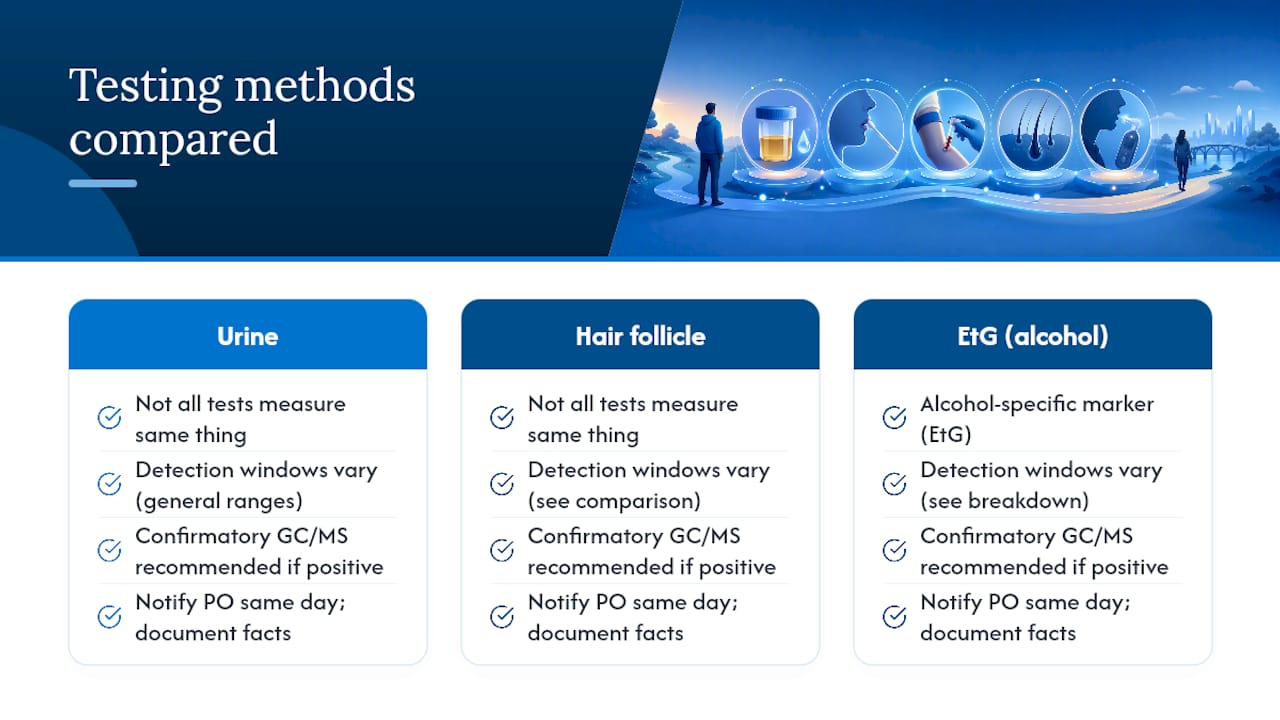
Detection windows vary by substance, dose, and individual metabolism, so treat these as general ranges rather than guarantees, a nuance covered in more depth in this side-by-side comparison of hair follicle and urine testing and this breakdown of EtG detection windows for alcohol.
If a result comes back positive and you believe it is wrong, ask immediately for confirmatory testing (a lab-based GC/MS test, not just an on-site screen) and request documentation of chain of custody. Notify your PO the same day, request a clinical reassessment from your provider, and write down the circumstances while they are fresh. Silence looks worse than a disputed result ever will.
How Courts Respond When Compliance Slips
Most probation systems do not jump straight to revocation over a single missed appointment or one positive test. State standards call for graduated, clinically informed responses to relapse rather than automatic punishment, treating a positive test as a signal for reassessment rather than a verdict, per Massachusetts Standard VIII.
Typical graduated responses, in rough order of severity:
- A verbal or written warning tied to a specific incident.
- Increased supervision intensity, such as more frequent testing or check-ins.
- Escalation to a higher level of care (outpatient to residential, for example).
- A short jail stay, used more as a deterrent than a full revocation.
- Full probation revocation, generally reserved for repeated or serious violations.
Judges weigh several factors before deciding where on that scale to land: how severe the violation was, your criminal history, whether you have documented engagement with treatment, and whether you pose an ongoing public safety risk. National supervision standards push agencies toward evidence-based, collaborative approaches that use treatment engagement and incentives rather than default punishment, according to the APPA. That framing matters practically: a documented relapse response plan, submitted before anything goes wrong, tends to move a judge toward treatment escalation rather than jail.
Daily Habits That Keep You Compliant
Compliance is mostly logistics. Missed appointments cause more violations than actual relapse does, so build habits that make missing one nearly impossible.
- Put every test date, session, and check-in on a shared calendar your PO, sponsor, or family member can also see.
- Line up transportation and stable housing before treatment starts, not after your first missed session.
- Tell your employer only what you need to, but confirm your schedule accommodates required sessions without creating a conflict you’ll have to explain later.
- If you’re going to miss an appointment, notify your PO before it happens, not after, and ask what alternative they want documented.
- Write a relapse plan now, while you’re stable. Name who you call first, what you tell your provider, and where the nearest emergency detox or crisis line is.
Pro Tip: Keep a one-line message template ready for your PO: “I have a scheduling conflict with my [date] session, requesting to reschedule to [date], provider aware.” Sending it before the missed appointment turns a potential violation into a documented, minor adjustment.
How Sylmar Treatment Center Supports Court-Directed Compliance
Sylmar Treatment Center works with clients navigating court-directed placements as a routine part of admissions, not an exception. The center’s six-bed model means individualized treatment plans, and 24/7 admissions support means a clinical assessment does not have to wait days once your PO gives the go-ahead.

Sylmar holds a DHCS license and Joint Commission accreditation, credentials that matter to courts because accredited providers produce documentation judges and probation departments already trust, since licensed facilities operate under recognized certification and compliance standards. Operationally, that means structured ROI coordination and progress reports formatted with the dates, clinical impressions, and participation details that supervision officers expect to see.
Where to Turn for Verified Help and Legal Guidance
Start with Findtreatment, the federal directory for locating licensed treatment providers by location and service type, and the SAMHSA National Helpline for confidential referrals and screening. For the legal side, review U.S. Courts guidance on supervised release conditions directly, and if a compliance dispute escalates, contact your local public defender’s office or a legal aid organization before your next scheduled check-in.
Why Documentation Beats Good Intentions Every Time
Most advice on this topic focuses on staying sober, which is obviously the point. But the advice that actually keeps people out of jail is duller than that: paper. Courts do not revoke probation because someone struggled. They revoke it because someone could not prove what happened, or worse, never told anyone something had changed.
The conventional wisdom treats rehab as a clinical decision between you and a provider. It is not, not while you are on probation. It is a legal transaction that happens to include clinical care. Every step, the assessment, the ROI, the progress report, exists because a court needs to verify something it cannot see directly. Treat those steps as optional and even a genuinely successful recovery can still end in a violation hearing.
If there is one thing to prioritize above all else, it is proactive communication with your PO the moment anything changes, good or bad. A missed session you report yourself reads completely differently than one your PO discovers on a delayed provider report.
— Jim
Get Court-Ready Treatment Without the Guesswork
Finding a provider that understands probation paperwork is half the battle, and most facilities are not built for it. Sylmar Treatment Center is set up specifically to handle court-directed placements, meaning the assessment, the written treatment plan, and the ongoing reporting your PO needs are part of how admissions already work here, not an afterthought bolted on for legal cases.

The six-bed setting means your case does not get lost in a large caseload, and 24/7 admissions support means you can move from PO approval to enrollment without a multi-week wait that risks a scheduling violation. Whether you need medically supervised detox, residential care, or an individualized treatment program built around a dual diagnosis, the clinical team documents everything in the format courts and probation departments already expect to see.
If you have a probation deadline approaching or your PO has requested a treatment plan, review Sylmar’s programs and reach out to admissions today to start the assessment your written plan will be built on.
This article is general information, not a substitute for advice from a qualified doctor. Consult a qualified healthcare professional about your own circumstances before acting on anything here.
Sources
- Chapter 3: Mental Health Treatment (Probation and supervised release conditions) — U.S. Courts
- Mass
- Findtreatment