If someone in your life needs help right now, the fastest path to a bed is this: check the county’s Service & Bed Availability Tool (SBAT) for real-time openings, then call a licensed provider’s 24/7 admissions line while you still have the momentum to make the call. Addiction treatment in Los Angeles moves through two channels: the public system run through Los Angeles County SAPC, and private licensed facilities like Sylmar Treatment Center that take same-day calls and verify insurance on the spot. Both work. Speed matters more than which door you walk through first.
Here’s what to do in the next two hours:
- Check SBAT now for open beds filtered by level of care and county.
- Call a 24/7 admissions line (a county access number or a licensed provider directly) and ask about same-day availability.
- Have insurance information ready (Medi-Cal card or private insurance ID) so the intake coordinator can verify coverage while you’re on the phone.
Quick fact: SBAT was built specifically so families and providers can see live bed counts across Los Angeles County instead of cold-calling a dozen facilities one at a time, according to SBAT’s own program description.
Key Takeaways
Getting into addiction treatment in Los Angeles fastest requires checking SBAT for real-time beds, verifying insurance before transport, and confirming DHCS licensure and accreditation before committing to any program.
| Point | Details |
|---|---|
| Check SBAT first | Filter by level of care and county to see real-time bed availability before calling anyone. |
| Verify insurance before transport | Call your plan or Medi-Cal to confirm network status and covered services ahead of admission. |
| Confirm licensing and accreditation | Ask for a DHCS license number and CARF or Joint Commission accreditation status directly. |
| Match the level of care to the need | Detox for medical withdrawal risk, residential for structure, IOP or outpatient for stable situations. |
| Consider a six-bed licensed option | Sylmar Treatment Center offers DHCS-licensed, Joint Commission accredited care with 24/7 admissions and individualized planning. |
Table of Contents
- How Do You Find Addiction Treatment in Los Angeles Today?
- What Levels of Care Are Available in Los Angeles?
- How Do You Choose a Safe, Licensed Program in Los Angeles?
- What Does Insurance Cover for Addiction Treatment in Los Angeles?
- What Happens During Intake and How Long Does Treatment Take?
- Where Can You Find Local Los Angeles Addiction Resources Right Now?
- Why Consider Sylmar Treatment Center for Licensed Care in Los Angeles?
- Where Sylmar Treatment Center Fits Into Your Search
- Frequently Asked Questions
- Sources
How Do You Find Addiction Treatment in Los Angeles Today?
Finding an open bed today is a mechanical process, not a mystery, once you know the order of operations. Most families waste hours calling facilities randomly instead of using the tools built for exactly this problem. Here’s the sequence that actually works.
- Open SBAT and filter by level of care. Set the filter to the type of bed you need (detox, residential, or outpatient) and the county region closest to you. The tool updates from participating providers, so a bed marked available is genuinely more likely to be open than one you’d guess at from a general directory.
- Cross-reference with Recover LA’s agency directory. SBAT tells you what’s open; Recover LA gives you full contact details and program descriptions so you’re not calling a number with no context.
- Call the facility’s 24/7 admissions line, not a general office number. Licensed residential programs staff admissions around the clock precisely because addiction crises don’t wait for business hours.
- If a program says “waitlist,” ask two follow-up questions immediately: “Do you have a projected opening date?” and “Can you refer me to a partner facility with current availability?” A program worth trusting will answer both without hesitation.
- If county-run options are backed up, call the DHCS SUD County Access Line. These lines exist specifically to reroute callers when the first option they tried is full.
When you call, use a script like this: “I’m calling about immediate admission for [myself/a family member]. Do you have a bed available today or this week? I have [Medi-Cal/private insurance] and can provide details now. What information do you need from me to move forward?” That single script gets you past gatekeeping small talk and straight to a real answer.
Before you pick up the phone, gather these documents so intake doesn’t stall on paperwork:
- Photo ID for the person entering treatment.
- Insurance card (Medi-Cal or private) or, if uninsured, any income documentation for sliding-scale evaluation.
- A list of current medications and dosages.
- Emergency contact information for a family member or friend.
- Any recent medical records related to substance use, if available.
Pro Tip: Call two or three programs in parallel instead of waiting for one callback. Bed availability changes hour to hour, and a program with no answer at 10 a.m. might have an opening by 2 p.m. Treat the first “no” as information, not a dead end.
If every residential option nearby reports a waitlist, don’t stop at “no bed today.” Ask about a short-term medical detox slot as a bridge, since detox units often cycle patients faster than residential programs and can hold someone safely while a residential bed opens elsewhere. County access coordinators reached through the DHCS line are trained to route exactly these cases.
What Levels of Care Are Available in Los Angeles?
Not every situation calls for the same intensity of care, and requesting the wrong level of care is one of the most common reasons families waste hours on the phone. Matching the right level to the right situation up front saves time and gets better outcomes.
Medical detox is for anyone with physical dependence severe enough to cause dangerous withdrawal (alcohol, benzodiazepines, and opioids top this list). It usually lasts several days under 24/7 medical supervision, with medication management to control symptoms and monitor vital signs.
Residential treatment follows detox or serves as the entry point for people who need round-the-clock structure without acute medical risk. Stays typically last several weeks to a few months, combining individual therapy, group work, and psychiatric oversight for anyone with a co-occurring mental health diagnosis.
Partial hospitalization (PHP) offers most of a residential program’s clinical intensity, five to seven days a week, but the patient sleeps elsewhere, whether at home or in sober living. It suits people stepping down from residential care or those with strong support at home who still need heavy clinical contact.
Intensive outpatient (IOP) typically meets three to five days a week for a few hours at a time, letting patients keep working or attending school while getting substantial therapeutic support.
Standard outpatient (OP) is once or twice weekly, usually for aftercare or milder substance use issues that don’t require intensive intervention.
Medication-assisted treatment (MAT) pairs FDA-approved medications like buprenorphine or naltrexone with counseling, primarily for opioid or alcohol use disorder, and can run alongside any of the levels above.
Sober living isn’t clinical treatment. It’s structured, substance-free housing that many people use after residential or PHP to practice independence with accountability still in place, often supported by peer-run models like those described by Social Model Recovery.
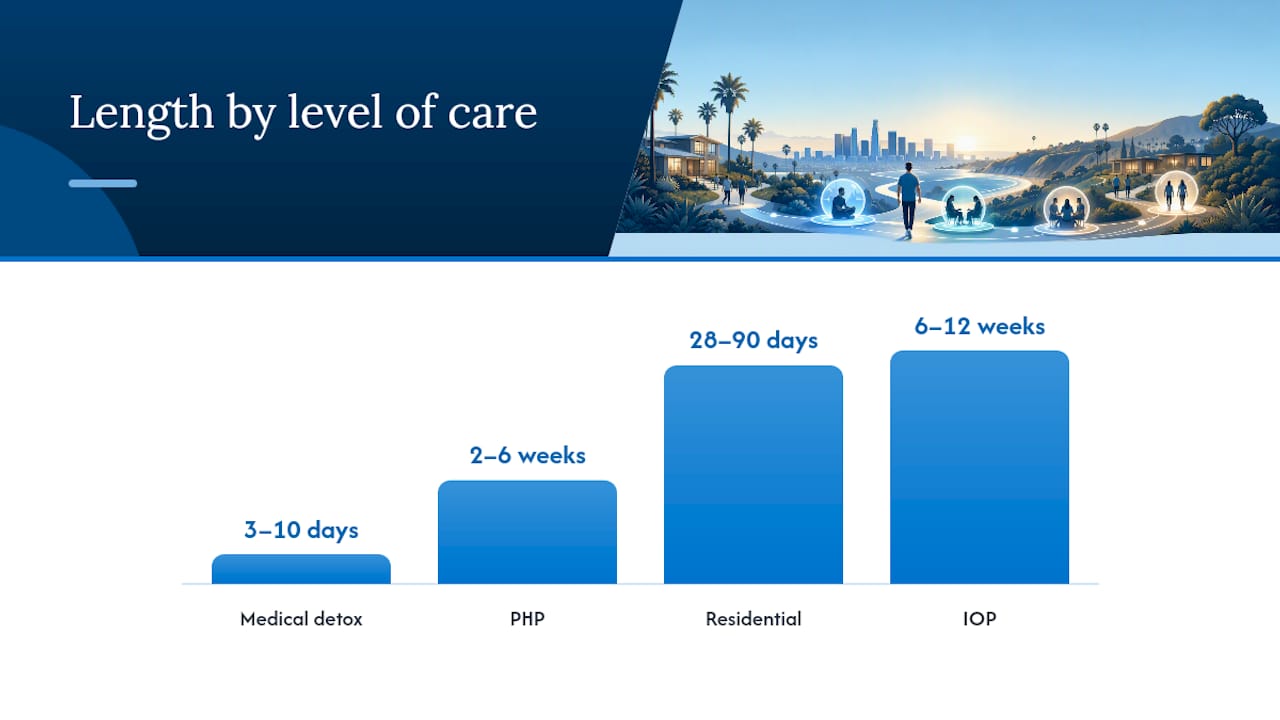
| Level of care | Typical admission trigger | Typical length | Bed availability pattern |
|---|---|---|---|
| Medical detox | Physical dependence, withdrawal risk | 3 to 10 days | Turns over quickly; often has same-day openings |
| Residential | Need for 24/7 structure, high relapse risk | 28 to 90 days | Tighter; wait times vary by facility size |
| PHP | Stepping down from residential, needs daily support | 2 to 6 weeks | Moderate availability |
| IOP | Stable enough for part-time treatment | 6 to 12 weeks | Generally more open slots |
| Outpatient (OP) | Aftercare or mild use disorder | Ongoing, weekly | Widely available |
| MAT | Opioid or alcohol use disorder, medical component | Months to ongoing | Available through many outpatient and residential programs |
Quick self-triage: if there’s a real risk of medical withdrawal, start with detox. If daily life has become unmanageable but withdrawal isn’t the immediate danger, residential or PHP is the right ask. If the person is functioning but struggling, IOP or outpatient with MAT support may be enough.
How Do You Choose a Safe, Licensed Program in Los Angeles?
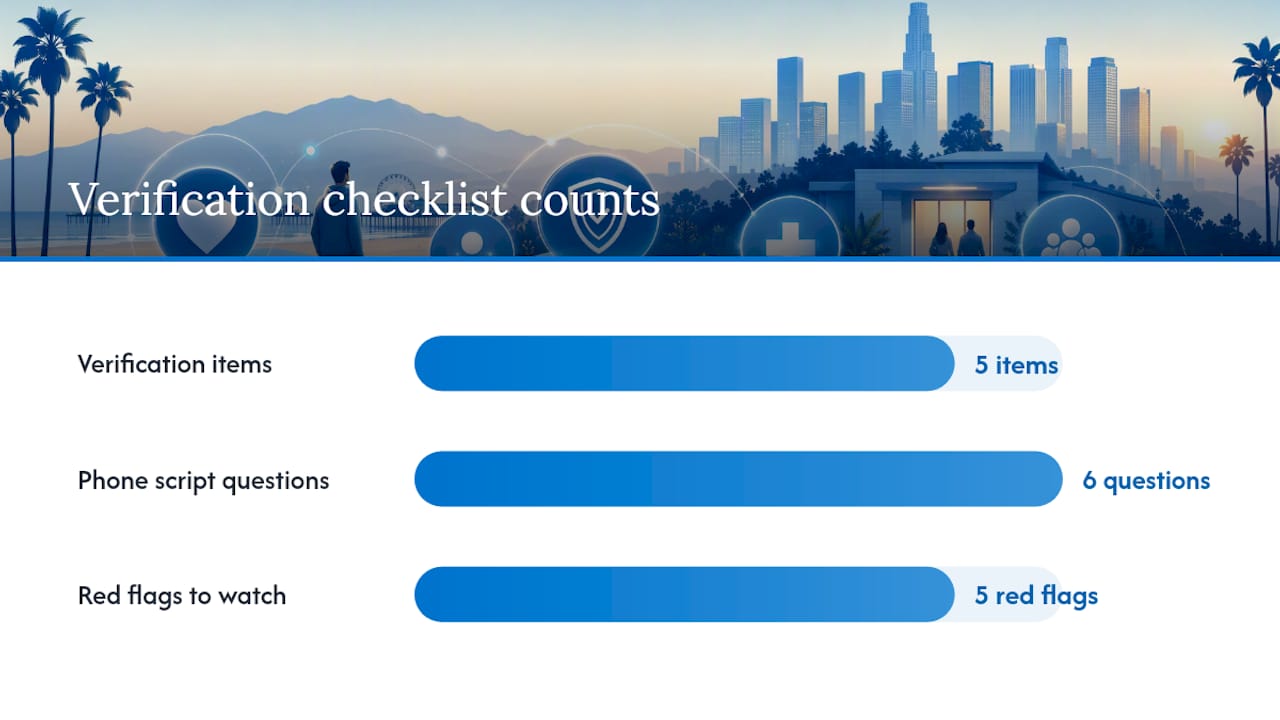
A program’s marketing tells you what it wants you to believe. Its licensing and staffing tell you what’s actually true, and that gap is where families get burned. Before committing to any facility, verify these five things.
Licensure. Every legitimate substance use disorder program in California operates under a DHCS license. Ask for the facility’s license number directly and don’t accept a vague “we’re fully licensed” as an answer.
Accreditation. DHCS licensure is the floor, not the ceiling. Look for accreditation from CARF International or the Joint Commission, both of which require programs to meet independently audited clinical and safety standards beyond the state minimum.
Medical staffing. Ask directly: is there a physician or psychiatric nurse practitioner on staff, and is a registered nurse present during detox? A program treating alcohol or benzodiazepine withdrawal without visible medical staffing is a serious red flag.
Dual-diagnosis capability. A large share of people entering treatment also carry an underlying mental health diagnosis, whether depression, anxiety, PTSD, or bipolar disorder. A program that can’t name its approach to co-occurring conditions isn’t equipped to treat the whole picture.
Discharge and aftercare planning. Ask what happens on day one after discharge. A program that can’t describe a concrete aftercare plan, whether that’s IOP referral, sober living placement, or MAT follow-up, is setting patients up to relapse within weeks.
Use this phone script during your first call to any admissions office:
- “What is your DHCS license number?”
- “Are you CARF or Joint Commission accredited?”
- “Who provides medical oversight during detox, and is a nurse on-site 24/7?”
- “How do you handle co-occurring mental health conditions?”
- “What does aftercare planning look like before I leave?”
- “What’s your estimated length of stay for my situation?”
Watch for these red flags, all of which should end the call:
- Guarantees of a “cure” or permanent sobriety. No ethical program makes that promise.
- Refusal to provide a license number or accreditation status when asked directly.
- Demands for large upfront cash payments before any insurance verification.
- Vague or evasive answers about who provides medical supervision.
- Pressure tactics urging you to commit before you’ve had time to think.
Pro Tip: Don’t take a facility’s word for its own accreditation. CARF maintains a public accredited-provider search, and you can verify DHCS licensure through the state’s own database in under five minutes. If a program hesitates when you mention you’re going to check, that hesitation is the answer.
Verification takes fifteen minutes and it’s the fifteen minutes that protects you from months of wasted time and money at a facility that can’t actually deliver what it promises. Los Angeles County SAPC also maintains provider standards you can cross-check against any facility claiming county affiliation.
What Does Insurance Cover for Addiction Treatment in Los Angeles?
Coverage depends entirely on your plan and the level of care, so the single most important thing you can do before admission is verify benefits by phone, not assume based on what a friend’s insurance covered. Here’s how that verification actually works.
If you have Medi-Cal, substance use disorder services are covered, but access typically runs through your county’s managed care system. If you’re an L.A. Care member, the plan’s own guidance recommends confirming a facility is in-network before admission, since out-of-network SUD claims can be denied or leave you with unexpected costs. Call L.A. Care’s member services line, give them the facility name, and ask them to confirm network status and which specific services (detox, residential, outpatient) are covered under your plan.
If you have private insurance, call the member services number on the back of your card and ask three specific questions: Is this facility in-network? Does my plan require pre-authorization for detox or residential admission? What’s my deductible and coinsurance responsibility for substance use treatment specifically? Insurance plans often cover detox and residential care differently, so don’t assume approval for one means approval for the other.
If you’re uninsured or facing a coverage gap, ask directly about sliding-scale fees or financing options. Many licensed programs, including community-based providers like L.A. CADA, work with major insurance companies and can walk you through what’s realistically affordable.
Cost reality check: private-pay residential treatment in Los Angeles commonly runs into the thousands of dollars per month depending on the facility and length of stay, while Medi-Cal-covered SUD services carry little to no out-of-pocket cost for eligible members. The gap between those two numbers is exactly why insurance verification before admission, not after, matters so much.
Have this ready before you call for verification:
- Insurance card (front and back) or Medi-Cal beneficiary ID.
- The exact facility name and its NPI or Tax ID number if the facility can provide it.
- A clear statement of the level of care being requested (detox, residential, outpatient).
- For court-directed placements, any paperwork from the referring court or probation officer, since these often require specific documentation to authorize funding quickly.
What Happens During Intake and How Long Does Treatment Take?
The path from first phone call to actually walking through a facility’s door usually moves faster than people expect, but each step has its own timeline worth knowing in advance.
Phase one: initial call and pre-screening (same day). The admissions coordinator asks about substance use history, current symptoms, and insurance, then gives a preliminary assessment of appropriate level of care.
Phase two: medical clearance and transport (same day to 48 hours). For anyone entering medical detox, a nurse or physician reviews vitals and health history before admission is finalized. Some programs coordinate transport for patients unable to drive themselves safely.
Phase three: the first 72 hours. This is where formal intake happens: full psychiatric and medical assessment, medication reconciliation, and the start of an individualized treatment plan. For alcohol or benzodiazepine detox specifically, this window is also when withdrawal symptoms peak and medical monitoring matters most.
Detox duration varies by substance. Alcohol and benzodiazepine withdrawal typically requires five to seven days of medical monitoring due to seizure risk. Opioid detox often runs three to seven days depending on the substance and dosage history. Stimulant withdrawal (including methamphetamine) is less medically dangerous but often involves several days of intense fatigue and psychiatric symptoms that still benefit from supervised care.
Once medical needs stabilize, the program shifts into its core structure:
- Comprehensive biopsychosocial assessment within the first 48 to 72 hours.
- Individualized treatment plan built around the assessment, covering therapy modalities, medication needs, and any dual-diagnosis treatment.
- Daily programming: individual therapy, group sessions, and psychiatric check-ins as needed.
- Discharge planning starting well before the actual discharge date, not the day of.
Aftercare typically points toward IOP, standard outpatient therapy, continued MAT if applicable, or sober living, and the specific combination depends on what the treatment team identifies during the stay.
Where Can You Find Local Los Angeles Addiction Resources Right Now?
A handful of tools cover almost every scenario you’ll run into, and knowing which one to use for which problem saves real time.
- Los Angeles County SAPC: the county body overseeing SUD treatment standards. Use it to check whether a provider is properly recognized within the county system.
- Recover LA: a directory of licensed agencies with contact details, useful once SBAT shows you what’s open and you need to actually reach someone.
- DHCS SUD County Access Lines: statewide access lines that route callers to available county-funded treatment when local options are backed up.
- L.A. CADA: a long-standing local provider that works with most major insurance carriers, useful as a direct call option alongside SBAT results.
When using SBAT, set filters for level of care and county region first, since an unfiltered search returns every facility type and buries the beds you actually need. A status marked “available” means the facility reported an open bed as of its last update, while “waitlist” or “full” means you should move to your next option immediately rather than waiting on hold.
Pro Tip: Call admissions lines in the late morning, between roughly 10 a.m. and noon. Overnight discharges and early-morning bed reassessments mean facilities often have their clearest picture of same-day openings by mid-morning, before the day’s new admission requests start competing for those same slots.
Why Consider Sylmar Treatment Center for Licensed Care in Los Angeles?
Sylmar Treatment Center is DHCS licensed and Joint Commission accredited, which means it meets both the state’s baseline regulatory requirement and an independently audited clinical standard. That combination is exactly what the verification checklist above tells you to look for, and it’s worth confirming directly rather than taking any facility’s word for it, including this one.
What sets the model apart is scale: Sylmar operates as a six-bed facility, not a two-hundred-bed campus. That means every patient gets a fully individualized care plan instead of a standardized track, and staff can build genuine working relationships with each person in treatment rather than managing a caseload that turns over faster than anyone can build trust.
Core services include:
- Medically supervised detox with psychiatric and medical oversight.
- Residential addiction treatment in a small, structured setting.
- Dual-diagnosis support for co-occurring mental health and substance use disorders.
- Medication management under psychiatric supervision.
- Court-directed placements for individuals with legal requirements tied to treatment.
- Specialized care for emerging substances, including evolving methamphetamine and synthetic drug use patterns seen across Los Angeles.
The intimacy of a six-bed setting isn’t a limitation. It’s the entire point: comprehensive assessments and custom care plans work best when staff genuinely know the person they’re treating, not just the diagnosis on the intake form.
Admissions support runs 24/7, so families facing a same-day crisis can call and get a real answer about bed availability and next steps without waiting for standard business hours.
Practical advice for families placing a loved one
Speed gets someone into a bed. Fit is what keeps them there. I’ve seen families treat these as the same goal, and they’re not: the fastest available program isn’t automatically the right one, so run the verification checklist even when you’re moving fast.
A few things that matter more than people expect. Have one calm family member stay with the patient through intake, since paperwork and assessments take longer than anyone wants and someone needs to hold steady. Arrange transportation in advance rather than scrambling once a bed opens. And keep insurance cards, ID, and medication lists in one folder, because you will need them more than once.
Pro Tip: Ask about aftercare planning on day one, not week three. Programs that build discharge planning into the very start of treatment consistently produce steadier transitions than ones that scramble at the end.
Where Sylmar Treatment Center Fits Into Your Search
If you’ve been working through SBAT listings and county directories looking for a licensed option with real medical oversight and no waitlist runaround, Sylmar Treatment Center is built for exactly that search. The six-bed model means you’re not competing with dozens of other admissions for staff attention, and every intake starts with a full assessment rather than a generic checklist.
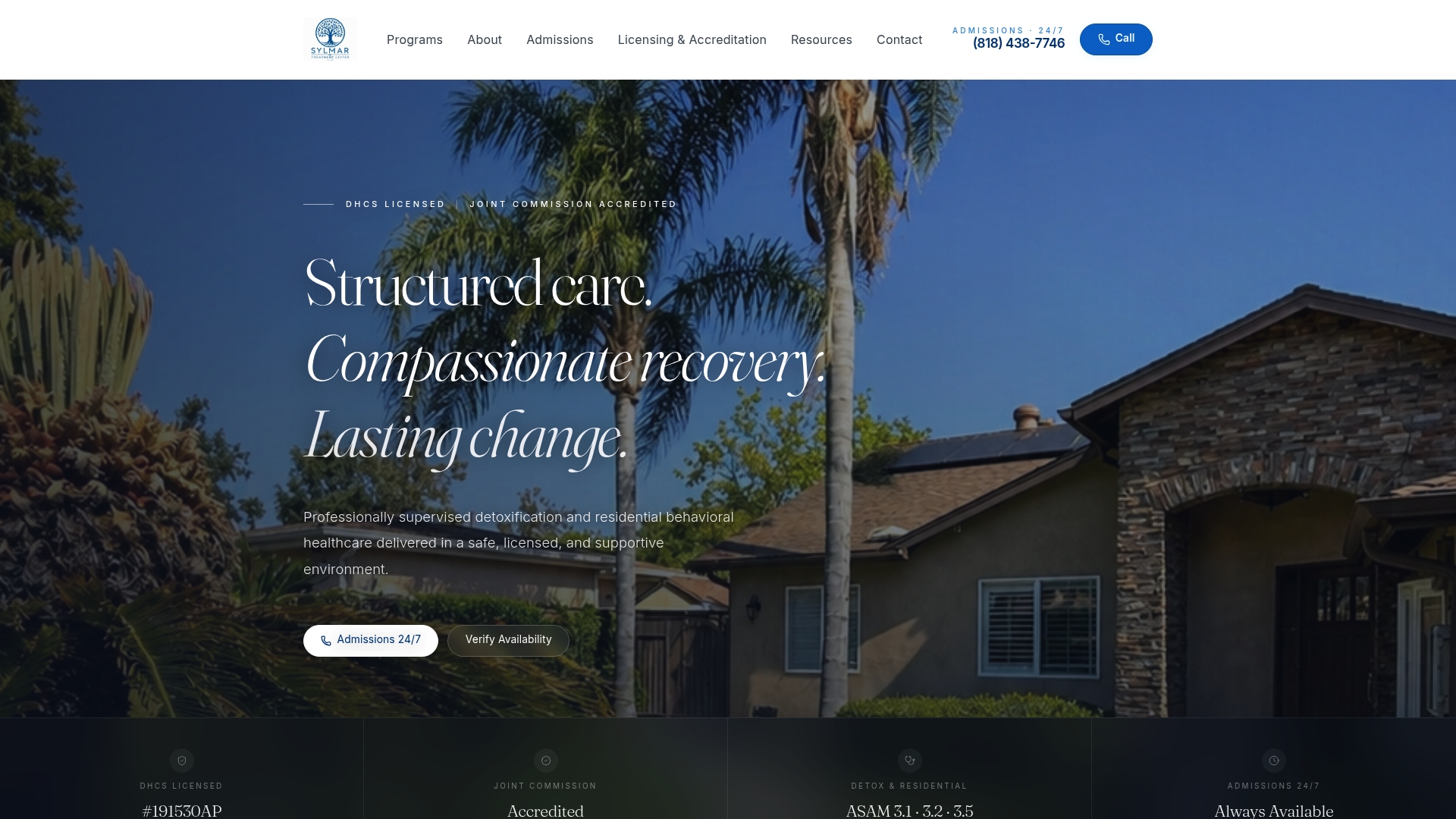
Sylmar handles medically supervised detox, residential treatment, and dual-diagnosis care under one roof, with psychiatric oversight built into the treatment programs rather than bolted on as an afterthought. Families dealing with a court-directed placement can also work directly with admissions on the documentation those cases require. If you’re evaluating residential treatment options today, call Sylmar’s 24/7 admissions line, verify your insurance on that same call, and ask what same-day availability looks like. That one call answers more questions than an afternoon of research.
Frequently Asked Questions
How do I find addiction treatment in Los Angeles the same day I need it? Start with SBAT to see real-time bed availability, then call the 24/7 admissions line of any facility showing an open bed. Most licensed programs, including Sylmar Treatment Center, can complete phone intake and insurance verification within the same call.
What’s the difference between meth addiction treatment and treatment for opioid or alcohol use disorder? Methamphetamine withdrawal isn’t typically medically dangerous the way alcohol or benzodiazepine withdrawal can be, but it often involves intense fatigue, depression, and psychiatric symptoms that benefit from supervised residential care. Meth rehab in Los Angeles programs often emphasize behavioral therapy and dual-diagnosis support more heavily than medication-based withdrawal management.
Does Medi-Cal cover residential addiction treatment in Los Angeles? Yes, Medi-Cal covers substance use disorder services, but access usually runs through your county’s managed care plan. L.A. Care members should confirm a facility is in-network before admission to avoid coverage denials.
How long does inpatient treatment typically last? Residential inpatient stays commonly run 28 to 90 days depending on clinical need, while medical detox alone typically lasts three to ten days depending on the substance involved.
What should I check before choosing a substance abuse rehab in LA? Verify DHCS licensure, ask about CARF or Joint Commission accreditation, confirm medical staffing during detox, and ask specifically how the program handles co-occurring mental health conditions before committing.
What if every program I call has a waitlist? Call the DHCS SUD County Access Line for rerouting to available county-funded options, and ask about short-term detox beds as a bridge while a residential slot opens elsewhere.
Can Sylmar Treatment Center handle court-directed placements? Yes. Sylmar Treatment Center accepts court-directed placements and works directly with admissions staff to process the documentation those cases typically require, alongside its standard detox and residential programs.
This article is general information, not a substitute for advice from a qualified doctor. Consult a qualified healthcare professional about your own circumstances before acting on anything here.
Sources
- Los Angeles County SAPC
- DHCS — SUD County Access Lines
- L.A. Care — Substance Use Disorder (SUD) Treatment Services
- Recover LA — Agencies
Recommended
- Integrated Chronic Pain and Addiction Treatment: A Complete Guide | Sylmar Treatment Center
- Inpatient vs. Outpatient Detox Options: A Safety Guide | Sylmar Treatment Center
- Choosing Residential Addiction Treatment: A Family Guide | Sylmar Treatment Center
- How Detox Prepares Patients for Rehab: 2026 Guide | Sylmar Treatment Center