
Residential addiction treatment, also called inpatient rehab, is defined as a live-in clinical program that provides 24-hour supervised care for substance use disorders and co-occurring mental health conditions. The decision to enter residential care is one of the most consequential choices a family or individual will make in the recovery process. Choosing residential addiction treatment means matching a person’s clinical severity to a program that delivers the right therapies, staffing, and structure. Accreditation bodies like the Joint Commission and CARF set the quality benchmarks that separate effective programs from inadequate ones. Programs that follow the American Society of Addiction Medicine (ASAM) Patient Placement Criteria give families a reliable, evidence-based framework for that match.
How do you know if residential addiction treatment is the right level of care?
Residential care is indicated when outpatient treatment has failed, the home environment is unsafe, or addiction and mental health disorders require simultaneous stabilization. That last point matters more than most families realize. A person managing severe depression alongside opioid dependence cannot stabilize in a weekly outpatient group. They need round-the-clock clinical support.
The ASAM Patient Placement Criteria use six dimensions to assess whether someone needs residential care. Those dimensions include withdrawal risk, medical conditions, emotional and behavioral conditions, readiness to change, relapse potential, and the recovery environment. A program that cannot explain how it uses ASAM multidimensional assessment to match patients to levels of care is not following current evidence-based standards. That is a red flag worth acting on.
Specific indicators that point toward residential care include:
- A history of multiple relapses after outpatient treatment
- Active withdrawal risk requiring medical monitoring
- A home environment with active substance use or trauma
- A co-occurring psychiatric disorder requiring daily clinical management
- Lack of a stable support network for outpatient accountability
Medical detox often precedes residential admission, particularly when withdrawal symptoms or co-occurring conditions pose physical risk. Detox alone is not treatment. It is the stabilization phase that makes residential care safe to begin.
Pro Tip: Before calling any treatment center, write down the person’s full substance use history, any psychiatric diagnoses, previous treatment attempts, and current medications. This preparation shortens the clinical intake process and helps staff assign the right level of care from day one.
What makes a high-quality residential addiction treatment program?
Program quality is not a feeling. It is measurable through credentials, staffing ratios, therapy types, and aftercare structure. Families evaluating residential rehab options should use these concrete markers rather than relying on facility aesthetics or marketing language.

Accreditation and licensing
Joint Commission or CARF accreditation signals that a program meets national clinical and safety standards. State licensing from a body like California’s Department of Health Care Services (DHCS) is the legal floor. Accreditation is the quality ceiling. Both matter. A program holding only a state license has cleared a lower bar than one that is also Joint Commission accredited.
Clinical staffing ratios and credentials
A client-to-staff ratio of 1:6 or better during clinical hours is the recommended standard for adequate individual attention in early stabilization. That ratio is not just a number. It determines whether a counselor can respond to a crisis, conduct a meaningful session, or notice a patient deteriorating. Licensed clinicians, including LMFTs, LCSWs, and PhD-level psychologists, should outnumber peer support staff in any program treating acute clinical presentations. An on-site medical director directly impacts patient safety during medically complex admissions.
Evidence-based therapies
The National Institute on Drug Abuse identifies cognitive behavioral therapy (CBT), motivational interviewing (MI), and contingency management as the most effective therapies for addiction treatment. Programs should be able to name which therapies they use, how frequently sessions occur, and which clinicians deliver them. Trauma-focused approaches like EMDR or Seeking Safety are additional markers of clinical depth, particularly for patients with trauma histories.
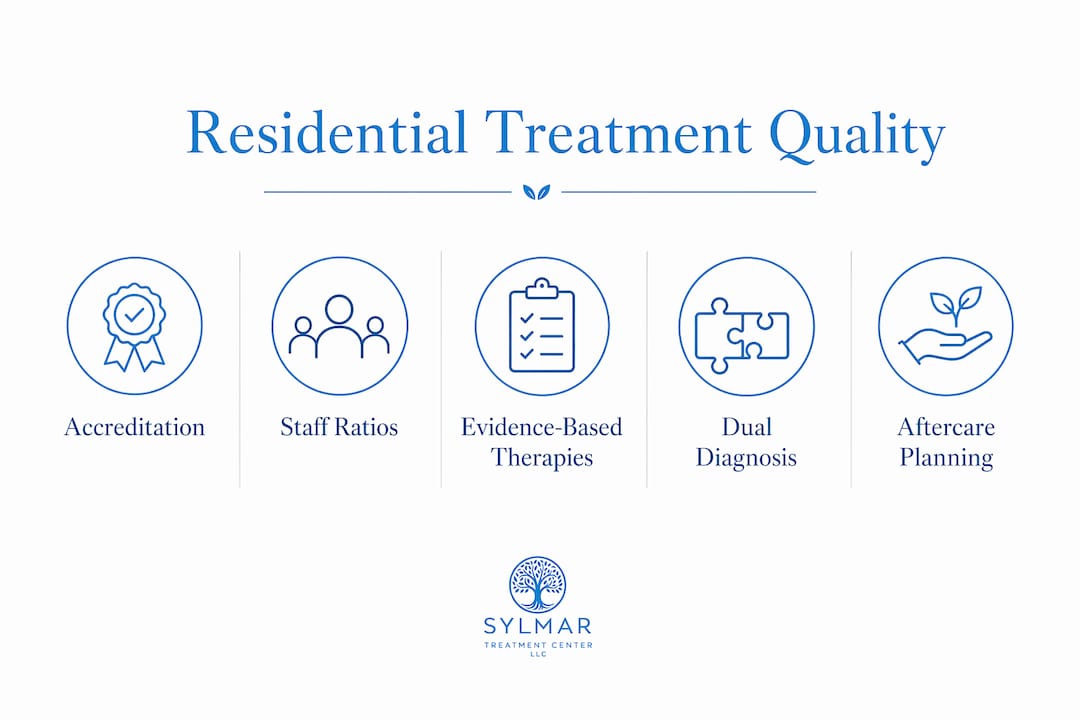
| Quality Marker | What to Look For |
|---|---|
| Accreditation | Joint Commission or CARF certification |
| Staffing ratio | 1:6 client-to-staff or better during clinical hours |
| Therapy types | CBT, MI, contingency management, trauma-focused options |
| Co-occurring care | Simultaneous psychiatric and addiction treatment on-site |
| Aftercare planning | Alumni support, step-down referrals, outpatient coordination |
Treating co-occurring disorders simultaneously is the modern clinical standard. Programs that address addiction first and defer mental health care create a gap that relapse fills. Strong programs also build aftercare into the treatment plan from day one, including alumni groups, step-down clinical contact, and referrals to outpatient providers.
Pro Tip: Ask directly: “What happens if a patient relapses during treatment?” Programs with zero-tolerance discharge policies can trigger shame and worsen outcomes. A compassionate relapse policy that keeps the patient engaged in care is a sign of clinical maturity.
What should you expect during residential treatment?
Residential treatment follows a structured daily schedule designed to replace the chaos of active addiction with predictable, therapeutic routine. A typical day includes individual therapy, group therapy, psychoeducation sessions, medication management if indicated, and structured downtime. That structure is therapeutic in itself. It rebuilds the capacity for routine that addiction erodes.
Individual therapy sessions address personal trauma, cognitive distortions, and relapse triggers. Group therapy builds social accountability and reduces the isolation that fuels substance use. The two formats work together rather than substituting for each other. Programs that rely heavily on group sessions while limiting individual therapy hours are cutting costs at the patient’s expense.
Residential rehab typically lasts 28–90 days, with longer or flexible lengths recommended for severe cases. Thirty days is often insufficient for lasting recovery in complex presentations. Program length should adapt based on clinical progress, not a fixed calendar. Ask any program you evaluate whether they extend stays based on clinical need or discharge on a fixed schedule regardless of patient status.
| Treatment Component | Clinical Purpose |
|---|---|
| Individual therapy (CBT, MI) | Addresses personal triggers, cognitive patterns, and trauma |
| Group therapy | Builds peer accountability and reduces isolation |
| Medication management | Stabilizes co-occurring conditions and manages cravings |
| Trauma-focused therapy (EMDR) | Processes underlying trauma driving substance use |
| Step-down planning | Reduces relapse risk after residential discharge |
Most relapses in early recovery occur soon after residential discharge. Structured step-down care, including partial hospitalization or intensive outpatient programs, directly reduces that risk. A residential program that discharges patients without a confirmed step-down plan is leaving the most dangerous transition unmanaged. Look for programs that coordinate directly with outpatient providers rather than handing patients a referral list and wishing them well.
Pro Tip: During the admissions call, ask to speak with a licensed clinician, not just an admissions coordinator. A clinician can explain the specific therapies used, how co-occurring disorders are treated, and what the step-down plan looks like. That conversation tells you more about program quality than any brochure.
What questions should families ask when selecting a treatment center?
The right questions cut through marketing language and reveal clinical reality. Families and individuals evaluating the best addiction treatment centers should ask directly and expect specific answers.
- What accreditations and licenses does the program hold?
- What is the client-to-licensed-clinician ratio during clinical hours?
- Is there a medical director on-site, and what are their hours of coverage?
- How are co-occurring mental health disorders treated, and by whom?
- Which evidence-based therapies are used, and how frequently do sessions occur?
- What is the program’s policy if a patient relapses during treatment?
- How is aftercare planned, and does the program coordinate with outpatient providers?
- What insurance plans are accepted, and what payment options exist?
Beyond these questions, families should ask about their own role in treatment. Programs that include family therapy sessions and maintain clear communication policies produce better outcomes than those that treat family involvement as optional. Ask specifically whether family sessions are included in the program or billed separately.
- Confirm the program uses ASAM criteria to guide placement decisions
- Ask whether the program offers integrated treatment planning for mental health and addiction together
- Clarify the discharge process and what happens if clinical progress is slower than expected
- Understand the program’s approach to medication-assisted treatment if relevant
Pro Tip: Request a tour or a virtual walkthrough before committing. The physical environment, staff interactions you observe, and how staff answer unscripted questions tell you more than a scheduled intake call.
Key takeaways
Selecting the right residential addiction treatment program requires matching clinical severity to program quality, not choosing based on cost, location, or aesthetics alone.
| Point | Details |
|---|---|
| Use ASAM criteria | Clinical assessment, not convenience, should determine the level of care needed. |
| Verify accreditation | Joint Commission or CARF accreditation confirms a program meets national quality standards. |
| Check staffing ratios | A 1:6 client-to-staff ratio or better during clinical hours is the recommended benchmark. |
| Demand integrated care | Programs must treat co-occurring mental health disorders alongside addiction simultaneously. |
| Confirm aftercare planning | Step-down care and outpatient coordination reduce relapse risk after residential discharge. |
What I’ve learned about choosing treatment that most families miss
Families almost always focus on the wrong variables first. They ask about amenities, location, and cost before asking about clinical staffing or how co-occurring disorders are managed. I understand why. Those questions feel safer. But they are the wrong starting point.
The single most predictive factor in treatment outcomes is whether the program treats mental health and addiction at the same time, with licensed clinicians who specialize in both. A beautiful facility with a poor therapist-to-patient ratio will underperform a modest program with a strong clinical team every time. I have seen families choose programs based on proximity to home and watch their loved one relapse within weeks of discharge because the program had no real aftercare structure.
The other thing families consistently underestimate is the relapse policy. A zero-tolerance discharge policy does not protect the patient. It punishes them for having a chronic illness. Programs with compassionate, clinically grounded responses to relapse keep patients engaged in care rather than sending them home in crisis. That distinction has real consequences for long-term recovery.
Fixed-length programs are another misconception worth addressing. Thirty days became an industry norm because of insurance reimbursement cycles, not clinical evidence. Severe addiction with co-occurring disorders rarely stabilizes in thirty days. Ask any program you consider whether they extend stays based on clinical progress. If the answer is no, that tells you something important about their priorities.
— Jim
How Sylmartreatmentcenter supports personalized residential care
Sylmartreatmentcenter holds both DHCS licensure and Joint Commission accreditation, placing it among the best addiction treatment centers in California by verified quality standards. The center’s six-bed setting means every patient receives a custom care plan built from a thorough clinical assessment, not a generic program template. Licensed clinical staff address addiction and co-occurring mental health disorders together, with medical detox available for patients who need safe stabilization before residential care begins.
Sylmartreatmentcenter offers dual diagnosis support alongside its residential program, with aftercare planning built into every treatment plan from admission. The center’s 24/7 admissions line means families can get clinical guidance at any hour. Explore the full range of treatment programs or call to speak with a licensed clinician about the right level of care for your situation.
FAQ
What is residential addiction treatment?
Residential addiction treatment is a live-in clinical program providing 24-hour supervised care for substance use disorders and co-occurring mental health conditions. Patients live at the facility for the duration of treatment, typically 28–90 days.
How do I know if residential or outpatient care is right?
ASAM Patient Placement Criteria guide this decision based on withdrawal risk, psychiatric stability, relapse history, and home environment. Residential care is indicated when outpatient treatment has failed or the home environment is unsafe.
What therapies should a quality residential program offer?
Evidence-based programs use CBT, motivational interviewing, and contingency management as core therapies. Trauma-focused options like EMDR or Seeking Safety are additional markers of clinical depth.
Why does aftercare matter so much after residential treatment?
Most relapses occur shortly after residential discharge, making structured step-down care critical. Programs that coordinate directly with outpatient providers reduce that transition risk significantly.
What should I ask about a program’s relapse policy?
Ask what happens clinically if a patient relapses during treatment. Programs with compassionate, clinically grounded responses produce better long-term outcomes than those with zero-tolerance discharge policies.