
ADHD raises the risk of substance use and substance use disorders by roughly two to three times the general population rate, and the pattern tends to start earlier and escalate faster than it does in people without ADHD. Shared dopamine circuitry, weak impulse control, and years of untreated executive dysfunction all push in the same direction. Among people already in treatment for a substance use disorder, about 23% meet diagnostic criteria for ADHD under DSM-5 standards, a number both CHADD and NIDA cite when urging clinicians to screen for ADHD in addiction settings rather than assume it away.
The clinical takeaway is straightforward, even if the details get complicated fast: screening for both conditions at intake, and treating them together instead of sequentially, produces better outcomes than treating either one alone.
- ADHD increases SUD risk 2 to 3 times over baseline, with earlier onset of use and quicker progression to dependence.
- Roughly 23% of people in treatment for substance use disorders also have ADHD, a rate far above the general population.
- Stimulant medication, when properly monitored, does not raise population-level SUD risk and may lower it in some cases.
Key Takeaways
Effective care for co-occurring ADHD and substance use requires simultaneous screening, individualized medication risk assessment, and coordinated psychosocial treatment rather than sequential, siloed care.
| Point | Details |
|---|---|
| Elevated risk is well-documented | ADHD raises SUD risk roughly 2 to 3 times over baseline, with earlier onset and faster progression. |
| Shared dopamine circuitry drives both | Mesolimbic and mesocortical hypofunction underlies impulsivity, reward-seeking, and substance use vulnerability. |
| Stimulants are not the enemy | Properly monitored stimulant treatment does not raise population-level SUD risk and may reduce some substance use. |
| Screening needs a staged approach | Tools like the ASRS help but require collateral history and, where possible, a period of stabilization first. |
| Integrated care outperforms siloed treatment | Sylmar Treatment Center combines psychiatric medication management with addiction treatment in one six-bed, accredited program. |
Table of Contents
- How Common Is Co-Occurring ADHD and Substance Use?
- Why ADHD and Addiction Share the Same Wiring
- Which Substances Are Most Common in ADHD, and Why
- Why ADHD Gets Missed in People Who Use Substances
- What Treatment Looks Like for Co-Occurring ADHD and Addiction
- What the Evidence Says About Prescribing Stimulants
- Getting the Sequencing Right: Consensus Guidance for Clinicians
- What Happens Long-Term, and How to Lower the Risk Now
- What to Do Next if You Suspect Both Conditions
- The Clinical Stance Behind Integrated Care
- Getting Integrated Care for ADHD and Addiction
- Frequently Asked Questions
- Sources
How Common Is Co-Occurring ADHD and Substance Use?
Prevalence estimates vary by study design, but the direction never wavers: childhood ADHD predicts a measurably higher chance of substance use and SUD later in life. Reviews cited by NIDA put concurrent SUD in adolescents and young adults with ADHD at roughly 15%, well above rates seen in peers without the diagnosis. In clinical addiction populations, that number climbs. Around 23% of people seeking treatment for a substance use disorder also meet criteria for ADHD, a figure drawn from expert consensus work published through PMC.
A few caveats matter here. Treatment-seeking samples skew toward more severe cases, so population-wide numbers likely sit lower. Study methods also differ on how they define “concurrent” use versus a full SUD diagnosis.
- Childhood ADHD is linked to earlier first use of alcohol, nicotine, and cannabis.
- Progression from casual use to dependence tends to happen faster in people with ADHD.
- Treatment-seeking samples show higher comorbidity rates than general population surveys, which inflates some published figures.
Why ADHD and Addiction Share the Same Wiring
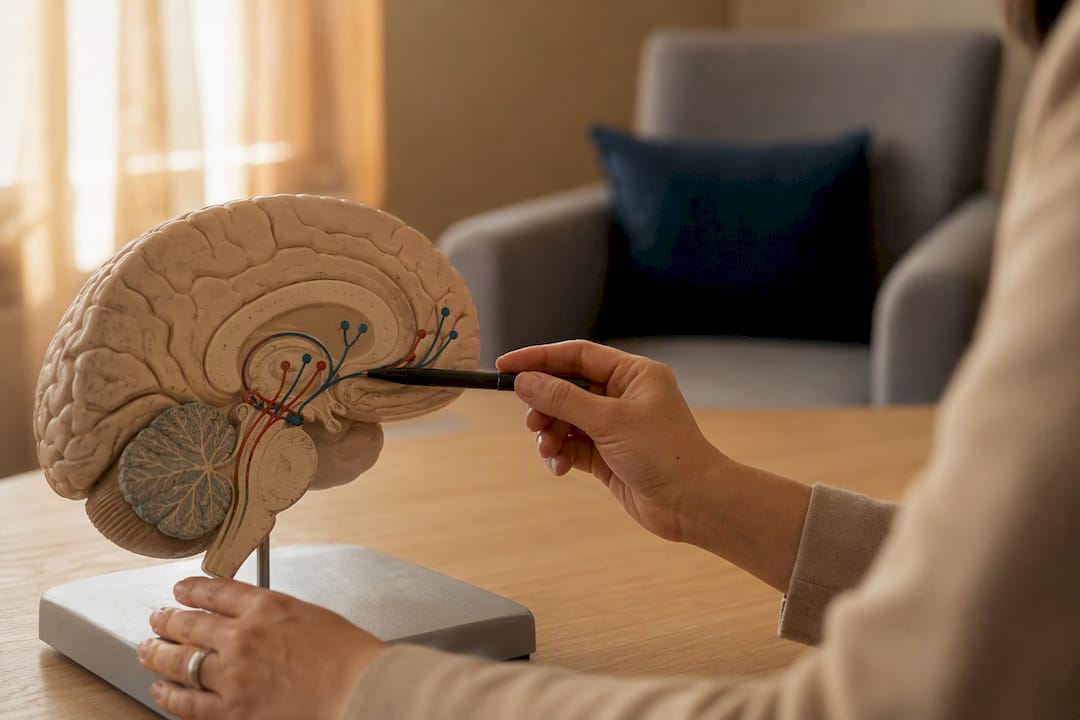
The overlap between ADHD and substance use disorder is not incidental. Both conditions trace back to overlapping trouble in the brain’s reward system, specifically hypofunction in the mesolimbic and mesocortical dopamine pathways. When these circuits under-respond to everyday rewards, the brain seeks stronger, faster hits of stimulation. That’s a mechanism PMC’s review of stimulant treatment and SUD describes as a shared vulnerability rather than two separate problems that happen to coincide.
Genetics load the dice further. Family and twin studies point to overlapping heritability between ADHD and addiction risk, often expressed through temperament traits like sensation seeking and novelty seeking, traits that show up in ADHD long before any substance enters the picture.
Behaviorally, this plays out through three connected pathways:
- Impulsivity drives quicker, less considered decisions to use substances and less capacity to stop once started.
- Emotional dysregulation makes substances feel like a fast way to smooth out mood swings that ADHD makes harder to manage.
- Self-medication shows up when people use stimulants, nicotine, or even cannabis to compensate for untreated attention and focus problems.
Treating the underlying dopamine dysfunction directly, rather than only addressing the substance use, is part of why integrated care outperforms treating each condition in isolation.
Which Substances Are Most Common in ADHD, and Why
Alcohol and nicotine top the list for people with ADHD, largely because they’re the most accessible substances and the easiest to use in a way that feels like self-medication. Cannabis follows closely as the most commonly used illicit drug in this population, and stimulants including cocaine and prescription amphetamines show up more often in some adult samples than in the general population, according to expert consensus findings.
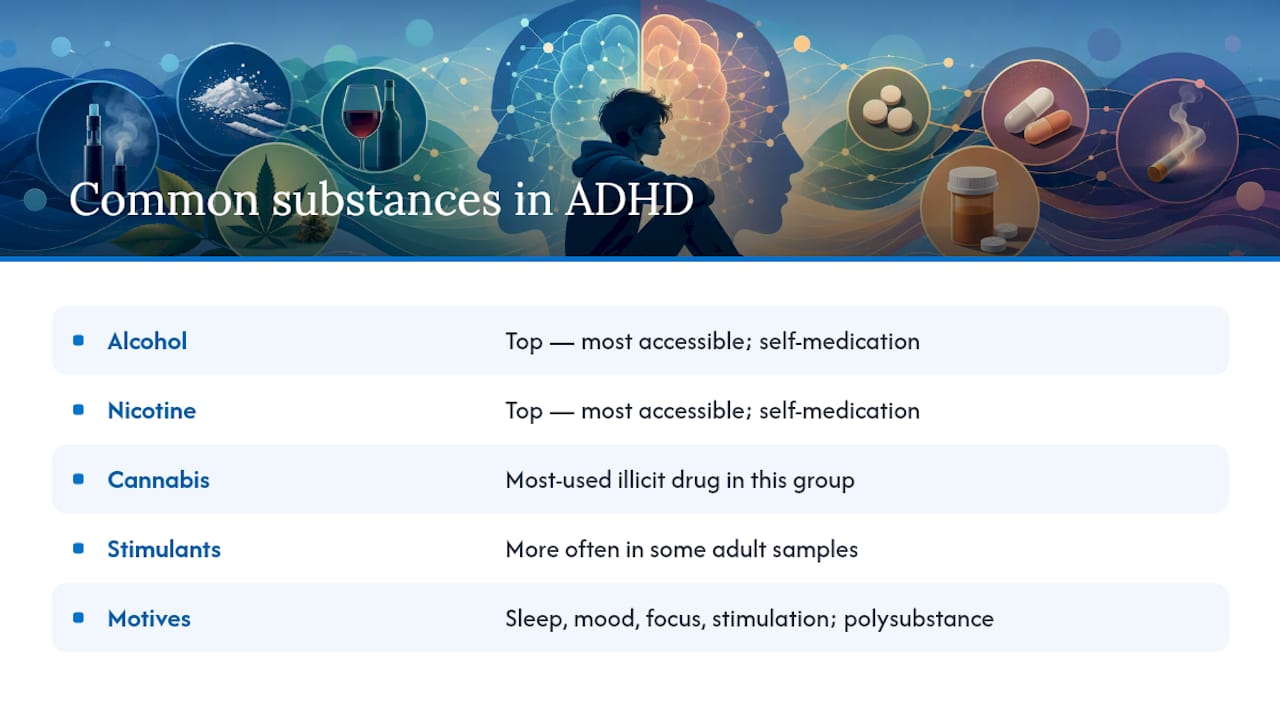
Motives cluster around a few recurring themes: better sleep, calmer mood, sharper focus, or simply more stimulation when the brain feels understimulated. Polysubstance use is common rather than exceptional, since people often combine substances to cover multiple symptoms at once.
Pro Tip: College-aged adults and people in shared or communal living situations report the highest rates of stimulant misuse, often because prescription stimulants circulate informally among peers. If you’re managing ADHD medication in that environment, dispensing controls matter more than usual.
Why ADHD Gets Missed in People Who Use Substances
Diagnosing ADHD accurately while someone is actively using substances is genuinely hard, and that difficulty causes real harm when it goes unacknowledged. Intoxication and withdrawal both mimic ADHD symptoms almost exactly: restlessness, poor concentration, irritability, and disorganized thinking show up in both conditions, which produces false positives during active use and false negatives once someone is in early recovery and exhausted.
Self-reported history also becomes less reliable during active substance use, which complicates the standard diagnostic interview. The Adult ADHD Self-Report Scale (ASRS) can help identify candidates for further evaluation, but its specificity drops in SUD populations because so many withdrawal symptoms overlap with the screening items.
A staged approach works better than a single-point assessment:
- Screen broadly using a validated tool like the ASRS, understanding its limits in this population.
- Gather collateral history from family members or old school and medical records when possible.
- Where feasible, wait for a period of stabilization or abstinence before finalizing a diagnosis.
- Complete a formal diagnostic assessment against DSM-5 criteria once the picture clears.
Coordination between addiction services and ADHD specialists prevents patients from falling through the cracks between two systems that rarely talk to each other.
What Treatment Looks Like for Co-Occurring ADHD and Addiction
Effective treatment for ADHD and addiction issues combines psychosocial therapy with carefully chosen medication, not one or the other. On the psychosocial side, CBT adapted specifically for ADHD, motivational interviewing, and skills training for organization and emotional regulation form the backbone. Family involvement often improves adherence, especially for younger adults still living with parents.

Medication decisions hinge on individual risk. Long-acting stimulants remain effective for ADHD symptoms and carry lower misuse potential than short-acting formulations. Atomoxetine and bupropion offer non-stimulant alternatives worth considering when diversion risk is a real concern, a point emphasized in research on holistic ADHD and addiction management.
| Patient Presentation | Recommended Approach |
|---|---|
| Stable in recovery, low misuse risk | Long-acting stimulant plus ADHD-focused CBT |
| Active SUD, higher diversion risk | Atomoxetine or bupropion plus intensive psychosocial support |
| Early recovery, unclear diagnosis | Delay medication decision; stabilize, then reassess with staged screening |
| Polysubstance history | Multimodal care combining psychiatric monitoring and addiction-specific counseling |
No single formula fits every patient. The right combination depends on substance history, current stability, and how well someone tolerates each option.
What the Evidence Says About Prescribing Stimulants
This is where a lot of anxious speculation runs ahead of the actual data. The best available evidence, summarized in an NCBI Bookshelf review, found that pooled studies reported around 14% of people prescribed stimulants for ADHD were later diagnosed with a new SUD, but that estimate carries a wide confidence interval (2% to 35%) and reflects highly inconsistent study designs. Across the broader literature, stimulant treatment does not show a consistent population-level increase in SUD risk, and some cohorts report reduced smoking and cannabis use once ADHD symptoms are controlled.
That doesn’t mean prescribing is risk-free. It means the risk is manageable with the right safeguards:
- Favor long-acting stimulant formulations over immediate-release versions, which carry higher misuse potential.
- Use pill counts and dispensing limits for patients with active or recent substance use.
- Incorporate toxicology monitoring as a routine part of ongoing care, not a one-time check.
- Talk openly with patients about diversion risk rather than avoiding the conversation.
Older or smaller trials still make up a chunk of this evidence base, so individualized risk-benefit conversations matter more than any blanket rule.
Getting the Sequencing Right: Consensus Guidance for Clinicians
Clinical consensus statements converge on a pragmatic middle ground: stabilize substance use where realistically possible, but don’t require full abstinence before starting ADHD treatment if symptoms are actively impairing someone’s functioning. Waiting indefinitely for sobriety before addressing ADHD often just prolongs the substance use it’s meant to prevent, a point multi-agency consensus guidance makes directly.
A workable clinical checklist looks like this:
- Screen for ADHD at intake to every SUD program, not as an afterthought.
- Collect collateral history to compensate for unreliable self-report during active use.
- Assess medication misuse risk individually rather than applying a blanket restriction.
- Choose formulation and monitoring plan based on that specific risk profile.
- Refer to psychosocial support for both ADHD and addiction, not just one.
- Build coordinated follow-up between SUD services and ADHD specialty care.
Pro Tip: If a clinician tells you they need six months of sobriety before they’ll evaluate you for ADHD, ask for a referral. Most current guidance rejects that rigid sequencing in favor of individualized assessment.
What Happens Long-Term, and How to Lower the Risk Now
Left untreated, the combination of ADHD and substance use tends to follow a predictable and discouraging arc: earlier onset, faster escalation to dependence, and a higher likelihood of using multiple substances at once. Functional outcomes, including job stability and relationship quality, tend to suffer more than in SUD alone.
The encouraging counterpoint: treating ADHD effectively appears to reduce certain substance use behaviors and improve how long people stay engaged in addiction treatment, according to holistic management research. That alone justifies taking ADHD treatment seriously as part of addiction care, not as an optional add-on.
- Safer-use education and counseling on alcohol and nicotine risk should be routine, not reserved for crisis moments.
- Naloxone access matters for anyone with opioid exposure history, regardless of how it started.
- Individualized medication planning, reviewed regularly, catches problems before they become relapses.
Pro Tip: Ask your care team to reassess your medication plan every few months rather than assuming a stable prescription needs no revisiting. Risk profiles shift as recovery progresses.
What to Do Next if You Suspect Both Conditions
If ADHD and substance use both sound familiar to your own experience or a loved one’s, the path forward has a logical order. Start here:
- Complete a validated self-screening tool like the ASRS, understanding it’s a starting point, not a diagnosis.
- Write down your substance use history and ADHD symptom timeline before your appointment, since memory gets unreliable under stress.
- Ask directly whether the program offers integrated care for both conditions simultaneously.
- Ask specifically how the team handles medication risk mitigation if stimulants come up.
Questions worth bringing to any clinician include how they choose between stimulant and non-stimulant options, what monitoring looks like month to month, and how they coordinate with addiction specialists if you’re seeing more than one provider.
- Residential or medically supervised detox may be the right starting point when substance use is severe or withdrawal carries medical risk.
- Programs offering dual-diagnosis support are built specifically for people managing both conditions at once, rather than treating them as separate referrals.
The Clinical Stance Behind Integrated Care
Treating ADHD and addiction as separate problems handled by separate teams is one of the more persistent mistakes in this field, and it’s the one Sylmar Treatment Center’s approach is built to avoid. Integrated care, individualized medication stewardship, and 24/7 admissions support exist because dual-diagnosis cases don’t wait for convenient scheduling. Our DHCS license and Joint Commission accreditation reflect a commitment to structured, evidence-based practice, not just a badge on a website. Every case still requires its own risk-benefit conversation. There’s no universal formula, but there is a right way to have that conversation, and it starts with taking both conditions seriously at the same time.
Getting Integrated Care for ADHD and Addiction
Sylmar Treatment Center runs a six-bed residential program built specifically around cases where ADHD and substance use disorder show up together, not two separate intake processes that happen to share a building.
That means one psychiatric team managing medication choice, misuse risk, and monitoring in the same conversation as addiction treatment, instead of a patient bouncing between an addiction counselor and a separate psychiatrist who never compare notes. The dual diagnosis program handles comprehensive assessment, individualized pharmacotherapy decisions including stimulant risk mitigation, and coordinated psychosocial treatment under one roof, backed by a DHCS license and Joint Commission accreditation. If you’re trying to figure out whether residential care makes sense for your situation, call the admissions line for a confidential assessment, available 24/7, and get a direct answer about whether integrated dual-diagnosis treatment fits what you’re dealing with right now.
Frequently Asked Questions
Does having ADHD mean I’ll develop a substance use disorder? No. It raises the statistical risk by 2 to 3 times, but most people with ADHD never develop a substance use disorder. Risk depends heavily on other factors, including whether ADHD itself is treated.
Can I take stimulant medication if I have a history of addiction? Often yes, with monitoring. Evidence doesn’t show a consistent increase in SUD risk from properly managed stimulant treatment, and long-acting formulations or non-stimulant alternatives like atomoxetine reduce misuse concerns further.
Do I need to be sober before starting ADHD treatment? Not necessarily. Current consensus guidance favors individualized assessment over requiring strict abstinence first, especially when untreated ADHD symptoms are actively driving substance use.
How is ADHD diagnosed accurately when someone is actively using substances? Through a staged process: initial screening with a tool like the ASRS, collateral history from family or records, a period of stabilization when possible, and a formal diagnostic assessment against DSM-5 criteria.
This article is general information, not a substitute for advice from a qualified doctor. Consult a qualified healthcare professional about your own circumstances before acting on anything here.
Sources
- ADHD, substance use disorders and stimulant treatment: understanding the relationships - PMC
- NCBI Bookshelf review on stimulant treatment and SUD outcomes
- Holistic Management of Adult ADHD with a History of Addiction: Emphasis on Low-Addiction-Risk Psychopharmacotherapy
Recommended
- Integrated Chronic Pain and Addiction Treatment: A Complete Guide | Sylmar Treatment Center
- 7-OH & Emerging Substance Recovery | Sylmar Treatment Center
- Integrated Treatment Options for Co-Occurring Disorders | Sylmar Treatment Center
- Bipolar Disorder Recovery: Finding the Right Addiction Program | Sylmar Treatment Center