

Autism does raise the risk of substance-use problems in certain populations, particularly when ADHD, depression, or trauma co-occur, though the risk pattern is more complicated than a simple yes or no. Autistic people often drink or use drugs less frequently than their peers, but when they do, they are far more likely to be self-medicating for behavior regulation or mental-health symptoms. The clinical takeaway is straightforward: screen every autistic adolescent and adult for substance use and co-occurring psychiatric conditions, and build treatment plans around sensory and communication needs rather than a generic protocol.
TL;DR:
- Autism increases the risk of substance-related problems, especially when co-occurring conditions like ADHD, depression, or trauma are present, with odds rising up to eight times for stimulant and opioid use disorders.
- Many autistic adults, particularly those undiagnosed or with comorbid psychiatric conditions, are at higher risk of substance use in clinical settings, while community samples show lower overall rates.
- Autistic individuals often self-medicate with substances to manage behavior, anxiety, sensory overload, or emotional distress rather than for social reasons, influencing their substance use patterns.
- Effective screening requires routine, concrete questions about function, sensory triggers, and safety concerns, with special attention to co-occurring conditions like ADHD and trauma that amplify addiction risk.
- Tailored, sensory-informed treatment approaches that address both addiction and co-occurring mental health issues have demonstrated promising results, emphasizing the importance of individualized care over standard protocols.
Table of Contents
- Autism and Addiction: What Prevalence Studies Actually Show
- Why Autistic Traits and Substance Abuse Are Connected
- Substance Patterns: What Autism and Substance Abuse Looks Like in Practice
- Mental Health in Autism: The Conditions That Raise Addiction Risk
- How to Screen for Addiction Risk in Autistic Adults
- Treatment Adaptations for Autism and Addiction Recovery
- What to Do If You’re Worried About a Loved One
- A Clinician’s Honest Take on Autism and Addiction Research
- Getting Autism-Informed Addiction Care at Sylmar Treatment Center
- Sources
- FAQ
Autism and Addiction: What Prevalence Studies Actually Show
Numbers on autism and substance use disorder (SUD) shift a lot depending on who researchers study and how. Population and registry studies tend to find a moderate but real elevation in risk. Clinical or treatment-seeking samples show something much sharper.
A large Swedish register study found an overall odds ratio of roughly 3.3 for substance-related problems among people with autism spectrum disorder, with the odds climbing considerably higher for drug use disorder in certain subgroups of that population-based analysis. That same research pointed toward shared familial liability, meaning relatives of autistic people also showed elevated substance-related risk, which suggests genetics and environment are both doing some of the work here.

Clinical samples tell a more urgent story. A study of youth ages 16 to 26 in SUD outpatient treatment found that 20% had elevated autistic traits, and those individuals had dramatically higher odds of stimulant use disorder (OR 7.59) and opioid use disorder (OR 5.02) compared to peers in the same clinic, according to Harvard’s coverage of the findings. That is not a subtle bump. It is a signal that autistic traits concentrate heavily in the highest-risk corners of addiction treatment, even if they are less visible in general community surveys.
A few forces explain why the numbers diverge so much between studies:
- Underdiagnosis skews community data. Many autistic adults, especially those diagnosed later in life or never formally diagnosed, are invisible to autism-specific research, which can understate population-level SUD rates.
- Comorbidity concentrates risk. Studies that separate out ADHD, depression, or anxiety from “pure” autism samples usually find the psychiatric overlap is doing much of the risk elevation.
- Sampling location matters enormously. Community and school-based samples show lower rates of regular substance use, while addiction treatment centers and psychiatric clinics show autistic traits clustering among the more severe cases.
- Self-report and masking complicate diagnosis. Autistic adults sometimes mask symptoms during intake, which can hide both the autism and the extent of substance use from clinicians.
Read together, these studies point to a pattern rather than a single verdict: autism alone carries a moderate elevation in SUD risk, but autism plus another psychiatric condition, particularly when it lands someone in treatment, carries a much steeper one.
Why Autistic Traits and Substance Abuse Are Connected
The “why” behind autism and substance abuse rarely matches the stereotype of casual, social drinking. But motivations flipped the script entirely.
Key finding: Autistic participants who did use substances were 8.89 times more likely to report using them to manage behavior, and 3.08 times more likely to use them to manage mental-health symptoms, compared to non-autistic peers in the same mixed-methods research00160-7).
That gap between “who uses” and “why they use” is the single most important thing to understand about autism and addiction. Fewer autistic people drink socially, but those who do often lean on substances as a coping tool rather than a social lubricant, which changes both the risk trajectory and the treatment approach.
Sensory processing adds another layer. A study of adults with autism spectrum disorder found that sensory seeking, sensory sensitivity, and low sensory registration scores each correlated with different drinking patterns, with sensory seekers showing more hazardous drinking behavior in that sensory-processing study. For some autistic people, alcohol or drugs may function less like a party favor and more like a blunt instrument for dialing sensory input up or down.
A few motivational threads show up repeatedly across the research:
- Self-medication for anxiety, depression, or emotional overwhelm.
- Managing repetitive or distressing behaviors, sometimes as an alternative to other regulation strategies.
- Sensory regulation, either seeking stimulation or dampening an overwhelming environment.
- Social pressure to “fit in,” though this appears to be a smaller driver than in non-autistic populations.
- Shared family risk, since relatives of autistic people also show elevated substance-related problems.
Substance Patterns: What Autism and Substance Abuse Looks Like in Practice
Not all substances carry the same risk profile for autistic people, and the pattern differs sharply between community samples and clinical ones.
Alcohol shows the clearest split. Community studies find autistic people drink less often and binge drink less, but once dependence starts, some evidence suggests it progresses differently, tied more to self-medication than habit or social reinforcement.
Cannabis and nicotine show mixed patterns across studies, with some autistic adults reporting use for anxiety or sensory calming rather than recreation. Nicotine in particular deserves attention because some autistic individuals describe it as a focus or regulation tool rather than a purely social habit, echoing the same self-medication motive seen with alcohol.

Stimulants and opioids are where the clinical data gets alarming. In that youth outpatient study, elevated autistic traits corresponded to stimulant use disorder odds nearly eight times higher and opioid use disorder odds five times higher than peers without those traits. This likely reflects the heavy overlap between autism, ADHD, and chronic pain or anxiety conditions that make stimulants and opioids feel like effective, if dangerous, self-treatment.
Practical signs worth watching for:
- Substance use that spikes during periods of behavioral or sensory overwhelm, not during social events.
- A stated reason for use tied to “calming down” or “focusing” rather than enjoyment.
- Rapid escalation in dose or frequency once use begins, even after a long period of abstinence or minimal use.
- Co-occurring signs of ADHD, chronic pain, or anxiety that predate the substance use.
- Withdrawal or cravings that intensify sensory sensitivity or meltdown frequency.
Mental Health in Autism: The Conditions That Raise Addiction Risk
Autism rarely travels alone, and the conditions that ride alongside it do most of the heavy lifting when it comes to addiction risk in autistic individuals.
ADHD is the single strongest modifier. The same clinical sample that found elevated stimulant and opioid use disorder odds among autistic youth was drawn from a population where ADHD overlap was common, and stimulant misuse in particular tracks closely with undiagnosed or undertreated attention difficulties. When ADHD and autism co-occur, expect substance-use risk to climb well beyond what either condition alone would predict.
Depression and bipolar disorder function as major drivers of self-medication, especially given how often autistic adults report chronic low mood tied to social exhaustion, masking fatigue, or unaddressed sensory stress. Depression rarely gets treated adequately in autistic adults because clinicians sometimes misattribute flat affect or withdrawal to autism itself rather than a separate mood disorder.
PTSD and trauma history matter more than most general addiction guides acknowledge. Autistic people report higher rates of bullying, abuse, and social victimization, and untreated trauma symptoms are a well-documented pathway into substance use across populations. A related resource on anxiety and substance use treatment covers how family dynamics shape this risk further.
Other modifiers worth flagging:
- Intellectual disability changes both risk and presentation, sometimes reducing access to substances but complicating consent and treatment communication.
- Adults show higher clinical-sample SUD rates than adolescents, likely reflecting years of accumulated untreated comorbidity.
- Social isolation can cut both ways, protecting against peer-driven use while increasing solitary self-medication.
- ADHD-related impulsivity compounds sensory-seeking substance use, creating a particularly high-risk combination.
Anyone screening for ADHD and substance use in an autistic client should treat that overlap as a priority flag, not an afterthought.
How to Screen for Addiction Risk in Autistic Adults
Standard intake questionnaires often miss autistic clients entirely, either because questions are too abstract or because clinicians assume flat or indirect answers mean nothing is wrong. A few concrete adjustments change that.
- Screen routinely, not selectively. Every autistic adolescent and adult in a mental-health or medical setting should get a brief substance-use screen, not just those who “look like” they use.
- Ask about function, not just frequency. Instead of “how often do you drink,” ask what the substance does for the person: does it calm them down, help them sleep, or quiet a specific sensory trigger?
- Use brief cognitive screens where indicated. Tools like the Montreal Cognitive Assessment (MoCA) can help clinicians spot processing or memory issues that affect how someone reports use.
- Probe sensory triggers directly. Ask what situations make the person want to use, and listen for sensory language (noise, crowding, texture, light) rather than only social or emotional language.
- Confirm safety concerns explicitly. Ask directly about withdrawal symptoms, overdose history, and any self-harm thoughts, since autistic clients may not volunteer this without a direct question.
SAMHSA’s advisory on treating people with cognitive and physical disabilities recommends voluntary cognitive screening during intake specifically to catch communication barriers before they derail treatment planning, according to that federal guidance.
Pro Tip: Use teach-back during intake. After explaining a form or a safety plan, ask the client to repeat it back in their own words. Verbal agreement without teach-back can mask a misunderstanding that surfaces later as a missed appointment or a relapse.
Treatment Adaptations for Autism and Addiction Recovery
There is no single certified treatment protocol built specifically for autism and addiction, and clinicians largely work from adapted versions of standard interventions layered with sensory and communication accommodations. That gap matters, but it does not mean nothing works.
A small manualized group intervention adapted for autism spectrum disorder and co-occurring SUD showed reductions in alcohol use, craving, anxiety, and stress by the end of treatment, with stronger effects showing up at the three-month follow-up mark in that clinical intervention study. The sample was small, and larger controlled trials still don’t exist, but the direction of the result lines up with what clinicians who work with autistic clients already suspected: structure and predictability improve outcomes.
SAMHSA’s TIP 42 guidance on co-occurring disorders sets the standard clinicians should be working from regardless of diagnosis: integrated, multidisciplinary assessment, concurrent treatment of both conditions rather than sequential treatment, and explicit safety and suicide-risk planning built into every stage of care, as laid out in that federal treatment improvement protocol.
Adaptations that show up consistently across pilot studies and clinical consensus include:
- Low-stimulus physical spaces that reduce sensory overload during sessions.
- Individualized, concrete treatment goals instead of abstract recovery language.
- Flexible group formats, since traditional talk-heavy group therapy can be exhausting or inaccessible for some autistic clients. A look at group therapy’s role in dual diagnosis recovery covers how that format gets adjusted in practice.
- Sensory-informed supports built directly into daily programming, not offered as an optional add-on.
- Concurrent treatment of co-occurring ADHD, depression, or trauma rather than treating substance use in isolation.
A treatment center structures care around exactly this kind of concurrent model. It is licensed and accredited, runs 24/7 admissions, and treats clients in a small setting designed for individualized attention rather than large-group processing. That scale supports dual diagnosis support for clients whose autism, ADHD, or trauma history is tangled up with their substance use, without forcing every client through an identical program track.
What to Do If You’re Worried About a Loved One
Raising the subject with an autistic loved one works better when it is specific and concrete rather than emotional or open-ended. Instead of “I’m worried about your drinking,” try naming an observed pattern: “I noticed you’ve been drinking more on days after work meltdowns. Can we talk about that?”
- Document specifics before the appointment. Write down what substance, how often, and what situations seem to trigger use, since this speeds up screening and reduces the burden of recall during an appointment.
- Watch for medical urgency. Signs of overdose, severe withdrawal symptoms (seizures, hallucinations, extreme agitation), or active self-harm mean the situation needs medically supervised care immediately, not a wait-and-see approach.
- Prioritize integrated dual-diagnosis care when comorbidity is present. If ADHD, depression, or trauma symptoms are visible alongside substance use, a program built for co-occurring conditions will outperform a substance-only track.
Pro Tip: Bring a written list of medications and diagnoses to the first appointment. Autistic clients under stress often struggle to recall or verbalize this information accurately in the moment, and a written list prevents a critical detail from getting lost.
A partner resource on recognizing signs of addiction in a loved one offers additional guidance for family members navigating this conversation for the first time.
A Clinician’s Honest Take on Autism and Addiction Research
The research on autism and addiction is younger and thinner than most families expect, and that gap causes real harm. Too many treatment programs still run one-size-fits-all group protocols and assume an autistic client who doesn’t engage the “normal” way is simply resistant to treatment. That is backwards. The client is often trying to communicate a sensory or cognitive barrier that the program never built room for.
What actually moves outcomes is unglamorous: routine screening, concrete language, low-stimulus environments, and treating ADHD or trauma at the same time as the substance use instead of after it. None of that requires a breakthrough study. It requires clinicians willing to adapt what they already know works. One treatment center exemplifies that kind of individualized, concurrent care as standard practice rather than a special accommodation. Until the larger trials this field badly needs get funded, that clinical adaptability is the difference between a treatment plan that fits and one that quietly fails.
— Jim
Getting Autism-Informed Addiction Care at Sylmar Treatment Center
A treatment center treats autism and addiction as connected clinical realities, not separate problems handled by separate teams. Every client goes through a comprehensive assessment that looks at substance use alongside co-occurring conditions like ADHD, depression, or trauma, then gets a custom care plan built around what actually works for that person.
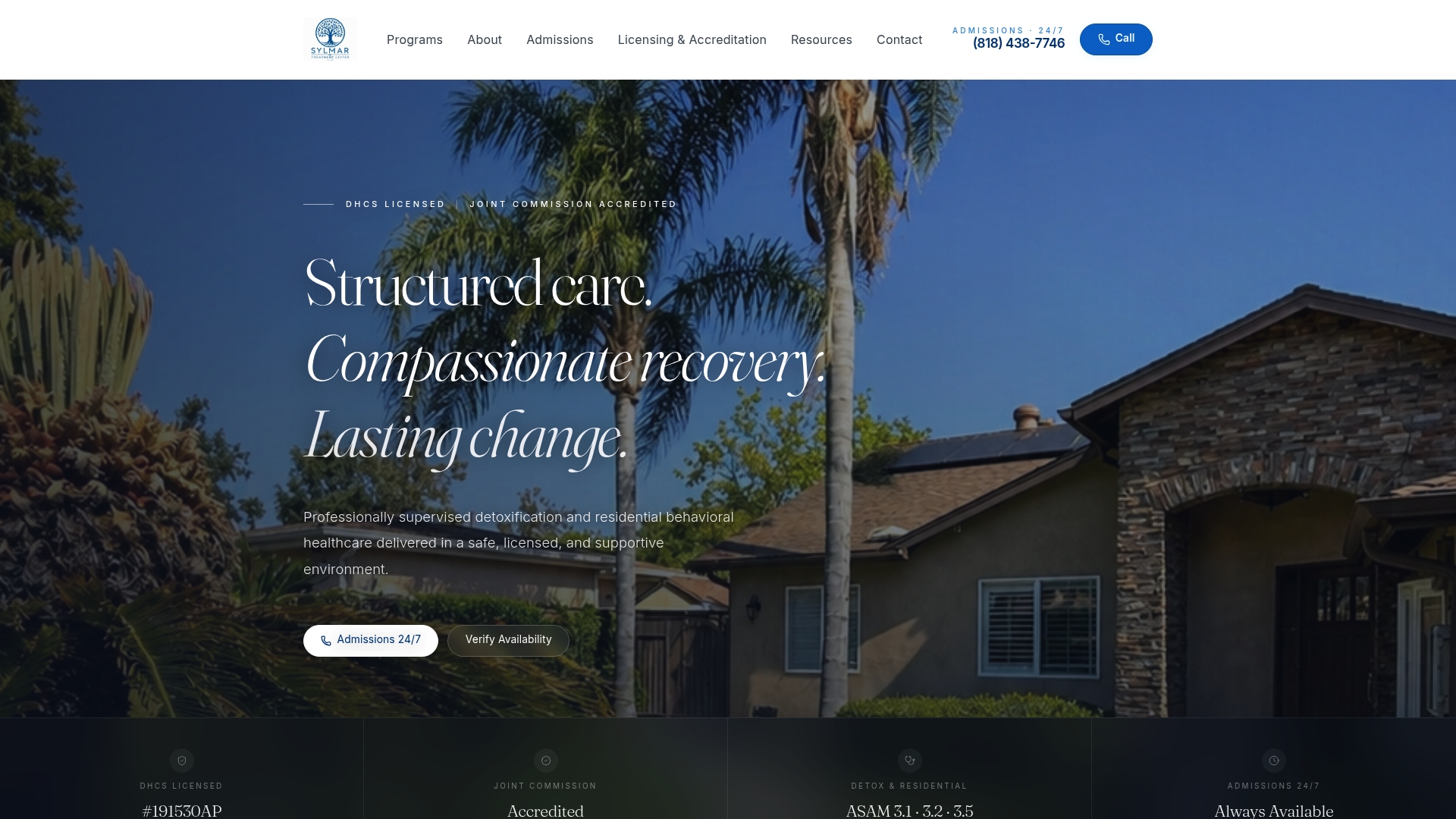
The center’s six-bed setting means no client gets lost in a crowded group model that wasn’t designed with sensory needs in mind. Care runs across medical detoxification for clients who need supervised withdrawal, residential treatment for longer-term structure, and individualized treatment programs that adjust to communication style, sensory sensitivities, and psychiatric history rather than forcing a standard curriculum. Medication management runs alongside behavioral care for clients whose ADHD, depression, or anxiety needs ongoing psychiatric oversight.
The facility holds a California DHCS license and Joint Commission accreditation, with admissions staffed 24/7 for families who need to act quickly. If you’re trying to figure out the right level of care for yourself or someone you love, call Sylmar’s admissions line or start with the programs overview to see which track fits.
This article is general information, not a substitute for advice from a qualified doctor. Consult a qualified healthcare professional about your own circumstances before acting on anything here.
Sources
- Study explores autism link in teens treated for addiction (Harvard Gazette)
- Substance use-related problems in autism spectrum disorder: population-based register study
- Sensory processing and alcohol use in adults with autism spectrum disorder
- Treating patients with co-occurring ASD and SUD: a clinical intervention study
FAQ
What Is the Biggest Red Flag for Autism and Addiction Risk?
The clearest warning sign is substance use tied to managing behavior or emotional overwhelm rather than social enjoyment. Autistic people who use substances are far more likely to report using them to manage behavior (nearly nine times more likely) or mental-health symptoms, based on mixed-methods research, which points to self-medication as the pattern clinicians should watch for first.
What Is a High-Functioning Autistic Person’s Addiction Risk?
“High-functioning” is not a clinical category, but adults with lower support needs who mask symptoms well often go undiagnosed, which can delay both autism recognition and SUD treatment. Their risk profile still tracks with the broader research: co-occurring ADHD, depression, or trauma raises risk far more than autism traits alone.
Does Autism Affect Life Expectancy for People Managing Addiction Well?
Untreated substance use disorder lowers life expectancy for anyone, autistic or not, primarily through overdose, accidents, and untreated medical complications. There isn’t reliable data specific to life expectancy for autistic adults managing addiction, so the safest approach is treating both conditions aggressively rather than relying on general population estimates.
What Is the Connection Between Autism and Nicotine Addiction?
Some autistic adults report using nicotine for focus or sensory regulation rather than social habit, which mirrors the self-medication pattern seen with alcohol and other substances. This overlaps heavily with ADHD, since nicotine’s stimulant-like effects can feel like relief for untreated attention or sensory-processing difficulties.
How Does Sylmar Treatment Center Handle Autism and Co-Occurring Addiction?
Sylmar Treatment Center evaluates substance use and co-occurring conditions together during intake, then builds an individualized plan rather than a standard group protocol. Its dual diagnosis support program runs within a six-bed, DHCS-licensed, Joint Commission accredited facility with 24/7 admissions.