

The most effective approach to anxiety and substance use treatment is integrated, concurrent care that addresses both conditions at once, with medical supervision for withdrawal when detox is needed. This isn’t a theoretical preference. It’s what the evidence supports, and it’s what the SAMHSA National Helpline and clinical guidance from the NIAAA point toward. If you or someone you love is struggling right now, the first move is a professional assessment or a call to a crisis or referral line, not a decision made alone.
TL;DR:
- Integrated treatment with psychiatric oversight is essential, especially for severe cases, since outpatient or non-coordinated approaches significantly increase relapse risk.
- Fully transdiagnostic protocols that treat anxiety and substance use simultaneously are most effective, particularly those targeting mutual maintenance mechanisms.
- Evidence shows that integrated care offers small-to-moderate benefits for both anxiety symptoms and substance use outcomes compared to separate treatments.
- Medications like SSRIs, buspirone, and gabapentin may help, but require careful coordination and monitoring due to interactions with active substance use and withdrawal risks.
- Medical supervision during detox is crucial for alcohol or benzodiazepine dependence, as withdrawal can be dangerously intense and may lead to seizures if unmanaged.
Table of Contents
- Why Anxiety and Substance Use Disorders Occur Together So Often
- Does Integrated Treatment Actually Beat Treating Each Disorder Separately?
- What Therapies Actually Help With Co-Occurring Anxiety and Addiction?
- What Medications Are Used, and What Should You Watch For?
- What Happens During Detox and Withdrawal, and When Is Medical Supervision Necessary?
- What Does the Path From Intake to Aftercare Actually Look Like?
- How Do You Evaluate a Program Before Committing?
- Who Provides This Kind of Care
- How Do You Prevent Relapse Once Treatment Ends?
- Why Does Peer Support Matter So Much in Dual Diagnosis Recovery
- How Does Trauma Affect Treatment Outcomes for Co-Occurring Disorders?
- Does Culture or Background Change How Treatment Should Work?
- Why Integrated Care Beats the Old Model, and What Families Get Wrong
- If You Need Residential Care, Here’s How Sylmar Can Help
- Sources
Why Anxiety and Substance Use Disorders Occur Together So Often
Anxiety disorders and substance use disorders travel together more than most people realize, and the overlap isn’t a coincidence of bad luck. People with alcohol use disorders show a notably high rate of co-occurring anxiety disorders, and when the two show up together, outcomes tend to be worse: more relapse, more treatment dropout, slower recovery.
There’s a biological reason this pairing is so common. Alcohol calms the nervous system in the short term by boosting GABA activity, but that relief is temporary and comes with a rebound. As GABA and glutamate systems swing back into balance, anxiety spikes, often worse than before the drink. This is why so many people describe a cycle: drink to quiet anxious thoughts, feel worse the next day, drink again to manage that worse feeling. The NIAAA’s review of overlapping neurobiology calls this mutual maintenance, and it’s a useful term because it captures something clinicians see constantly: each disorder actively feeds the other rather than sitting side by side.
The prevalence and stakes are hard to overstate. Co-occurring anxiety and alcohol use disorder doesn’t just double the treatment challenge. It changes it entirely, because untreated anxiety is one of the most consistent predictors of relapse in early sobriety.
That’s the practical reason specialized dual diagnosis treatment exists. Treating the substance use alone and hoping the anxiety resolves on its own tends to leave the door open for both problems to return.
Does Integrated Treatment Actually Beat Treating Each Disorder Separately?
Yes, and the research backing that claim has gotten considerably stronger. A 2023 meta-analysis of integrated behavioral treatments for comorbid anxiety and substance use disorders found that integrated care outperforms substance-use-only treatment, with small-to-moderate effect sizes across both anxiety symptoms and substance outcomes. That’s not a dramatic cure-all, but in mental health research, consistent small-to-moderate effects across multiple studies are meaningful and durable.
The same research describes integration on a spectrum rather than a single fixed method:
- Level 1 (adjunctive): Anxiety-focused techniques are added on top of standard substance use treatment as a supplement, not the core focus.
- Level 2 (coordinated): Anxiety and substance use are treated by coordinated providers or protocols running in parallel with shared treatment goals.
- Level 3 (fully transdiagnostic): A single, unified protocol treats both conditions simultaneously, often targeting shared mechanisms like anxiety sensitivity and distress intolerance rather than treating each diagnosis in its own silo.
Programs that operate at Level 3 tend to produce the most efficient results because they’re built around the mutual maintenance cycle itself, not two separate treatment tracks bolted together. It’s worth asking any program directly which level describes its model. Sylmar Treatment Center’s integrated treatment approach explains why concurrent care matters clinically, not just administratively.
The honest caveat: effect sizes vary by study and by which specific intervention is used, and researchers are still refining which transdiagnostic mechanisms matter most. This is an active, evolving area of clinical science, not a solved problem.
What Therapies Actually Help With Co-Occurring Anxiety and Addiction?
Cognitive behavioral therapy remains the backbone of anxiety and alcohol treatment, but the version used for dual diagnosis clients looks different from standard CBT. Integrated CBT protocols weave exposure exercises and coping-skills training directly into relapse-prevention work, so a client practicing tolerance for anxious sensations is simultaneously practicing tolerance for cravings. The two skill sets reinforce each other.
Beyond CBT, several other modalities show up regularly in effective anxiety recovery strategies:
- Dialectical behavior therapy (DBT): Especially useful when emotional dysregulation, self-harm risk, or intense mood swings accompany the anxiety and substance use pattern.
- Trauma-informed care: Necessary when a history of trauma is driving both the anxiety and the self-medicating substance use, which is common enough that most quality programs screen for it during intake.
- Motivational interviewing: Helps when ambivalence about quitting is part of the picture, building internal motivation rather than confrontation.
- Group therapy and family involvement: Peer accountability plus family education tend to reduce relapse risk more than individual therapy alone, particularly once someone leaves a structured program.
Pro Tip: Ask any prospective therapist directly whether they use an integrated or transdiagnostic protocol versus treating the anxiety and the substance use as two separate treatment tracks. The answer tells you a lot about how the program actually thinks about your case.
Practical resources like mindfulness-based exercises for anxiety can serve as a useful adjunct between formal therapy sessions, though they work best alongside professional treatment rather than in place of it.
What Medications Are Used, and What Should You Watch For?
Medication for anxiety and addiction rehab requires more caution than treating anxiety alone, because some standard anxiety medications carry real risk in someone actively using substances. Several options have shown genuine promise in comorbid populations:
- SSRIs (sertraline, paroxetine): Both have evidence in comorbid anxiety-alcohol trials, with paroxetine showing particular benefit for social anxiety and sertraline showing benefit for PTSD symptoms in some alcohol use disorder samples.
- Buspirone: Non-habit-forming and often preferred as a first-line option precisely because it carries no dependence risk.
- Gabapentin and pregabalin: Both show efficacy in some trials and are sometimes favored because they double as tools for managing certain withdrawal symptoms.
The caution that matters most: SSRIs require careful timing in someone actively drinking, since alcohol can blunt their effectiveness and complicate side effect profiles. Prescribing decisions in this population aren’t a solo call. They require coordination between a psychiatric provider and an addiction specialist, with monitoring through validated symptom scales and, when relevant, urine toxicology to catch any unintended increase in substance use early.
Benzodiazepines deserve their own callout here. They’re genuinely effective for short-term alcohol withdrawal management in monitored settings, but they carry a high dependence risk and should never become a long-term anxiety solution for someone with a substance use history. Any program offering benzodiazepines as an ongoing anxiety treatment for a client in recovery is missing a fairly basic safety principle.
What Happens During Detox and Withdrawal, and When Is Medical Supervision Necessary?
Withdrawal is where anxiety and substance use collide most intensely. The same GABA-glutamate rebound that drives hangover anxiety intensifies during full withdrawal, and for alcohol or benzodiazepine dependence specifically, it can become medically dangerous, not just uncomfortable.
Here’s roughly how that timeline and decision-making tends to unfold:
- Early withdrawal (hours to 2 days): Anxiety, tremors, and insomnia typically peak here, often the most anxiety-heavy stretch of the entire process.
- Medical evaluation determines the setting: Anyone with a history of heavy alcohol or benzodiazepine use, seizures, or severe withdrawal symptoms generally needs medically supervised detox rather than an outpatient taper, given the seizure and delirium tremens risk involved.
- Stabilization (days 3 to 7): Physical symptoms ease, but underlying anxiety often remains and needs to be addressed directly, not just waited out.
- Transition to integrated care: Detox alone doesn’t treat anxiety or prevent relapse. It has to be followed by therapy and, when appropriate, medication management, or the same cycle tends to restart.
What Does the Path From Intake to Aftercare Actually Look Like?
A comprehensive assessment for co-occurring disorders covers more ground than a standard intake. Expect a full psychiatric evaluation, a detailed substance use history, and a medical review to catch anything that affects withdrawal risk or medication choices.
From there, the right level of care depends on severity, not preference:
- Outpatient therapy works for milder anxiety and stable, lower-risk substance use where someone can maintain daily responsibilities.
- Intensive outpatient programs (IOP) add structure and hours for people who need more support but don’t require 24-hour supervision.
- Residential treatment fits situations with more severe symptoms, unstable living environments, or a history of relapse after less intensive care.
- Inpatient/medical detox becomes necessary when withdrawal risk is significant or psychiatric symptoms are acute.
A realistic timeline matters here too. Detox might resolve in a week, but meaningful anxiety and substance use treatment progress usually takes months, not days, and relapse-prevention skills keep developing well past the initial program. Programs describing rapid, permanent fixes should raise your skepticism, not your confidence.
How Do You Evaluate a Program Before Committing?
The single most important question to ask any prospective program: does it provide truly integrated dual diagnosis treatment with psychiatric oversight on-site, or does it hand off the anxiety component to an outside referral? That distinction changes everything about coordination and consistency of care.
Beyond that, a short list of concrete questions and checks helps separate solid programs from weaker ones:
- Ask specifically what their withdrawal management protocol looks like and who supervises it medically.
- Ask about their medication policy, particularly their stance on benzodiazepines for ongoing anxiety.
- Confirm licensing through your state’s health authority and check for Joint Commission accreditation, both signals of external, independent quality review.
- Ask how family involvement and aftercare planning work once the initial program ends.
- Confirm whether they accept your insurance or offer financing, and whether telehealth follow-up is available after discharge.
Pro Tip: Treat any program that promises a quick, guaranteed fix, or that defaults to blanket benzodiazepine prescribing for anxiety, as a red flag worth walking away from. Real dual diagnosis care is deliberate, coordinated, and rarely fast.
Who Provides This Kind of Care
Sylmar Treatment Center delivers medically supervised detox and dual diagnosis support inside a licensed, accredited residential setting.
- Licensed by the DHCS and accredited by the Joint Commission, external benchmarks families can independently verify.
- A six-bed setting built for individualized care plans rather than a one-size-fits-all program.
- Dual diagnosis support that treats anxiety and substance use as connected, not separate, problems.
- Real examples of what integrated dual diagnosis treatment looks like in practice, for readers who want specifics before reaching out.
How Do You Prevent Relapse Once Treatment Ends?
Long-term management for dual diagnoses looks different from standard relapse prevention because it has to track two sets of warning signs simultaneously, anxiety symptoms and substance cravings, since a spike in one reliably predicts trouble with the other.
The strongest long-term plans build in specific anxiety-coping tools clients can use in the exact moments cravings typically hit: a panic-driven urge to drink after a stressful day looks completely different from a boredom-driven urge, and generic relapse-prevention worksheets rarely distinguish between the two. Effective aftercare plans usually include continued therapy on a step-down schedule (weekly, then biweekly, then monthly), a clear medication management plan if pharmacotherapy is part of the picture, and specific, written triggers to watch for rather than a vague reminder to “avoid stress.”
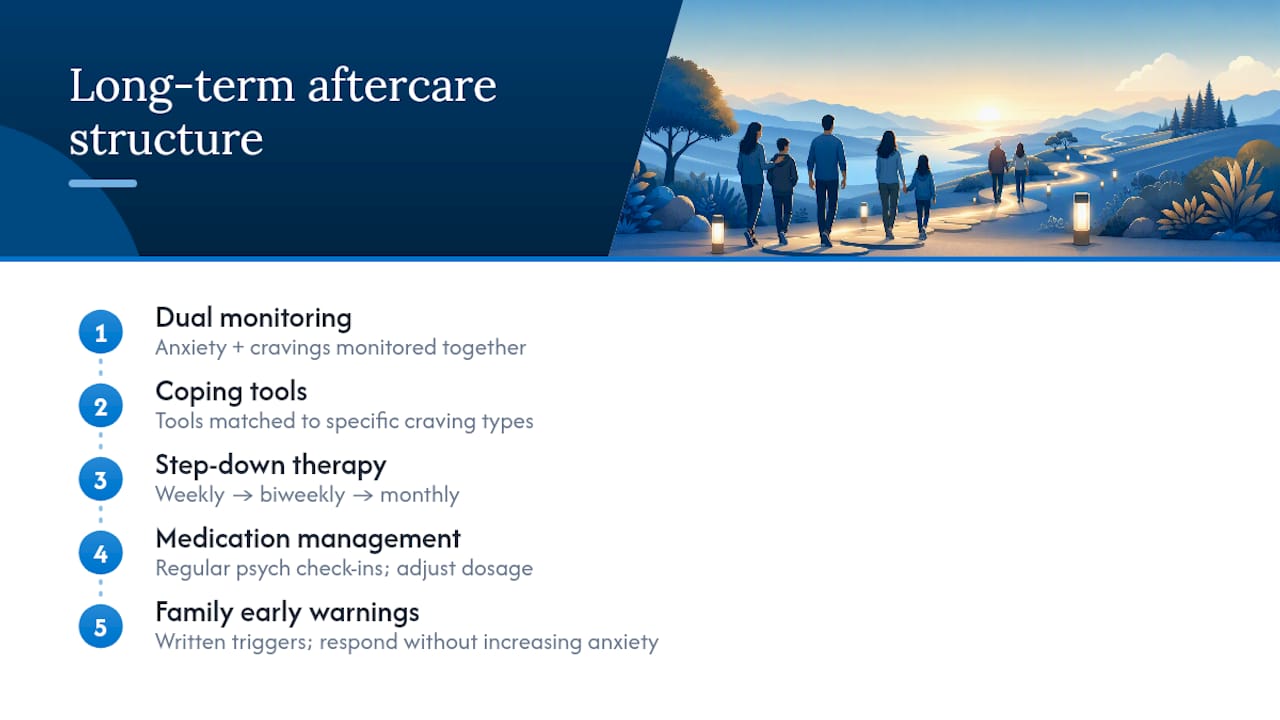
Regular check-ins with a psychiatric provider matter more here than in single-diagnosis recovery, because anxiety symptoms can shift over months and medication needs sometimes change with them. A plan that assumes the discharge-day medication and dosage will work indefinitely is planning for stagnation, not for a life that keeps changing.
Family plays a real role too, not as passive support but as an early-warning system. Loved ones who understand the mutual maintenance cycle between anxiety and substance use are far better equipped to notice the early signs of anxiety escalation before it turns into a full relapse, and to respond in ways that don’t inadvertently worsen the anxiety they’re trying to help with.
Why Does Peer Support Matter So Much in Dual Diagnosis Recovery
Clinical treatment addresses the mechanisms driving anxiety and substance use, but peer support addresses something clinical care structurally can’t: the isolation that comes from feeling like nobody else understands what living with both conditions is actually like.
Peer support groups built specifically for co-occurring disorders tend to outperform generic addiction-only or anxiety-only groups for this population, simply because members aren’t spending energy explaining a second diagnosis nobody else in the room shares. Community resources, whether structured peer-support meetings, alumni networks from a treatment program, or informal recovery communities, give people a place to normalize the specific experience of anxiety spiking during early sobriety, or substance cravings intensifying during an anxious week.

The role families play deserves equal weight here. Family therapy sessions and psychoeducation help loved ones understand that mutual maintenance cycle in concrete terms, which changes how they respond during hard moments. A partner who understands that withdrawal-related anxiety is temporary and biologically driven reacts very differently than one who reads it as a personal setback or a sign of failure.
Peer support isn’t a replacement for clinical care, and treating it that way is a common mistake. It’s a parallel track that keeps people engaged in recovery during the long stretches between therapy sessions, which is exactly when relapse risk tends to spike.
How Does Trauma Affect Treatment Outcomes for Co-Occurring Disorders?
Untreated trauma is one of the most common hidden drivers behind both anxiety and substance use, and skipping trauma screening during intake is one of the more consequential gaps in weaker treatment programs. Someone using alcohol to numb anxious hypervigilance rooted in past trauma won’t respond fully to standard anxiety treatment or standard addiction treatment alone, because neither approach touches the actual source.
Trauma-informed care changes how clinicians deliver every other intervention, not just whether trauma-specific therapy gets added on. A clinician trained in trauma-informed approaches paces exposure exercises differently, builds safety and trust before pushing into harder material, and watches for dissociation or shutdown responses that a standard CBT protocol might misread as simple resistance. Skipping this adjustment doesn’t just slow progress. It can actively retraumatize someone and push them out of treatment early.
Gender differences show up meaningfully here too. Women in comorbid anxiety and alcohol treatment often present with higher baseline anxiety severity and a higher likelihood of trauma history, which often calls for more intensive or trauma-focused intervention rather than a standard protocol applied uniformly across genders.
The practical takeaway for families evaluating a program: ask directly whether trauma screening is part of standard intake, and whether staff have specific training in trauma-informed methods. A program that treats trauma history as an optional add-on rather than a core part of assessment is likely to miss the actual driver behind a client’s anxiety and substance use pattern.
Does Culture or Background Change How Treatment Should Work?
Anxiety and substance use don’t present or get discussed the same way across every community, and treatment that ignores this tends to underperform. Stigma around mental health and addiction varies significantly by cultural background, and in some communities, seeking help for anxiety carries a different weight than seeking help for substance use, which affects whether someone is honest during intake or delays seeking care altogether.
Age matters here too. Younger clients often respond well to technology-supported aftercare and peer-based recovery communities, while older clients may need treatment plans that account for longer substance use histories, coexisting physical health conditions, and different family dynamics around disclosure and support.
Language access and culturally competent staff aren’t a nice-to-have detail. They’re often the difference between a client engaging honestly in therapy and a client giving surface-level answers because they don’t feel fully understood. Programs serious about dual diagnosis care should be asking about cultural background, religious or spiritual practices relevant to recovery, and family structure during assessment, then adjusting therapy style accordingly rather than applying one template to every client. A therapy approach that works well for one demographic can fall flat, or even backfire, for another if delivered without that context.
Why Integrated Care Beats the Old Model, and What Families Get Wrong
The conventional advice on this topic still leans toward “get sober first, deal with the anxiety later.” The evidence doesn’t support that sequencing, and clinically, it never made much sense. Anxiety left untreated during early recovery is one of the strongest predictors of relapse, so deferring it isn’t cautious. It’s a delay that raises risk.
What I think gets underestimated most is how much the mutual maintenance cycle explains ordinary-seeming relapses that families read as a lack of willpower. A relapse three weeks after detox usually isn’t a moral failure. It’s often an anxiety spike that nobody had a plan for, because the treatment focused on substance use and treated the anxiety as secondary or temporary.
Families searching for help should prioritize one thing above program amenities or location: does this place treat both conditions as one connected problem from day one? Everything else, the setting, the extras, the marketing, matters far less than whether the clinical model itself is built around integration.
— Jim
If You Need Residential Care, Here’s How Sylmar Can Help
Some treatment centers are built around the exact model this article describes: integrated dual diagnosis care in a small, residential setting where staff can track how anxiety and substance use interact day to day, not just check boxes on two separate treatment plans.
Every client starts with a comprehensive assessment covering psychiatric history, substance use patterns, and medical needs, then moves into a custom care plan rather than a standardized track. That includes psychiatric oversight for medication management, medically supervised detox when withdrawal risk calls for it, and coordinated therapy that treats anxiety and substance use as one connected recovery, not two separate problems handled by two separate teams. The dual diagnosis program outlines exactly how that coordination works in practice.
Admissions support may be available at all hours, and some teams work directly with insurance providers to sort out coverage before you commit to anything. If a court-directed placement or a specific legal requirement is part of your situation, specialized intake teams sometimes handle these matters. Explore the full range of individualized treatment programs or call the admissions line today to start an assessment and find out what a realistic care plan looks like for your specific case.
This article is general information, not a substitute for advice from a qualified doctor. Consult a qualified healthcare professional about your own circumstances before acting on anything here.
Sources
- Integrated behavioral treatments for comorbid anxiety and substance use disorders: model and meta-analysis (2023)
- Co-Occurring Alcohol Use Disorder and Anxiety: Bridging psychiatric, psychological, and neurobiological perspectives (NIAAA)