

Residential treatment is defined as a live-in clinical program where patients receive 24/7 medical supervision and structured therapy inside a treatment facility. Outpatient treatment, by contrast, allows patients to live at home while attending scheduled therapy sessions several times per week. Understanding the residential treatment vs outpatient explained comparison is the first step toward choosing the right level of care. The two models differ in intensity, cost, duration, and clinical purpose. The right choice depends on the severity of the substance use disorder, the stability of the home environment, and whether prior treatment attempts have failed.
What are the main differences between residential and outpatient programs?
Residential treatment involves stays typically lasting 30 to 90 days under round-the-clock clinical monitoring. Costs range from $5,000 to $60,000 before insurance. Outpatient programs last 8 to 16 weeks, with 9 to 30 hours of therapy per week, and cost $3,000 to $15,000. That cost gap reflects the difference in staffing, housing, meals, and medical oversight.
The structural difference between the two is significant. Residential care removes patients entirely from their daily environment. Outpatient care keeps patients in their home setting, which means they face real-world triggers while still receiving treatment. Each approach has a distinct clinical purpose.

| Parameter | Residential treatment | Outpatient treatment |
|---|---|---|
| Typical duration | 30–90 days | 8–16 weeks |
| Hours of therapy per week | 30+ hours | 9–30 hours |
| Supervision level | 24/7 clinical monitoring | Session times only |
| Cost before insurance | $5,000–$60,000 | $3,000–$15,000 |
| Living arrangement | On-site at facility | Patient’s own home |
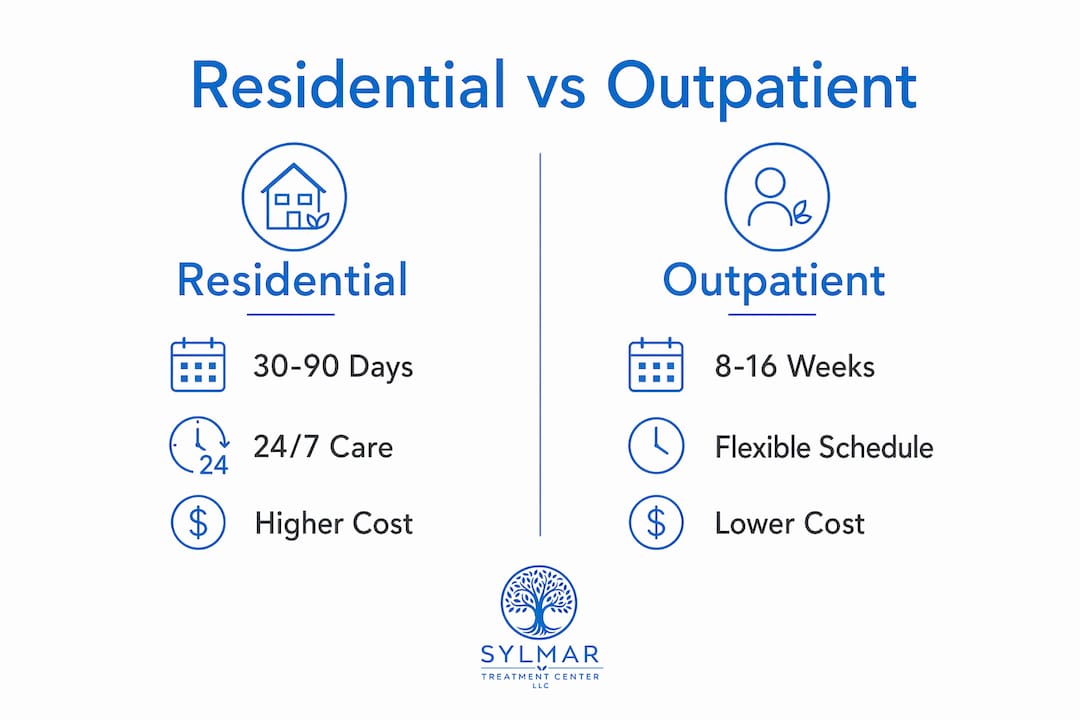
Residential programs are best suited for patients who need medical detox, constant supervision, or complete separation from an unsafe environment. Outpatient programs work well for patients with stable housing and moderate symptoms who can manage daily responsibilities alongside treatment.
Pro Tip: Ask any treatment program whether their duration is based on your clinical progress or on a fixed billing cycle. The answer tells you a great deal about the quality of care.
Who is best suited for residential vs outpatient care?
Residential treatment is indicated for patients with severe substance use disorders, unsafe or unstable living conditions, medical detox needs, or co-occurring serious psychiatric disorders. Outpatient care is the right fit for patients with mild to moderate symptoms, strong motivation, and a stable, supportive home environment. Clinical guidelines like the ASAM Criteria prioritize individualized placement based on severity, stability, and home safety rather than arbitrary treatment durations.
Patients who have already attempted outpatient treatment without success are strong candidates for residential care. The higher structure and constant clinical presence reduce the opportunity for relapse during the most vulnerable phase of recovery. Families often underestimate how much the home environment itself can work against recovery.
Clinical criteria that point toward residential treatment include:
- Severe physical dependence requiring medically supervised detox evaluation
- Active suicidal ideation or severe co-occurring psychiatric illness
- Unstable or unsafe living conditions, including active substance use by household members
- Prior outpatient treatment that did not result in sustained recovery
- Lack of reliable transportation or social support for outpatient attendance
Outpatient care suits patients who have completed residential treatment and are stepping down, or those whose disorder is mild enough that daily life does not pose an immediate relapse risk. The key word is “matched.” Placing a high-severity patient in outpatient care because it costs less is a clinical mistake that families sometimes make under financial pressure.
Pro Tip: Before choosing a level of care, have a licensed clinician complete a formal assessment using the ASAM Criteria. This takes the guesswork out of placement and gives you a defensible clinical rationale.
What does research say about residential vs outpatient effectiveness?
Research confirms outpatient care, especially Intensive Outpatient Programs, can produce clinical outcomes equivalent to residential treatment for well-selected patients with mild to moderate substance use disorders and stable home environments. That finding surprises many families who assume residential care is always superior. The key phrase is “well-selected.” Outcomes are equivalent only when the patient is genuinely appropriate for outpatient care.
“The common 28-day residential stay is primarily a historical billing artifact, not a clinical standard. Effective treatment duration should be based on individual clinical progress.” — clinical research finding
The 28-day model became standard in the 1980s because insurance companies needed a billing unit. It was never derived from clinical evidence about what duration produces the best outcomes. Patients and families who understand this are better equipped to push back against programs that apply a one-size-fits-all timeline.
Well-structured Intensive Outpatient Programs involve 3 to 5 days per week with sessions of 3 or more hours each. That level of engagement is clinically meaningful and allows patients to maintain work and family obligations simultaneously. For many patients with moderate disorders, this structure produces outcomes that match residential care at a fraction of the cost.
The transition period after residential treatment is where outcomes most often diverge. Abrupt discharge from residential care without a structured step-down plan frequently undermines the gains made during the residential stay. Long-term success depends less on whether a patient attended residential treatment and more on whether they received effective continuation care afterward.
Pro Tip: When evaluating any residential program, ask specifically what their discharge planning process looks like. A program with no formal step-down protocol is a red flag.
How do residential and outpatient treatments fit into daily life?
Residential programs remove patients from daily environmental triggers, providing intensive immersive therapy. Outpatient programs allow patients to maintain family and work responsibilities while receiving structured care. These are not just logistical differences. They represent fundamentally different theories about where recovery skills are best developed.
Residential treatment gives patients a protected environment to stabilize, build coping skills, and address underlying trauma without the noise of daily life. That protection is genuinely valuable for patients in crisis. The limitation is that those skills must eventually transfer to the real world, and that transfer does not happen automatically.
Outpatient treatment forces patients to practice recovery skills in their actual environment from day one. A patient who learns to manage a craving while sitting in a therapy room faces a different challenge than one who manages it while driving past a former dealer’s neighborhood. Outpatient care builds that real-world resilience in real time.
Practical considerations for each setting:
Residential treatment
- Pauses work and family responsibilities for the duration of the stay
- Provides meals, housing, and 24/7 peer and clinical support
- Removes access to substances and environmental triggers
- Requires a clear plan for returning to daily life after discharge
Outpatient treatment
- Allows patients to keep working and maintain family roles
- Requires strong self-discipline and a substance-free home environment
- Builds recovery skills in the patient’s actual daily context
- Costs significantly less and is easier to sustain over longer periods
The step-down transition from residential to outpatient care is critical. Long-term success often hinges on effective continuation and community supports after residential stays. Families play a central role in that transition and should be included in discharge planning from the start.
What are the financial and insurance differences?
Residential care costs significantly more upfront, and insurance cost-sharing differs between inpatient and outpatient services. Inpatient stays typically trigger a per-admission deductible, while outpatient visits involve per-session copays. That distinction matters because a 30-day residential stay may exhaust your deductible in one admission, while outpatient copays accumulate gradually over weeks.
| Cost factor | Residential treatment | Outpatient treatment |
|---|---|---|
| Typical cost before insurance | $5,000–$60,000 | $3,000–$15,000 |
| Insurance cost-sharing model | Per-admission deductible | Per-visit copay |
| Prior authorization required | Usually yes | Often yes |
| Out-of-pocket risk | High upfront | Spread over time |
Insurance plans often cover both levels of care, but the coverage terms differ. Residential stays frequently require prior authorization, and insurers may limit the number of covered days. Outpatient sessions may require referrals or step-by-step documentation of medical necessity. Reading your Summary of Benefits before choosing a program prevents costly surprises.
Pro Tip: Call your insurance company before admission and ask three specific questions: Does this facility accept my plan? What is my per-admission deductible? How many residential days does my plan cover per year? Write down the answers and the name of the representative.
Key Takeaways
The most effective treatment choice is the one matched to the patient’s clinical severity, home stability, and prior treatment history, not the one with the longest duration or highest cost.
| Point | Details |
|---|---|
| Setting defines intensity | Residential provides 24/7 care on-site; outpatient delivers structured therapy while patients live at home. |
| Outcomes depend on patient match | Research shows equivalent outcomes for well-selected patients in either setting. |
| The 28-day model is not clinical | Standard residential stay lengths reflect billing history, not evidence-based duration guidelines. |
| Step-down care drives long-term success | Transitioning from residential to outpatient with a formal plan significantly improves lasting recovery. |
| Financial planning prevents surprises | Residential and outpatient care trigger different insurance cost-sharing structures; verify coverage before admission. |
What I’ve learned about treatment decisions that most families get wrong
Families almost always come to me with the same assumption: residential treatment is the serious option, and outpatient is the fallback for people who can’t commit. That framing gets the decision backward. The right level of care is the one that matches the patient’s clinical picture, not the one that feels most dramatic or most affordable.
I’ve seen patients placed in residential programs they didn’t need because a family wanted to “do everything possible.” The result was a 30-day stay that cost $40,000, followed by an abrupt discharge with no step-down plan, and a relapse within two weeks. The residential stay wasn’t the problem. The lack of transition planning was. That pattern is far more common than most families realize.
The other mistake I see is families pushing for outpatient care to save money when the patient’s home environment is actively hostile to recovery. A patient who returns each night to a household where substances are present is not in outpatient treatment. They are in a daily relapse scenario with therapy appointments. The family guide to residential treatment at Sylmartreatmentcenter addresses this directly and is worth reading before any placement decision.
The most important thing I can tell you is this: get a formal clinical assessment before you choose a program. The ASAM Criteria exist precisely to remove personal bias and financial pressure from placement decisions. A good clinician will tell you what level of care the patient actually needs. Your job as a family member is to support that recommendation, even when it is harder or more expensive than you hoped.
— Jim
How Sylmartreatmentcenter supports your recovery at every level
Sylmartreatmentcenter provides both residential and outpatient addiction treatment within an intimate six-bed setting that prioritizes personalized care over volume. The center’s 24/7 admissions support means families can get clinical guidance at any hour, not just during business hours.
Sylmartreatmentcenter holds both a DHCS license and Joint Commission accreditation, which means every program meets independently verified clinical standards. The center’s addiction recovery programs include residential treatment, medical detox, dual diagnosis support for co-occurring mental health disorders, and individualized treatment plans built around each patient’s specific clinical needs. Step-down planning is built into every residential stay, not added as an afterthought. Families can call 24/7 to discuss placement options and get a clear picture of what care will look like from admission through transition.
FAQ
What is the main difference between residential and outpatient treatment?
Residential treatment requires patients to live at the facility and receive 24/7 clinical care, while outpatient treatment allows patients to live at home and attend scheduled therapy sessions. The core difference is supervision intensity and environmental separation.
Which is better, residential or outpatient treatment?
Neither is universally better. Research shows equivalent outcomes for well-matched patients in either setting. The right choice depends on the severity of the disorder, home stability, and whether prior treatment attempts have succeeded.
How long does residential treatment typically last?
Residential stays typically last 30 to 90 days, though clinical guidelines recommend basing duration on individual progress rather than fixed timelines. The common 28-day model is a billing artifact, not a clinical standard.
Does insurance cover both residential and outpatient treatment?
Most insurance plans cover both levels of care, but with different cost-sharing structures. Residential stays typically trigger a per-admission deductible, while outpatient visits involve per-session copays. Prior authorization is commonly required for both.
What happens after residential treatment ends?
A structured step-down plan to outpatient care is critical after residential treatment. Abrupt discharge without continuation support significantly increases relapse risk, making transition planning one of the most important parts of any residential program.