
Group Therapy’s Role in Dual Diagnosis Recovery

Group therapy is one of the most clinically supported treatments for dual diagnosis, and the evidence behind it is hard to argue with. A review of 329 clinical trials covering more than 27,000 participants found group therapy to be as effective as individual therapy for mental health and substance use disorders. That finding alone reframes how many people think about treatment options. For those managing co-occurring conditions, the group format does something individual sessions cannot: it creates a shared therapeutic environment where both disorders are addressed at once, by the same team, in the same room.
The role of group therapy in dual diagnosis treatment centers on integration. Rather than treating a mood disorder in one clinic and a substance use disorder in another, integrated group therapy brings both into a single, coordinated process. Integrated Group Therapy (IGT), developed specifically for bipolar disorder and substance use disorder co-occurrence, is the most studied example. IGT protocols typically run 12–20 weekly sessions and focus on three core goals:
- Relapse prevention for both substance use and mood episodes
- Medication adherence and early symptom recognition
- Mood stabilization and recovery behavior development
Randomized controlled trials of IGT found it significantly more effective than standard group drug counseling on both substance use and mental health outcomes. That is the baseline this article builds from.
How group therapy works for dual diagnosis patients
Structure matters more in dual diagnosis groups than in general therapy groups, because the population is more complex. Sessions typically involve one or two trained therapists working with a small group, often in a closed format where membership stays consistent across the treatment course. That consistency builds the trust that makes honest disclosure possible.
The therapist’s role goes well beyond facilitation. According to StatPearls via NCBI, the group leader fulfills an executive function: setting membership, managing time and subject matter, and maintaining the emotional boundaries that keep the group safe. Therapists also manage group dynamics actively, watching for roles that members sometimes fall into, such as the defiance leader, the task leader, or the scapegoat, and redirecting those patterns before they undermine cohesion.

One of the more underappreciated aspects of group development is the storming phase. Conflict and resistance are not signs that a group is failing. When a skilled facilitator manages that friction well, it typically leads to stronger cohesion and more sustained engagement. The group that works through tension together tends to hold together longer.
Evidence-based techniques woven into sessions include cognitive behavioral therapy (CBT), motivational interviewing, and psychoeducation. These are not used in isolation. A single session might open with psychoeducation about a shared trigger, move into a motivational interviewing exercise, and close with a CBT-based skill practice. The table below shows how session elements map to expected outcomes:
| Session element | Primary technique | Expected outcome |
|---|---|---|
| Psychoeducation on warning signs | Didactic instruction | Earlier symptom recognition |
| Trigger identification | CBT functional analysis | Reduced relapse risk |
| Motivation exploration | Motivational interviewing | Increased treatment engagement |
| Skill practice | Role-play, behavioral rehearsal | Improved coping and refusal skills |
| Group reflection | Process discussion | Stronger group cohesion |
Therapist and patient roles within sessions:
- Therapist sets norms, manages conflict, and models empathy
- Patients share experiences, give peer feedback, and practice new skills in real time
- Both therapist and group members hold each other accountable to stated goals
When group therapy runs alongside individual therapy, the two formats can be combined (same therapist) or conjoined (separate therapists who communicate regularly). Conjoined therapy requires clear information-sharing agreements to prevent triangulation, where a patient uses one therapist’s reaction to justify behavior in the other setting.
What makes group therapy uniquely effective for co-occurring disorders
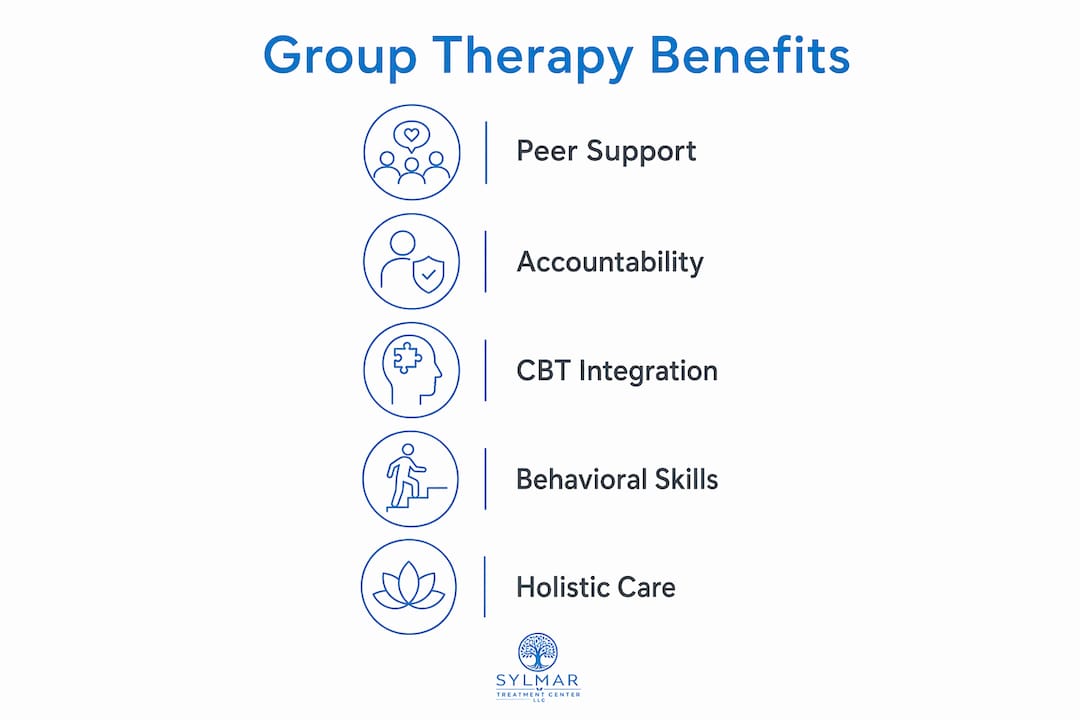
Peer support is the most cited benefit of group therapy, but the mechanism behind it is more specific than the phrase suggests. Hearing someone else describe the same pattern of using substances to manage a mood episode reduces the shame that often keeps people from disclosing. That reduction in isolation is not just emotional relief. It tends to increase willingness to engage with treatment, which directly affects outcomes.

Group accountability works differently from individual accountability. When you tell a therapist you will do something, the consequence of not doing it is private. When you tell a group, the consequence is social. That distinction changes behavior in ways that matter for long-term recovery, particularly for people whose disorders have historically led to social withdrawal.
Pro Tip: If you are entering group therapy for the first time, resist the urge to stay silent for the first several sessions. Early disclosure, even brief, accelerates the trust-building that makes the group useful to you.
Key benefits specific to dual diagnosis group therapy:
- Shared experience reduces stigma around both mental illness and substance use
- Social skills practice happens in a real interpersonal context, not a hypothetical one
- Emotional regulation is modeled and reinforced by peers, not just taught by a therapist
- Group cohesion improves treatment retention, which is one of the strongest predictors of recovery
- Cost efficiency means more people can access structured psychotherapy
Cognitive behavioral therapy delivered in a group format carries the same core benefits as individual CBT for substance use disorder, including functional analysis, high-risk situation avoidance, and drug refusal skills. The group context adds a layer: members can challenge each other’s cognitive distortions in ways a therapist alone cannot replicate.
Recovery behavior integration is another advantage that gets less attention than it deserves. IGT explicitly teaches behaviors that support both disorders simultaneously, things like maintaining a regular sleep schedule, recognizing early warning signs, and attending self-help groups. Some of those behaviors are disorder-specific, but many overlap, and addressing them together in a group setting reinforces the message that both conditions are part of one recovery process.
Why integrated group therapy solves the siloed care problem
The traditional model of care for dual diagnosis patients was sequential or parallel: treat the substance use disorder first, then address the mental health condition, or send the patient to two separate providers who rarely communicated. That approach has a well-documented failure mode. Clinicians in one setting would discharge patients as “too complex” because of the other condition, and patients would fall through the gap between systems.
Integrated group therapy directly addresses this by treating both conditions in the same setting, with the same team. The misconception that active substance use makes psychiatric therapy ineffective has been a significant barrier to care. Integrated approaches reject that premise entirely, keeping patients in treatment rather than excluding them.
IGT operates on a specific conceptual framework: it treats bipolar disorder and substance use disorder as manifestations of a single underlying process called “bipolar substance abuse.” That framing matters clinically because it removes the question of which condition to treat first. The answer is both, always, simultaneously.
Dual Recovery Therapy (DRT) takes a similarly integrated approach, combining relapse prevention, motivational enhancement therapy, 12-step principles, and social skills training. DRT delivers these through linked individual and group sessions, with communication skills taught through role-play. What makes DRT distinctive is the explicit link between the two formats: topics from group sessions are reinforced in individual sessions, and vice versa.
Benefits of integrated treatment over siloed approaches:
- Single treatment team reduces contradictory messages about recovery
- Patients are not discharged for complexity; the model is built for it
- Medication adherence improves when both prescribers and therapists share goals
- Recovery behaviors for both disorders are taught and monitored together
- Treatment accessibility increases for patients who previously fell between systems
A systematic review of 120 studies confirmed that psychological and psychosocial treatments, particularly CBT and integrated approaches, reduce both substance use and psychiatric symptoms in patients with co-occurring disorders. The evidence is especially strong for comorbidities involving depression, anxiety, PTSD, bipolar disorder, and schizophrenia paired with substance use.
Practical considerations: what to expect from dual diagnosis group therapy
Not all groups are structured the same way, and the format matters for fit. Open groups allow new members to join at any point, which makes them practical for outpatient settings with rolling admissions. Closed groups maintain a fixed membership from start to finish, which builds deeper cohesion but requires more careful intake planning. For dual diagnosis patients, closed groups tend to produce stronger outcomes because the consistency of membership supports the trust needed for honest disclosure.
Diagnosis-specific groups, like IGT for bipolar disorder and substance use disorder, are designed around the particular interaction between two conditions. Mixed groups address substance use across a broader range of co-occurring mental health conditions. Both formats have their place, and the right choice depends on the severity and specificity of the co-occurring disorders.
Typical structure and logistics:
- Session frequency: weekly, sometimes twice weekly in early treatment phases
- Duration: 12–20 sessions for structured protocols like IGT; open-ended for maintenance groups
- Group size: small groups of roughly 5–10 members allow meaningful participation
- Session length: typically 60–90 minutes
- Setting: outpatient, intensive outpatient, or residential programs
Patient suitability is a real consideration. Group therapy works best when patients have enough stability to participate without disrupting the group’s function. Active psychosis, severe cognitive impairment, or acute crisis states may require stabilization before group participation is appropriate. Patients who are highly paranoid or who have a history of severe interpersonal aggression may need individual therapy first to build the baseline skills for group participation.
Progress in dual diagnosis group therapy is measured across multiple dimensions, not just abstinence. Clinicians track medication adherence, frequency and severity of mood episodes, social functioning, and engagement with recovery behaviors like sleep hygiene and self-help group attendance. The integrated treatment approach treats all of these as interconnected indicators, not separate metrics.
Expert insights on integrated group therapy in dual diagnosis recovery
The American Psychological Association has formally recognized group psychotherapy as a unique clinical specialty, a designation that carries real weight. It signals that group therapy is not simply individual therapy delivered to multiple people at once. It requires distinct training, distinct skills, and a distinct understanding of how therapeutic change happens in a social context.
Professional facilitation makes a measurable difference. A qualitative study with 12 participants found that group-based teaching led by healthcare professionals significantly improved patients’ understanding of their co-occurring disorders, and that improved understanding correlated with better treatment adherence. The therapist’s credibility and genuine belief in the treatment model shapes the group’s early engagement more than any single technique.
Expert observations on what makes integrated group therapy work:
- Skilled facilitators manage the storming phase without suppressing it, using conflict as material for growth
- Therapists who maintain optimism and genuine empathy set the emotional tone that determines whether patients feel safe enough to disclose
- Integrated models address the clinical misconception that substance use disqualifies patients from psychiatric treatment
- The therapeutic alliance in group therapy extends across the entire group, creating accountability structures that individual therapy cannot replicate
- Regular communication between group and individual therapists, when both formats are used, prevents the triangulation that can undermine both
One persistent challenge is the gap between practice and research. Group therapy is one of the most common modalities in substance use treatment settings, yet formal training in group-specific dynamics and evidence-based group processes remains inconsistent. Therapists often adapt individual therapy techniques to a group format without training in the distinct mechanics of group cohesion, role dynamics, or the therapeutic use of peer interaction. That gap affects outcomes in ways that are difficult to measure but clinically significant.
The evidence base for psychosocial interventions in dual diagnosis continues to grow, but it also continues to reveal how much depends on implementation quality. The protocol matters. The therapist matters. The group’s composition and the consistency of its membership matter. A well-run IGT group and a poorly facilitated mixed group are not the same intervention, even if both are labeled “group therapy.”
How success gets measured in dual diagnosis group therapy
Outcome evaluation in dual diagnosis group therapy is more layered than a simple sobriety count. Clinicians and researchers track a combination of substance use metrics, psychiatric symptom scales, and functional indicators to get a complete picture of how a patient is progressing.
Standard outcome measures used in dual diagnosis group therapy include:
- Substance use frequency and severity: self-report measures and urine toxicology screens track changes in use patterns over the course of treatment
- Psychiatric symptom scales: tools like the Hamilton Depression Rating Scale or the Young Mania Rating Scale measure mood stability across sessions
- Medication adherence rates: tracked through self-report and, where possible, pharmacy records or pill counts
- Treatment retention: how long patients stay engaged with the group is itself a meaningful outcome, since dropout predicts relapse
- Recovery behavior checklists: IGT and similar protocols use structured checklists to monitor behaviors like sleep regularity, self-help group attendance, and avoidance of high-risk situations
- Social functioning assessments: measures like the Global Assessment of Functioning (GAF) capture changes in relationships, work, and daily living
- Relapse episodes: both substance use relapses and mood episode recurrences are tracked, with attention to whether they co-occur or follow a predictable sequence
The most meaningful measure is often the interaction between substance use and psychiatric symptoms over time. A patient who reduces drinking frequency but experiences more frequent depressive episodes has not fully recovered. Integrated outcome tracking catches that pattern. Siloed tracking, where substance use and mental health are measured separately by different providers, often misses it entirely.
Group-level outcomes also matter. Therapists assess group cohesion, participation rates, and the quality of peer interactions as indicators of whether the group is functioning therapeutically. A group with low cohesion, where members avoid eye contact and give only surface-level responses, is unlikely to produce the peer accountability effects that make group therapy worth the effort.
Sylmartreatmentcenter’s approach to integrated dual diagnosis care
Sylmartreatmentcenter was built around the reality that co-occurring disorders require more than parallel treatment. The center’s six-bed residential setting means each patient receives genuinely individualized attention, not a standardized program applied uniformly. Every admission begins with a comprehensive assessment that informs a custom care plan, one that integrates both substance use and mental health treatment from the start.
The center holds both a DHCS license and Joint Commission accreditation, which means its treatment protocols meet independently verified clinical standards. For patients and families navigating dual diagnosis, that accreditation is a concrete signal of quality, not a marketing claim. Sylmartreatmentcenter’s dual diagnosis programs incorporate evidence-based group therapy alongside individual sessions, medication management, and structured recovery behavior support. Admissions support is available 24/7 for anyone ready to take the first step.
Key Takeaways
Integrated group therapy is the most evidence-supported format for dual diagnosis treatment, addressing both substance use and mental health disorders simultaneously within a structured, peer-reinforced setting.
| Point | Details |
|---|---|
| Clinical effectiveness | A review of 329 trials found group therapy as effective as individual therapy for mental health and substance use disorders. |
| IGT protocol length | Integrated Group Therapy typically runs 12–20 weekly sessions targeting relapse prevention, medication adherence, and mood stability. |
| Integration over siloed care | Treating both conditions with one team prevents premature discharge and improves adherence across both disorder types. |
| Peer accountability | Group therapeutic alliance extends across all members, creating accountability structures individual therapy cannot replicate. |
| Outcome tracking | Effective evaluation measures substance use, psychiatric symptoms, medication adherence, and recovery behaviors together, not separately. |