
Medical detox is defined as clinically supervised withdrawal management that uses medication and continuous monitoring to keep patients safe as substances leave the body. The benefits of 24 hour detox admissions go far beyond comfort. Round-the-clock nursing care prevents life-threatening complications like seizures and delirium tremens, and same-day admission measurably improves the odds of successful recovery. The Mental Health Parity and Addiction Equity Act (MHPAEA) requires most insurers to cover detox at the same level as other inpatient medical care, which means cost is rarely the barrier people assume it is. Sylmartreatmentcenter operates with 24/7 admissions support, a DHCS license, and Joint Commission accreditation, making immediate entry into medically supervised care a real option for most patients.
1. What are the primary medical benefits of 24 hour detox admissions?
Continuous medical supervision is the single most important advantage of round-the-clock detox care. Nurses and clinicians can respond within minutes to escalating withdrawal symptoms, adjust medications in real time, and prevent a manageable situation from becoming a medical emergency.
Clinicians use standardized tools to guide every decision. The Clinical Institute Withdrawal Assessment for Alcohol (CIWA) and the Clinical Opiate Withdrawal Scale (COWS) provide objective scores that tell staff exactly how severe withdrawal is at any given moment. Clinical withdrawal scales allow clinicians to adjust medication doses based on measurable data rather than patient self-report alone. That precision matters because under-medicating leads to dangerous symptoms, and over-medicating creates new risks.

The most serious withdrawal complications, including grand mal seizures and delirium tremens from alcohol, can appear suddenly and without warning. 24/7 nursing care enables immediate response to these events, reducing the risk of permanent injury or death. No outpatient or self-managed setting can replicate that level of protection.
Psychological support is also built into the 24-hour model. Withdrawal produces intense anxiety, depression, and disorientation. Having a nurse or counselor available at 3:00 AM is not a luxury. It is a clinical necessity that keeps patients from leaving treatment prematurely.
Pro Tip: Ask the admitting team to screen for co-occurring mental health conditions on day one. Early identification of depression, PTSD, or anxiety disorders significantly improves long-term outcomes and shapes the entire care plan.
2. How does 24 hour admission speed access to treatment?
Speed of admission is directly tied to patient safety. Same-day admission to detox reduces the risks associated with delayed treatment and improves the chances of successful recovery. Every hour a person in severe alcohol or opioid dependence waits without medical support is an hour of compounding risk.
Rapid admission matters for several concrete reasons:
- Prevents dangerous delays. Alcohol withdrawal can produce seizures within 6–48 hours of the last drink. Waiting days for a bed is not a neutral choice.
- Reduces relapse before treatment starts. Patients who cannot get in quickly often use again to manage withdrawal symptoms, deepening dependence.
- Stabilizes the body faster. Immediate medical intervention shortens the acute withdrawal phase and gets patients to a stable baseline sooner.
- Supports insurance continuity. Many insurance authorizations have time limits. Delayed admission can complicate coverage approval.
- Reduces psychological barriers. The window of willingness to seek help is often narrow. Same-day entry captures that moment before doubt or fear takes over.
Facilities that offer 24/7 admissions, like Sylmartreatmentcenter, remove the scheduling friction that causes people to abandon the decision to get help. Insurance verification can happen over the phone in real time, so patients know their coverage before they arrive.
Pro Tip: Call a treatment center’s admissions line directly rather than waiting for a referral. Most centers with 24/7 intake can verify your insurance benefits and confirm a bed within hours.
3. What insurance and financial benefits support 24 hour detox admissions?
Cost is the most common reason people delay or avoid detox. The financial reality is more favorable than most people realize. Most commercial health plans cover 80–100% of inpatient medical detox costs after deductibles are met. Medicaid in all 50 states generally covers detox with little or no out-of-pocket expense for eligible patients.
The legal framework reinforces this access. The MHPAEA law mandates that most insurance plans cover medical detox at parity with other inpatient medical care. That means an insurer cannot apply stricter limits to detox than it would to, say, a cardiac hospitalization.
Key financial facts for patients considering 24 hour detox:
- Commercial insurance typically covers the majority of detox costs after the annual deductible.
- Medicaid covers detox in all 50 states, often at zero out-of-pocket cost for qualifying individuals.
- Medicare covers medically necessary detox under Part A for inpatient stays.
- Uninsured patients face higher costs, but many facilities offer sliding-scale fees or payment plans.
- Free insurance verification is available through most treatment center admissions lines, including Sylmartreatmentcenter, at no cost and with no obligation.
The practical step is simple. Call the admissions line, provide your insurance card information, and the team will tell you exactly what your plan covers before you commit to anything.
4. What supportive features does 24 hour detox provide for lasting recovery?
Medical stabilization is the first goal of detox, but it is not the only one. Medically supervised detox with 24/7 nursing care facilitates continuity of care that reduces patient dropout between detox and further treatment. That transition gap is where recovery most often fails.
“24-hour nursing care prevents patients from ‘falling through the cracks’ by coordinating a seamless transition into post-detox treatment. Without that coordination, patients leave detox without a next step and relapse rates climb sharply.”
The supportive features embedded in round-the-clock care include:
- Addiction education. Patients learn what is happening in their brain and body during withdrawal, which reduces fear and builds motivation for continued treatment.
- Relapse prevention planning. Counselors begin identifying triggers and coping strategies during detox, not after.
- Dual diagnosis screening. Emotional and psychological support during 24 hour admissions helps staff identify co-occurring conditions like depression or PTSD that require parallel treatment.
- Coordinated handoff. The clinical team arranges the next level of care, whether that is inpatient rehab, a Partial Hospitalization Program (PHP), or Medication-Assisted Treatment (MAT), before discharge.
- Family communication. Staff can update families with consent, reducing the isolation that often accompanies addiction.
Understanding how detox prepares patients for rehab makes clear why the transition plan matters as much as the detox itself. A patient who leaves detox with a confirmed rehab bed and a clinical handoff has a fundamentally different prognosis than one who leaves with a pamphlet.
5. How does 24 hour detox compare to self-managed or outpatient detox?
Not all detox options carry the same level of safety. Unsupervised or outpatient detox lacks continuous medical monitoring and exposes patients to higher risks of complications and relapse. The difference is not a matter of preference. For alcohol and benzodiazepine dependence especially, unsupervised withdrawal can be fatal.
| Feature | 24-hour medical detox | Outpatient or self-managed detox |
|---|---|---|
| Continuous nursing supervision | Yes | No |
| Medication-Assisted Treatment (MAT) | Available around the clock | Limited or unavailable |
| CIWA/COWS monitoring | Yes, real-time | Rarely available |
| Seizure and emergency response | Immediate | Delayed or absent |
| Dual diagnosis screening | Integrated | Typically not available |
| Transition to next level of care | Coordinated | Patient-managed |
| Insurance coverage | Widely covered | Varies |
Outpatient detox is appropriate for a narrow group of patients: those with mild dependence, strong social support, no history of severe withdrawal, and no co-occurring medical conditions. For everyone else, the medical detox protocols available in a 24-hour setting are not optional. They are the standard of care.
The core advantage of 24 hour admission is not just what it adds. It is what it prevents. Seizures, cardiac events, severe dehydration, and psychological crises are all manageable in a supervised setting and potentially fatal without one.
Key takeaways
24 hour detox admissions provide the medical supervision, speed, and care coordination that give patients the best possible start in recovery.
| Point | Details |
|---|---|
| Immediate medical safety | Round-the-clock nursing prevents seizures, delirium tremens, and other life-threatening withdrawal events. |
| Speed of admission matters | Same-day entry reduces relapse risk and captures the critical window of willingness to seek help. |
| Insurance covers most costs | MHPAEA, Medicaid, and commercial plans make 24 hour detox financially accessible for most patients. |
| Continuity reduces dropout | Coordinated handoffs from detox to rehab or MAT programs prevent the treatment gap where relapse most often occurs. |
| Self-managed detox carries real risk | Unsupervised withdrawal from alcohol or opioids lacks the monitoring needed to prevent serious complications. |
What I’ve learned from watching people choose 24 hour detox
People often ask me whether the level of care really matters if someone is “motivated enough.” My answer is always the same: motivation does not stop a seizure.
I have seen patients arrive at medically supervised detox who genuinely believed they could manage withdrawal at home. Some had tried. What they did not account for was how quickly alcohol withdrawal can escalate, or how disorienting opioid withdrawal becomes at hour 36. The clinical team at a 24-hour facility does not just provide medication. They provide the psychological anchor that keeps a person in treatment when every instinct is telling them to leave.
The patients who do best are not always the ones who wanted help the most. They are the ones who got into a medically supervised setting fast, before the window of willingness closed. For high-dependency substances like alcohol and benzodiazepines, that window can be measured in hours, not days.
Seeking help quickly is not weakness. It is the most medically sound decision a person can make. If you are reading this for yourself or someone you care about, the right time to call is now, not after one more attempt to manage it alone.
— Jim
Sylmartreatmentcenter: 24/7 detox admissions and full recovery support
Sylmartreatmentcenter accepts patients around the clock, with admissions staff available 24 hours a day, 7 days a week to begin the intake process immediately.
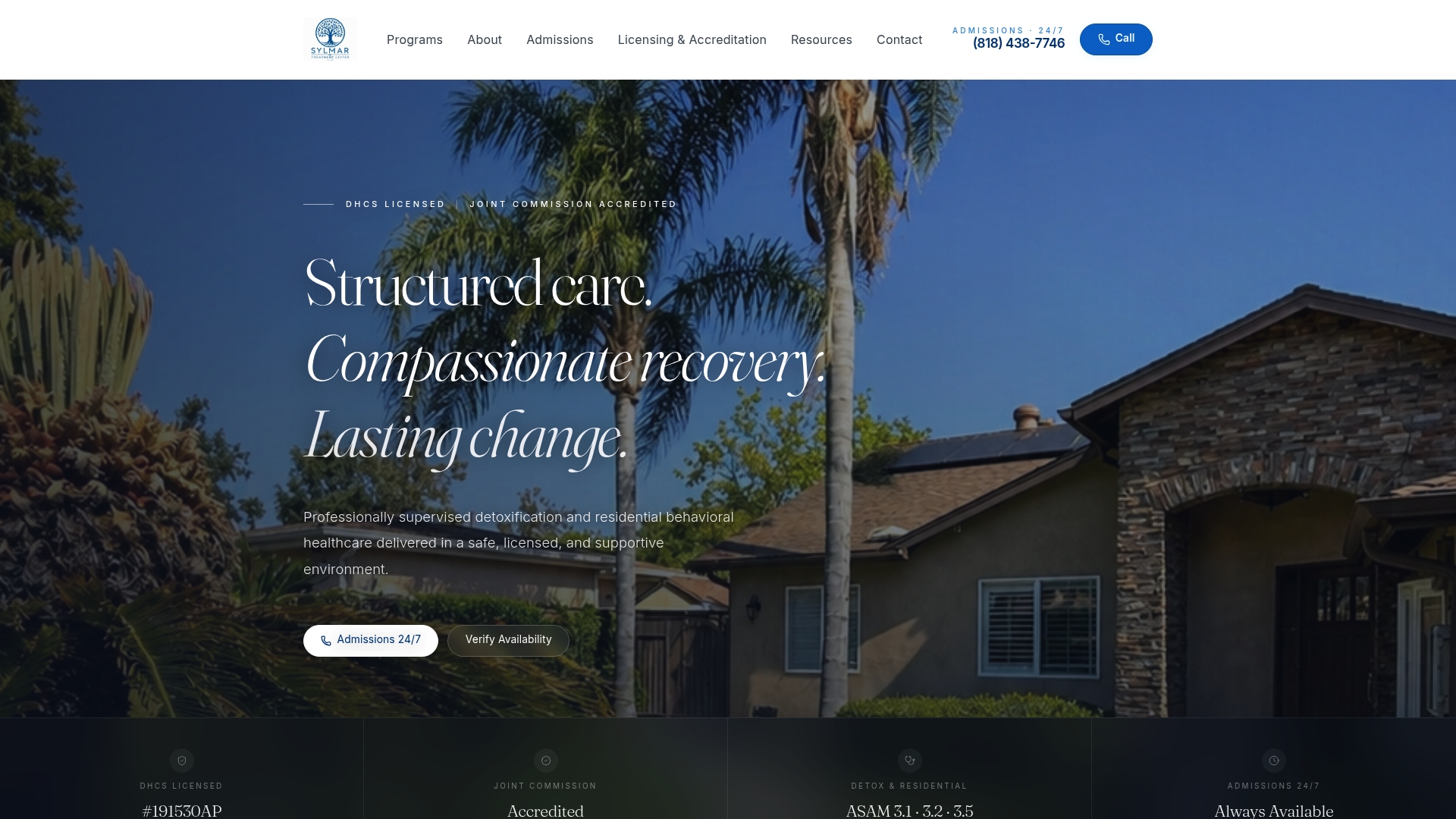
The center’s intimate six-bed setting means every patient receives individualized attention from a clinical team that knows their name and their history. Joint Commission accreditation and a DHCS license back every protocol. Free insurance verification is available by phone, and the team handles prior authorization directly with your insurer. From medical detox through residential treatment, Sylmartreatmentcenter coordinates every step of the care continuum so patients never face a gap between detox and the next phase of recovery. Dual diagnosis support is integrated from day one for patients managing both addiction and mental health conditions.
FAQ
What does 24 hour detox admission mean?
24 hour detox admission means a patient enters a medically supervised facility at any time of day or night and receives continuous clinical monitoring and medication management throughout withdrawal. There is no waiting until business hours.
Is 24 hour medical detox covered by insurance?
Most commercial health plans cover 80–100% of inpatient detox costs after deductibles, and Medicaid covers detox in all 50 states, often at no out-of-pocket cost. The MHPAEA law requires insurers to treat detox coverage at parity with other inpatient medical care.
Why is 24 hour detox safer than quitting at home?
Alcohol and benzodiazepine withdrawal can cause fatal seizures and delirium tremens without warning. A 24-hour facility provides immediate medication response and clinical monitoring that no home setting can replicate.
What happens after 24 hour detox ends?
Clinical staff coordinate a direct handoff to the next level of care, such as inpatient rehab, a PHP, or a MAT program. This coordinated transition is what prevents the dropout gap where relapse most commonly occurs.
How quickly can I get admitted to a 24 hour detox program?
Many facilities, including Sylmartreatmentcenter, offer same-day admission with real-time insurance verification by phone. Calling the admissions line directly is the fastest path to securing a bed.
Recommended
- What Is a 24-Hour Detox Facility? Your Safe Start | Sylmar Treatment Center
- Detox Safety Best Practices: Your 2026 Guide | Sylmar Treatment Center
- Starting Detox in a Six-Bed Facility: A Safety Guide | Sylmar Treatment Center
- How Detox Prepares Patients for Rehab: 2026 Guide | Sylmar Treatment Center