

If you’re facing a deadline, here’s the short version: bring the signed court order with your case number, a government photo ID, any arrest or police reports named in the order, current medical records and a prescription list with dosages and prescriber contact info, prior treatment admission and discharge summaries, recent drug-test results, and a copy of your probation instructions. That’s the core of any court-ordered rehab documentation checklist, and missing even one item can stall an evaluation.
Your next move: call the court clerk or your probation officer before you submit anything. Confirm exactly where documents go and whether the evaluator or treatment provider needs specific credentials on file. Courts vary on this, and a five-minute call saves a rejected packet.
- Signed court order with case number
- Government-issued photo ID
- Arrest or police reports referenced in the order
- Medical records and current prescription list with dosages
- Prior treatment/admission/discharge summaries
- Recent drug-test results
- Probation instructions or referral forms
Pro Tip: Put a one-page cover sheet and table of contents on top of your packet. Evaluators and clerks handle dozens of files a week, and a labeled stack gets processed faster than a loose pile of paper.
Key Takeaways
A court-ordered rehab documentation checklist succeeds when every document carries a verifiable signature, credential, or date that a clerk or probation officer can confirm without a follow-up call.
| Point | Details |
|---|---|
| Confirm recipient first | Call the court clerk or probation officer before submitting anything to verify destination and credential requirements. |
| Match names and dates exactly | Mismatched dates of birth or names across documents are a leading cause of rejection. |
| Lead with credentials | A signed plan of care with an NPI number carries more weight than informal attendance notes. |
| Track every submission | Keep a dated log, receipts, and copies of signed releases in case a dispute arises later. |
| Choose an accredited provider | Sylmar Treatment Center packages POCs, attendance logs, and drug-test results for direct court transmission through its court-directed placement program. |
Table of Contents
- What Documents Go Into a Court Rehab Checklist?
- What Assessment Tools Do Evaluators Use?
- How Do Treatment Programs Document Compliance for Courts?
- How Do You Organize and Submit Your Documents?
- How Long Does Evaluation and Placement Take, and Who Pays?
- Can a Court-Ordered Evaluation Happen by Telehealth?
- How Does an Accredited Provider Package Court Documentation?
- What Privacy Rules Apply to Rehab Records?
- What This Editorial Take Means for Your Court Rehab Checklist
- Getting Court-Directed Placement Right With Sylmar
- Frequently Asked Questions
- Sources
What Documents Go Into a Court Rehab Checklist?
Every document group in a court-ordered rehab documentation checklist serves a specific verification purpose, and courts reject packets more often for formatting problems than missing content.
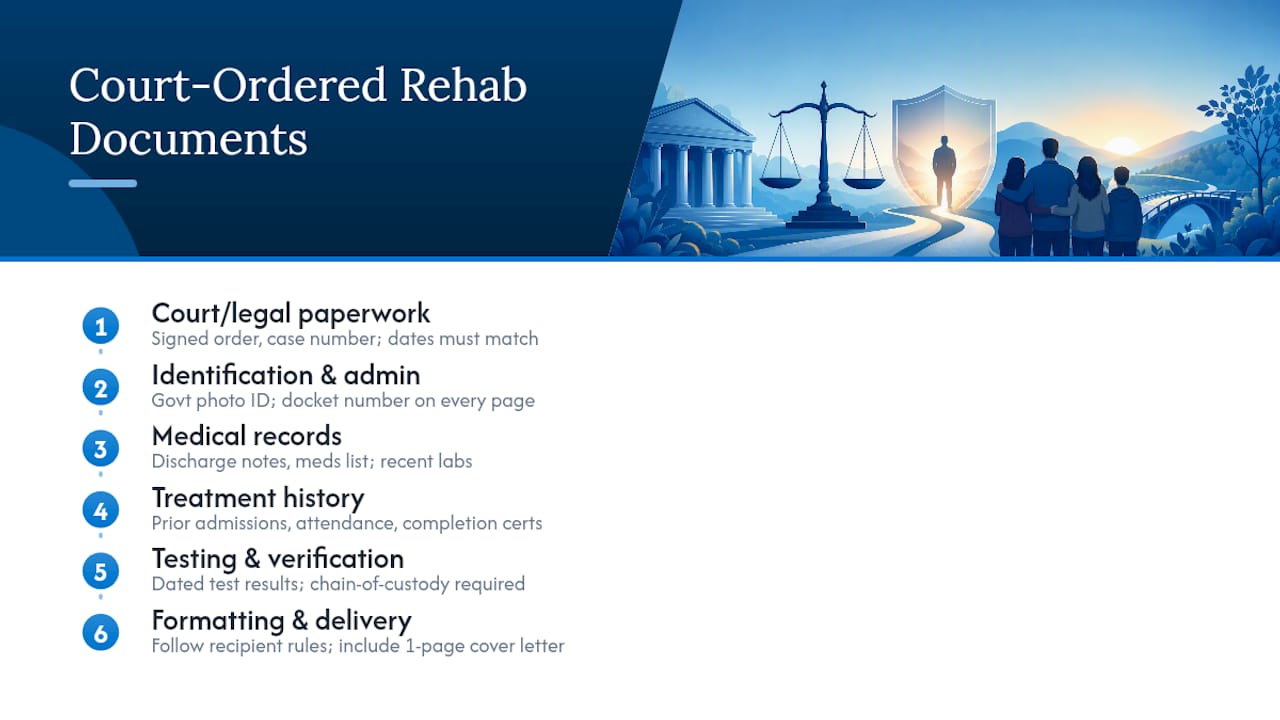
Court and legal paperwork. This means the actual signed court order showing your case number and any required service language, plus the citation or summons and your probation conditions or referral form. Names and dates on these documents need to match your case record exactly. A typo in a middle name or a mismatched date of birth is one of the most common reasons a clerk bounces a submission back.
Identification and administrative items. A government photo ID is standard. Some jurisdictions also want proof of address. Whatever you submit, the court docket number should appear on every single page, not just the cover sheet.
Medical records and prescriptions. Hospital discharge summaries, physician notes, and a current medication list with dosages and prescriber contact information all belong here. Include recent lab results, especially toxicology, since evaluators often cross-check these against your intake interview.
Substance-use and treatment history. Prior admissions, discharge summaries, attendance records, and any completion certificates matter, along with counseling or mutual-help meeting attendance where the order specifies it.
Testing and verification documents. Urine, ETG, or point-of-care testing reports need dates and results that line up with your order’s timeline. Chain-of-custody documentation matters here too, since lab-quality practices around toxicology testing are what courts and providers rely on to trust a result at all.

Formatting and delivery. Some courts want original signed reports, others accept secure electronic transmission, and a few still require notarization. Always check the recipient’s actual instructions rather than assuming last year’s rules still apply.
One thing families underestimate: a treatment provider that supplies stamped, dated attendance logs and lab-certified test reports tends to get its reports accepted without delay, while informal or handwritten summaries often trigger a request for more proof.
Pro Tip: Write a one-page cover letter listing every document in the packet and naming exactly who should receive each one, whether that’s the court clerk, the probation officer, or the treatment provider.
What Assessment Tools Do Evaluators Use?
Evaluators don’t just take your word for it. They lean on standardized screening instruments because scores are comparable across cases and harder to challenge in court.
- AUDIT (Alcohol Use Disorders Identification Test): measures the severity of alcohol use over the past year.
- DAST-10: a ten-item screen for drug involvement and related problems.
- CAGE: four quick questions that flag likely alcohol dependence.
- Standardized mental-health screens: used when a co-occurring disorder is suspected.
These instruments exist because standardized screening reduces variability in what one evaluator recommends versus another. A mild-to-moderate score often points toward outpatient care; a higher-risk score tends to push toward intensive outpatient or residential placement, though the exact threshold depends on the evaluator’s clinical judgment and the court’s own standards.
Evaluators frequently ask for corroborating evidence, meaning your medical records or lab results, to confirm what you reported in the interview. Self-report alone rarely satisfies a judge.
Pro Tip: If you’ve already been screened once, bring that report. Duplicate testing wastes time and sometimes produces a slightly different score that raises unnecessary questions.
How Do Treatment Programs Document Compliance for Courts?
A treatment provider’s paperwork carries as much weight as your own documents, and courts look for specific pieces before they’ll trust a progress report.
The core document is the treatment plan, sometimes called a plan of care or POC. Federal guidance on outpatient therapy documentation requires that a written POC include diagnoses, goals, and the specific therapy type, amount, frequency, and duration, along with the signature and professional identity of whoever established it.
- Dated clinician signatures with NPI or license numbers attached
- Attendance records showing exact dates and times
- Drug-test results tied to the reporting period
- Clinical observations and specific next-step recommendations
Since January 2025, a physician’s or nurse practitioner’s dated signature on the referral can substitute for a separate signature on the initial POC under certain conditions, but timely recertification still matters for showing continued treatment necessity. Beyond the paperwork itself, credentials matter: a provider’s license, Joint Commission accreditation, and NPI number all function as trust signals a probation officer can verify independently.
Pro Tip: Ask whether your court wants reports sent directly from the provider or will accept copies you deliver yourself. Direct provider-to-court delivery is usually the preferred route and avoids any appearance of tampering.
How Do You Organize and Submit Your Documents?
A clean packet beats a thick one. Courts consistently prefer concise, verifiable materials over long narrative explanations.
- Assemble every document from your checklist.
- Build a cover sheet and table of contents.
- Verify your provider’s credentials are current and attached.
- Confirm the exact recipient and delivery method.
- Submit copies, not originals, unless told otherwise, and request a receipt.
- Put the case number and date on every page, not just the first one.
- Track delivery with a stamped copy, an email receipt, or a timestamped PDF.
- Keep a submission log with dates and recipient names.
Rejections usually trace back to a handful of causes: the wrong recipient, a missing signature, mismatched names or dates, or a provider credential that doesn’t check out. Each of those is fixable with an amended report or a certified copy, so don’t panic if a clerk sends something back.
Pro Tip: If a document is genuinely delayed, submit a short cover note explaining why, along with proof you requested it, like an email or a call log. Courts respond better to visible effort than to silence.
How Long Does Evaluation and Placement Take, and Who Pays?
Timelines vary by court, but a few patterns hold up. Initial evaluation appointments often happen within days to a few weeks of the order. Report preparation typically takes several days up to two weeks. Treatment start windows depend on provider availability, though your court order may set a hard deadline regardless.
Cost responsibility splits a few ways. The federal judiciary’s reference materials note that courts sometimes fund treatment through contract placements, while in many cases individuals, families, or insurance cover the cost, depending on the provider and coverage terms.
- Schedule immediately once a deadline is set; don’t wait for a reminder.
- Document any provider waitlist and notify the court proactively.
- Ask the provider whether they bill insurance directly and whether they’ll issue itemized receipts for any cost-sharing the court requires.
Pro Tip: If you anticipate a scheduling or payment problem, document your attempts to resolve it right away and tell your attorney or treatment team. Courts respond far better to a documented effort than to a missed deadline with no explanation.
Can a Court-Ordered Evaluation Happen by Telehealth?
Telehealth evaluations are increasingly common, but they’re not universally accepted. Courts generally allow remote assessment only when the evaluator is licensed in your jurisdiction and the order explicitly permits it.
- Government photo ID visible on camera
- Signed records release forms
- Recent lab results if the evaluator requests them
- A private, quiet space with a stable internet connection
Some courts, and some specific tests, still require in-person evaluation or lab-verified specimens, so don’t assume remote is an option by default.
Pro Tip: Get written confirmation, an email is fine, that a telehealth evaluation will satisfy your specific court order before you schedule the appointment.
How Does an Accredited Provider Package Court Documentation?
Sylmar Treatment Center’s process for court-directed placements shows what a well-run packet actually looks like in practice. The center confirms the court order and case number, verifies its own DHCS licensing and Joint Commission accreditation are current, then compiles a plan of care with dated clinician signatures before sending progress reports to probation or the court directly.
- Intake evaluation summary
- Plan of care with clinician signature and NPI
- Attendance logs
- Drug-test results
- Final completion or discharge summary
Accredited providers with a clear transmission protocol tend to move faster through court review, since a probation officer can verify credentials without extra phone calls. Sylmar’s court-directed placement program follows this exact structure.
Pro Tip: Ask any provider for their court reporting protocol in writing before admission, specifically who receives reports, how often, and whether delivery goes directly to the court or through you.
What Privacy Rules Apply to Rehab Records?
Health records don’t move to a court, probation officer, or attorney without a signed release. That release needs to name the specific recipient, the date range covered, exactly which records are included, and your signature with the date.
Talk to an attorney if the court order is unclear, if noncompliance could mean jail time, or if there’s a dispute over what records the court can actually demand.
- Keep a dated copy of every release you sign.
- Save written confirmation that records were sent under that release.
Pro Tip: File your signed releases in the same folder as your submission log. If a dispute comes up later, you want proof of exactly what you authorized and when.
What This Editorial Take Means for Your Court Rehab Checklist
The advice most families get boils down to “bring your paperwork,” which is technically true and practically useless. What actually determines whether a court accepts your submission is whether the documents were produced by someone whose credentials the court can verify in under five minutes. A stack of handwritten attendance notes from a well-meaning sponsor doesn’t carry the same weight as a signed plan of care with an NPI number attached.
Conventional advice also underplays how much a clean cover sheet matters. Judges and probation officers aren’t reading your file for pleasure. A concise packet with a table of contents gets a faster, more favorable read than a thick folder of loose records, even when the thick folder technically contains more proof.
If you’re prioritizing anything first, prioritize provider credentials over volume. One accredited program’s plan of care will outweigh five pages of informal documentation every time.
Getting Court-Directed Placement Right With Sylmar
Piecing together a court rehab checklist on your own, chasing prescriber signatures, tracking down old discharge summaries, guessing which format a clerk will accept, eats up time you may not have before a deadline. Sylmar Treatment Center handles that packaging work as part of its court-directed placement program: a DHCS-licensed, Joint Commission-accredited six-bed facility that confirms your court order, builds a clinician-signed plan of care with NPI documentation, and transmits progress reports directly to your probation officer or the court on the schedule your order requires.

Because the facility is intimate by design, just six beds, your case manager knows your paperwork status without you having to chase them for updates. If you’re facing a placement deadline, call Sylmar’s admissions team today to confirm timeline, cost responsibility, and exactly which documents they’ll need from you to start the court reporting process.
Frequently Asked Questions
What is the most common reason a court rejects rehab documentation? Mismatched names, dates, or missing case numbers across pages cause more rejections than missing content. Double-check every page carries the correct case number before submission.
Do I need original documents or will copies work? Most courts accept copies, but some require notarization or original signatures for specific items like the treatment plan. Confirm this with the clerk before you submit.
Can a family member submit documentation on behalf of someone in treatment? Only with a signed release naming that family member as an authorized recipient or submitter. Without it, providers generally cannot share health records, even with close relatives.
How do I get a missing document from a previous treatment program? Contact the prior provider’s records department directly and request it in writing, citing the specific date range and your case number, then follow up if you don’t hear back within a few days.
What happens if I miss a court deadline for documentation? Document every effort you made to resolve the delay, provider waitlists, scheduling conflicts, and notify your attorney or the court immediately rather than letting the deadline pass silently.
This article is general information, not a substitute for advice from a qualified lawyer. Consult a qualified legal professional about your own circumstances before acting on anything here.
Sources
- Complying with Outpatient Rehabilitation Therapy Documentation Requirements (MLN905365)
- Substance Use Disorders reference materials — U.S. Courts
- TT or NTT? A primer on urinary drug testing — CDC (lab-quality guidance)