

At your first contact with a facility, say this: “I need a written, individualized care plan based on a comprehensive intake assessment, and I’d like to schedule a care-team meeting within the first week.” That single sentence puts the facility on notice that you know what good care looks like and that you expect documentation. A realistic outcome from asking well: a documented intake assessment completed within 24–72 hours of admission, a written care plan signed by your clinical team, scheduled reviews at 30, 60, and 90 days, and a clear record of family involvement. Facilities that meet the Joint Commission standard and hold a state DHCS license are required to support this process. Sylmartreatmentcenter is one example of a licensed, accredited provider that builds individualized programs from a comprehensive intake forward.
Why this matters immediately:
- Individualized approaches match therapy type, intensity, and medication to your specific clinical history rather than a default group schedule.
- Personalized treatment decision-support methods have shown that better alternative treatment options were available for most patients when clinicians used precision-cohort analytics across several chronic disease categories.
- Asking clearly and early creates a paper trail that protects you if care quality slips later.
Pro Tip: Write down your three most important treatment needs before your first call. Facilities that genuinely offer individualized care will ask about them. Ones that don’t are a signal worth noting.
Table of Contents
- What “individualized care” actually means in a rehab setting
- Core components every individualized care plan should include
- Why individualized care improves outcomes
- How to request individualized care: a step-by-step approach
- Questions to ask a rehab facility: a printable checklist
- What to expect in the care-planning process and timeline
- Costs, insurance, and verifying coverage for individualized services
- U.S. rights, regulations, and quality signals to watch for
- How to tell if care is genuinely individualized
- How Sylmartreatmentcenter implements individualized care
- Key Takeaways
- The gap between “individualized” and actually individualized
- Sylmartreatmentcenter: where individualized care is the starting point
- Useful U.S. sources to check before choosing a facility
What “individualized care” actually means in a rehab setting
Individualized care centers the whole person, not just the diagnosis. Where a standard rehab model assigns patients to a fixed group schedule and a generic 28-day curriculum, an individualized program starts with a thorough intake assessment covering medical history, psychiatric status, substance use patterns, social circumstances, and personal goals. From there, the clinical team builds a therapy schedule, medication plan, and aftercare strategy specific to that person.

You’ll see this concept marketed under several labels: “personalized treatment,” “custom care plan,” “bespoke program,” or “individualized treatment.” In practice, they should all mean the same thing: a written plan that reflects your history and gets updated as you progress.
| Feature | Standard/Group Model | Individualized Model |
|---|---|---|
| Intake depth | Basic screening | Comprehensive medical, psychiatric, and social assessment |
| Therapy schedule | Fixed group sessions | Mix of one-on-one and optional groups, chosen by clinical fit |
| Co-occurring disorders | Often referred out | Treated on-site, integrated into the plan |
| Plan updates | Rarely documented | Scheduled reviews at 30, 60, and 90 days with written notes |
| Family involvement | Minimal | Structured, documented, and part of the plan |
| Client decision-making | Low | High — preferences and goals shape the plan |
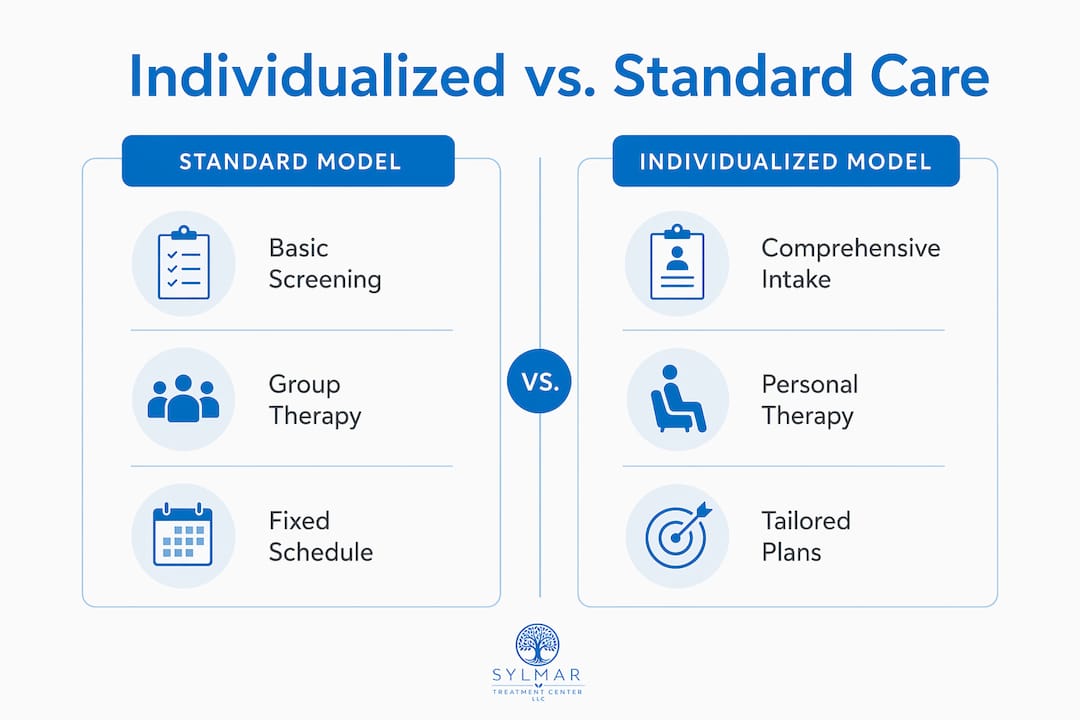
One distinction worth knowing: individualized treatment looks beyond biological markers to life circumstances, values, and personal preferences. A good program asks what matters to you, not just what substance you used.
Core components every individualized care plan should include
A genuine individualized plan has specific, verifiable elements. If a facility claims to offer personalized care but can’t show you most of these in writing, treat that as a gap.
- Comprehensive intake assessment: Covers medical history, psychiatric diagnoses, substance use history, functional needs, trauma history, and social supports. This is the foundation everything else is built on.
- Measurable, written goals: Not “client will improve,” but “client will attend three individual therapy sessions per week and demonstrate two coping strategies by day 30.” Vague goals are unenforceable.
- Individualized therapy schedule: One-on-one sessions with a primary therapist, with group attendance based on clinical fit rather than mandatory attendance. Modalities like CBT, DBT, EMDR, or family therapy are chosen based on your history, not facility convenience.
- Integrated co-occurring disorder treatment: If you have a dual diagnosis, both conditions are treated together on-site, not sequentially or by referral.
- Medication management with psychiatric oversight: A psychiatrist or prescribing clinician reviews and documents medication decisions, not just a general counselor.
- Written aftercare and relapse-prevention plan: Produced before discharge, not handed to you on the way out the door.
- Scheduled plan reviews: Documented check-ins at 30, 60, and 90 days where the plan is formally updated based on progress.
- Family involvement strategy: A documented plan for how family members participate, including communication policies and scheduled family sessions.
Pro Tip: Ask specifically: “How many individual therapy sessions per week are included in my plan, and who decides that number?” If the answer is “it depends on the group schedule,” the program is group-first, not person-first.
Why individualized care improves outcomes
The logic behind personalized treatment is straightforward: the same intervention doesn’t work equally well for every person. Personalized medicine uses individual characteristics to select more effective treatments, reducing both adverse outcomes and wasted time on approaches that don’t fit.
In addiction treatment specifically, this matters because substance use disorders rarely travel alone. Co-occurring depression, anxiety, PTSD, or bipolar disorder change which therapies work and which medications are safe. Treating only the substance use while ignoring a psychiatric condition is one of the most common reasons people relapse after discharge.
AI-augmented personalized treatment systems and precision-cohort analytics have shown measurable improvements when clinicians use data-driven decision support to match patients to therapies. The mechanism isn’t magic: it’s simply that a plan built around your actual history is more likely to address the real drivers of your substance use than a plan built around a facility’s default schedule.
Evidence note: A precision-cohort study published in Scientific Reports found that better alternative treatment options were available for the majority of cases across several chronic disease categories when clinicians used patient-similarity analytics at the point of care.
Individualized care is especially valuable for people with co-occurring disorders, those who have tried standard group-based programs without success, and anyone whose clinical picture is complex enough that a one-size schedule would miss key needs.
How to request individualized care: a step-by-step approach
Knowing what to ask is half the work. Here’s a practical sequence you can follow from first contact through your first week in the program.
- Before you call: Write a one-page summary of your medical history, current medications, psychiatric diagnoses, and the three treatment needs that matter most to you. Bring this to every conversation. Families preparing for a loved one’s admission can use a family intake guide to organize this information.
- At the admissions call: Ask directly: “Does your program produce a written, individualized care plan for each patient based on a comprehensive intake assessment?” If the answer is vague, ask for a sample plan format.
- At intake: Use the script from the opening of this article. Add: “I’d like to know who my primary therapist will be and when we’ll have our first one-on-one session.”
- Request a care-team meeting: Within the first week, ask for a meeting with your clinical team to review the intake findings and confirm your written plan. This is standard in quality programs.
- Confirm review dates: Before the meeting ends, get the dates of your 30-day and 60-day plan reviews in writing.
- Document everything: Keep copies of your intake summary, written care plan, medication orders, consent forms, and any review notes. Under 42 CFR Part 2, your substance use records have specific privacy protections, and you have the right to request copies.
Sample script for patients at intake: “I want to make sure my treatment plan is built around my specific history. Can we schedule a care-team meeting this week to review my intake assessment and put a written plan in place? I’d also like to know the dates for my 30- and 60-day reviews.”
Sample script for families: “We’d like to understand how our family member’s care plan will be individualized. Who is the primary clinician we should speak with, and how will family involvement be documented in the plan?”
Pro Tip: If a facility says they don’t provide written care plans or that reviews happen “as needed,” ask for their accreditation documentation. Joint Commission-accredited facilities are required to maintain documented, reviewed care plans.
Questions to ask a rehab facility: a printable checklist
Use these during facility tours, admissions calls, and care-team meetings. A facility that welcomes these questions is a facility worth considering.
Licensing and accreditation:
- Are you licensed by the state (e.g., DHCS in California)?
- Do you hold Joint Commission accreditation? Can I verify your accreditation number?
- What credentials do your clinical staff hold?
Assessment depth:
- What does your intake assessment cover? Does it include psychiatric screening and co-occurring disorder evaluation?
- Who conducts the assessment, and how long does it take?
Therapy and treatment:
- How many individual therapy sessions per week are included?
- Which therapy modalities do you use, and how are they selected for each patient?
- Is group therapy mandatory, or is attendance based on clinical fit?
Plan documentation and reviews:
- Will I receive a written care plan? When?
- How often is the plan reviewed, and who participates in those reviews?
- How are plan changes documented?
Family involvement:
- How is family included in the care-planning process?
- What is your communication policy with family members?
- Are family therapy sessions available?
Aftercare:
- When does aftercare planning begin?
- What does the written aftercare plan include?
Insurance and payment:
- Which insurance plans do you accept?
- Can you provide billing codes (CPT codes) so I can verify coverage with my insurer before admission?
- Will you provide an itemized estimate of costs?
Pro Tip: Ask the admissions coordinator to send you the facility’s accreditation number in writing. You can verify Joint Commission status directly at qualitycheckjointcommission.org.
What to expect in the care-planning process and timeline
The intake-to-plan sequence in a residential program follows a predictable pattern in quality facilities. Knowing the timeline helps you spot delays.
- Pre-admission screening: A phone or video call to assess clinical appropriateness, insurance, and immediate medical needs. Usually completed before arrival.
- Comprehensive intake assessment (first 24–72 hours): A full medical, psychiatric, and psychosocial evaluation. This is the document everything else is built from. You or your family should receive a summary.
- Multidisciplinary care-team meeting (within the first week): Your primary therapist, psychiatrist or prescribing clinician, and case manager review the intake findings together and produce the written care plan. You should be present or represented.
- Written plan delivery: The signed care plan should be in your hands within the first week, not at the end of the program.
- Scheduled reviews: Quality programs review and update the plan at 30, 60, and 90 days. Each review should produce a written update signed by the clinical team.
“A personalised care and support plan must be developed following an initial holistic assessment about the person’s health and well-being needs. The person, or their family, work hand-in-hand with their health and social care professionals to complete this assessment.” This principle applies directly to residential addiction treatment: the plan is a collaborative document, not something handed down to you.
Pro Tip: If you’re past day five and haven’t seen a written plan, ask your primary therapist in writing (email or a dated note) when you can expect it. A written request creates a record and usually accelerates the process.
Costs, insurance, and verifying coverage for individualized services
What drives cost in individualized residential care: the ratio of clinical staff to patients, the presence of on-site psychiatric oversight, private versus shared rooms, and the frequency of one-on-one therapy. A six-bed facility with a psychiatrist on staff and daily individual sessions costs more than a 40-bed facility running mostly group programming. The difference is clinical capacity, not luxury.
How to verify insurance coverage:
- Ask the admissions team for the specific CPT codes they bill for individual therapy, psychiatric evaluation, and medication management.
- Call your insurer’s behavioral health line with those codes and ask whether they are covered under your plan and at what level (in-network vs. out-of-network).
- Request a pre-authorization in writing before admission. Verbal approvals are not binding.
- Ask the facility to provide an itemized estimate of costs not covered by insurance.
- Get any denial or approval in writing. If coverage is denied, ask the facility’s billing team about the appeals process.
Coverage note: The Mental Health Parity and Addiction Equity Act requires most U.S. insurance plans to cover substance use disorder treatment at the same level as medical or surgical care. If your insurer applies stricter limits to addiction treatment than to comparable medical services, that may be a parity violation worth appealing.
Pro Tip: Before admission, ask the facility: “If my insurer requires a concurrent review after day seven, who handles that communication on your end?” Facilities with dedicated utilization review staff are less likely to have coverage gaps mid-treatment.
U.S. rights, regulations, and quality signals to watch for
You have specific rights as a patient in a U.S. residential addiction treatment program. Knowing them makes advocacy easier.
Key quality signals to verify:
- Joint Commission accreditation: Verifiable online. Accredited facilities must maintain documented, reviewed care plans and meet staffing and safety standards.
- State licensure: In California, the Department of Health Care Services (DHCS) licenses residential treatment facilities. Other states have equivalent licensing bodies. Ask for the license number and verify it on the state agency’s website.
- Credentialed staff: Licensed clinical social workers (LCSWs), licensed professional counselors (LPCs), licensed marriage and family therapists (LMFTs), and board-certified addiction psychiatrists are the credentials to look for.
- Documented comprehensive intake: A facility that cannot show you a structured intake assessment form is a facility that may not be conducting one.
Privacy and records:
- Under 42 CFR Part 2, your substance use disorder treatment records have stronger privacy protections than standard medical records. Facilities cannot disclose them without your written consent except in specific circumstances.
- HIPAA applies to all health information. You have the right to request copies of your records.
If you suspect poor care, here’s how to escalate:
- Document the concern in writing with dates, names, and specific incidents.
- Request a meeting with the clinical director or facility administrator.
- If unresolved, file a complaint with the state licensing board (e.g., DHCS in California).
- File a complaint with the Joint Commission at jointcommission.org/report-a-concern.
- Contact SAMHSA’s National Helpline (1-800-662-4357) for guidance on patient rights and alternative resources.
Pro Tip: Keep a dated log of every conversation with clinical staff, including who said what and when. If you ever need to file a complaint, this log is your most useful document.
How to tell if care is genuinely individualized
The difference between a facility that markets individualized care and one that actually delivers it shows up in documentation and daily practice.
| Good practice signals | Red flags |
|---|---|
| Written care plan delivered within the first week | No written plan, or “we’ll get to that” |
| Measurable, specific goals tied to your history | Vague goals like “improve coping skills” |
| Psychiatric involvement in medication decisions | Medications managed by non-prescribing staff |
| Scheduled reviews at 30, 60, and 90 days | Reviews happen “as needed” with no dates |
| Family involvement documented in the plan | Family contact discouraged or undocumented |
| Group attendance based on clinical fit | Mandatory group schedule for all patients |
| Written aftercare plan before discharge | Aftercare discussed verbally at discharge |
| Co-occurring disorders treated on-site | Psychiatric issues referred out or ignored |
If red flags appear, here’s how to escalate:
- Put your concern in writing and give it to your primary therapist. Ask for a written response within 48 hours.
- If no response, request a meeting with the clinical director.
- Ask specifically: “Can you show me my written care plan and the documentation of my last plan review?”
- If the facility cannot produce these documents, contact the state licensing board.
- If you or a family member is in immediate clinical danger, contact 911 or the facility’s 24/7 clinical line.
Script for raising a concern: “I’ve noticed that my care plan hasn’t been updated since admission. I’d like to schedule a care-team review this week and receive a written update. Can you confirm who will arrange that?”
How Sylmartreatmentcenter implements individualized care
Sylmartreatmentcenter operates as a six-bed residential facility, which means the staff-to-patient ratio is high enough to make individualized care a practical reality rather than a marketing claim. The small census allows the clinical team to conduct thorough intake assessments, build written care plans specific to each patient, and adjust those plans as treatment progresses.
Trust signals you can verify at Sylmartreatmentcenter:
- Joint Commission accreditation: Verifiable through the Joint Commission’s online Quality Check tool.
- DHCS licensure: California Department of Health Care Services license, verifiable on the DHCS website.
- 24/7 admissions availability: Clinical staff are reachable around the clock, which matters when a family is in crisis outside business hours.
- Dual-diagnosis treatment on-site: Co-occurring mental health and substance use disorders are treated together, not sequentially. The integrated dual diagnosis approach means a patient with depression and alcohol use disorder gets both addressed in the same program.
- Psychiatric oversight: Medication management is handled with psychiatric involvement, not delegated to counseling staff.
- Evidence-based modalities: CBT, DBT, and other clinically validated approaches are used based on individual clinical fit.
- Written, reviewed care plans: Plans are produced from the intake assessment and reviewed on a scheduled basis.
Families can ask Sylmartreatmentcenter’s admissions team directly for a description of the intake process, the care-plan format, and the review schedule before committing to admission. That conversation itself is a quality signal.
Key Takeaways
Asking for individualized care in rehab starts with one sentence at intake, but it requires documentation, scheduled reviews, and verified accreditation to be real.
| Point | Details |
|---|---|
| Use the script at intake | Ask for a written, individualized care plan and a care-team meeting within the first week. |
| Verify accreditation and licensure | Confirm Joint Commission status and state DHCS licensure before admission using public verification tools. |
| Insist on written documentation | Request your intake summary, written care plan, medication orders, and scheduled review dates in writing. |
| Check insurance before admission | Get CPT codes from admissions, call your insurer’s behavioral health line, and obtain pre-authorization in writing. |
| Sylmartreatmentcenter | A six-bed, Joint Commission-accredited, DHCS-licensed facility offering individualized treatment, dual-diagnosis support, and 24/7 admissions. |
The gap between “individualized” and actually individualized
Most families arrive at a rehab facility relieved just to have found a bed. That relief is understandable, and facilities know it. The problem is that “individualized care” has become a marketing phrase that appears on nearly every program’s website, regardless of what the program actually delivers. A facility can call its care individualized while running every patient through the same group schedule, the same 28-day curriculum, and the same discharge checklist.
The tell is always in the documentation. A program that genuinely builds care around each patient can show you a written plan with specific goals, a named primary therapist, a scheduled review date, and a documented rationale for every therapy modality chosen. A program that uses “individualized” as a synonym for “we’re not a prison” cannot.
Families who ask the questions in this article before admission are not being difficult. They are doing exactly what quality facilities expect and welcome. The admissions coordinator who gets annoyed by a question about the written care plan format is telling you something important about how the facility handles clinical accountability once you’re inside.
The other thing worth saying: individualized care is not universally superior for every person in every situation. For someone who thrives in community and finds group accountability motivating, a strong group-based program may be the better fit. The goal is match, not prestige. What makes a program worth choosing is whether it can honestly assess your needs and build a plan around them, not whether it uses the right vocabulary.
Sylmartreatmentcenter: where individualized care is the starting point
Recovery looks different for everyone, and Sylmartreatmentcenter’s individualized treatment programs are built around that reality. The six-bed residential setting means your care plan isn’t a template, it’s a document built from your intake assessment by a clinical team that knows your name and your history.
For families dealing with co-occurring mental health and substance use disorders, Sylmartreatmentcenter’s dual-diagnosis support integrates psychiatric care directly into the treatment plan. Admissions staff are available 24/7 to walk you through the intake process, explain the care-plan format, and verify insurance coverage before you commit. If you’re ready to ask the right questions and want a facility that expects them, contact Sylmartreatmentcenter to start the conversation.
Useful U.S. sources to check before choosing a facility
These are the authority resources worth bookmarking when you’re evaluating a rehab program or verifying a facility’s claims.
- The Joint Commission Quality Check (qualitycheck.org): Search any facility by name to verify current accreditation status, accreditation type, and any public reports. This is the fastest way to confirm a facility’s accreditation claim.
- SAMHSA’s Treatment Locator (findtreatment.gov): The federal database of licensed treatment facilities. Filter by state, level of care, and payment type. Each listing shows state licensure status.
- California DHCS License Verification (dhcs.ca.gov): For California facilities, verify the license number, license type, and current status directly on the DHCS website.
- NCBI / NIH on personalized medicine (ncbi.nlm.nih.gov): Background on how personalized approaches improve treatment selection, useful for understanding the clinical rationale behind individualized care.
- Sylmartreatmentcenter program pages (sylmartreatmentcenter.com/programs): Descriptions of individualized treatment, dual-diagnosis support, and residential care, plus direct admissions contact.
This article provides general information about requesting individualized care in U.S. rehabilitation settings. It is not a substitute for professional medical, legal, or clinical advice. Verify current licensing, accreditation, and insurance coverage directly with the relevant facility, insurer, or regulatory body for your specific situation.