
A treatment center intake is the formal admission process where clinical staff collect your medical history, substance use background, and mental health information to build a personalized treatment plan. Known in clinical settings as a biopsychosocial assessment or admissions evaluation, intake is the foundation of every effective addiction recovery program. Without it, clinicians cannot match you to the right level of care, manage withdrawal risks, or address co-occurring mental health conditions. Understanding what happens during intake removes the fear of the unknown and helps you walk through the door prepared.
What is a treatment center intake, step by step?
The treatment center admission process begins before you arrive and unfolds in distinct stages. Each stage serves a specific clinical purpose.
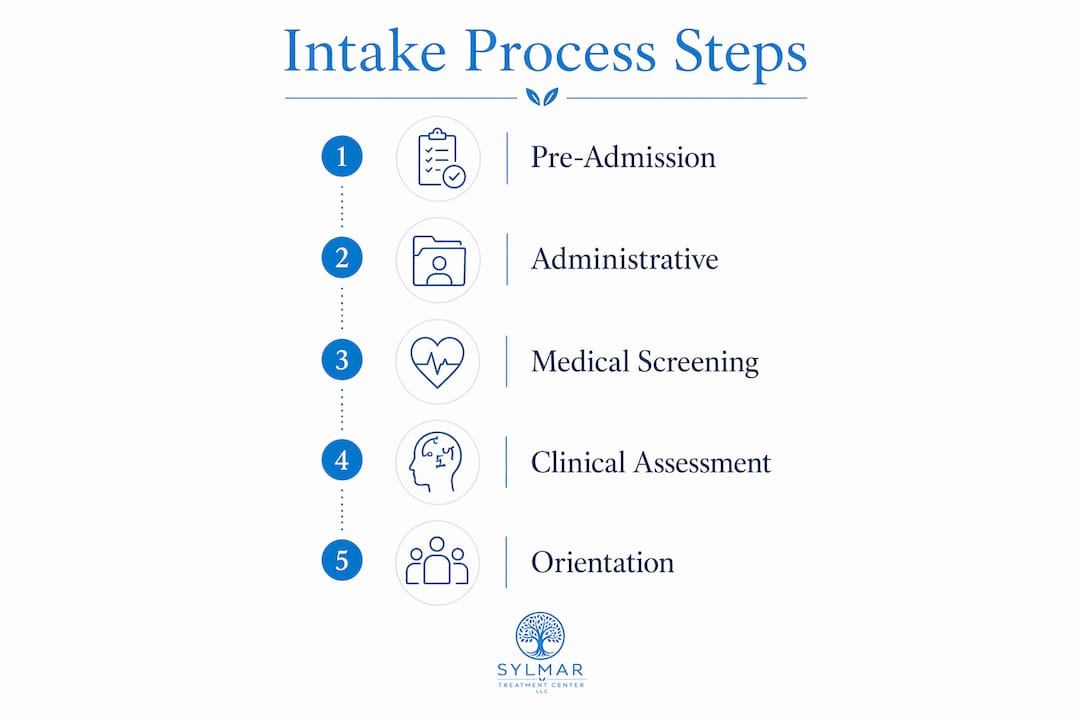
Step 1: Pre-admission contact. A staff member calls to verify insurance, confirm your arrival time, and collect basic identifying information. This step reduces paperwork delays on arrival day.

Step 2: Administrative intake. You complete consent forms, release of information documents, and financial agreements. Admissions staff walk you through each form so nothing is signed blindly.
Step 3: Medical screening. A nurse or physician reviews your current medications, vital signs, and physical health. This step identifies immediate withdrawal risks and any conditions requiring medical attention before treatment begins.
Step 4: Clinical assessment. A counselor or licensed therapist conducts a structured interview covering your substance use history, mental health symptoms, trauma history, and social environment. This is the core of the intake process for rehabilitation.
Step 5: Orientation. Staff introduce you to the facility, explain daily schedules, and outline program rules. Intake may include facility tours, staff introductions, and initial group meetings depending on arrival time and patient readiness.
The full intake process typically takes 1–2 hours, though some centers spread assessments across the first few days. That timeline reflects the depth of information clinicians need to build an accurate care plan.
Pro Tip: Bring a written list of all current medications, including dosages, to your intake appointment. Nurses need exact details to assess withdrawal risk and prevent dangerous drug interactions.
How do treatment centers use assessment tools during intake?
Validated assessment tools are the clinical backbone of any addiction treatment intake process. They standardize data collection and reduce the risk of missed diagnoses.
The most widely used framework is the ASAM Criteria, a multidimensional tool developed by the American Society of Addiction Medicine. It evaluates six dimensions during intake:
- Withdrawal potential: Risk and severity of withdrawal symptoms
- Biomedical conditions: Physical health issues that affect treatment
- Emotional and behavioral conditions: Mental health diagnoses and psychological stability
- Readiness to change: Motivation level and treatment engagement
- Relapse potential: History of relapse and triggers
- Recovery environment: Housing, family support, and social stability
ASAM’s multidimensional approach ensures that treatment placement matches diverse patient needs beyond just substance type or severity. A patient with severe alcohol withdrawal and untreated depression requires a very different placement than someone with mild cannabis use and strong family support. The six dimensions capture that difference precisely.
The National Institute on Drug Abuse (NIDA) publishes validated screening tools organized by substance type, age group, and administration method. Examples include the TAPS Tool for adults and specialized adolescent screening instruments. These tools give clinicians a fast, reliable snapshot of substance use risk before the longer clinical interview begins.
Structured screening tools are often paired with longer biopsychosocial interviews for complete care planning. This combination reduces redundant questioning across multiple staff members and improves the patient experience. You answer the detailed questions once, and the information flows accurately through the clinical team.
“High-quality intake documentation and precise details in all assessment dimensions help prevent placement mismatches that can cause premature treatment changes.” — Center for Health Care Strategies, ASAM Criteria Assessment Interview Guide
The practical implication is direct. Vague or incomplete answers during intake can result in a level of care that is too low or too high for your actual needs. Clinicians rely on recent use patterns, withdrawal history, current medications, mental health symptoms, and environmental factors to justify every placement decision.
How does intake differ across treatment settings?
The treatment facility entry assessment looks different depending on whether you are entering inpatient, residential, outpatient, or detox care. Understanding those differences helps families set accurate expectations.
| Setting | Intake length | Medical focus | Key priorities |
|---|---|---|---|
| Medical detox | 2+ hours | High: continuous monitoring | Withdrawal safety, medication protocols |
| Inpatient residential | 1–2 hours | Moderate to high | Full biopsychosocial assessment, orientation |
| Outpatient (IOP/PHP) | 1–2 hours | Lower | Scheduling, daily life integration, safety screening |
| Telehealth outpatient | 30–60 minutes | Low | Screening tools, digital consent, care coordination |
Inpatient and detox intake processes are generally more comprehensive and medically intensive than outpatient procedures. Inpatient intake includes continuous monitoring and detailed medical history review to manage withdrawal safely. Outpatient intake focuses more on scheduling logistics and less on immediate medical detox needs.
For families, the most important distinction is this: if your loved one is physically dependent on alcohol, benzodiazepines, or opioids, the intake team at a detox or inpatient program will prioritize medical stabilization above all else. The detox assessment process includes specific protocols for monitoring vital signs and administering medications to prevent dangerous withdrawal complications.
Outpatient intake is less medically intensive but no less thorough on the clinical side. Counselors still conduct full substance use and mental health screenings. The difference is that you return home after each session, so the intake team pays particular attention to your home environment, support system, and daily schedule.
Pro Tip: If you are unsure which setting is right for your situation, ask the intake coordinator directly during your first call. A good admissions team will assess your needs honestly and recommend the appropriate level of care, even if that means referring you elsewhere.
How to prepare for the intake process
Preparation reduces anxiety and produces better clinical outcomes. The intake team is not there to judge you. They are there to understand your full picture so they can help effectively.
Bring the following to your intake appointment:
- A photo ID and insurance card
- A complete list of current medications with dosages
- Names and contact information for your primary care physician
- Any prior treatment records or discharge summaries you have access to
- A list of known allergies and current medical conditions
Honesty during the assessment is the single most important factor in your intake outcome. A thorough intake is foundational for creating personalized treatment plans, setting the correct level of care, and ensuring patient safety. Minimizing your substance use history or hiding mental health symptoms leads directly to a care plan that does not fit your actual needs.
Families can support the process by gathering medical records in advance and writing down a timeline of observed substance use behaviors. Intake counselors often ask family members for collateral information, especially when the patient is in early withdrawal and may not recall recent events clearly.
Pro Tip: Write down three to five questions you want to ask the intake team before you arrive. Good questions include: What does a typical day look like? How will my mental health needs be addressed? What happens if I need a higher level of care mid-treatment?
Questions to ask the intake team include how they handle co-occurring mental health conditions, what the dual diagnosis support process looks like, and how family members can stay involved in treatment. These questions signal to the clinical team that you are engaged and ready to participate fully.
Key takeaways
A thorough treatment center intake is the single most important factor in matching patients to the right level of care, preventing placement errors, and building a treatment plan that addresses the full scope of their needs.
| Point | Details |
|---|---|
| Intake defines your care plan | Clinical staff use intake data to match you to the correct treatment level and address all health dimensions. |
| ASAM Criteria guides placement | The six-dimension framework prevents one-size-fits-all treatment by capturing medical, mental, and social factors. |
| Honesty improves outcomes | Accurate answers during intake directly determine whether your care plan fits your actual needs. |
| Setting shapes intake intensity | Detox and inpatient intake is more medically intensive than outpatient; both require full clinical screening. |
| Preparation reduces delays | Bringing medication lists, prior records, and insurance information speeds up the process and improves accuracy. |
What I’ve learned from watching intake done right and wrong
After years of working in and around addiction treatment, I can tell you that intake quality is the clearest predictor of treatment success I have ever seen. A rushed or superficial intake does not just miss information. It sets the entire treatment trajectory off course.
The most common mistake I see is patients minimizing their use out of shame or fear of judgment. The intake team has heard every story. They are not there to evaluate your character. They are there to build a clinical picture accurate enough to keep you safe. When patients are honest, even about the things they are most ashamed of, the care plan that follows is genuinely built for them.
The second mistake I see is families withholding information because they want to protect their loved one. A family member who tells the intake counselor “it’s not that bad” when it clearly is can inadvertently push their loved one into a lower level of care than they need. That mismatch often leads to early discharge and relapse.
The best intakes I have witnessed share one quality: the clinician makes the patient feel safe enough to tell the truth. That is not a soft skill. It is a clinical competency. When you are choosing a treatment center, ask how long their intake process takes and who conducts it. A center that rushes intake or assigns it entirely to administrative staff is cutting corners on the most critical step in your care.
— Jim
Sylmartreatmentcenter’s approach to personalized intake and recovery
Sylmartreatmentcenter operates with a six-bed residential model, which means every intake is conducted with the full attention of a dedicated clinical team rather than processed through a high-volume admissions pipeline.
The center’s medical detox program begins with a thorough clinical intake that covers withdrawal risk, co-occurring mental health conditions, and environmental factors. For patients managing both addiction and a mental health diagnosis, the dual diagnosis program integrates psychiatric evaluation directly into the intake process. Sylmartreatmentcenter holds both a DHCS license and Joint Commission accreditation, which means its intake and assessment protocols meet independently verified clinical standards. If you or a family member is ready to take the first step, the admissions team is available 24/7 to walk you through what to expect.
FAQ
What does a treatment center intake involve?
A treatment center intake involves administrative paperwork, medical screening, and a clinical assessment covering substance use history, mental health, and social circumstances. The goal is to gather enough information to build an individualized treatment plan.
How long does the intake process take?
The intake process typically takes 1–2 hours, though some centers spread assessments over the first few days depending on program type and patient condition.
What questions are asked during intake?
Intake assessment questions cover current and past substance use, withdrawal history, mental health symptoms, medications, trauma history, living situation, and support systems. Clinicians use tools like the ASAM Criteria and NIDA screening instruments to structure these questions.
Is the intake process different for detox vs. outpatient programs?
Yes. Detox and inpatient intake is more medically intensive, focusing on withdrawal safety and continuous monitoring. Outpatient intake focuses more on scheduling, daily life integration, and clinical screening without the same level of medical oversight.
What should I bring to a treatment center intake?
Bring a photo ID, insurance card, a complete medication list with dosages, prior treatment records if available, and contact information for your primary care physician. Accurate documentation speeds up the process and improves the quality of your care plan.
Recommended
- Integrated Treatment Plan Creation Guide for Families | Sylmar Treatment Center
- Choosing Residential Addiction Treatment: A Family Guide | Sylmar Treatment Center
- Role of Treatment Centers in Legal Cases: 2026 Guide | Sylmar Treatment Center
- What Does Detox Involve for Families: A Guide | Sylmar Treatment Center