

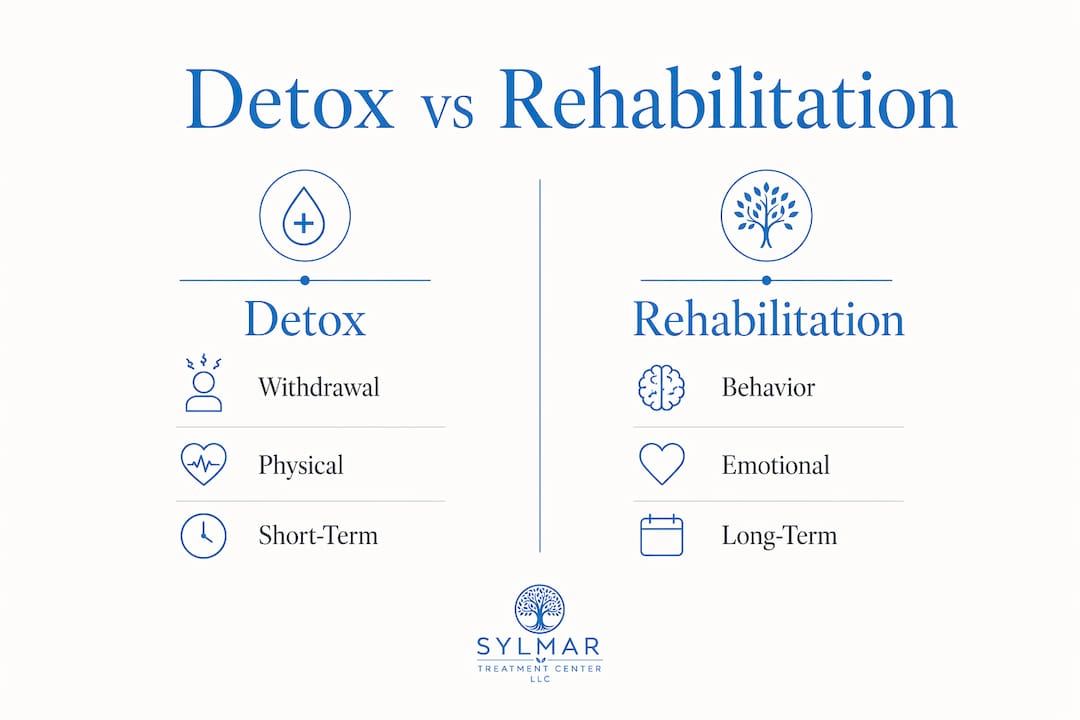
Detox is defined as the medically supervised process of clearing substances from the body and managing withdrawal symptoms safely. Rehabilitation, by contrast, is the therapeutic process that changes behaviors, builds coping skills, and addresses the root causes of addiction. These two phases serve completely different clinical purposes, yet both are necessary for lasting recovery. Authorities like NIDA, SAMHSA, and ASAM consistently describe detox and rehab as complementary and sequential steps, not interchangeable options. Understanding the detox vs rehabilitation differences explained in this guide will help you make informed decisions about treatment planning from day one.
What is detox and how does it work?
Detox is the first clinical phase of addiction treatment, focused entirely on physical stabilization. Detox typically lasts 3–10 days, depending on the substance, the severity of dependence, and the patient’s medical history. That short window is medically intense, not a rest period.
Medical supervision during detox varies by risk level. ASAM criteria define two key levels for withdrawal management:
- ASAM Level 3.7 (medically monitored): 24-hour nursing care with physician availability, used for moderate-to-severe withdrawal outside a hospital setting.
- ASAM Level 4.0 (medically managed inpatient): Hospital-based daily physician management for life-threatening withdrawal or acute psychiatric conditions.
Alcohol and benzodiazepine withdrawal can cause seizures and delirium tremens, making Level 4.0 the appropriate choice for those cases. Opioid withdrawal is rarely fatal but is intensely uncomfortable, and medications like buprenorphine and methadone reduce both symptoms and overdose risk. Detox settings range from hospital units and dedicated detox facilities to certified opioid treatment programs (OTPs) and, for lower-risk cases, outpatient or telehealth programs.
The goal of detox is physiological stabilization only. It does not change thought patterns, address trauma, or teach relapse prevention skills. Patients who complete detox are physically stable but remain at high risk without the behavioral work that follows.
Pro Tip: Ask any detox facility whether they coordinate rehab placement before discharge. Facilities that plan the next step during intake give patients a measurable safety advantage.
What is rehabilitation and how does it support long-term recovery?
Rehabilitation is the behavioral and psychosocial phase of addiction treatment that begins after physical stabilization. Rehab typically runs 30–90 days for inpatient programs, with extended outpatient phases that can last six months or longer. The longer duration reflects the complexity of changing deeply rooted patterns of thought and behavior.
Effective rehab programs use multiple treatment modalities working together:
- Individual therapy: Cognitive behavioral therapy (CBT) and dialectical behavior therapy (DBT) target distorted thinking and emotional regulation.
- Group therapy: Peer support builds accountability and reduces isolation, two major relapse risk factors.
- Family therapy: Addresses relationship dynamics that often sustain addictive behavior.
- Recovery skills training: Teaches practical tools for managing triggers, cravings, and high-risk situations.
- Medication-assisted treatment (MAT) continuation: For opioid use disorder, buprenorphine maintains better retention and lower relapse risk than stopping medication at detox discharge.
Rehab also addresses co-occurring mental health conditions like depression, anxiety, and PTSD, which frequently drive substance use. Aftercare planning is built into quality programs, connecting patients to outpatient counseling, sober living, and peer support networks before they leave residential care.
The contrast with detox is stark. Detox clears the substance. Rehab changes the person’s relationship with it.

Pro Tip: When evaluating rehab programs, ask specifically about their aftercare planning process. A program that starts aftercare planning on day one of admission takes long-term outcomes seriously.
How do detox and rehabilitation differ in treatment goals and outcomes?
The core difference between detox and rehab comes down to what each phase actually changes. Detox does not alter behavioral patterns, social networks, or coping skills. It removes the substance from the body. That is its entire clinical purpose.
Rehab is the change agent. It targets the triggers, emotional patterns, and lifestyle factors that drove substance use in the first place. Without that work, the body is clean but the conditions that produced addiction remain fully intact.
The outcome data makes the stakes clear. Detox-only programs carry relapse rates of approximately 80–90% within six months. Combining detox with rehab reduces that figure substantially. That gap is not a minor statistical difference. It represents the difference between a temporary physical reset and a genuine recovery.
There is a specific danger that most people do not anticipate. Completing detox lowers a patient’s tolerance to the substance significantly. If that patient relapses without having built any behavioral defenses through rehab, the dose that felt normal before detox can now cause a fatal overdose. Detox without rehab does not just fail to help. It can actively increase overdose risk.
| Factor | Detox | Rehabilitation |
|---|---|---|
| Primary goal | Manage withdrawal safely | Change behavior and prevent relapse |
| Duration | 3–10 days | 30–90 days inpatient, longer outpatient |
| Setting | Hospital, detox facility, OTP | Residential, PHP, IOP, outpatient |
| Addresses root causes | No | Yes |
| Relapse prevention skills | No | Yes |
| Relapse rate without follow-up | ~80–90% | ~30–50% with combined treatment |
ASAM and NIDA both state that detox alone is insufficient for moderate-to-severe substance use disorder. The clinical consensus is not ambiguous on this point.
When might someone start with detox vs directly enter rehabilitation?
The decision between starting with detox or entering rehab directly depends on the severity of physical dependence. A clinical assessment measuring withdrawal risk, medical history, and psychiatric status determines the appropriate entry point. Higher ASAM levels reflect greater medical need and guide placement decisions.
Substances that almost always require medically supervised detox first include:
- Alcohol: Withdrawal can cause seizures and delirium tremens within 24–72 hours of the last drink.
- Benzodiazepines: Similar seizure risk, often requiring a slow medical taper rather than abrupt cessation.
- Opioids: Withdrawal is rarely fatal but creates intense physical distress; medically supervised detox with buprenorphine or methadone is standard.
Patients with mild substance use, no significant physical dependence, and stable medical status may enter rehab directly without a formal detox phase. Cannabis and stimulant use, for example, rarely produce withdrawal severe enough to require medical management before behavioral treatment begins.
Skipping medically supervised detox for alcohol or benzodiazepine dependence is not a shortcut. It is a medical risk. Seizures can occur without warning, and delirium tremens carries a mortality risk without proper treatment. ASAM Level 4.0 criteria exist precisely because some withdrawals require hospital-level care to survive safely.
SAMHSA-certified OTPs serve a distinct role here. OTPs provide medication treatment for opioid use disorder to over 600,000 patients annually under 42 CFR 8 regulations updated in 2024. They offer maintenance medications like methadone and buprenorphine that extend well beyond the detox window, functioning as ongoing treatment rather than a brief stabilization phase.
Pro Tip: Request a clinical detox evaluation before making any treatment decisions. That assessment determines your ASAM level and prevents both under-treatment and unnecessary hospitalization.
How to navigate the detox to rehab transition for optimal recovery success
The gap between detox discharge and rehab admission is one of the highest-risk periods in the entire recovery process. Immediate or next-day transfer from detox to rehab reduces relapse risk significantly. Every day of delay increases the chance that a patient does not make it to rehab at all.
The practical steps for a safe transition follow a clear sequence:
- Plan rehab placement during detox intake. The best detox facilities begin identifying rehab options on the first day of admission, not the last.
- Confirm insurance and admission before discharge. Leaving detox without a confirmed rehab bed is the most common reason patients fall through the gap.
- Match rehab intensity to clinical need. Options range from residential treatment (24-hour care) to partial hospitalization programs (PHP), intensive outpatient programs (IOP), and standard outpatient care.
- Build aftercare into the rehab plan from day one. Sober living arrangements, outpatient counseling, and peer support groups should be identified before residential rehab ends.
- Involve family or support persons in the transition. Informed family members reduce the chance of a patient abandoning treatment between phases.
Recovery is a continuum, not a series of isolated events. Treating detox and rehab as separate decisions made at separate times is the structural mistake that leads to relapse. The most successful patients and families plan the full sequence before detox even begins.
Pro Tip: Ask the detox facility for a warm handoff, meaning a direct phone call or transfer coordination with the receiving rehab program. A warm handoff is a concrete indicator that a facility takes continuity of care seriously.
Key Takeaways
Detox manages physical withdrawal safely, and rehab changes behavior permanently. Neither phase alone produces lasting recovery without the other.
| Point | Details |
|---|---|
| Detox is physical stabilization only | It clears substances and manages withdrawal but does not address triggers or relapse risk. |
| Rehab changes behavior and builds skills | Therapy, skills training, and aftercare planning address the root causes of addiction. |
| Detox-only relapse rates are very high | Without rehab, approximately 80–90% of patients relapse within six months. |
| Transition timing is critical | Immediate transfer from detox to rehab closes the highest-risk gap in recovery. |
| ASAM levels guide treatment placement | Clinical assessment determines whether a patient needs Level 3.7, Level 4.0, or direct rehab entry. |
Why detox without rehab is usually wasted effort
I have watched this pattern repeat more times than I can count. A patient completes detox, feels physically better, and convinces themselves that the hard part is over. Three weeks later, they are back where they started, sometimes in worse shape because their tolerance dropped and they did not know it.
The uncomfortable truth is that detox is the easiest part of recovery to complete and the least useful part to complete alone. The physical discomfort of withdrawal is real, but it ends in days. The behavioral patterns, the social environments, the emotional triggers that drove the addiction in the first place, those do not resolve on their own. They sit there, unchanged, waiting.
Families make this mistake too. They see their loved one complete detox and feel relief. That relief is premature. Detox is the runway, not the flight. The behavioral work of rehab is where actual recovery happens, and skipping it because someone “feels better” is the most expensive shortcut in addiction treatment.
The families and patients who do best are the ones who treat the full sequence as non-negotiable from the start. They do not wait to see how detox goes before thinking about rehab. They plan both phases before the first day of detox. That mindset shift, from “let’s get through detox first” to “we are committing to the full continuum,” is the single biggest predictor of whether someone actually makes it.
— Jim
Sylmartreatmentcenter: integrated detox and rehab in one place
Sylmartreatmentcenter offers both medical detox and residential rehabilitation under one roof, which eliminates the dangerous gap between phases that causes so many patients to relapse before reaching behavioral treatment.
The center operates with a six-bed model, which means every patient receives a personalized care plan rather than a standardized protocol. Sylmartreatmentcenter holds both a DHCS license and Joint Commission accreditation, two independent quality standards that confirm clinical rigor. The admissions team is available 24/7 to assess treatment needs and coordinate placement. Patients and families can review the full range of treatment programs to find the level of care that fits their clinical situation and personal circumstances.
FAQ
What is the main difference between detox and rehab?
Detox manages physical withdrawal from substances over 3–10 days, while rehab addresses the behavioral, emotional, and social factors driving addiction over 30–90 days or longer. Detox stabilizes the body; rehab changes the patterns that led to substance use.
Can someone skip detox and go straight to rehab?
Patients with mild dependence and no significant withdrawal risk can enter rehab directly. Alcohol, benzodiazepine, and opioid dependence typically require medically supervised detox first because withdrawal from those substances can be life-threatening.
How long does rehabilitation take after detox?
Inpatient rehabilitation typically runs 30–90 days, followed by outpatient phases that can extend six months or longer depending on clinical need and progress.
Why do so many people relapse after detox alone?
Detox does not change behavioral patterns, triggers, or coping skills. Without the behavioral work of rehab, the conditions that produced addiction remain intact, which is why detox-only programs carry relapse rates of approximately 80–90% within six months.
What is an OTP and how does it differ from standard detox?
A SAMHSA-certified opioid treatment program (OTP) provides ongoing medication treatment, including methadone and buprenorphine, for opioid use disorder. Unlike standard detox, OTPs offer long-term maintenance treatment that significantly reduces relapse and overdose risk.