
Motivational interviewing in rehab is a person-centered counseling method that helps clients resolve ambivalence about quitting substance use and move toward change. It is not a stand-alone cure. Research shows small-to-moderate benefits in the short-to-medium term, especially when clinicians deliver it with real fidelity and ongoing supervision, and when it’s paired with other treatments rather than used in isolation.
TL;DR:
- Motivational interviewing (MI) provides short-term benefits in engaging clients and increasing their readiness to change, especially when delivered with high fidelity and supervision.
- Its effectiveness diminishes over the long term, making it a key component of broader treatment plans rather than a standalone cure for substance use.
- Clinicians must receive ongoing coaching and supervision to maintain MI skills and avoid slipping into advice-giving or confrontational approaches that reduce its impact.
- MI is adaptable across diverse populations and settings, but requires deliberate adjustments in language and pacing to respect cultural and individual differences.
- Ethical MI practice emphasizes respecting client autonomy and surfacing genuine motivation without manipulation, even in mandated treatment contexts.
Table of Contents
- What Motivational Interviewing Is and Its Clinical Spirit
- The OARS Skills and Four Processes Clinicians Rely On
- Motivational Enhancement Therapy and How Rehab Programs Adapt MI
- What the Research Actually Shows About MI’s Effectiveness
- How Rehab Programs Train, Supervise, and Track MI Fidelity
- What Motivational Interviewing Aims to Achieve for You in Rehab
- Where MI Falls Short and Why It’s Rarely Used Alone
- MI in Action: Two Rehab Scenarios
- The Real Challenges Therapists Run Into With MI
- Adapting MI for Different Clients and Cultural Backgrounds
- Autonomy, Consent, and the Ethics Behind MI
- A Working Perspective on MI’s Place in Real Treatment
- How Sylmar Treatment Center Puts MI Into Individualized Care
- Sources
- FAQ
What Motivational Interviewing Is and Its Clinical Spirit
Motivational interviewing (MI) is a collaborative counseling style built to help someone talk themselves into change rather than be talked into it. William Miller and Stephen Rollnick developed the approach decades ago, originally for problem drinking, after noticing that confrontational counseling often backfired. Clients who got lectured about their drinking tended to dig in and defend themselves. Clients who got asked open questions and reflected back tended to talk their way toward change on their own.
That observation shaped what practitioners call the “spirit” of MI, which matters as much as any specific technique a therapist uses.
- Partnership: the counselor and client work as collaborators, not expert and patient.
- Acceptance: the therapist respects the client’s autonomy and worth, even amid ambivalence.
- Compassion: the work centers the client’s welfare, not the counselor’s agenda.
- Evocation: the counselor draws out the client’s own reasons for change instead of supplying them.
MI fits particularly well in the early stages of the stages-of-change model, especially precontemplation and contemplation, when someone hasn’t decided change is worth it yet. Rather than pushing a client past ambivalence, MI treats ambivalence as normal and workable. SAMHSA’s TIP 35 frames motivational approaches as adaptable across settings precisely because they meet people where they are instead of demanding readiness they don’t yet feel.
The OARS Skills and Four Processes Clinicians Rely On
Every MI conversation draws on four core skills, often taught with the acronym OARS.
- Open questions. Instead of “Are you ready to quit drinking?” a clinician asks, “What’s making you think about your drinking these days?”
- Affirmations. Genuine recognition of a client’s strengths or effort, such as noting the courage it took to show up for an intake appointment.
- Reflective listening. The counselor repeats or reframes what the client said, often adding a layer of meaning, which pushes the conversation forward without arguing.
- Summarization. Periodically tying threads together to show the client their own reasoning has been heard and organized.
These skills operate inside four sequential processes: engaging (building rapport and trust), focusing (agreeing on a direction for the conversation), evoking (drawing out the client’s own motivations for change), and planning (translating motivation into concrete steps). A session can loop back through earlier processes as needed. A client might seem ready to plan, then reveal new ambivalence that sends the conversation back to evoking.
The mechanism clinicians watch for is the balance of change talk versus sustain talk. Change talk is language that leans toward change (“I’m tired of feeling sick every morning”); sustain talk leans away from it (“but drinking is how I relax”). Skilled counselors use double-sided reflections and strategic summaries to amplify change talk without dismissing sustain talk outright, a technique detailed in the Project MATCH MET manual.
Pro Tip: If you’re evaluating a rehab program, ask how counselors respond when a client expresses doubt about quitting. A well-trained MI clinician won’t argue back. They’ll reflect the doubt, then ask what the client has noticed about the costs of staying the same.
Motivational Enhancement Therapy and How Rehab Programs Adapt MI
Motivational Enhancement Therapy (MET) is the most tightly structured version of MI you’ll encounter in a treatment setting. Developed for Project MATCH, MET typically runs across four sessions: an initial assessment, two sessions built around personalized feedback (comparing the client’s substance use to relevant norms and risks), and follow-up sessions that reinforce progress and troubleshoot plans.
Beyond formal MET, most rehab programs adapt MI in a few recognizable ways:
- Intake blending, sometimes called MIA (Motivational Interviewing Assessment), where MI-style conversation brackets a standard clinical assessment rather than replacing it.
- Brief interventions, short MI-informed check-ins used during detox or early stabilization when longer sessions aren’t practical.
- Integration with CBT and MAT, where MI builds the willingness to engage, then cognitive behavioral therapy or medication-assisted treatment supplies the structured skill-building or pharmacological support.
- Recovery management checkups, periodic MI-style conversations that catch relapse risk between formal treatment episodes.
What the Research Actually Shows About MI’s Effectiveness
The honest answer is that motivational interviewing works, but not as a magic fix. The clearest picture comes from a systematic review of 93 randomized controlled trials covering more than 22,000 participants. It found that MI may reduce substance use compared with no intervention at all in the short term, with a smaller but still measurable edge over standard assessment-and-feedback approaches at medium-term follow-up. Evidence certainty across these outcomes ranges from low to moderate, and effects tend to shrink the further out researchers measure.
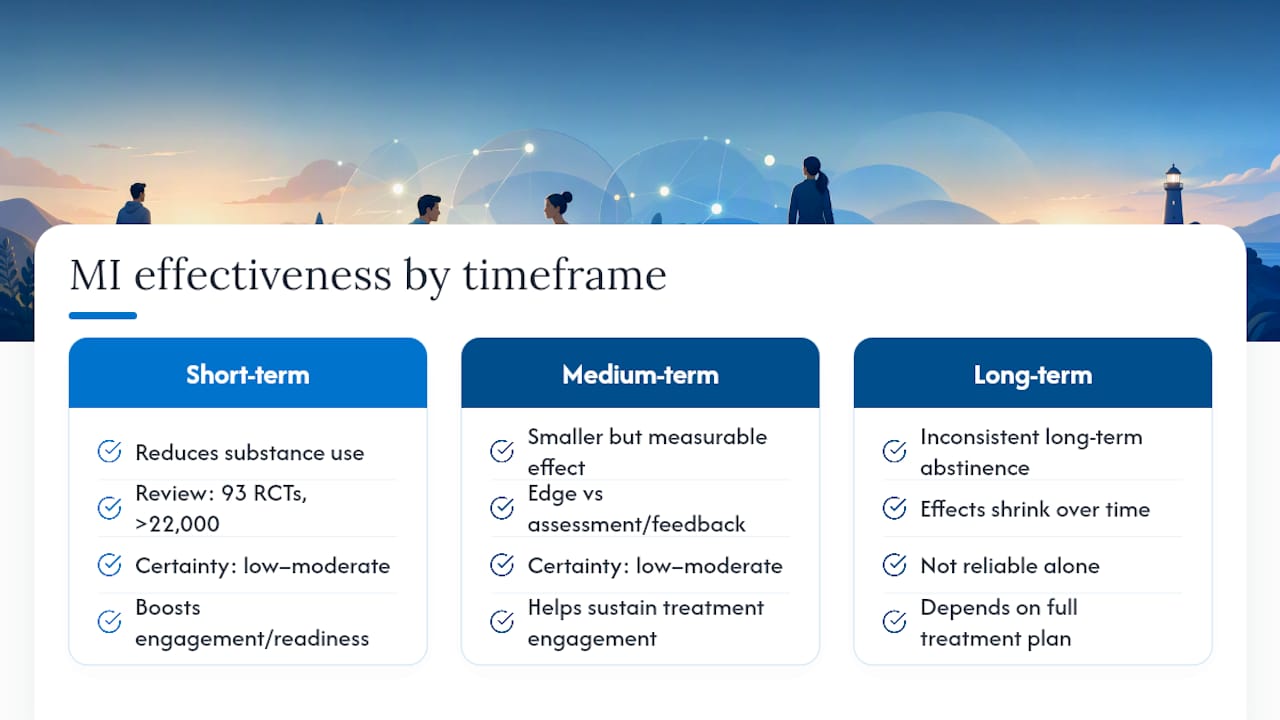
That pattern matters more than any single number. MI reliably moves the needle right after treatment starts. It’s less reliable at producing durable, years-long abstinence on its own.
SAMHSA’s TIP 35 arrives at a similar conclusion from the guidance side rather than the trial side. It positions MI and MET as engagement tools that work across the stages of change and across wildly different settings, from outpatient counseling to residential detox, but it repeatedly stresses that training and fidelity monitoring determine whether that potential actually shows up in a given program. A counselor who took a weekend workshop and never got coached afterward is not delivering the same intervention as one under ongoing competency-based supervision.
Across the largest reviews, MI produces consistent short-term improvements in engagement and readiness. Long-term abstinence advantages are inconsistent, which is why clinicians treat MI as a valuable component of care rather than a stand-alone solution.
What does “small-to-moderate effect” mean for a person walking into detox this week? It means MI will likely help you get unstuck faster and stick with treatment longer than you would without it. It does not mean MI alone will keep you sober five years from now. That job usually falls to the fuller treatment plan MI helps you commit to in the first place, which is why programs that rely on individualized treatment plans use MI as a front door, not the whole house.
How Rehab Programs Train, Supervise, and Track MI Fidelity
Good intentions don’t make someone competent at MI. Fidelity, meaning how closely a clinician’s actual practice matches the model, has to be built and then maintained, and the research on how to do that is fairly specific.
Programs typically start counselors with an initial foundational workshop covering the spirit, OARS, and the four processes. That workshop alone rarely produces lasting change in clinician behavior. Skills tend to fade within months without structured follow-up, which is why credible programs pair training with ongoing coaching and competency-based supervision, not a one-time certificate.
Fidelity monitoring usually involves coding recorded or observed sessions against standardized rating scales that track things like the ratio of reflections to questions and the presence of open questions versus closed ones. Coding every session is labor-intensive, so many supervisors sample brief segments regularly instead, which keeps oversight realistic without letting quality slip.
MI shows up operationally in a few key places:
- During intake, often through an MI-blended assessment (MIA) that has been linked to better enrollment and stronger early retention than standard intake alone, according to guidance compiled by SAMHSA on integrating motivational approaches.
- During brief interventions early in detox or stabilization.
- Woven into individual and group sessions throughout residential treatment, not confined to a single “MI hour” on the schedule.
Pro Tip: When you’re comparing programs, ask directly whether counselors receive ongoing MI coaching or just an initial training. The answer tells you more about actual treatment quality than any brochure will.
What Motivational Interviewing Aims to Achieve for You in Rehab
Strip away the clinical language and MI is trying to accomplish three practical things for the person sitting across from the counselor.
- Sharper, more personal goals. Instead of a generic “get sober” target, MI helps clients articulate what change actually means for them, whether that’s rebuilding trust with a child or getting back to a job they care about.
- Stronger early engagement. Clients who go through MI-informed intake and early sessions tend to show up for more of their treatment and drop out less in the first weeks, when attrition risk is highest.
- Increased self-efficacy. MI builds a client’s belief that they’re actually capable of the change they say they want, which matters because confidence, not just willingness, predicts whether someone follows through on harder therapeutic work like CBT or trauma processing later.
None of that shows up as a dramatic breakthrough moment. It shows up as a client who keeps their next appointment, engages honestly in group therapy, and can name a reason for staying in treatment that belongs to them rather than to a parent, judge, or spouse.
Where MI Falls Short and Why It’s Rarely Used Alone
MI’s evidence base has real limits worth naming plainly. Studies vary widely in populations, settings, and dosage, which makes pooled results harder to generalize. Certainty ratings for several outcomes sit at low to moderate, and effects that look solid right after treatment often shrink at longer follow-up.
MI is also frequently misunderstood. It is not casual chit-chat, and it is not permission to withhold advice entirely. Skilled counselors ask pointed questions and offer information when invited. What they avoid is arguing, lecturing, or trying to out-reason a client’s ambivalence.
Because of these limits, most residential programs treat MI as an engagement layer, not the whole treatment. Cognitive behavioral therapy typically supplies coping-skill structure, medication-assisted treatment addresses physiological dependence, and MI keeps the client willing to show up for both.
MI in Action: Two Rehab Scenarios
Consider a client arriving for detox who insists they’re “not really an addict, just going through a rough patch.” A directive counselor might cite consequences and push back. An MI-trained counselor instead reflects: “It sounds like the substance use feels separate from who you really are.” That reflection, rather than an argument, often opens space for the client to volunteer their own doubts, the actual entry point for change talk.
A second scenario: a client midway through residential treatment starts talking about leaving early. Instead of listing reasons to stay, a counselor using MI might ask, “What would you miss out on if you left this week?” and then reflect back the client’s own answer, which often surfaces reasons to stay that the client generated rather than reasons imposed from outside. This is also where MI intersects with dual diagnosis care, since ambivalence about treatment often tangles with untreated anxiety, depression, or trauma symptoms that make leaving feel like relief rather than risk.
Neither scenario resolves in one conversation. MI works cumulatively, session by session, which is part of why programs embed it throughout treatment rather than treating it as a single intake formality.
The Real Challenges Therapists Run Into With MI
Clinicians who know MI in theory often struggle to sustain it under real caseload pressure. A few patterns show up repeatedly in supervision and training literature.
The most common failure is slipping into the “righting reflex,” the instinct to correct or persuade a client the moment they say something self-defeating. Under time pressure, that instinct is hard to resist, and it’s the fastest way to trigger sustain talk instead of change talk.
A second challenge is skill erosion after initial training. As noted earlier, a single workshop rarely sustains fidelity beyond a few months without coaching, so programs that skip supervision often see counselors quietly drift back into advice-giving.
A third challenge is applying MI with clients who are mandated into treatment, such as court-directed placements, where genuine internal motivation can feel harder to locate. Skilled counselors handle this by exploring what the client wants independent of the mandate, rather than pretending the external pressure doesn’t exist.
The fix across all three is the same: structured, ongoing supervision with real session feedback, not just annual refresher trainings.
Adapting MI for Different Clients and Cultural Backgrounds
MI’s core assumption, that people are the experts on their own lives, translates across cultural contexts more easily than many manualized therapies, but it still requires deliberate adjustment.
Language and communication style matter immediately. Directness that reads as respectful in one cultural context can read as confrontational in another, so counselors adjust pacing and the phrasing of reflections accordingly. Family-oriented cultures may also require MI conversations that acknowledge collective decision-making rather than framing change as a purely individual choice.
Age and cognitive presentation matter too. MI with an adolescent often leans more heavily on affirmations and less on lengthy reflections, since younger clients can disengage from conversations that feel like lectures in disguise. Clients with co-occurring mental health conditions may need slower pacing and more concrete, focused questions rather than open-ended exploration that can feel overwhelming during acute symptoms.
None of these adaptations change MI’s underlying spirit. They change its delivery, which is exactly the flexibility SAMHSA’s guidance points to when it describes motivational approaches as adaptable across diverse settings and populations.
Autonomy, Consent, and the Ethics Behind MI
MI’s ethical foundation is client autonomy, and that principle carries real weight in a setting where clients sometimes arrive under legal or family pressure to change.
A counselor practicing MI with integrity doesn’t manufacture motivation that isn’t there. They surface motivation that already exists, even if it’s buried under fear, shame, or resentment about being in treatment at all. That distinction matters because it’s what separates MI from manipulation. The goal is not compliance. It’s helping a client make a decision they can actually stand behind once treatment ends.
This gets complicated with mandated or court-directed clients, where refusing treatment isn’t a real option. Ethical MI practice in that context still respects the client’s right to disagree, express ambivalence, and set personally meaningful goals within the mandate, rather than treating compliance as the only acceptable outcome. Respecting autonomy inside a constrained situation is harder than respecting it in a fully voluntary one, but the manuals treat it as non-negotiable rather than optional.
A Working Perspective on MI’s Place in Real Treatment
Most articles about motivational interviewing treat it as either a miracle technique or a soft-skills afterthought. Both framings miss what actually matters in a residential setting.
Sylmar Treatment Center is a DHCS-licensed and Joint Commission accredited facility, which means the assessment and care-planning process MI feeds into has to meet a documented standard, not just a philosophical one. MI conversations happen inside comprehensive intake assessments and individualized care plans, with clinical attention that can be harder to sustain in larger facilities. Admissions support allows those conversations to start as soon as possible.
What that structure changes is simple: MI stops being a scheduled technique and becomes part of how staff actually talk to clients, all day, across detox and residential care alike.
— Jim
How Sylmar Treatment Center Puts MI Into Individualized Care
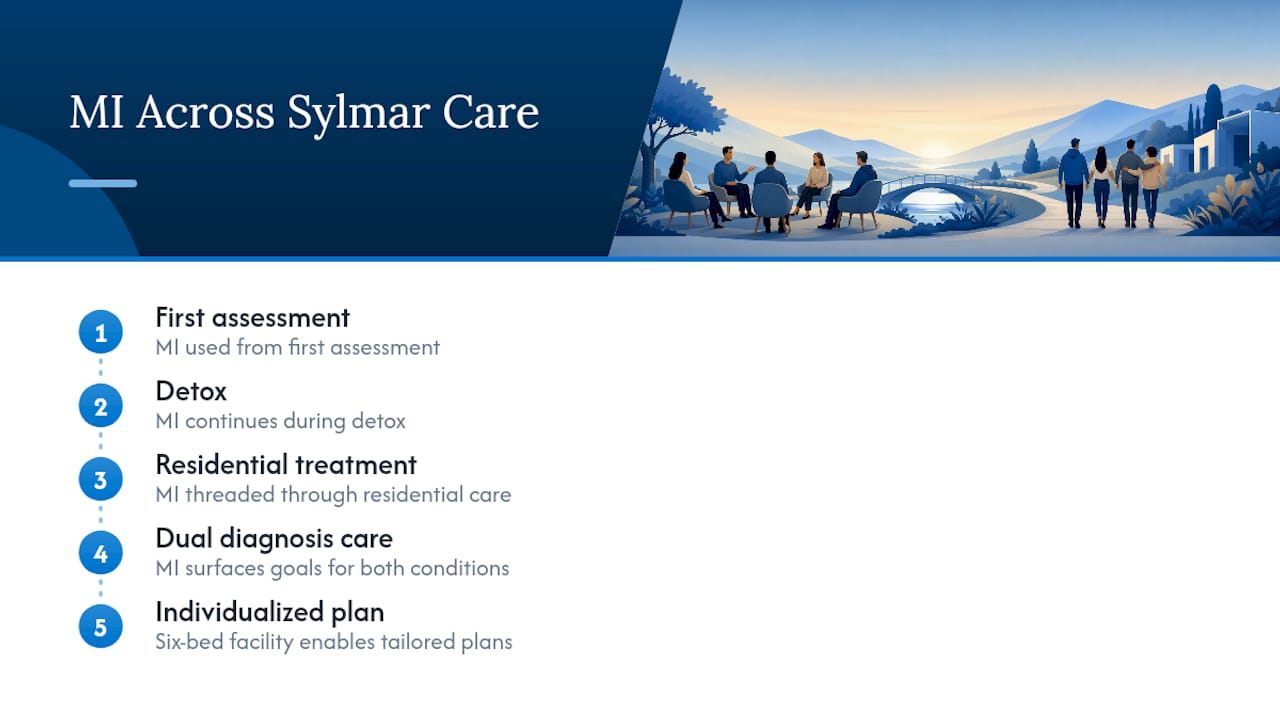
Sylmar Treatment Center’s programs use motivational interviewing from the first assessment forward, not as a one-time intake exercise but as a running thread through detox, residential treatment, and dual diagnosis care. Because the facility operates with six beds, comprehensive assessments and MI-informed conversations translate directly into an individualized treatment plan, rather than getting flattened into a generic track shared across dozens of clients.
For clients navigating both substance use and a co-occurring mental health diagnosis, MI helps surface goals that account for both conditions at once, which is central to dual diagnosis support rather than treating them as separate problems. Admission typically starts with a clinical and psychiatric assessment, insurance verification, and a conversation about goals and history, exactly the kind of conversation MI is built for.
If you or someone you love is weighing whether residential treatment makes sense right now, that ambivalence itself is worth talking through with someone trained to work with it. Sylmar Treatment Center’s admissions team is available 24/7, and you can view current programs or reach out directly to start that conversation today.
This article is general information, not a substitute for advice from a qualified doctor. Consult a qualified healthcare professional about your own circumstances before acting on anything here.
Sources
- Enhancing Motivation for Change in Substance Use Disorder Treatment (SAMHSA TIP 35)
- Project MATCH Volume 2: Motivational Enhancement Therapy Manual
FAQ
How is motivational interviewing used in substance abuse treatment?
Clinicians use MI throughout treatment, from intake conversations through ongoing counseling, to help clients explore ambivalence, strengthen their own reasons for change, and set personally meaningful goals rather than being told what to do.
What are some encouraging words for someone in rehab?
Encouragement works best when it affirms a specific effort the person already made, such as “showing up today after everything you’ve dealt with took real strength,” rather than generic praise, since MI-style affirmations are meant to reflect something true and specific about the person.
What are the 5 A’s of motivational interviewing?
MI is typically taught through the four OARS skills (open questions, affirmations, reflective listening, summarization) and the four processes (engaging, focusing, evoking, planning). A standardized additional framework isn’t part of the core MI or MET manuals, so treat any such label with caution if you see it elsewhere.
What are the basic principles of motivational interviewing?
The core principles are partnership, acceptance, compassion, and evocation, sometimes described together as the “spirit” of MI, and they guide how a counselor uses OARS and moves through the engage, focus, evoke, and plan processes.
Does Sylmar Treatment Center use motivational interviewing?
Yes. Sylmar Treatment Center integrates MI into assessments and individualized treatment planning across its detox and residential programs, supporting clients through both substance use and co-occurring mental health needs.