

Individualized addiction treatment plans consistently outperform standardized programs on the outcomes that matter most: keeping people in treatment, reducing relapse, and addressing the full picture of what drives someone’s substance use. The core mechanism is straightforward. When a plan is built around a specific person’s history, mental health, biology, and life circumstances, the treatment feels relevant, which strengthens therapeutic alliance and reduces premature dropout.
The benefits of individualized addiction treatment plans, supported by peer-reviewed research, include:
- Stronger engagement and retention because goals reflect the person’s own priorities, not a generic curriculum
- Lower relapse risk through targeted relapse-prevention strategies matched to personal triggers
- Concurrent dual-diagnosis management so co-occurring depression, anxiety, PTSD, or other disorders are treated alongside the addiction, not after
- Better medication matching with the right pharmacotherapy at the right dose, under medical supervision
- Culturally and logistically relevant care that accounts for language, family structure, employment, and childcare
- Flexible step-down and aftercare built into the plan from day one, not improvised at discharge
- Trauma-informed framing that prevents re-traumatization and keeps people from leaving early
Before you call any program, ask one question: “Can you show me how a treatment plan changes after the first two weeks?” The answer tells you whether personalization is real or just marketing language.
Key Takeaways
Individualized addiction treatment plans consistently outperform standardized programs on engagement, retention, and long-term recovery outcomes because they match evidence-based interventions to each person’s specific clinical, cultural, and logistical needs.
| Point | Details |
|---|---|
| Personalization improves retention | Tailored goals and relevant interventions strengthen therapeutic alliance, reducing premature dropout. |
| Dual-diagnosis treatment is essential | Concurrent treatment of co-occurring mental health disorders produces better outcomes than siloed care. |
| Combined MAT and therapy outperforms medication alone | Reviews support pharmacotherapy plus psychotherapy for stabilization across many substance-use contexts. |
| Plan quality depends on review cadence | Ask for weekly reviews in residential care and formal revisions at least every four weeks. |
| Sylmartreatmentcenter offers accredited individualized care | Joint Commission-accredited, six-bed residential programs with 24/7 admissions and documented plan revisions. |
Table of Contents
- What is an individualized treatment plan in addiction care?
- What belongs in every high-quality individualized treatment plan?
- How does personalization actually improve recovery outcomes?
- What does the research say about effectiveness?
- How do clinicians build and update an individualized plan?
- Which evidence-based therapies appear in individualized plans?
- What are the real limitations of personalized addiction care?
- How does personalized care extend into aftercare?
- What questions should you ask any program before enrolling?
- How Sylmartreatmentcenter implements individualized plans
- Residential individualized care at Sylmartreatmentcenter
- Sources
What is an individualized treatment plan in addiction care?
An individualized treatment plan (ITP) is a living clinical document co-created by the patient and their care team that specifies the person’s diagnosis, measurable recovery goals, selected interventions, and a schedule for reviewing progress. “Living document” is not a cliché here. A genuine ITP gets revised as the person stabilizes, as new information surfaces, and as goals shift. It is not a form completed at intake and filed away.
The contrast with a fixed-curriculum program is stark. In a standardized program, everyone moves through the same sequence of groups, topics, and milestones on the same schedule, regardless of whether they have a trauma history, a co-occurring psychiatric disorder, or a family system that needs to be part of recovery. An ITP flips that: the assessment findings drive which therapies are selected, which medications are considered, and how family involvement is structured. The patient co-signs the plan and is treated as a participant in clinical decisions, not a recipient of them.
The Joint Commission, which accredits behavioral health programs across the United States, identifies individualized, multidisciplinary treatment planning with measurable goals as a core quality marker. Programs that meet those standards are required to document how the plan was developed, who contributed, and how it is updated over time. That documentation requirement is what separates accredited programs from facilities that use the word “personalized” loosely.
Key structural differences between an ITP and a fixed program:
- Who drives decisions: The ITP is shaped by assessment findings and client input; a fixed curriculum is driven by program schedule.
- Flexibility: ITPs can add or remove modalities mid-treatment; fixed programs rarely deviate from their sequence.
- Measurable objectives: ITPs specify what success looks like for this person (e.g., “attend three community support meetings per week by week four”); fixed programs use completion of modules as the proxy for progress.
- Review cadence: ITPs are formally revisited on a scheduled basis; fixed programs typically reassess only at discharge.
What belongs in every high-quality individualized treatment plan?
The quality of an ITP depends almost entirely on the depth of the assessment that precedes it. A superficial intake produces a superficial plan. A thorough biopsychosocial assessment, by contrast, surfaces the information that makes every subsequent clinical decision defensible.
Comprehensive intake assessment covers substance use history (substances, duration, prior treatment episodes, withdrawal risk), mental health history (diagnoses, medications, hospitalizations), trauma history, medical conditions, social determinants (housing, employment, legal status, support network), and the person’s own goals and values. This is not a checklist. It is a clinical conversation that takes time.

Specific, measurable goals are agreed on with the client and written in plain language. “Reduce alcohol use” is not a goal. “Abstain from alcohol and attend two AA meetings per week for the first 30 days of outpatient care” is. The difference matters because vague goals cannot be evaluated, which means the plan cannot be meaningfully revised.
Modality selection flows from assessment findings. Someone with a primary trauma history and opioid use disorder needs a different therapy mix than someone with alcohol use disorder and no psychiatric comorbidity. The plan names which therapies, which medications (if any), and which support services are being used and why.
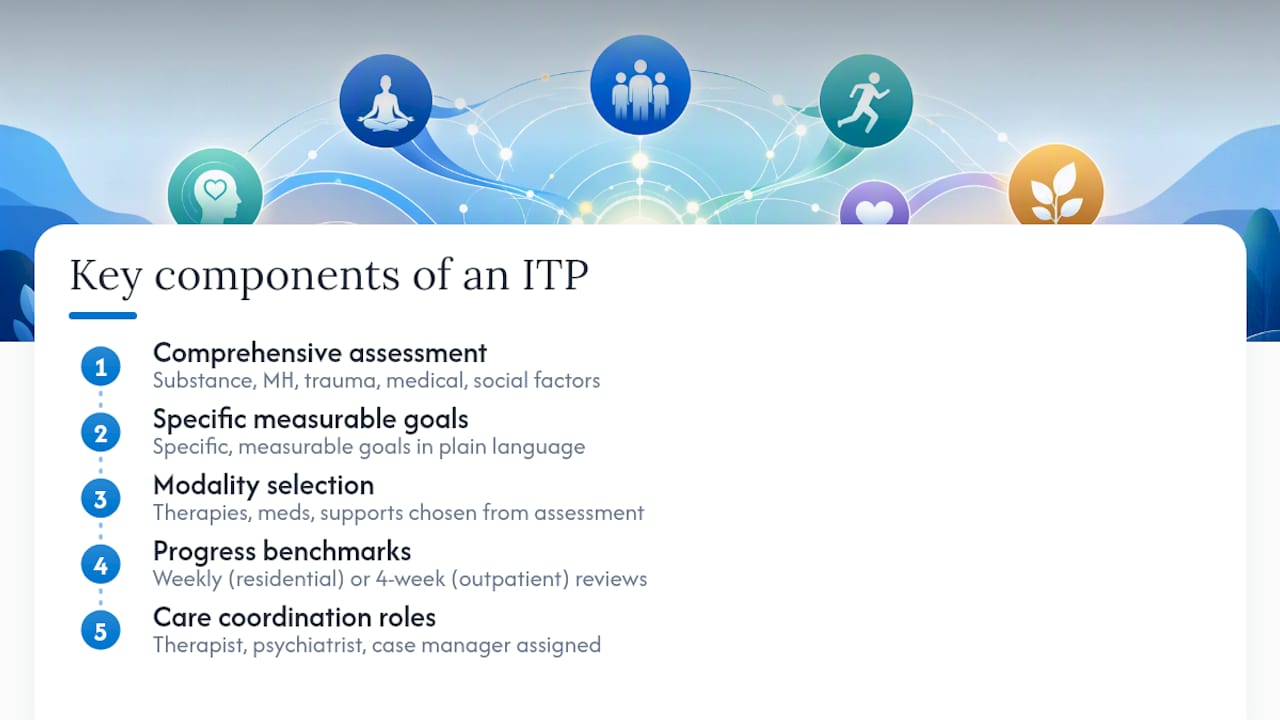
Progress benchmarks and review cadence specify when the team will formally evaluate whether the plan is working. Weekly reviews are standard in residential care; four-week reviews are common in outpatient settings. The review schedule should be written into the plan itself.
Care coordination roles identify who is responsible for each element: the primary therapist owns the psychotherapy component, the psychiatrist manages medication, the case manager handles housing and employment coordination, and so on. When roles are clear, nothing falls through the cracks at transitions between levels of care.
Pro Tip: Ask the program to show you a sample plan with the goals section filled in. If the goals are vague or identical across patients, the plan is a template, not a genuine ITP. Real individualization shows up in the specificity of the language.
How does personalization actually improve recovery outcomes?
The mechanism behind personalized treatment benefits is not mysterious. When a treatment plan reflects a person’s actual history, goals, and circumstances, the work feels relevant. Relevance drives motivation. Motivation drives attendance and honest participation. Those two things, more than almost any other variable, predict whether someone completes treatment and sustains recovery.
Therapeutic alliance and engagement
Research published in the American Journal of Psychiatry identifies therapeutic alliance as one of the strongest predictors of treatment retention. Personalized care builds that alliance faster because the clinician is responding to the actual person, not running a script. When patients feel heard and see their own priorities reflected in the plan, they are more likely to stay when treatment gets hard.
Concurrent dual-diagnosis management
Most people entering addiction treatment have at least one co-occurring mental health condition. Treating the addiction without addressing the underlying depression, anxiety, or PTSD is a common reason for relapse after discharge. Integrated treatment that addresses both concurrently is associated with better outcomes than siloed care, where the mental health piece is deferred until sobriety is established. An ITP makes concurrent treatment the default, not the exception.
Personalization matters most for people with co-occurring disorders, trauma histories, or prior failed treatments. These groups derive outsized benefit from tailored care because standardized programs were rarely designed with their complexity in mind.
Medication matching and stabilization
Medication-assisted treatment (MAT) is not one-size-fits-all. The right medication, dose, and adherence support depend on the substance, the person’s medical history, their psychiatric medications, and their own preferences and concerns. Combining pharmacotherapy with psychotherapy generally improves stabilization and functional outcomes compared with medication alone, but that combination has to be calibrated to the individual. An ITP creates the structure for that calibration.

Cultural, family, and logistical fit
A plan that ignores a person’s work schedule, childcare responsibilities, or cultural relationship to family involvement will lose that person to logistical attrition before clinical factors ever come into play. Tailoring scheduling, language of care, and the role of family members in treatment is not a soft accommodation. It is a retention strategy.
Consider two brief illustrations. A person with opioid use disorder and untreated PTSD who enters a program without trauma-informed components often disengages within the first two weeks, not because they lack motivation, but because the content is re-traumatizing. A tailored plan that sequences trauma work carefully and includes a trauma-focused therapy keeps that person in treatment long enough for the work to take hold. Similarly, a parent with childcare constraints who cannot attend a rigid daytime group schedule may drop out of a standardized program but thrive in one that builds scheduling flexibility into the plan from the start.
What does the research say about effectiveness?
The evidence base for tailored psychosocial interventions shows small but statistically significant advantages over standardized approaches across multiple systematic reviews and meta-analyses. “Small” in clinical research terms does not mean unimportant. In addiction treatment, where the baseline for sustained recovery is already challenging, a consistent advantage across studies is a meaningful signal.
The evidence landscape breaks down roughly as follows:
| Evidence type | What it shows | Strength |
|---|---|---|
| Systematic reviews and meta-analyses | Tailored psychosocial interventions outperform standardized approaches on engagement and retention | Small but statistically significant |
| Integrated dual-diagnosis reviews | Concurrent treatment of substance use and mental health improves outcomes vs. siloed care | Moderate, consistent across populations |
| Pharmacotherapy plus psychotherapy trials | Combined approaches improve stabilization vs. medication alone in many substance-use contexts | Moderate; varies by substance type |
| Precision medicine and AI reviews | Promising for matching and relapse prediction; equity and validation gaps remain | Early-stage; not yet ready for routine rollout |
Statistic callout: Systematic reviews find that tailored psychosocial interventions produce statistically significant benefits over standardized care on engagement and retention outcomes, a finding that holds across multiple independent meta-analyses.
What do these effect sizes mean for someone choosing a program? A small-to-moderate advantage, replicated consistently across independent research teams, is the kind of signal that should shift a real-world decision. It means the personalization is not just a marketing claim. It is a clinically meaningful difference, particularly for people with complex presentations.
Precision medicine tools, including AI and digital monitoring, show genuine promise for improving how clinicians match interventions to individuals and predict relapse risk. The same review that highlights this potential also flags important equity and validation gaps. These tools are not yet standard of care, but they represent the direction the field is moving.
How do clinicians build and update an individualized plan?
The process follows a predictable sequence, and knowing it helps you evaluate whether a program is actually doing it.
The first 72 hours
- Medical evaluation and withdrawal risk assessment (determines whether medically supervised detox is needed and at what level of intensity)
- Psychiatric screening (identifies co-occurring disorders requiring immediate intervention)
- Comprehensive biopsychosocial intake interview (substance history, trauma, mental health, social determinants)
- Safety planning (addresses any acute suicidality, self-harm risk, or domestic safety concerns)
- Preliminary goal-setting conversation with the client
Drafting the plan
The primary therapist drafts the initial plan, typically within the first few days of admission, incorporating findings from the medical team, the psychiatric evaluation, and the intake interview. The client reviews the draft, proposes changes, and co-signs it. This is not a formality. Programs that treat the co-signature as a formality are not doing genuine individualized care.
Review cadence and multidisciplinary case conferences
- Weekly in residential settings: the full team (therapist, psychiatrist, case manager, nursing) reviews each patient’s progress against plan goals
- Four-week formal plan revisions: goals are updated, modalities adjusted, and the next level-of-care transition is planned
- Client participation in reviews: the person should be present for or at least briefed on the outcome of every formal review
Transitions and cost/insurance considerations
The plan should specify the criteria for stepping down from residential to PHP (partial hospitalization), then IOP (intensive outpatient), then standard outpatient. Vague discharge criteria (“when clinically appropriate”) are a red flag. Ask for the specific benchmarks.
On cost: most private insurance plans cover medically necessary residential addiction treatment, though prior authorization requirements and length-of-stay limits vary significantly. Verify your benefits before admission and ask the program’s admissions team to walk you through what documentation they submit to support authorization. Individualized care plans at addiction facilities that are well-documented tend to support stronger insurance authorization cases because the medical necessity is explicit in the plan.
Which evidence-based therapies appear in individualized plans?
The interventions selected for an ITP depend on what the assessment reveals. There is no universal combination. That said, certain therapies and medications appear frequently because the evidence for them is strong across a range of presentations.
Psychotherapies
- Cognitive Behavioral Therapy (CBT): First-line for most substance use disorders; targets the thought patterns and behavioral cues that sustain use. Fits nearly every presentation but is especially effective when cognitive distortions and automatic triggers are prominent.
- Dialectical Behavior Therapy (DBT): Indicated when emotional dysregulation, self-harm history, or borderline personality features are present. The distress tolerance and emotion regulation skills directly address common relapse drivers.
- Trauma-focused therapies (EMDR, CPT, Prolonged Exposure): Selected when trauma history is a primary driver of use. Sequencing matters: stabilization typically precedes trauma processing.
- Motivational Interviewing (MI): Used across all stages but especially valuable in early treatment when ambivalence about change is high. MI is a clinical skill, not a standalone program.
Medication strategies
Medications for opioid use disorder (OUD) include buprenorphine, methadone, and naltrexone. Each has a different mechanism, risk profile, and logistical requirement. Buprenorphine can be prescribed in office-based settings; methadone requires a licensed opioid treatment program. Naltrexone is an option for people who have completed detox and have no opioid dependence. For alcohol use disorder, naltrexone, acamprosate, and disulfiram are the primary pharmacological options. Psychiatric medications for co-occurring disorders are managed separately but must be coordinated with addiction medications to avoid interactions.
All medication strategies require medical supervision. Self-adjusting doses or discontinuing medications without clinical guidance carries serious safety risks.
Research consistently supports combining pharmacotherapy with psychotherapy rather than relying on either alone. The ITP is the document that coordinates that combination.
Statistic callout: Reviews indicate that combining medication-assisted treatment with psychotherapy improves stabilization and functional outcomes compared with medication alone in many substance-use contexts, though the magnitude of benefit varies by substance type.
Support services and adjuncts
- Family therapy: addresses relational dynamics that sustain use or undermine recovery
- Case management: housing, employment, legal coordination
- Peer support specialists: lived-experience mentorship, especially valuable in early recovery
- Mindfulness and exercise: evidence-supported adjuncts that reduce stress and craving; they complement but do not replace evidence-based therapies
Understanding why mental health affects addiction recovery helps clarify why the intervention mix in a dual-diagnosis plan looks different from a plan focused on substance use alone.
What are the real limitations of personalized addiction care?
Candor here matters. Individualized care is the clinical standard, but implementing it well is genuinely hard, and many programs that claim to offer it fall short.
Access and geographic barriers
- Rural areas face significant shortages of trained addiction specialists, making multidisciplinary teams difficult to staff
- Telehealth has expanded access but does not fully replicate the intensity of residential care for complex presentations
- Wait times for residential beds in high-demand markets can delay care for weeks
Workforce and cost pressures
- Individualized planning is time-intensive. High caseloads push clinicians toward standardized templates because there are not enough hours to do genuine individualization for every patient
- Staff turnover in addiction treatment is high, which disrupts therapeutic relationships and plan continuity
- Programs operating on thin margins often cannot afford the multidisciplinary staffing that genuine ITPs require
Privacy and data concerns
Precision medicine and AI tools that could improve matching and relapse prediction raise legitimate questions about data security, algorithmic bias, and what happens to sensitive health information. These tools are promising but not yet validated for routine clinical use, and equity gaps in the underlying research mean they may not perform equally well across racial and ethnic groups.
Evidence gaps
Certain populations are underrepresented in addiction treatment trials: rural communities, older adults, people with severe mental illness, and many racial and ethnic minority groups. The evidence base for individualized care is real, but it was built largely on studies of populations that do not reflect the full diversity of people seeking treatment today.
Pro Tip: Ask any program you’re evaluating: “Can you give me a specific example of how a patient’s plan changed after the first month?” A program doing genuine individualization can answer that question concretely. Vague answers about “ongoing assessment” are a warning sign.
How does personalized care extend into aftercare?
The ITP does not end at discharge. A well-constructed plan treats aftercare as a continuation of the same document, not a separate handoff. The step-down and aftercare components should be drafted during residential care, not improvised in the final days before discharge.
Typical aftercare elements built into the ITP:
- Outpatient therapy schedule (frequency, modality, provider name if known)
- Medication refill plan and prescriber contact
- Relapse-prevention plan with identified triggers, warning signs, and response steps
- Peer support and community meeting schedule (AA, NA, SMART Recovery, or other)
- Family or support person roles and communication agreements
- Employment and housing stability check-ins
Graduated step-down and contingency planning
A good ITP specifies the criteria for moving from residential to PHP, then IOP, then standard outpatient, and also the criteria for stepping back up if relapse or crisis occurs. That contingency plan should be written in plain language and reviewed with the patient before discharge.
A basic aftercare plan template to bring to your discharge planning conversation:
- Outpatient therapy: provider, frequency, start date
- Medication: prescriber, refill schedule, pharmacy
- Peer support: meeting type, frequency, home group if applicable
- Relapse warning signs: three to five personal early indicators
- Response plan: who to call first, crisis line, step-up criteria
- Family/support contact: one named person, their role, agreed communication frequency
- 30-day check-in: scheduled call or appointment with the residential program or case manager
Addiction recovery support for families is a meaningful part of this aftercare structure, particularly when family members need guidance on how to support without enabling.
What questions should you ask any program before enrolling?
The gap between programs that genuinely individualize care and those that use the term loosely is wide. These questions will surface that gap quickly.
Questions to ask on the first call or visit:
- Who conducts the intake assessment, and what does it cover? (Look for: licensed clinician, biopsychosocial scope, trauma screening)
- Who writes the treatment plan, and does the patient co-sign it?
- How often is the plan formally reviewed, and is the patient present for those reviews?
- Who is on the clinical team, and what are their credentials? (Look for: therapist, psychiatrist or prescriber, case manager at minimum)
- How do you handle co-occurring mental health disorders? Are they treated concurrently or deferred?
- What does your step-down process look like, and what criteria trigger a transition?
- Can you describe a specific example of how a patient’s plan changed after the first few weeks?
Red flags to watch for:
- Vague answers to the plan-revision question (“we’re always monitoring”)
- No psychiatrist or prescriber on staff for a program that accepts dual-diagnosis patients
- Plan not updated after the initial intake week
- Identical-looking plans across patients (ask to see a sample with goals filled in)
- No written relapse-prevention plan included in discharge documentation
- Pressure to commit before the assessment is complete
Sample language to request plan documentation:
“I’d like to see the section of the plan that lists my measurable goals and the criteria for reviewing them. Can you walk me through what that looks like?”
Families advocating for a loved one can find specific guidance on asking for individualized care in rehab, including how to participate in plan reviews and what documentation to request.
How Sylmartreatmentcenter implements individualized plans
Sylmartreatmentcenter operates a six-bed residential facility, and that scale is not incidental to how individualized care works there. With six patients at a time, the clinical team knows each person’s plan in detail. There is no caseload pressure that pushes toward template-driven care.
The workflow follows the structure described throughout this article: comprehensive biopsychosocial assessment within the first 72 hours, a draft plan co-signed by the patient within the first days of admission, weekly multidisciplinary team reviews, and formal plan revisions on a scheduled cadence. The team includes a primary therapist, psychiatric oversight for medication management, and case management for coordination across medical, legal, and social needs.
Sylmartreatmentcenter holds both a DHCS license and Joint Commission accreditation, the two primary quality markers for residential addiction treatment in California. Joint Commission accreditation specifically requires documented individualized treatment planning with measurable goals, multidisciplinary team involvement, and evidence of plan revisions over time. That is not a marketing claim. It is an audited standard.
The center’s programs address dual-diagnosis presentations, medically supervised detox, and court-directed placements, all within the same individualized planning framework. Admissions support is available 24/7, which matters because the decision to seek treatment rarely happens at a convenient hour.
For a detailed look at how personalized recovery program components are structured at Sylmartreatmentcenter, the program blog walks through the specific elements the clinical team uses to build and revise plans.
Residential individualized care at Sylmartreatmentcenter
Sylmartreatmentcenter’s individualized treatment programs are built for adults with substance use disorders, co-occurring mental health diagnoses, or both. The six-bed model means your plan is not competing with 40 other patients for clinical attention. Every element described in this article, from the biopsychosocial assessment to the weekly team review to the written aftercare plan, is part of the standard workflow, not an upgrade.
The admissions team is available around the clock. On the first call, they will walk you through what the assessment covers, how insurance verification works, and what the first 72 hours look like. If you want to see how the program documents measurable goals or how plans are revised, ask. That transparency is part of how Sylmartreatmentcenter operates.
To learn more about the full range of programs, including dual-diagnosis support and residential detox, visit the programs page or call admissions directly to start the conversation.
Sources
The following sources were used in this article. Prioritize peer-reviewed systematic reviews and accreditation body guidance when evaluating any clinical claim about personalized addiction care.
- American Journal of Psychiatry article on therapeutic alliance and personalized care
- PMC review on integrated treatment for co-occurring disorders
- PubMed entry summarizing trials on pharmacotherapy plus psychotherapy integration
This article provides general educational information about addiction treatment planning and is not a substitute for professional medical or clinical advice. Consult a qualified healthcare provider or licensed addiction specialist to evaluate treatment options appropriate for your specific situation.