

Yes, many U.S. insurance plans can cover out-of-network rehab, but how much depends on your plan type, prior authorization rules, and how well the claim is documented. Expect to pay more out-of-pocket than you would in-network, and expect to do more legwork upfront. Before you commit to any facility, request a written verification of benefits (VOB) and call admissions to confirm what your specific policy allows.
TL;DR:
- Out-of-network rehab billing starts from the facility’s full list price, and insurers usually pay a lower allowed amount, leaving you responsible for the difference.
- PPO plans generally cover out-of-network care but with higher deductibles and coinsurance, whereas HMOs and EPOs rarely cover out-of-network stays outside emergencies.
- Confirm coverage by requesting a written verification of benefits, documenting calls, and exploring single-case agreements before committing to a facility.
- Out-of-pocket costs for a 30-day residential stay can range from a few thousand dollars in-network to significantly more out-of-network once balance billing is involved.
- Proper documentation, including clinical notes and a medical necessity letter, greatly increases the chances of insurer approval for out-of-network rehab coverage.
Table of Contents
- What Out-of-Network Rehab Coverage Actually Means
- When Choosing an Out-of-Network Rehab Makes Sense
- How Different Plans Handle Out-of-Network Rehab
- How to Verify and Use Your Out-of-Network Benefits
- What Out-of-Network Rehab Actually Costs
- What to Do If Your Insurer Denies Out-of-Network Coverage
- How Sylmar Treatment Center Helps With Insurance Verification
- Why the Standard Advice on Rehab Coverage Falls Short
- Get Help Verifying Your Benefits Before You Commit
- Where to Verify Coverage Rules and Protections
- Sources
- FAQ
What Out-of-Network Rehab Coverage Actually Means
In-network providers sign a contract with your insurer agreeing to a negotiated rate, a discounted price the insurer has already worked out in advance. Out-of-network providers have no such contract, so they bill their full, undiscounted rate, called the billed charge.
Your insurer pays a portion of what it considers the “allowed amount” for out-of-network care, which is often far lower than the facility’s actual bill. The gap between what the facility charges and what insurance pays is called balance billing, and in most out-of-network situations, you’re responsible for that difference.
A few things worth knowing before you call anyone:
- Negotiated rates only exist for in-network providers; out-of-network billing starts from a facility’s list price.
- Behavioral health networks tend to be narrower than medical networks, partly because fewer specialized programs exist and fewer accept the negotiated rates insurers offer.
- “Allowed amount” is not the same as “billed amount,” and the difference is where most surprise costs come from.
When Choosing an Out-of-Network Rehab Makes Sense
Cost isn’t the only variable that matters. Sometimes the in-network list simply doesn’t have what you need.
- A facility with deep experience in dual-diagnosis care, treating a substance use disorder alongside anxiety, depression, or trauma, may not appear in your network at all.
- Access problems are common: in-network directories often include “ghost” listings, providers who are technically contracted but not actually accepting new patients or don’t specialize in addiction treatment.
- Religious, cultural, or gender-specific program preferences sometimes only exist outside your network.
Pro Tip: Ask any facility directly whether they’ve secured single-case agreements with major insurers before. A facility with that track record can often get you a better negotiated rate even though they’re technically out-of-network.
Paying more for the right clinical fit, especially for dual diagnosis support, sometimes beats saving money on a program that isn’t equipped to treat what’s actually going on.
How Different Plans Handle Out-of-Network Rehab
Plan type drives almost everything here.
- PPOs typically cover out-of-network rehab, but with a higher deductible, higher coinsurance, and a separate (often higher) out-of-pocket maximum for OON care.
- HMOs and EPOs generally don’t cover out-of-network care except in emergencies, so an OON residential stay may mean paying the full bill yourself unless you secure a prior exception.
- Medicaid coverage for OON rehab varies by state; some states allow out-of-network reimbursement under specific waivers, others don’t.
- Medicare distinguishes between inpatient and outpatient rehab benefits, and OON coverage rules shift depending on which part applies.
Federal law adds real protection on top of plan design. Marketplace plans must treat substance use disorder and mental health treatment as essential health benefits, and the Mental Health Parity and Addiction Equity Act requires that treatment limits and financial requirements for behavioral health be no more restrictive than what a plan applies to medical or surgical care.
That parity rule matters more than most people realize. If your plan caps in-network medical visits generously but caps behavioral health visits tightly, that’s potentially a parity violation worth flagging in an appeal.
How to Verify and Use Your Out-of-Network Benefits
Confirming coverage before admission saves you from unpleasant surprises later. Here’s the sequence that actually works:
- Request a written VOB from both the facility and your insurer, not just a verbal quote over the phone.
- Document every call, including the representative’s name, the date, and a reference number for the conversation.
- Ask about prior authorization and medical necessity criteria, and specifically ask whether an in-network exception or single-case agreement is possible.
- Confirm whether OON charges apply toward your in-network out-of-pocket maximum, or whether your plan tracks a separate, usually much higher, OON maximum.
- Get a reimbursement estimate in writing, and ask whether the facility accepts assignment of benefits so the insurer pays them directly instead of routing payment through you.
Pro Tip: Ask the facility whether they’ll help prepare a medical necessity letter directly for the insurer. Facilities that regularly work with out-of-network cases often know exactly which documentation triggers approval and which gets bounced back, a process similar to navigating insurance coverage for specialty treatment like Spravato therapy.
What Out-of-Network Rehab Actually Costs
A rehab bill has more moving parts than people expect. Your deductible is what you pay before insurance kicks in at all. Coinsurance is the percentage you pay after that, often 20 to 50 percent for OON care versus 10 to 20 percent in-network. A copay is a flat fee per visit or service. The allowed amount is what your insurer agrees to pay toward an OON claim, and anything above that becomes your responsibility through balance billing.
Here’s a rough comparison: a 30-day residential stay can cost you a few thousand dollars in-network after cost-sharing, but significantly more out-of-network once balance billing enters the picture.
A few tactics reduce the damage:
- Request an itemized bill and check every line for errors or duplicate charges.
- Ask the facility directly about negotiating the balance, many will reduce it for self-pay portions.
- Ask about financial assistance, payment plans, or sliding-scale options before assuming the full balance is fixed.
For a deeper breakdown of what residential care actually runs, see this residential rehab cost guide.
What to Do If Your Insurer Denies Out-of-Network Coverage
Denials happen for predictable reasons: missing prior authorization, insufficient documentation of medical necessity, or a claim coded incorrectly.
- Request the denial letter in writing and identify the specific reason cited.
- Build an appeal packet with clinical notes, a letter from the treating clinician, and any supporting diagnostic history.
- File an internal appeal first, then escalate to an external or independent review if the internal appeal fails.
- Know your protections: the No Surprises Act limits certain unexpected out-of-network bills, particularly in emergency situations, and many states layer on additional parity or access requirements.
How Sylmar Treatment Center Helps With Insurance Verification
Sylmar Treatment Center holds a California DHCS license and Joint Commission accreditation, the same quality benchmark families look for when vetting any behavioral health provider. The center’s admissions team runs benefit checks and VOB requests directly, and where appropriate, opens the conversation with insurers about single-case agreements on a client’s behalf.
When you call, have your insurance card, policy ID, and any recent clinical notes or diagnostic history ready. That documentation speeds up both the verification call and any prior authorization request that follows.
Why the Standard Advice on Rehab Coverage Falls Short
Most articles on this topic stop at “call your insurer and ask.” That advice isn’t wrong, but it’s incomplete, and it puts the entire burden of navigating a confusing system on someone who’s often in crisis or supporting a family member in one.
The real leverage points are procedural, not informational. A documented VOB, a reference number from every call, and a clinical letter that speaks the insurer’s language on medical necessity change outcomes more than knowing the general rules do. Parity law under MHPAEA is powerful on paper, but it only helps you if you know to invoke it when a behavioral health limit looks tighter than a comparable medical one.
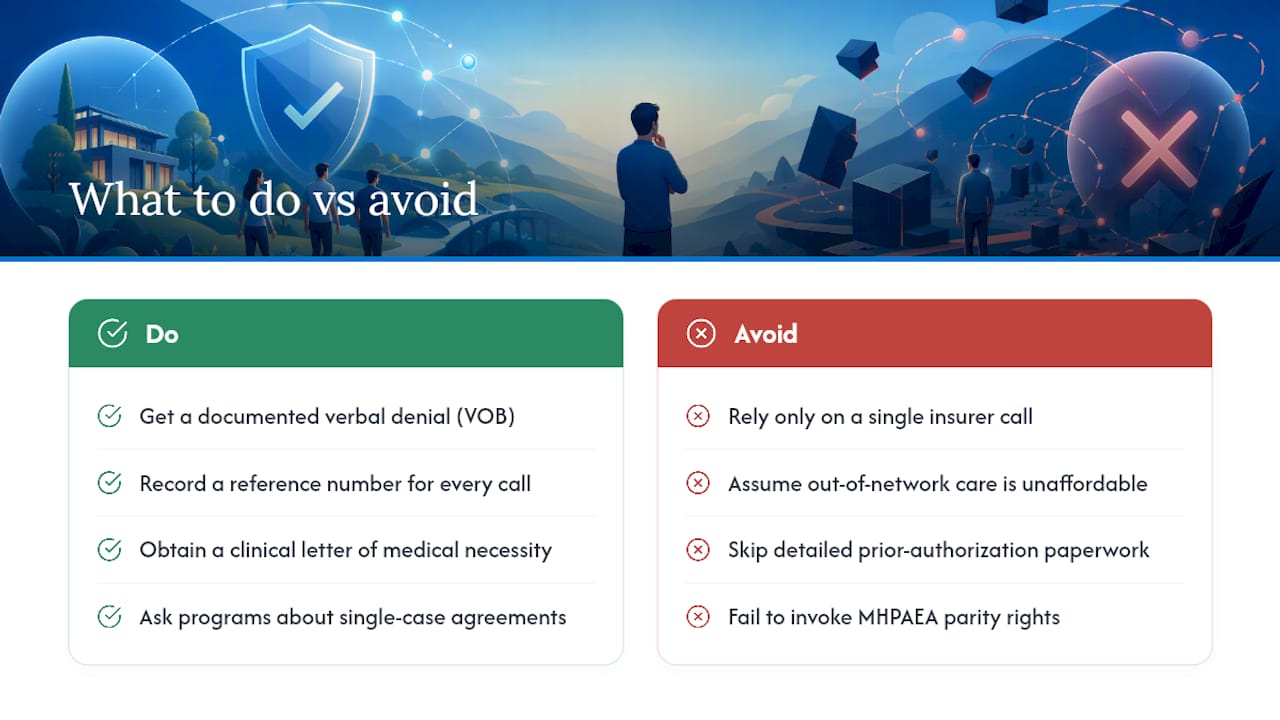
The other thing conventional advice underplays: a single-case agreement isn’t a long shot. Facilities that regularly work with out-of-network cases request them often enough to know which insurers are receptive and what documentation moves the request forward. That’s worth asking about before you assume a program is financially out of reach.
Prioritize the paperwork first. The clinical fit matters, but a strong VOB and a well-documented prior authorization request are what actually determine whether that fit is affordable.
— Jim
Get Help Verifying Your Benefits Before You Commit
Some treatment centers provide a small, intimate setting where admissions staff personally assist with insurance options rather than using a call center. If you’re considering an out-of-network stay, a direct, one-on-one benefits check can help clarify potential costs and coverage options.
Before you call, have your insurance card, policy ID number, and any recent clinical or diagnostic notes on hand. Sylmar’s admissions team is available 24/7 to run a full verification of benefits, walk through what your plan actually covers for medical detoxification or residential treatment, and explain what a single-case agreement might look like for your situation. Coverage varies by plan, and treatment centers typically confirm your specific benefits before admission. Call or request a benefits check today to find out where you stand.
Where to Verify Coverage Rules and Protections
Check current rules directly: CMS, Healthcare.gov, SAMHSA, and NIDA.
This article is general information, not a substitute for advice from a qualified doctor. Consult a qualified healthcare professional about your own circumstances before acting on anything here.
Sources
- Healthcare
- CMS — No Surprises Act
- SAMHSA — Substance Abuse and Mental Health Services Administration
- NIDA — Treatment and recovery
- Joint Commission — Behavioral health provider locator
FAQ
Will Insurance Cover Rehab If the Provider Is Out of Network?
Often yes, especially with PPO plans, though you’ll typically face a higher deductible, higher coinsurance, and possible balance billing unless a single-case agreement is arranged.
Are There Free Rehab Programs in the United States?
Some state-funded and nonprofit programs offer free or low-cost treatment, and SAMHSA’s treatment resources can help you locate options based on income and location.
How Much Does Rehab Cost Without Insurance?
Costs vary widely by level of care and length of stay, and paying without insurance typically means negotiating the facility’s full billed rate directly, so ask about payment plans or sliding-scale pricing before assuming you can’t afford it.
How Many Days Will Medicare Pay Fully for Rehab?
Medicare rules differ significantly between inpatient and outpatient rehab benefits, and coverage details depend on the specific part of Medicare involved, so confirm your exact benefit period directly with Medicare or your plan administrator.
What Should I Have Ready Before Calling About Coverage?
Have your insurance card, policy ID, and any recent clinical notes ready. Sylmar Treatment Center’s admissions team uses this information to run a verification of benefits and discuss options like single-case agreements.