

A 30-day residential rehab stay in the United States typically runs $6,000 to $30,000 in cash at a standard private facility, with luxury programs reaching $80,000 or more. If you have private insurance and use an in-network provider, expect to pay far less: most insured families cover $2,000 to $7,000 out-of-pocket for a 30-day stay, thanks to protections under the Mental Health Parity and Addiction Equity Act (MHPAEA). Medicaid can bring that number down to $0 to a few hundred dollars for eligible patients.
The single most useful thing you can do right now before you compare a single brochure is call your insurer and ask for a written benefits check for substance use disorder residential treatment. Get the deductible remaining, the coinsurance percentage, and whether the facility you’re considering is in-network. That one phone call tells you more about your real cost than any pricing page will.
Here’s how the market generally breaks down by tier:
- State-funded or Medicaid-covered programs: $0 to a few hundred dollars out-of-pocket for eligible residents, located through your state behavioral health agency or the SAMHSA treatment locator
- Budget-to-standard private facilities: roughly $6,000 to $20,000 cash for a 30-day program, per market cost surveys.
- Mid-tier private residential programs: $20,000 to $30,000 cash, often with more individualized clinical staffing.
- Luxury or executive programs: $30,000 to $80,000+, driven by amenities, private rooms, and low patient-to-staff ratios rather than better clinical outcomes.
Pro Tip: Ask about an insurance benefits check and a self-pay discount at the same time. Facilities often quote a lower cash rate once they know you’re comparing it against your insurance estimate, and having both numbers side by side gives you real negotiating leverage.
Key Takeaways
Residential rehab cost in the United States ranges from $0 with Medicaid or state funding to $80,000 or more for luxury care, and insurance status is the single biggest variable in what a family actually pays.
| Point | Details |
|---|---|
| 30-day cash range is wide | Standard private programs run $12,000–$30,000; luxury programs run $30,000–$80,000+. |
| Insurance changes everything | In-network insured patients often pay $2,000–$7,000 out-of-pocket for a 30-day stay under MHPAEA parity rules. |
| Medicaid can eliminate cost | Eligible patients often pay $0–a few hundred dollars out-of-pocket for Medicaid-covered residential treatment. |
| Longer stays cost less per day | A 90-day program often averages a similar or lower daily rate than a 30-day program. |
| Sylmar Treatment Center verifies benefits upfront | The center runs insurance checks and provides written estimates before admission, backed by DHCS licensing and Joint Commission accreditation. |
Table of Contents
- How Much Does Residential Rehab Cost by Program Type and Length?
- What Makes One Residential Program Cost Five Times More Than Another?
- Does Insurance Cover Inpatient Rehab, and What Will You Actually Pay?
- How Do You Calculate Your Real Out-of-Pocket Cost Before Admission?
- Does a Longer Stay Really Cost Proportionally More?
- What Should You Ask Admissions Before You Commit?
- Where Can Families Find Lower-Cost or No-Cost Treatment?
- Why Insurance Verification and Written Estimates Matter More Than the Sticker Price
- How Sylmar Treatment Center Approaches Pricing and Insurance
- Where to Verify Coverage and Find Local Programs
- Frequently Asked Questions
- Sources
How Much Does Residential Rehab Cost by Program Type and Length?
The price tag on residential rehab depends less on the facility’s marketing and more on two variables: level of care and length of stay. Medical detox, which manages withdrawal under clinical supervision, is priced separately from the residential program that follows it. A single-facility program that bundles both will often quote one combined number, while others bill detox and residential as two line items.
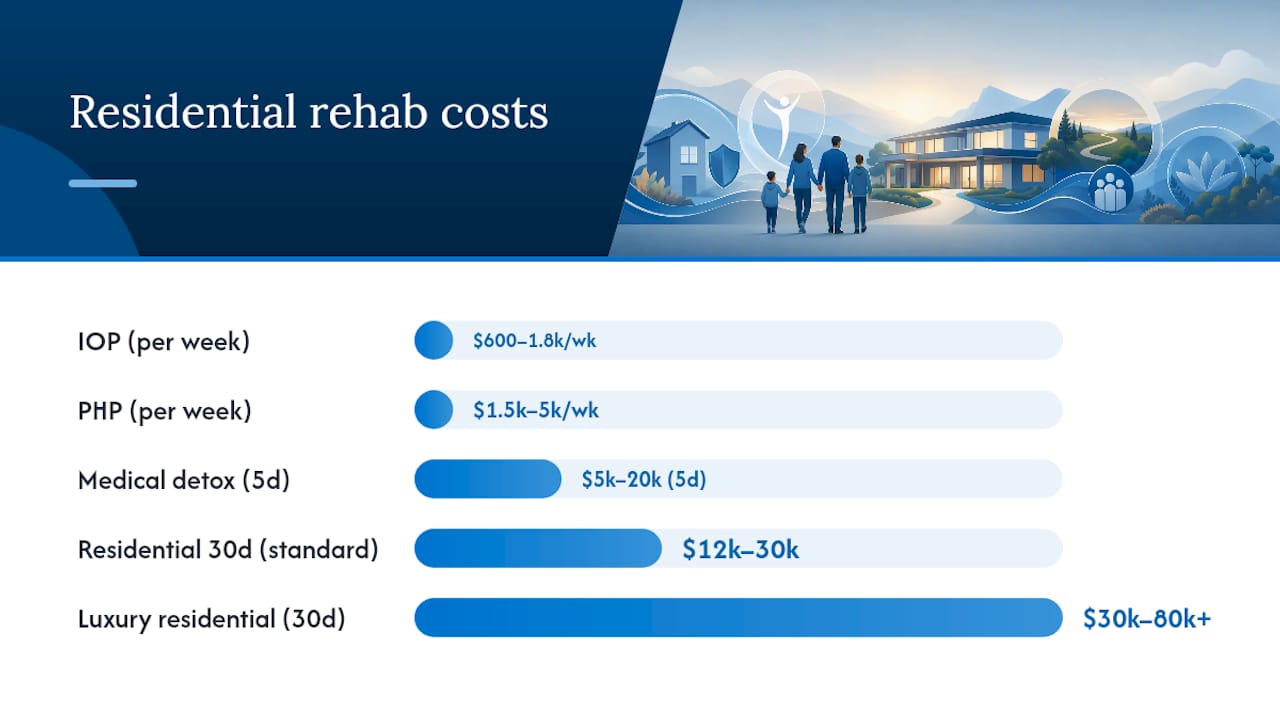
For medical detox alone, expect $5,000 to $20,000 depending on the substance involved and the medical monitoring required. Alcohol and benzodiazepine withdrawal, which carry higher medical risk, tend to sit at the upper end of that range because they require more frequent vital-sign checks and sometimes IV medication.
Once detox is complete, standard residential treatment pricing scales with duration. A 30-day stay at a standard private facility runs $12,000 to $30,000 in cash, while 60-day programs often land between $20,000 and $50,000, and 90-day programs between $30,000 and $75,000. The per-day rate usually drops slightly as length increases, since fixed intake and assessment costs get spread across more days.
| Level of Care | Typical Duration | Cash Price Range | Typical Insured/Medicaid Out-of-Pocket |
|---|---|---|---|
| Medical detox | 5 days | $5,000–$20,000 | $1,000–$3,000 |
| Residential (standard private) | 30 days | $12,000–$30,000 | $2,000–$7,000 |
| Residential (standard private) | 60 days | $20,000–$50,000 | $3,000–$7,000 |
| Residential (standard private) | 90 days | $30,000–$75,000 | $4,000–$7,000 |
| Residential (luxury/executive) | 30 days | $30,000–$80,000+ | Varies by out-of-network benefits |
| PHP (partial hospitalization) | Per week | $1,500–$5,000/week | $200–$800/week |
| IOP (intensive outpatient) | Per week | $600–$1,800/week | $100–$400/week |
| Medicaid-covered residential | 30 days | $0–a few hundred dollars | $0–a few hundred dollars |
Three quick scenarios show how differently this plays out in practice. A single parent on Medicaid in a state with strong SUD coverage might pay nothing for a 30-day residential stay, aside from transportation. A family with a mid-range employer PPO plan and a $2,000 deductible might see a $12,000 in-network facility bill reduced to roughly $4,000 to $6,000 out-of-pocket once coinsurance and the deductible are applied. A family choosing an out-of-network luxury program at $60,000 with no in-network alternative could end up paying the majority of that bill directly, since out-of-network benefits are usually far thinner.
What’s actually included in that base price matters as much as the number itself. Standard programs typically bundle room and board, group and individual therapy sessions, medical monitoring, and meals into one daily or program rate. What’s usually billed separately: specialized therapies like EMDR or equine therapy, lab work and toxicology screens, medication management beyond what’s included in detox, and private-room upgrades. Ask for a written breakdown before you compare two quotes side by side, since a $15,000 quote with everything bundled can be cheaper in practice than a $12,000 quote that adds $6,000 in extras.
What Makes One Residential Program Cost Five Times More Than Another?
Two facilities offering what looks like the same 30-day residential program on paper can differ in price by a factor of five or more. The gap almost never comes down to one thing. It’s a stack of decisions the facility made about staffing, location, and clinical scope, and most of those decisions are visible if you know what to ask about.
Staffing ratios and clinical credentials drive the daily rate more than almost anything else. A facility with one nurse for every six patients and psychiatrists on-site costs more to run than one relying on a rotating on-call physician. That difference shows up directly in your bill, because staffing is the largest recurring operating cost for any residential program.

Level of medical oversight matters just as much. A program equipped to handle medical detox in-house, with 24/7 nursing and physician coverage, will cost more than a behavioral-only residential program that requires patients to detox elsewhere first. If you need medical detox and the facility can’t provide it, you may end up paying for two separate admissions.
Dual-diagnosis capability is another major driver. Treating co-occurring depression, anxiety, PTSD, or bipolar disorder alongside a substance use disorder requires psychiatric staff, more complex medication management, and often smaller caseloads per counselor. Programs built for dual diagnosis care typically charge more than programs treating substance use in isolation, but for many patients it’s the difference between a stay that works and one that doesn’t.
Other factors that shift the price meaningfully:
- Accreditation and licensing: DHCS licensing and Joint Commission accreditation require ongoing clinical standards that cost money to maintain, but they also signal real oversight.
- Location: facilities in high-cost-of-living states or metro areas pay more for staff wages and real estate, and that gets reflected in the rate.
- Facility size and setting: a small facility with a handful of beds can offer higher staff attention per patient, though it may also carry a premium for that ratio.
- Program length and intensity: more therapy hours per day and more one-on-one clinical time both add cost.
- Amenities: private chefs, pools, and equine therapy are what usually separate a $70,000 program from a $15,000 one with comparable clinical outcomes.
Pro Tip: Ask every facility you’re considering for an itemized fee schedule before you commit, not after. If a facility won’t give you a written breakdown of what’s included versus billed separately, treat that as a warning sign. Reputable programs are used to this question and can produce the document quickly.
Does Insurance Cover Inpatient Rehab, and What Will You Actually Pay?
Most private health insurance plans in the United States are legally required to cover substance use disorder treatment at parity with medical and surgical care. That’s the core of the Mental Health Parity and Addiction Equity Act, and it means an insurer generally can’t impose stricter limits, higher copays, or lower visit caps on addiction treatment than it does on, say, cancer treatment or a hospital stay for a broken leg.
That legal protection doesn’t mean treatment is free. It means your out-of-pocket cost follows the same math as any other major medical expense: your deductible, your coinsurance percentage, and your annual out-of-pocket maximum. If your plan has a $2,000 deductible and 20% coinsurance, and the facility bills $15,000 at its negotiated in-network rate, you’d typically pay the $2,000 deductible plus 20% of the remaining $13,000, or about $4,600, unless you’ve already hit your out-of-pocket max for the year.
In-network insured patients typically pay a fraction of the cash rate for residential care, according to market data on parity-covered treatment. On a $20,000 program, that’s roughly $1,600 to $7,000 out-of-pocket.
Medicaid changes the equation entirely for eligible patients. In most states, Medicaid covers residential substance use treatment at $0 to a few hundred dollars in cost-sharing, and emergency Medicaid applications can often be processed within a few days in states with expedited eligibility tracks. Veterans have their own pathway: VA benefits and TRICARE frequently cover residential treatment at VA facilities or approved community providers, often with minimal or no out-of-pocket cost, and the VA’s benefits resources can help identify eligibility and admissions routes.
Before you commit to any facility, work through this checklist with your insurer and the facility’s billing office:
- Confirm in-network status directly with your insurer, not just the facility’s website, since networks change.
- Ask for your remaining deductible and out-of-pocket maximum for the current plan year.
- Request pre-authorization requirements in writing, since most insurers require this before residential admission.
- Get an itemized estimate from the facility’s billing office that separates the base rate from likely extras.
- Ask Healthcare or your plan documents to confirm exactly what “substance use disorder residential treatment” means under your specific plan.
Pro Tip: Request your benefits check in writing, not just over the phone. Verbal quotes from insurance representatives change, and a written confirmation of coverage percentage and network status protects you if a billing dispute comes up later.
How Do You Calculate Your Real Out-of-Pocket Cost Before Admission?
You can build a reasonably accurate estimate of your own cost with seven pieces of information, most of which you can gather in a single afternoon of phone calls.
- Insurer name and plan type (PPO, HMO, EPO), since network rules differ significantly between them.
- Remaining deductible for the current plan year, from your insurer’s member portal or a phone call.
- Coinsurance percentage for behavioral health and substance use treatment specifically.
- Remaining out-of-pocket maximum, which caps your total exposure for the year.
- Facility’s network status, confirmed directly with your insurer using the facility’s tax ID or NPI number.
- Facility’s negotiated rate or billed charge, requested from the billing office in writing.
- Planned length and level of care, since detox and residential are often billed and authorized separately.
Here’s how that plays out with realistic numbers. Say you have a PPO plan with a $1,500 remaining deductible, 20% coinsurance, and a $6,000 remaining out-of-pocket maximum. The facility’s negotiated in-network rate for a 30-day residential stay is $18,000. If that exceeds your out-of-pocket max, your responsibility caps at $6,000 regardless of the full bill.
If the facility is out-of-network, the math changes and often gets worse. Out-of-network benefits typically cover a much smaller percentage, and the facility can bill you for the difference between what insurance pays and its full charge, a practice known as balance billing. If you’re facing an out-of-network situation, ask about single-case agreements, where the facility negotiates a one-time in-network rate directly with your insurer, and be prepared to file an appeal if your insurer denies coverage for medical necessity.
Pro Tip: Always request a pre-admission benefits check and a written estimate from the billing office before you sign anything. A same-day admission decision under pressure is exactly when unclear pricing does the most financial damage.
Does a Longer Stay Really Cost Proportionally More?
Extending treatment from 30 to 90 days roughly doubles or triples total cost, but not proportionally. The daily rate typically drops as the stay lengthens, since fixed costs like intake assessments and initial medical evaluations get spread across more days.
- A 30-day stay at $12,000 to $30,000 works out to roughly $400 to $1,000 per day.
- A 60-day stay at $20,000 to $50,000 averages closer to $330 to $830 per day.
- A 90-day stay at $30,000 to $75,000 often lands around $330 to $830 per day as well, with the marginal cost of each additional week typically lower than the first 30 days.
Medical detox fees usually stack on top of the residential total as a separate line item, and insurers often require a distinct authorization for detox versus residential care. That means your insurer might approve five days of detox and then require a new review before approving the following 30 days of residential treatment.
NIDA’s clinical guidance notes that longer treatment durations, often cited around 90 days, are associated with better long-term outcomes for many people with severe substance use disorders. Insurers, however, typically authorize care in 30-day increments regardless of that guidance, which means extending your stay past the first month usually requires your treatment team to document continued medical necessity. Ask your facility’s clinical team how they handle this authorization process before you assume a 90-day stay is automatically covered.
What Should You Ask Admissions Before You Commit?
A short phone call to admissions and billing can save you thousands of dollars in surprise fees. Ask directly:
- Is your facility in-network with my specific insurance plan, confirmed by my insurer, not just your intake team?
- What is the negotiated rate or self-pay price, and what’s actually included in that number?
- Can you send me an itemized fee schedule showing base charges versus optional add-ons?
- Are medication management, lab tests, and specialized therapies billed separately?
- What are aftercare costs, and are payment plans or sliding-scale fees available?
Watch for red flags: a facility that won’t provide a written estimate, refuses to disclose its negotiated insurance rate, or gets vague when you ask about add-on fees. Families calling around commonly ask: “Will my insurance cover detox and residential separately?” “What happens if I need to extend my stay past 30 days?” and “Is there a payment plan if I have a high deductible?” A facility with nothing to hide answers these quickly and in writing.
Where Can Families Find Lower-Cost or No-Cost Treatment?
Cost shouldn’t be the reason someone doesn’t get into treatment, and several real channels exist for families who can’t afford private-pay rates.
- State behavioral health agencies fund treatment slots for residents who meet income or clinical criteria, and every state runs its own program with its own application process.
- The SAMHSA treatment locator is the most reliable way to search state-funded, nonprofit, and sliding-scale facilities near you by zip code.
- Medicaid, including emergency fast-track applications in many states, can often be processed within a few days and covers residential treatment at $0 to minimal cost for eligible applicants.
- VA and TRICARE benefits cover residential treatment for eligible veterans and their dependents, often through VA medical centers or approved community partners.
- Faith-based and nonprofit programs, including organizations like the Salvation Army, offer free or low-cost residential recovery programs in many communities.
- Federally Qualified Health Centers (FQHCs) and community health centers often provide sliding-scale assessment and referral services even when they don’t run residential beds themselves.
More than half of state-funded and nonprofit facilities tracked in SAMHSA’s national survey offer sliding-scale or reduced-fee options, making cost-based exclusion far less common than many families assume.
Waitlists for state-funded beds can run anywhere from a few days to several weeks depending on your region and the substance involved. If you’re waiting for a bed to open, ask your local behavioral health agency about interim options like intensive outpatient care or peer support groups, which can provide structure and monitoring while you wait for residential placement.
| Point | Details |
|---|---|
| Public and nonprofit options exist | State agencies, Medicaid, and faith-based programs can bring residential cost to $0 for eligible families. |
| SAMHSA locator is the starting point | Search by zip code for state-funded, sliding-scale, and nonprofit programs near you. |
| Emergency Medicaid moves fast | Some states process expedited applications within a few days for urgent cases. |
Why Insurance Verification and Written Estimates Matter More Than the Sticker Price
Families rarely get burned by the number on a facility’s website. They get burned by the gap between that number and what actually shows up on their bill three weeks into treatment. At Sylmar Treatment Center, every admission starts with a benefits check and a clear conversation about what’s included in the program, because a family in crisis shouldn’t also have to decode a billing statement.
Accreditation matters here too, not as a marketing checkbox but as a practical signal. A DHCS license and Joint Commission accreditation mean a facility has been externally reviewed against clinical and safety standards, which is worth more than any amenity list when you’re trusting a facility with someone’s recovery. In a six-bed model, that oversight extends to individualized care planning instead of generic protocols applied to a large census.
How Sylmar Treatment Center Approaches Pricing and Insurance
Sylmar Treatment Center runs medically supervised detox, residential treatment, and dual diagnosis care in a six-bed setting, which means every admission gets an individualized care plan instead of a one-size-fits-all program price.
Before anyone commits to treatment, the admissions team runs a full insurance benefits check and walks families through what’s covered, what the estimated out-of-pocket cost looks like, and where flexible payment options like sliding-scale arrangements or payment plans can help close the gap. The center holds a DHCS license and Joint Commission accreditation, so the clinical standards behind that price are externally verified, not just self-reported.
If you’re trying to figure out what residential treatment will actually cost your family, the fastest way to get a real answer is to talk to admissions directly. Visit Sylmar Treatment Center’s programs page to see the full range of care options, or reach out through the main site to request a benefits check and a written estimate before you decide anything.
Where to Verify Coverage and Find Local Programs
- The SAMHSA treatment locator is best for finding state-funded, nonprofit, and sliding-scale facilities near you.
- Healthcare explains how deductibles, coinsurance, and out-of-pocket maximums apply to substance use treatment.
- The DOL’s parity guidance explains your legal rights to equal coverage for addiction treatment.
- NIDA’s treatment guide offers evidence on how program duration affects outcomes.
- A rehab cost calculator can help estimate cash pricing before you call facilities directly.
Frequently Asked Questions
How much does 30-day residential rehab typically cost without insurance? Cash prices for a standard private 30-day program generally run $12,000 to $30,000, with luxury programs reaching $80,000 or more.
Does insurance cover inpatient rehab? Most private insurance plans must cover substance use disorder treatment under the Mental Health Parity and Addiction Equity Act, though your out-of-pocket cost still depends on your deductible, coinsurance, and network status.
What’s the difference between medical detox cost and residential treatment cost? Medical detox typically runs $5,000 to $20,000 separately from residential treatment, since it involves more intensive medical monitoring for withdrawal management before behavioral treatment begins.
Can Medicaid cover the full cost of residential rehab? In many states, yes. Eligible patients often pay $0 to a few hundred dollars out-of-pocket, and emergency Medicaid applications can sometimes be processed within a few days.
Why do two residential programs with similar descriptions cost so differently? Staffing ratios, medical oversight level, dual-diagnosis capability, accreditation, and location typically explain most of the price gap between comparable-sounding programs.
This article is general information, not a substitute for advice from a qualified doctor. Consult a qualified healthcare professional about your own circumstances before acting on anything here.
Sources
- Mental health and substance use disorder parity (DOL)
- Rehab Cost Calculator — What Will Treatment Cost Me? (RehabPulse)
- Principles of Drug Addiction Treatment: A Research-Based Guide (NIDA, 3rd Ed.)
- NSSATS: National Survey of Substance Abuse Treatment Services (SAMHSA)
- Healthcare