

Yes, attending rehab can satisfy a court’s treatment condition, but only if the court has approved the program and you follow its rules to the letter. Attendance gets verified through signed logs, drug tests, and written reports sent straight to the judge or probation officer. Miss sessions, skip a test, or leave early, and you risk sanctions, a warrant, or the jail time the program was meant to replace.
TL;DR:
- Attendance is verified through signed logs, drug test results, and progress reports sent directly to the court, not just by participant self-report.
- Missed sessions or tests can lead to sanctions such as fines, increased supervision, warrants, or program termination, often reversing the treatment benefits.
- Programs typically last from 30 to 90 days for initial phases, with full drug court tracks extending up to 18 months when including aftercare and supervision.
- Falsifying attendance documentation or failing to communicate issues promptly are treated as serious violations that can cause program failure or legal penalties.
- Requesting treatment instead of incarceration requires early legal action supported by a clinical assessment and documented treatment plan to improve chances of court approval.
Table of Contents
- What Court-Ordered Rehab Is and When Courts Use It
- How Court-Ordered Rehab Programs Work and Attendance Expectations
- How Providers Verify Attendance and Report Progress to the Court
- Consequences of Missing or Leaving Court-Ordered Rehab
- How to Ask a Judge or Request Rehab Instead of Incarceration
- What to Expect Inside Court-Ordered Treatment
- How Sylmar’s Court-Directed Placement Program Supports Compliance
- Why Attendance and Honest Communication Matter More Than People Think
- Getting Assessed and Documented at Sylmar Treatment Center
- Where to Verify the Rules Yourself
- Sources
- FAQ
What Court-Ordered Rehab Is and When Courts Use It
Court-ordered rehab is substance use treatment imposed as a condition of release, diversion, probation, or sentencing rather than something you sought out voluntarily. Judges lean on it because untreated addiction tends to drive repeat offenses, and treatment lowers that risk more than jail alone.
You’ll see it show up in a few different procedural moments. Pretrial, federal courts can order testing and treatment as a condition of release under 18 U.S.C. § 3142, largely to help ensure someone shows up for hearings and doesn’t pose a risk to the community. Diversion programs let eligible defendants complete treatment in exchange for reduced or dismissed charges. Drug courts combine treatment, testing, and judicial supervision into one structured track, and probation or supervised release often carries treatment as a standing condition.
Rules vary by state and even by county courtroom, so what one drug court requires in Tennessee won’t match Maine’s treatment court framework exactly. That’s why your attorney’s read on the local handbook matters more than anything you find in a general guide.
How Court-Ordered Rehab Programs Work and Attendance Expectations
Programs generally fall into three tiers: inpatient (24-hour residential care), outpatient (scheduled visits while you live at home), and intensive outpatient, or IOP (several hours a day, multiple days a week, without an overnight stay). Courts pick the level based on the severity of the substance use disorder and, often, an assessment your attorney requests.
Whichever tier you’re placed in, the day-to-day obligations look fairly consistent:
- Group therapy sessions, usually several times a week
- Individual counseling with a case manager or clinician
- Peer support meetings, sometimes with signed attendance verification required
- Vocational or educational components in later program phases
- Scheduled court appearances or treatment-status hearings
Those status hearings are where the judge sees how you’re actually doing. Treatment court handbooks describe status review hearings as the mechanism where the court receives updates directly from your provider, not just your word for it. Random drug testing runs alongside all of this, and a missed or diluted test tends to get treated as seriously as a missed session. If you’re unclear on which tier applies to your case, a breakdown of court-mandated treatment types can help you ask your attorney the right questions.
How Providers Verify Attendance and Report Progress to the Court
Courts don’t take attendance on faith. Providers document it, and that documentation is what actually moves your case forward.
- Signed meeting sheets and attendance logs track every session, session type, and who ran it.
- Urinalysis and drug test results get logged and sent alongside attendance data, not held separately.
- Treatment status review forms summarize your progress for the judge and probation officer at each scheduled check-in.
- Progress reports typically cover attendance rate, test results, phase advancement, and any clinical concerns, sent on a cadence the court sets (often monthly or before each hearing).
Falsifying or altering any of this paperwork is treated as a serious violation on its own, separate from the underlying case. Meeting verification rules in treatment court handbooks explicitly warn participants against forged attendance slips, and getting caught tends to trigger sanctions faster than a missed session would.
Keep your own copies of everything your provider sends the court. If you miss something for a legitimate reason, tell your case manager the same day, not the week of your next hearing.

Consequences of Missing or Leaving Court-Ordered Rehab
Sanctions usually escalate rather than jump straight to the worst outcome, but that escalation happens fast once a pattern shows up.
- A first missed session often draws a warning or a stricter check-in schedule.
- Repeated misses can bring fines, increased supervision, or a short jail stay as a sanction, without ending the program.
- Failing to appear at a scheduled court date or status hearing can result in a bench warrant, even if your treatment attendance is otherwise fine.
- Leaving a residential program against medical advice, or getting discharged for noncompliance, often triggers program termination.
- Termination frequently reinstates whatever sentence the treatment program was meant to replace.
The single best move when something goes wrong is immediate, documented communication. Treatment court guidance points to logged emails or phone calls to your provider, plus supporting proof like a medical note or transportation record, as the standard way to explain an absence before the next review. A step-by-step probation compliance roadmap walks through how to build that habit before you need it.
How to Ask a Judge or Request Rehab Instead of Incarceration
Requesting treatment instead of jail is a real option in many cases, but it has to be raised at the right moment and backed by paperwork, not just a promise to do better.
- Talk to your attorney early about petitioning for a diversion program, raising treatment during plea negotiations, or requesting treatment as a mitigating factor at sentencing.
- Get a clinical assessment done before the hearing. A documented substance use evaluation carries far more weight than a verbal request.
- Bring a readiness letter and treatment plan from a licensed provider, including how the program will be funded, whether through insurance, private pay, or a sliding scale.
- Coordinate with probation or pretrial services so the judge sees a plan everyone involved has already reviewed, not a last-minute idea.
Timing matters. Raising this at arraignment or during early plea discussions generally carries more weight than waiting until after a probation violation has already been filed.
What to Expect Inside Court-Ordered Treatment
Program length depends heavily on the model and the offense, but most court-ordered tracks run somewhere between 30 and 90 days for the acute treatment phase, with drug court programs often extending 12 to 18 months when you count aftercare and supervision.
Phase-based programs are common, with some courts and providers exploring the latest top interventions for addiction risk reduction to help patients succeed. Early phases usually demand the highest attendance frequency and the tightest testing schedule. As you move through phases, requirements shift toward proving stability: a minimum number of consecutive sober days, consistent attendance quotas, and often a vocational or educational task like job searching or GED coursework. Example phase requirements from a recovery court program show weekly reporting on employment, meeting attendance, and test results all tracked together.
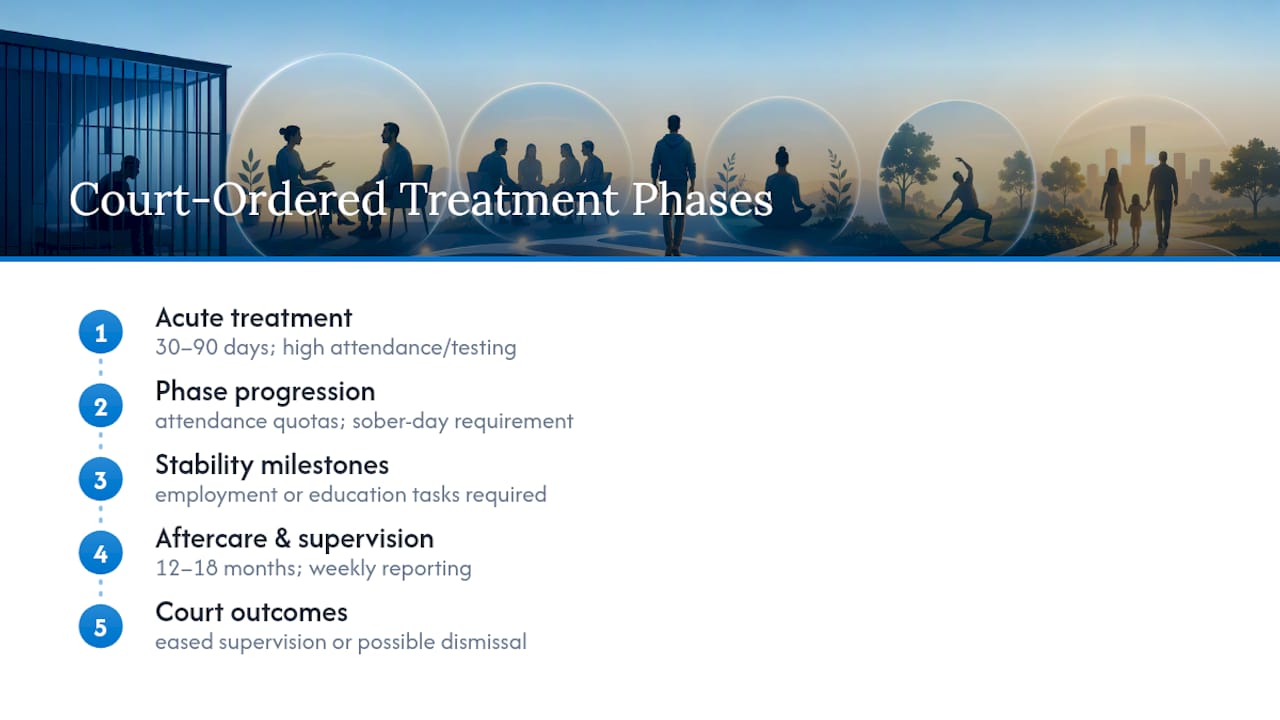
Advancing through phases isn’t just a formality. It’s usually what determines whether supervision eases up, whether a diversion agreement results in dismissed charges, or whether a probation term ends early. Stall out in one phase too long, and the court may treat that as a red flag worth revisiting at your next hearing.
How Sylmar’s Court-Directed Placement Program Supports Compliance
Courts and defense attorneys need a provider that documents everything, not just one that treats well. Sylmar Treatment Center’s court-directed placement program is built around that reality: detailed progress reports, attendance verification, and direct communication with probation officers and court staff.
The center holds a DHCS license and Joint Commission accreditation, credentials often recognized as evidence of legitimate, monitored care rather than a program assembled to check a box. With 24/7 admissions, Sylmar can move quickly when a court deadline is tight, and its dual-diagnosis capability matters because untreated co-occurring mental health conditions are a common reason court-ordered treatment fails partway through.
Why Attendance and Honest Communication Matter More Than People Think
Compliance and recovery aren’t separate tracks. The same habits, consistent attendance and quick, documented communication, protect your case and your progress at the same time. Keep copies of every report. Notify your provider the moment something goes wrong.
Pro Tip: Always request written confirmation of an excused absence from your provider, not just a verbal “it’s fine.” That document is what your case manager or attorney will actually use at your next status review.
— Jim
Getting Assessed and Documented at Sylmar Treatment Center
If a court has ordered treatment, or your attorney is negotiating for it, the paperwork trail matters as much as the clinical care behind it. Sylmar Treatment Center handles both under one roof, with a six-bed setting small enough that staff can catch a missed test or a shaky week before it becomes a court problem.
Sylmar’s court-directed placements are built specifically for defendants who need documented attendance, verified progress reports, and direct lines of communication with probation officers and court staff, not generic paperwork bolted onto standard treatment. The center’s DHCS license and Joint Commission accreditation provide recognized credentials. With 24/7 admissions, the center can often accommodate tight court deadlines that a longer intake process would miss.
If you or a family member has been ordered into treatment, or your attorney is asking about placement options for an upcoming hearing, call Sylmar’s admissions line or review the full treatment programs to see which level of care fits your court’s requirements.
Where to Verify the Rules Yourself
Don’t rely on secondhand summaries for anything court-facing. Check federal conditions of release under 18 U.S.C. § 3142, the NIJ overview of drug court structure, and the SAMHSA national helpline for locating certified programs near you.
This article is general information, not a substitute for advice from a qualified doctor. Consult a qualified healthcare professional about your own circumstances before acting on anything here.
Sources
- Substance use Testing & Substance Use Disorder Treatment (U.S. Courts guidance)
- Maine Treatment Court handbook (treatment status reviews and participant requirements)
- Overview of drug courts (NIJ / OJP)
FAQ
Can You Miss Court If You’re in Rehab?
Being in a residential program doesn’t automatically excuse a court date. Most courts require advance notice through your attorney or provider, and unapproved absences can trigger a bench warrant regardless of your treatment status.
Can You Ask a Judge to Send You to Rehab Instead of Jail?
Yes, defendants can request treatment through diversion petitions, plea negotiations, or sentencing mitigation, typically supported by a clinical assessment and a documented treatment plan from a licensed provider.
How Long Does Court-Ordered Rehab Usually Last?
Acute treatment phases commonly run 30 to 90 days, while full drug court tracks with aftercare and supervision often extend 12 to 18 months depending on phase advancement.
What Happens If Someone Leaves Court-Ordered Rehab Early?
Leaving against medical advice or getting discharged for noncompliance usually leads to program termination, which frequently means the court reinstates the original sentence the treatment was meant to replace.