

Courts in the United States order three main categories of treatment: specialty treatment courts (drug courts, DUI/DWI courts, family treatment courts, mental health courts, veterans courts, juvenile courts, and tribal healing-to-wellness courts), clinical levels of care (medical detox, residential/inpatient, partial hospitalization, intensive outpatient, standard outpatient, and continuing care), and supervision-linked programs (pretrial diversion, probation conditions, and supervised release requirements). Court-mandated treatment means a judge has made participation in a substance use or mental health program a legal condition — of release, diversion, probation, or sentencing — rather than ordering incarceration alone.
The types of court-mandated treatment programs differ significantly by setting, weekly time commitment, monitoring intensity, medication-assisted treatment (MAT) availability, and who pays. Here is a quick map of what the article covers:
- Specialty courts: Dedicated dockets that combine judicial supervision with treatment for specific populations
- Clinical levels of care: The continuum from 24-hour medical detox to weekly outpatient sessions
- Supervision-linked options: Diversion agreements, probation conditions, and supervised release requirements that attach treatment to an existing case
Key Takeaways
Court-mandated treatment programs span specialty courts, clinical levels of care, and supervision-linked conditions — and the level of care ordered should always be driven by clinical assessment, not charge severity alone.
| Point | Details |
|---|---|
| Three main program categories | Specialty courts, clinical levels of care (detox through continuing care), and supervision-linked conditions (diversion, probation, supervised release). |
| MAT access varies widely | Criminal justice referrals are less likely to receive MAT; ask in writing whether the assigned program permits buprenorphine, methadone, or naltrexone. |
| Drug courts run 12–24+ months | Phased programs (stabilization, clinical care, reintegration, continuing care) require sustained commitment — not a short-term fix. |
| Documentation protects compliance | Attendance logs, treatment summaries, and written communication with your probation officer reduce the risk of sanctions after a lapse. |
| Sylmartreatmentcenter | Accepts court-directed placements with DHCS and Joint Commission accreditation, MAT-inclusive care, and 24/7 admissions coordination. |
Table of Contents
- What court-ordered treatment actually means and how it works
- The main types of specialty treatment courts you might encounter
- Clinical levels of care courts commonly order
- Medication-assisted treatment in court-mandated programs
- Who qualifies and how long programs typically last
- Who pays for court-mandated treatment
- How courts monitor compliance and what the research says about outcomes
- What to do immediately after a court orders treatment
- How a licensed court-directed placement works: Sylmartreatmentcenter
- Sylmartreatmentcenter supports court-directed placements with clinical precision
- Sources
What court-ordered treatment actually means and how it works
“Court-mandated” and “court-ordered” are used interchangeably, but both describe the same legal mechanism: a judge attaches treatment participation as a condition rather than, or in addition to, a punitive sentence. State judicial guidance advises that courts should order treatment only when a substance use or mental health condition is a documented factor in the case, and that clinical input should guide which level of care is ordered.
Courts impose treatment through four main legal pathways:
- Pretrial diversion: Charges are held or dismissed if the person completes treatment before trial — no conviction on record if they succeed
- Condition of probation: The person is convicted but placed on probation; treatment attendance is a required condition
- Condition of supervised release: Applied after a federal or state prison term; treatment and testing are attached to the release order
- Alternative to incarceration: A judge offers treatment in lieu of a jail or prison sentence, often through a specialty court
The typical sequence runs: court-ordered clinical assessment → individualized treatment plan → treatment enrollment → regular status hearings → drug/alcohol testing → phase advancement or sanctions → graduation or termination. Who decides the level of care matters enormously. Judges have discretion, but clinical assessment should drive placement. A judge ordering residential care when outpatient is clinically appropriate wastes resources and can harm outcomes; a judge ordering outpatient when someone needs detox creates safety risks.
Common legal contexts where treatment orders appear:
- DUI/DWI arrests, especially repeat offenses
- Drug possession charges (felony or misdemeanor)
- Probation violations involving substance use
- Child welfare and family court cases where parental substance use is a factor
- Juvenile delinquency cases with identified substance use
The main types of specialty treatment courts you might encounter
The Office of Justice Programs describes treatment courts as specialized dockets that combine long-term treatment with judicial supervision, with the explicit goals of reducing recidivism and supporting rehabilitation. Each court model targets a specific population and wraps treatment around that population’s particular needs.
- Adult drug courts: The most common model. Designed for adults with substance use disorders facing drug-related charges. Combines frequent court appearances, random drug testing, case management, and treatment.
- DWI/DUI courts: Focused on repeat drunk or drugged drivers. Typically more intensive monitoring than standard drug courts, with ignition interlock requirements alongside treatment.
- Family treatment courts: Address parental substance use in child welfare cases. The goal is family reunification alongside sobriety, with services often extending to housing and parenting support.
- Mental health courts: Serve defendants whose charges are linked to untreated mental illness. Treatment plans include psychiatric care, medication management, and community support services.
- Veterans courts: Combine the drug court model with VA services and veteran peer mentors. Designed for service members whose substance use or mental health issues are connected to military service.
- Juvenile drug courts: Adapted for youth in the delinquency system. Family involvement is central, and programs tend to be shorter with more emphasis on school and community reintegration.
- Tribal healing-to-wellness courts: Operate within tribal justice systems and integrate traditional healing practices alongside clinical treatment.
- Opioid intervention and rapid-response courts: Emerging models that prioritize same-day MAT access and harm reduction for people with opioid use disorder, often bypassing the traditional phased model.
- Re-entry courts: Target people returning from incarceration. Treatment and supervision are coordinated to reduce the risk of relapse and re-arrest in the critical months after release.
Participation in specialty courts is almost always voluntary in the sense that defendants choose to enter rather than face the standard criminal process. That said, the alternative is usually incarceration or a harsher sentence, so “voluntary” is relative. The National Treatment Court Resource Center maintains definitions and the 10 key components used to design effective programs across all these models.
Statistic to know: Peer-reviewed evaluations show mixed but cautiously positive results for drug courts: some studies report modest reductions in recidivism when programs follow evidence-based practices, though gaps in MAT access and racial disparities in outcomes remain documented concerns.
Clinical levels of care courts commonly order
Courts order treatment across a full clinical continuum. The level should match clinical need, not just the severity of the charge. Here is how the main levels compare:
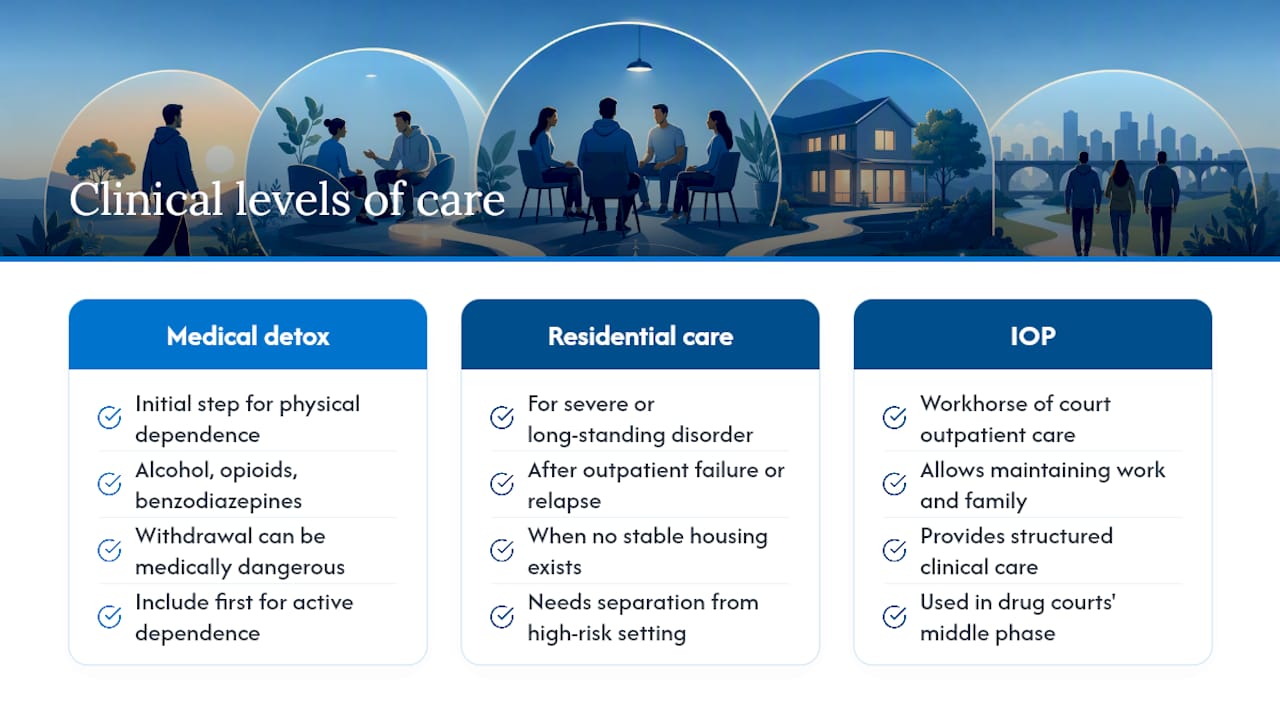
Federal judiciary guidance confirms that courts can and do impose this full menu of services as conditions of supervised release or probation, with funding handled through court contracts, participant fees, or other payer arrangements.
A few practical notes on when each level is typically recommended:
Medical detox is the starting point for anyone with physical dependence on alcohol, opioids, or benzodiazepines. Withdrawal from these substances can be medically dangerous, and detox without supervision is a serious health risk. Courts ordering treatment for someone with active dependence should always include detox as the first step.
Residential care makes sense when someone has a severe or long-standing disorder, has tried outpatient before and relapsed, lacks a stable home environment, or needs separation from a high-risk social setting. The detox evaluation criteria that guide clinical placement decisions look at exactly these factors.
IOP is the workhorse of court-mandated outpatient treatment. It allows people to maintain employment or family obligations while still receiving structured clinical care. Most drug court programs use IOP as their primary treatment modality during the middle phases.
Clinical assessment should always guide placement. Courts that skip assessment and assign a level based on charge severity alone tend to produce worse outcomes.
Medication-assisted treatment in court-mandated programs
MAT is not optional for many people with opioid or alcohol use disorder. It is evidence-based medicine. Johns Hopkins clinical guidance recommends prioritizing MAT — specifically buprenorphine and methadone — and individualized treatment plans over abstinence-only models in mandated programs. Yet courts vary widely in whether they allow or support it.
The three main MAT medications used in court-mandated contexts:
- Buprenorphine (Suboxone, Subutex): Reduces opioid cravings and withdrawal symptoms; can be prescribed by a certified physician in office-based settings, making it accessible in outpatient programs
- Methadone: Highly effective for opioid use disorder; dispensed daily at licensed opioid treatment programs (OTPs); more restrictive access but well-established for severe cases
- Naltrexone (Vivitrol): Blocks opioid and alcohol effects; available as a monthly injection, which makes it attractive to courts because compliance is easy to verify; no abuse potential
NIDA data shows that people referred to treatment through the criminal justice system are less likely to receive MAT than those referred through other channels. That gap is a real problem: withholding MAT from someone with opioid use disorder increases overdose risk, especially at the point of release from custody when tolerance has dropped.
Some drug courts still operate abstinence-only models that prohibit MAT. If you or someone you know is entering a court-mandated program, this is worth clarifying before enrollment.

Pro Tip: Ask the court coordinator or probation officer in writing whether MAT is permitted in the assigned program. If it is not, request a clinical review and ask whether an alternate placement that allows MAT is available. Document every request and response. This protects both your health and your legal standing.
Who qualifies and how long programs typically last
Eligibility for court-mandated treatment depends on the legal pathway and the court’s statutory authority. The broad categories:
- Diversion candidates: Usually first-time or low-level offenders with an identified substance use disorder; charges are pending and the person has not yet been convicted
- Probationers and parolees: People already under supervision whose conditions include treatment compliance
- Specialty court participants: Must meet the specific eligibility criteria of the court model (e.g., veterans courts require military service; family treatment courts require an open child welfare case)
- Juveniles: Processed through the juvenile delinquency system with age-appropriate program adaptations
Common eligibility triggers by case type:
- Repeat DUI/DWI with identified alcohol use disorder
- Felony drug possession without a violent offense history (in most jurisdictions)
- Probation violation linked to substance use
- Child welfare case where parental substance use is documented
- Misdemeanor drug charges diverted before trial
Program duration varies more than most people expect. Kentucky’s Drug Court Participant Handbook illustrates a phased model typical of many drug courts: a stabilization phase, a clinical care phase, a social reintegration phase, and a continuing care phase. Across most drug courts, the minimum total length runs 12–24 months. Shorter programs exist for diversion agreements, but anything under 90 days is generally considered insufficient for moderate-to-severe SUD.
Clark County Recovery Court materials show that early phases typically require the most frequent court appearances and treatment hours, with intensity tapering as participants demonstrate stability. Phase fees are common in many jurisdictions, though courts often have hardship provisions.
Judicial discretion plays a real role. Statutory limits define the outer boundaries, but judges have latitude within those limits. Specialty courts also require voluntary participation — a defendant must agree to enter, even when the alternative is incarceration.
Who pays for court-mandated treatment
Payment is one of the most confusing parts of court-mandated treatment, and the answer genuinely varies by jurisdiction, program type, and individual circumstances.
Federal court guidance confirms that funding can be contract-based (the court or jurisdiction pays a contracted provider) or non-contract (the participant or another payer covers costs). In practice, the payer mix looks like this:
- Court-contracted providers: The court has a standing agreement with specific treatment facilities; services are covered at no or low cost to the participant within that network
- Medicaid/Medicare: Covers many substance use treatment services for eligible participants; availability depends on state Medicaid expansion status and the specific services ordered
- Private insurance: Covers treatment at varying levels depending on the plan; the Mental Health Parity and Addiction Equity Act requires most plans to cover SUD treatment comparably to medical care
- Participant fees: Many programs charge sliding-scale fees, phase fees, or drug testing fees; hardship waivers are often available
- Grants and state funding: Some specialty courts receive federal or state grants that subsidize participant costs
Practical steps to access services after a court order:
- Get the treatment order in writing and identify whether the court has contracted providers
- Contact your probation officer or court coordinator to get a list of approved facilities
- Call your insurance company to verify SUD treatment benefits and in-network providers
- Request a clinical assessment at the assigned or chosen facility
- Ask the facility directly about sliding-scale fees and hardship provisions if cost is a barrier
- If you want a specific provider not on the court’s list, ask the court coordinator how to request an alternate placement
Probation officers are often the most practical point of contact for referrals. They know which providers the court works with regularly and can sometimes expedite paperwork.
How courts monitor compliance and what the research says about outcomes
Courts use a layered set of tools to track whether participants are meeting their treatment conditions. The core monitoring mechanisms are:
- Random drug and alcohol testing: Urinalysis, breathalyzer, or oral fluid tests; frequency is calibrated to risk level and phase of the program
- Status hearings: Regular appearances before the judge (often weekly in early phases, monthly later) where the treatment provider reports on attendance and progress
- Treatment attendance reports: Providers submit attendance and participation records directly to the court or probation officer
- Community supervision: Probation or parole officers conduct home visits, check employment status, and verify compliance with collateral conditions
The “carrot-and-stick” model is not just a metaphor. Consistent, transparent sanctions paired with meaningful incentives improve retention and reduce recidivism compared with ad-hoc punitive responses. Incentives might include reduced supervision frequency, public recognition in court, or phase advancement. Sanctions escalate from verbal warnings to increased treatment hours, community service, brief jail stays, or program termination.
What the evidence shows: Peer-reviewed reviews find that drug courts produce modest reductions in recidivism when programs follow evidence-based practices. The effect is real but not uniform: programs that restrict MAT, apply sanctions inconsistently, or serve populations with high co-occurring mental health needs tend to show weaker results.
Federal supplemental guidance on testing notes that testing frequency should be adjusted based on individual risk, and courts may reduce or suspend testing in low-risk cases as participants demonstrate stability.
Pro Tip: If you miss an appointment or have a positive test, contact your probation officer and treatment provider the same day — before the court hears about it. A multidisciplinary team (judge, probation officer, treatment provider) is far more likely to respond proportionately when the participant is transparent. Proactive communication, documented in writing, is the single most effective way to avoid escalated sanctions after a slip.
What to do immediately after a court orders treatment
The first 72 hours after receiving a treatment order matter more than most people realize. Here is a numbered checklist:
- Get the order in writing. Ask the court clerk for a certified copy of the order specifying the required program type, duration, and reporting requirements.
- Identify the assigned or approved provider. Ask your attorney or probation officer for the court’s approved provider list and whether you have any choice among them.
- Request a clinical assessment. Every placement should start with a formal assessment (ASAM criteria are the standard in the U.S.). Do not accept a placement that skips this step.
- Ask about MAT explicitly. Confirm in writing whether the assigned program permits MAT and, if not, how to request an alternate placement.
- Ask about co-occurring disorder services. If you have a mental health diagnosis alongside a substance use disorder, confirm the provider can address both. Integrated treatment planning is the clinical standard for dual-diagnosis cases.
- Get contact information for the court coordinator and probation officer. You will need to communicate with both throughout the program.
- Understand confidentiality limits. Treatment records are protected under 42 CFR Part 2, but courts can require providers to report attendance and compliance. Ask the provider exactly what they report and to whom.
Questions to ask the provider at intake:
- What level of care are you recommending and why?
- Do you offer MAT, and which medications?
- How do you report to the court or probation officer?
- What are the fees, and is there a hardship waiver?
- What happens if I miss a session?
- How do I request a treatment summary or attendance log for court?
If you disagree with the level of care assigned, you have the right to request a clinical review. Your attorney can file a motion asking the court to reconsider placement based on a second clinical opinion. Document everything.
How a licensed court-directed placement works: Sylmartreatmentcenter
Sylmartreatmentcenter accepts court-directed placements and coordinates directly with probation officers, court coordinators, and legal representatives to meet documentation requirements from day one.
Services relevant to court-mandated cases include:
- Medically supervised detox with 24-hour clinical oversight
- Residential treatment with individualized care plans built around ASAM assessment criteria
- Dual-diagnosis support for co-occurring mental health and substance use disorders
- Medication management with psychiatric oversight, including MAT where clinically indicated
- Clinical documentation for courts: attendance logs, treatment summaries, MAT verification letters, and progress reports
- 24/7 admissions support for urgent placements
Sylmartreatmentcenter holds a DHCS license and Joint Commission accreditation, which means courts and probation officers can verify the facility’s standing through recognized regulatory bodies. The six-bed residential setting means each patient gets a genuinely individualized treatment plan, not a one-size-fits-all group curriculum. That matters in court-directed cases because personalized recovery program components directly affect whether someone can demonstrate meaningful progress at status hearings.
Pro Tip: When you contact Sylmartreatmentcenter for a court-directed placement, ask admissions to prepare a court-ready intake packet from the start: a signed release of information for the court and probation officer, a treatment plan summary, and a schedule of reporting dates. Having this documentation ready before the first status hearing removes one of the most common sources of compliance problems.
What actually makes a difference in mandated programs
The participants and clinicians who navigate these programs most successfully tend to say the same things: structure matters, but the relationship with the treatment team matters more.
Courts provide the structure — status hearings create accountability that many people in early recovery genuinely need. The judge who sees you every two weeks and notices your progress is doing something a weekly group session alone cannot replicate. That accountability loop, when it is consistent and fair, keeps people engaged through the hardest stretches.
What clinicians consistently flag as the non-obvious success factor is team communication. A multidisciplinary team — judge, probation officer, treatment provider, social services — that shares information and responds consistently produces far better outcomes than a siloed system where the provider and the court never talk directly. Participants who stay in active communication with every member of that team are much less likely to face escalated sanctions after a minor lapse.
The other thing worth saying plainly: program label matters less than program quality. A well-run IOP with MAT access and a responsive clinical team will outperform a poorly run residential program every time. The role treatment centers play in legal cases depends almost entirely on whether the clinical team treats the court relationship as a collaboration rather than an administrative burden.
Sylmartreatmentcenter supports court-directed placements with clinical precision
When a court orders residential treatment, the difference between a facility that handles court paperwork as an afterthought and one that treats legal coordination as part of clinical care is immediate and measurable. Sylmartreatmentcenter’s court-directed placements program is built around exactly that coordination: 24/7 admissions, DHCS-licensed and Joint Commission-accredited residential care, MAT-inclusive treatment planning, and documentation that meets court and probation requirements from intake through discharge.
The six-bed setting means your treatment plan is genuinely yours, not a template. Admissions staff can coordinate directly with your probation officer or court coordinator to confirm placement, prepare required paperwork, and schedule reporting. If you have a co-occurring mental health diagnosis, the dual-diagnosis program addresses both conditions under one roof.
Call Sylmartreatmentcenter’s admissions line now, request a court placement intake packet, and ask for a clinical assessment to be scheduled within 24 hours. You can also review the full programs overview to confirm which services align with your court order before you call.
Sources
These are the primary policy and clinical references used throughout this article. They are the best starting point if you need to verify program standards, court procedures, or clinical guidance for your specific jurisdiction.
- What to Know About Mandated Treatment Programs | Opioid Principles
- Mass
- Treatment Courts | Overview
- Substance use reference guide | U.S. Courts
- Drug Court Participant Handbook | Kentucky Court of Justice
- PMC article on drug courts and outcomes | NCBI
This article is general information, not a substitute for advice from a qualified doctor. Consult a qualified healthcare professional about your own circumstances before acting on anything here.