
Why small treatment facilities feel safer: the core reasons
Small residential treatment facilities feel safer because their size makes anonymity nearly impossible. When a program holds six to eight clients instead of fifty, every person gets seen, heard, and tracked daily. That structural reality drives better outcomes across every dimension of care.
Here is what specifically makes the difference:
- Lower clinician-to-client ratios mean therapists spend real time with each person, not just scheduled check-ins. SAMHSA notes that small groups build therapeutic alliances faster than larger groups.
- Consistent staff assignments let clients work with the same therapist across weeks, building the trust that drives retention and long-term sobriety.
- Close daily monitoring allows staff to catch disengagement or distress within hours, not days.
- Smaller peer groups create accountability. Every client participates actively because there is no crowd to disappear into.
- Stable physical environments with calm, private spaces reduce sensory overload and support emotional openness.
- Clear family communication keeps loved ones informed and involved, which reinforces the client’s sense of security.
The safety in small treatment facilities is not incidental. It is built into how these programs are structured from day one.
What makes people feel unsafe at treatment centers in the first place
Fear of treatment is real, and it often comes from specific, concrete concerns rather than vague anxiety. Understanding those barriers clarifies exactly what smaller programs work to prevent.
- Crowded, impersonal settings where clients feel like numbers rather than people. Large facilities with rotating staff and packed group sessions rarely allow genuine connection to form.
- High staff turnover that forces clients to restart trust-building repeatedly, which is exhausting and counterproductive during recovery.
- Rigid, one-size-fits-all programs that ignore individual history, co-occurring disorders, or readiness to change.
- Poor family communication, leaving loved ones in the dark and clients feeling cut off from their support systems.
- Inadequate supervision in large, understaffed settings where adverse events go unnoticed longer than they should.
- Lack of privacy, particularly in dormitory-style housing where clients have no quiet space to process difficult emotions.
Each of these barriers erodes the psychological safety that recovery depends on. Small facilities address them structurally, not just philosophically.
How to evaluate whether a residential treatment facility is actually safe
Not every small facility is automatically safe, and not every large one is dangerous. These are the criteria that actually matter when you are choosing a residential treatment program for yourself or someone you love.
- Accreditation and licensing: look for Joint Commission accreditation and state licensure, such as a DHCS license in California. These are not marketing claims. They are verified standards. Learn more about why accreditation matters when evaluating care quality.
- Qualified, consistent clinical staff: therapists and counselors should hold recognized credentials and stay assigned to the same clients throughout treatment.
- Evidence-based treatment programs: cognitive behavioral therapy, motivational interviewing, and medication-assisted treatment where appropriate, not just group meetings and worksheets.
- Family inclusion protocols: structured family therapy and regular progress updates are a sign that the facility treats recovery as a relational process.
- Emergency response capacity: 24/7 clinical oversight and clear protocols for medical or psychiatric crises.
- Physical environment: clean, secure, and designed for calm. Private sleeping areas, accessible common spaces, and no institutional feel.
Pro Tip: Ask any facility you are considering how often a client sees the same therapist each week. The answer tells you more about the program’s actual structure than any brochure will.
How personalized care and staff attention build safety in small facilities

The therapeutic alliance, the working relationship between a client and their clinician, is one of the strongest predictors of treatment retention and recovery outcomes. Small facilities build it faster because the conditions are right.
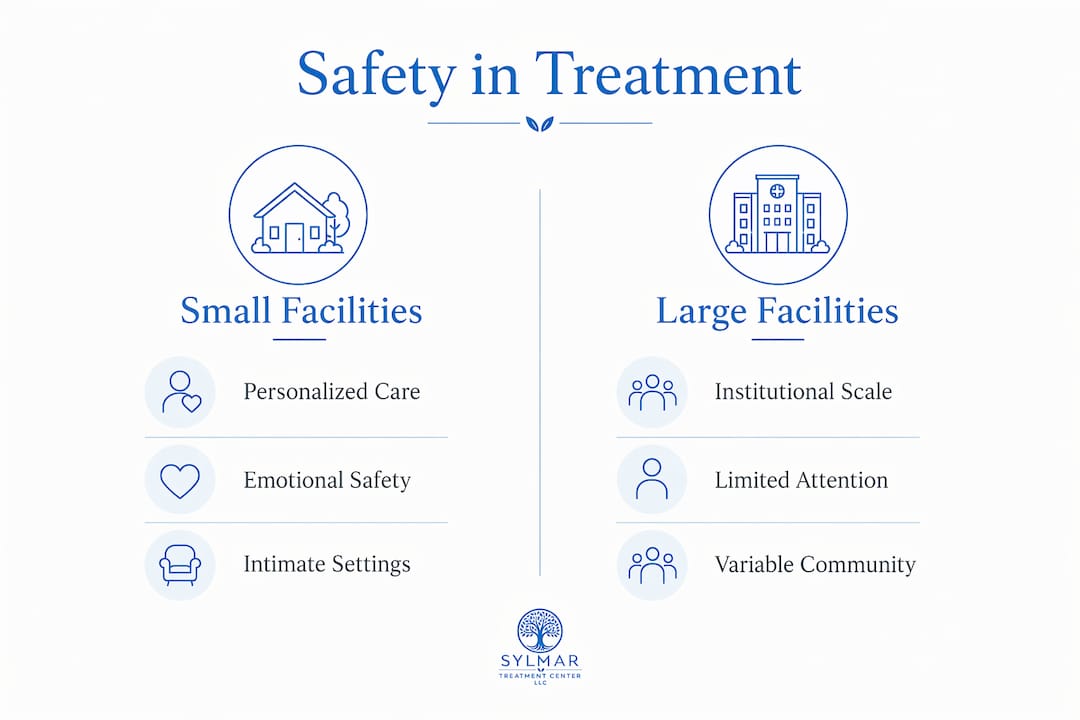
SAMHSA’s Treatment Improvement Protocol 41 identifies lower clinician-to-client ratios as a key driver of stronger alliances and better long-term sobriety. When a therapist carries a caseload of six rather than twenty, sessions go deeper. They remember what was said last week. They notice when something shifts.
Personalized treatment plans also adapt in real time. If a client hits a wall in week two, a small-facility clinician can adjust the approach without navigating institutional approval chains. That flexibility is a clinical advantage, and clients feel it. Research on group therapy engagement confirms that a group size of six demands consistent involvement from every participant, which prevents the passive disengagement that stalls progress in larger settings.
A group of six means no one disappears. Staff notice changes in mood, appetite, and participation within hours, not days. That speed of response is what makes small facilities genuinely safer for clients in early, fragile recovery.
How small facilities create emotional safety through community
Emotional safety is not a soft concept. It is the condition under which people tell the truth about their addiction, their trauma, and their fears. Without it, treatment stays surface-level.
- Smaller peer groups reduce anonymity, turning what could feel like exposure into a therapeutic asset. When group size demands participation, clients engage rather than observe.
- Shared daily routines among the same small group, eating together, exercising together, attending sessions together, build the kind of mutual understanding that accelerates trust. Spending 30 days alongside the same peers creates bonds that reinforce accountability.
- Selective, voluntary admissions protect group cohesion. When everyone in the room chose to be there and meets similar readiness criteria, the group dynamic stays constructive rather than disruptive.
- Privacy within the community matters too. Small facilities can offer private or semi-private rooms, quiet spaces for reflection, and a pace that does not feel institutional.
- Stable group membership over the course of treatment lets trust deepen past the surface. Clients stop performing and start working.
The family recovery program component reinforces this further. When families are included through structured communication and therapy, clients feel anchored to something beyond the facility walls.
What “safety” actually means in a treatment center context
Safety in addiction and mental health treatment covers two distinct but connected dimensions: physical safety and emotional safety. Physical safety means freedom from harm, adequate medical supervision, secure facilities, and clear emergency protocols. Emotional safety means the freedom to be honest without fear of judgment, punishment, or abandonment.
Both matter. A facility can be physically secure but emotionally hostile, which produces compliance without healing. The goal of a truly safe treatment environment is to create conditions where a person feels protected enough to do the hard work of recovery. For many people entering treatment, emotional safety is actually the harder thing to find, and the more urgent need.
Why peer community in small facilities accelerates recovery
Peer support is one of the most consistent predictors of sustained recovery, and small facilities generate it more reliably than large ones. When the same six to eight people share meals, sessions, and downtime for weeks, they develop a genuine investment in each other’s progress.
That investment creates informal accountability that extends beyond scheduled therapy hours. A peer who notices you skipped breakfast or seemed withdrawn at dinner is doing something a staff member in a 60-bed facility simply cannot do at scale. The community becomes part of the treatment. Peer bonds formed in small, intimate rehab settings often persist well beyond discharge, providing a recovery network that supports sobriety long after the formal program ends.
How the physical environment shapes the feeling of safety
The physical space of a treatment facility sends a message before a single session begins. Crowded hallways, institutional furniture, and shared dormitory rooms signal that the facility is managing volume. Private rooms, natural light, calm common areas, and accessible outdoor space signal something different: that the people here are worth caring for.
Small facilities tend to occupy residential-scale buildings rather than converted hospitals or large campuses. That scale matters psychologically. A home-like environment lowers the threat response that many people in early recovery carry constantly. Trauma-informed design, which considers noise levels, sightlines, personal space, and sensory input, is far easier to implement in a six-bed setting than in a 100-bed institution. For clients whose trauma is tied to feeling trapped or surveilled, the physical openness of a small facility can itself be therapeutic. Smaller settings also make it easier to provide trauma-focused support that addresses the underlying experiences driving substance use.
Key Takeaways
Small treatment facilities feel safer because their structure, not just their philosophy, creates the conditions for genuine therapeutic connection and close clinical oversight.
| Point | Details |
|---|---|
| Ratio drives alliance | SAMHSA links small groups to faster therapeutic alliances than larger groups. |
| Emotional safety enables honesty | Clients tell the truth and do real work only when they feel safe from judgment and abandonment. |
| Peer bonds extend recovery | Small-group cohesion creates accountability and support networks that persist after discharge. |
| Accreditation is verifiable | Joint Commission accreditation and state licensure confirm standards, not just marketing claims. |
| Physical environment matters | Home-scale spaces reduce the threat response and support openness in early recovery. |
Sylmartreatmentcenter operates from exactly this model: a six-bed residential setting with Joint Commission accreditation, a DHCS license, and 24/7 admissions support. Every client receives a comprehensive assessment and a custom care plan, with consistent staff who know their name, their history, and their progress. If you are ready to explore what personalized recovery programs look like in practice, Sylmartreatmentcenter is available around the clock to answer your questions.