

Benzodiazepine withdrawal often starts within hours for short-acting drugs, or days for long-acting ones, with acute symptoms peaking somewhere in the first one to four weeks. A minority of people, roughly 10 to 15 percent, go on to experience protracted symptoms that stretch for months. Never stop a benzodiazepine abruptly. Talk to a clinician about a supervised taper, and treat seizures, severe confusion, or hallucinations as emergencies requiring immediate care.
TL;DR:
- Short-acting benzodiazepines typically cause withdrawal symptoms within hours that peak within 2 to 7 days, resolving in about 1 to 2 weeks.
- Longer-acting drugs like diazepam may delay withdrawal onset by weeks, with symptoms lasting longer but often less intense initially.
- Severe complications such as seizures or psychosis usually occur during the first two weeks, requiring close monitoring and emergency care.
- A medically supervised taper can extend the withdrawal timeline over months or even years, significantly reducing risks like seizures.
- Protracted withdrawal symptoms, including anxiety and insomnia, can persist for months or over a year, often requiring supportive therapies and patience.
Table of Contents
- Benzodiazepine Detox Timeline at a Glance
- What Happens in Each Phase of Withdrawal
- What Stretches or Shortens the Withdrawal Timeline
- Symptoms to Expect, and Warning Signs That Need Immediate Care
- How Medical Tapering Changes the Detox Timeline
- Living Through Protracted Withdrawal: What Actually Helps
- Why Timelines on Paper Rarely Match Timelines in Practice
- How Sylmar Treatment Center Approaches Benzodiazepine Detox
- Get Supervised Support for Benzodiazepine Detox
- Sources
Benzodiazepine Detox Timeline at a Glance
How fast withdrawal hits, and how long it lingers, depends heavily on the drug’s half-life. A benzodiazepine that clears the body quickly produces a sharper, faster withdrawal curve. One that lingers in tissue for days produces a slower, more drawn-out one.
Here’s how the three main categories typically break down:
- Short-acting agents (like alprazolam or triazolam): withdrawal can begin within hours, with symptoms typically peaking between 2 and 7 days and much of the acute phase resolving within 1 to 2 weeks.
- Intermediate-acting agents (like lorazepam or temazepam): onset usually falls between 24 and 48 hours, with a peak around days 3 through 7, and an acute phase that can run 2 to 3 weeks.
- Long-acting agents (like diazepam or clonazepam): onset can be delayed by days to weeks, and while the ride is often gentler, symptoms can drag out longer before resolving.
Clinicians generally describe three phases across all three categories: an early rebound phase, an acute peak, and, for some, a protracted phase often called PAWS (post-acute withdrawal syndrome). The drug’s half-life shifts the timing of each phase, but the sequence itself rarely changes.
What Happens in Each Phase of Withdrawal
Each phase has a distinct biological signature, and knowing what drives it helps explain why the calendar matters as much as the symptoms themselves.
-
Early or rebound phase. This is the return of the original symptoms the benzodiazepine was prescribed for, usually anxiety or insomnia, often worse than before treatment started. It happens because the drug’s calming effect on GABA receptors drops off faster than the brain can readjust. Timing tracks closely with half-life: short-acting drugs rebound within hours, long-acting ones may take a week or more to show it.
-
Acute withdrawal. This is the danger window. Symptom intensity climbs toward a peak, and it’s during this stretch that the more serious complications, seizures and, less commonly, psychosis, tend to show up. Research and clinical literature both describe this acute phase as generally running 10 to 14 days, though it can extend to about four weeks in some cases.
-
Protracted withdrawal, or PAWS. For most people, symptoms fade steadily after the acute peak. But an estimated 10 to 15 percent of long-term users experience waves of anxiety, insomnia, and cognitive fog that persist for months, occasionally over a year. This isn’t a sign that something went wrong. It reflects real neuroadaptation that takes longer to reverse than the drug takes to leave the bloodstream.
What Stretches or Shortens the Withdrawal Timeline
No two withdrawal timelines look identical, and clinicians rely on a handful of predictable factors to estimate how rocky, or how long, a given case will be.
- Drug half-life and dose. Short-acting benzodiazepines and higher doses tend to produce sharper, more intense acute symptoms, including a higher seizure risk.
- Duration of use. Years of continuous use, and higher cumulative dose over that time, raise the odds of protracted symptoms developing later.
- Polysubstance use. Concurrent alcohol or other sedative use compounds withdrawal severity and adds its own complication risks.
- Prior withdrawal history. A previous severe withdrawal episode, sometimes called the kindling effect, tends to predict a rougher course the next time.
- Age and organ function. Older adults and those with liver or kidney impairment often clear the drug more slowly, which can extend timing unpredictably.
- Untreated psychiatric conditions. Anxiety, depression, or other conditions left unaddressed can intensify and prolong the psychological symptoms of withdrawal.
Pro Tip: If more than one of these risk factors applies to you, don’t attempt a home taper on a fixed calendar. Ask your clinician about a slower, supervised schedule, or inpatient monitoring, before you make a single dose change.
Symptoms to Expect, and Warning Signs That Need Immediate Care
Most withdrawal symptoms are miserable but not dangerous. A smaller set of symptoms cross into medical emergency territory, and knowing the difference matters.
Common, expected symptoms include:
- Anxiety and rebound insomnia
- Irritability and mood swings
- Tremor and muscle tension
- Sweating and gastrointestinal upset
- Trouble concentrating
- Heightened sensitivity to light or sound
The complications that require emergency attention are a different category entirely: generalized tonic-clonic seizures, severe autonomic instability (racing heart, dangerously high blood pressure), psychosis, and suicidal ideation. Research on severe withdrawal complications links these outcomes most strongly to high-dose use or abrupt, unsupervised cessation.
Timing matters here. These severe events cluster in the acute phase, commonly within the first two weeks, which is exactly why close monitoring early in a taper isn’t optional for higher-risk patients. If you or someone you’re supporting has a seizure, becomes severely confused, or shows signs of psychosis during a taper, call emergency services. Do not wait it out.
How Medical Tapering Changes the Detox Timeline
A supervised taper doesn’t just make withdrawal more comfortable. It fundamentally reshapes the timeline by spreading the acute peak out instead of letting it hit all at once.
Clinicians generally use one of two strategies. The first is a gradual reduction of the same drug the patient has been taking. The second is a cross-taper: switching to a long-acting benzodiazepine like diazepam, then tapering that drug slowly. Both approaches are described in the NCBI clinical overview as standard practice for reducing acute rebound and seizure risk.
Taper length varies enormously depending on dose history and risk factors:
- Straightforward cases may taper over several weeks to a few months.
- Long-term, high-dose, or high-risk cases often extend the taper across many months, sometimes longer.
- Clinicians increasingly advise planning for the long game: follow-up and adjustment that can span months to years, not a fixed end date.
Inpatient or residential medically supervised detox adds a layer that home tapers can’t match: 24/7 monitoring and the ability to adjust medication in real time if severe symptoms appear. That’s a meaningful safety margin for anyone with multiple risk factors.
Pro Tip: A slower taper isn’t a failure to “push through” withdrawal faster. Stretching a taper from weeks to months is often the exact adjustment that prevents a seizure or hospitalization.
For a closer look at what a supervised process actually involves day to day, see how medically supervised detox works and why inpatient monitoring matters for safety.
Living Through Protracted Withdrawal: What Actually Helps
If you’re past the acute phase but still dealing with waves of anxiety, insomnia, or brain fog months later, that’s consistent with protracted withdrawal, not a sign you’re doing something wrong. Most people see real, measurable improvement somewhere in the 6 to 18 month range, though the timeline isn’t linear. Expect better weeks and worse weeks, not a steady climb.
What tends to help during this stretch:
- Cognitive behavioral therapy for anxiety and sleep disruption
- Consistent sleep hygiene practices, even when sleep still feels unreliable
- Paced, gradual exercise rather than intense exertion
- Peer support or group therapy specific to benzodiazepine recovery
Full cessation isn’t always the immediate goal, either. Some clinicians treat dose reduction or a stabilized maintenance dose as a legitimate clinical endpoint when pushing to zero risks prolonged impairment. That’s a decision made with a prescriber, not a personal failure to “finish” the taper.
Why Timelines on Paper Rarely Match Timelines in Practice
Most benzodiazepine withdrawal charts treat the process like a countdown clock. It isn’t one. The drug’s half-life sets a rough starting point, but residual tissue binding and slow elimination mean symptoms can resurface in unpredictable waves long after a calendar-based taper says they should be gone. That mismatch is where a lot of home tapers fall apart. People follow a fixed schedule, hit an unexpected wave of anxiety at week nine, and assume something has gone badly wrong when it’s actually a known, if under-discussed, pattern.
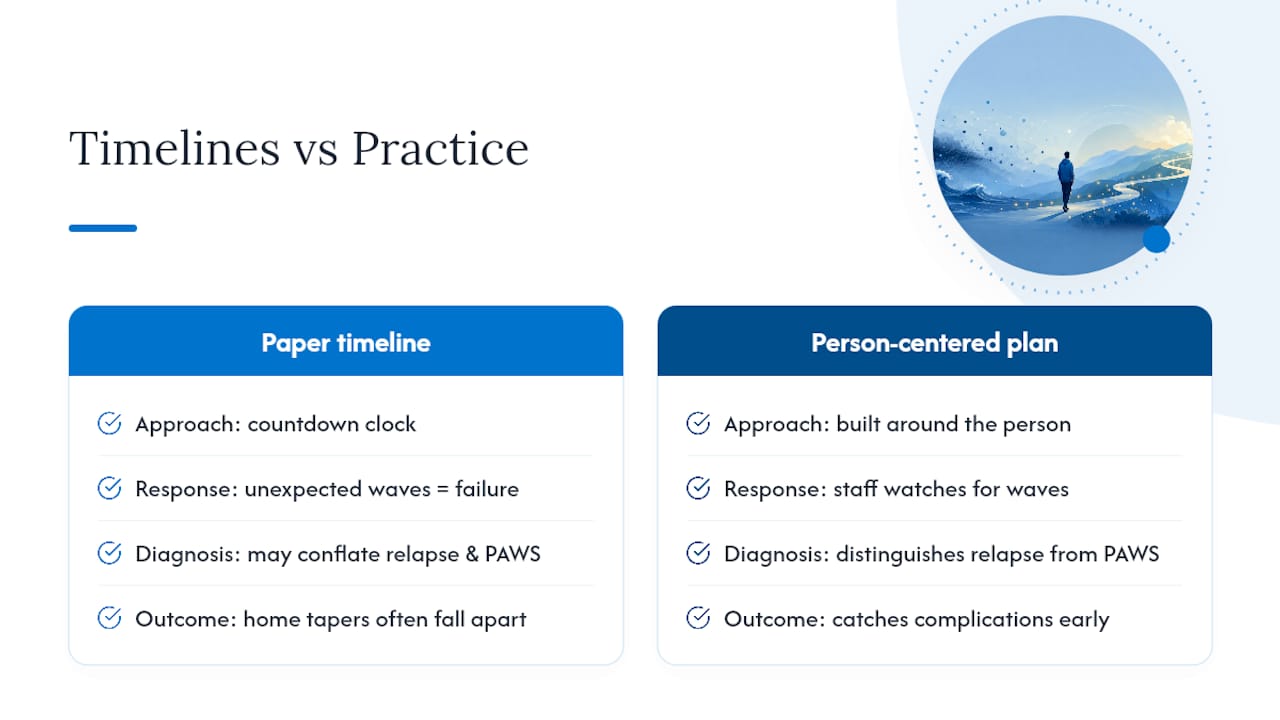
The other thing conventional advice gets wrong is treating protracted withdrawal and relapse of the original psychiatric condition as the same problem. They’re not, and telling them apart takes real clinical judgment over time rather than a snap diagnosis at the first sign of returning anxiety. That distinction changes the treatment plan entirely: one calls for patience and supportive care, the other calls for actually treating the underlying condition.
At Sylmar Treatment Center, this is exactly why taper plans get built around the person rather than a printed schedule. A six-bed setting means staff can actually watch for those unexpected waves instead of managing symptoms from a checklist. That kind of attention isn’t a luxury add-on. It’s what catches the difference between a hard week and a genuine complication before it becomes one.
— Jim
How Sylmar Treatment Center Approaches Benzodiazepine Detox
Sylmar Treatment Center provides medically supervised detox with psychiatric oversight, built around individualized taper plans rather than a one-size schedule. Care includes dual-diagnosis support for co-occurring anxiety, depression, or other psychiatric conditions that often complicate withdrawal timing.
The intimate setting allows for personalized 24/7 monitoring. Sylmar holds appropriate licenses and accreditation. Patients typically go through a full clinical assessment, an individualized taper, continuous monitoring through the acute phase, and transitional planning into outpatient support once stabilized.

Get Supervised Support for Benzodiazepine Detox
Reading a timeline is useful. Going through withdrawal without someone watching for the warning signs is a different situation entirely, and it’s the one place a home taper genuinely can’t compete with supervised care. This center offers a small residential setting where staff can monitor patients closely to manage risks before they escalate.

If you or someone you love is on a benzodiazepine and thinking about stopping, the individualized treatment programs at Sylmar start with a full clinical assessment, not a generic schedule. Admissions support is available 24/7, so you can call today, ask direct questions about what a supervised taper would look like for your specific situation, and find out whether residential detox is the right next step.
This article is general information, not a substitute for advice from a qualified doctor. Consult a qualified healthcare professional about your own circumstances before acting on anything here.
Sources
- Benzodiazepines: Clinical overview — NCBI Bookshelf
- When tapering benzodiazepines, plan for the long game — Psychiatric News
- Pharmacokinetics-related factors in benzo withdrawal — Springer (2021)
- The benzodiazepine withdrawal syndrome — PubMed