

Detox stabilization is the medically supervised process of guiding a patient through acute intoxication and withdrawal to reach a physically stable, substance-free state, while simultaneously beginning the psychosocial work that makes lasting recovery possible. According to the Substance Abuse and Mental Health Services Administration, stabilization covers both the medical and psychosocial processes of assisting patients through withdrawal to a fully supported, substance-free condition. It is not addiction treatment in the full sense. Think of it as the doorway: you have to walk through it safely before anything else can happen.
Detox stabilization applies across a range of substances, with alcohol and opioids carrying the highest medical risk during withdrawal. Here is what the process typically involves:
- Medical management of withdrawal symptoms, including medications when needed
- Vital sign monitoring and symptom tracking throughout the acute phase
- Psychosocial support to orient patients to the treatment setting and their role in recovery
- Family and support network engagement, where appropriate and with patient consent
- Transition planning toward longer-term substance abuse treatment
- Individualized care plans based on substance type, dependence severity, and co-occurring conditions
One point worth stating clearly: detox stabilization addresses the physical crisis. It does not resolve the psychological, social, and behavioral dimensions of addiction. Those require ongoing treatment after stabilization ends.
What does the detoxification process actually involve?
Detoxification is a set of interventions aimed at managing acute intoxication and withdrawal by clearing toxins from the body of a patient who is acutely intoxicated or physically dependent on substances. The goal is to minimize physical harm. What it is not, and this distinction matters clinically, is a program designed to resolve the longstanding psychological, social, and behavioral problems tied to addiction.
Two primary models guide how detox is delivered in the United States:
- The medical model uses physicians, nurses, and medications to ease withdrawal safely, typically in a hospital or licensed residential setting
- The social model relies on a supportive, non-hospital environment and peer support, with little or no medication
The right model depends on the substance involved and the patient’s medical history. Alcohol and benzodiazepine withdrawal can be life-threatening, which generally requires the medical model. Cannabis withdrawal, by contrast, rarely demands pharmacological intervention.
Duration varies widely, from hours of crisis monitoring to weeks of extended withdrawal management, depending on the substance, the length of use, and the patient’s overall health. Substances that commonly require medically supervised detox include alcohol, opioids, benzodiazepines, and stimulants. For a closer look at which substances carry the highest risk, Sylmartreatmentcenter’s guide on substances requiring medical detox breaks it down by category.
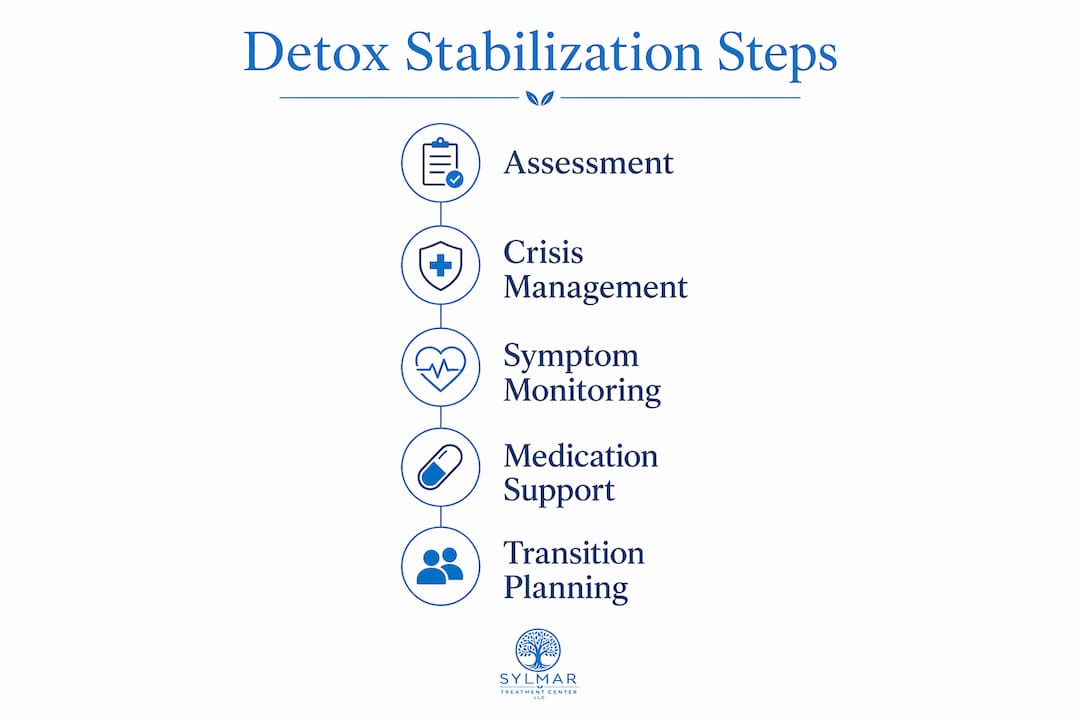
How does the stabilization phase work after detox begins?
Stabilization is the phase within detox where the patient moves from acute crisis toward a medically stable, substance-free state. It combines medical interventions with psychosocial support, and the two tracks run simultaneously rather than sequentially.

On the medical side, stabilization often involves medication-assisted treatment (MAT). Benzodiazepines are commonly used for alcohol withdrawal; methadone or buprenorphine for opioid dependence. Medications are titrated carefully based on symptom severity, not given at a fixed dose from the start.
The psychosocial side is where stabilization distinguishes itself from a simple medical detox. Key elements include:
- Orienting patients to what they can expect from the treatment setting and their own role in recovery
- Building a therapeutic alliance between the patient and clinical staff
- Motivational engagement to help patients see the detox crisis as an opportunity rather than just a medical event
- Involving family members or employers when the patient consents, to strengthen external support
- Assessing co-occurring psychiatric conditions that may complicate withdrawal or require separate treatment
Duration at this stage can range from hours to weeks, depending on withdrawal complexity. Once withdrawal symptoms have improved and the patient is medically stable, the clinical team shifts focus toward preparing the patient for the next level of care.
What withdrawal symptoms and complications should you expect?
Withdrawal looks different depending on the substance, but certain patterns are consistent across clinical settings. Common symptoms include tremors, nausea, vomiting, anxiety, insomnia, and muscle pain. The severity ranges from uncomfortable to genuinely dangerous.

Alcohol withdrawal carries the highest risk of severe complications. Delirium tremens (DTs), which can include seizures, hallucinations, and cardiovascular instability, typically appears 48–72 hours after the last drink and requires immediate medical management. Opioid withdrawal, while rarely fatal on its own, produces intense physical distress including agitation, sweating, and respiratory changes that demand close monitoring.
Clinical teams manage these risks through:
- Continuous vital sign monitoring, including blood pressure, heart rate, temperature, and respiratory rate
- Validated symptom scales such as the Clinical Opiate Withdrawal Scale (COWS) for opioids or the Clinical Institute Withdrawal Assessment (CIWA) for alcohol
- Medication adjustments based on real-time symptom data rather than fixed schedules
- Immediate escalation protocols when complications like seizures or severe agitation arise
Premature discharge before stabilization is complete dramatically increases the risk of relapse and medical emergency. Sylmartreatmentcenter’s clinical guide on vital sign monitoring covers the specific assessment tools used throughout this phase.
Pro Tip: If you are supporting a loved one through detox, ask the clinical team which symptom scale they are using and what score triggers a medication adjustment. That one question tells you a lot about the quality of monitoring in place.
Which evidence-based therapies are used during detox and stabilization?
The medical and psychosocial interventions used during detox stabilization are not arbitrary. They follow protocols grounded in decades of clinical research, with the strongest evidence concentrated in a few specific areas.
Medication-assisted treatment is the backbone of medical stabilization for the two highest-risk substance categories:
- Alcohol withdrawal: Benzodiazepines (such as diazepam or lorazepam) reduce seizure risk and ease autonomic symptoms. Dosing is typically symptom-triggered using the CIWA scale rather than given on a fixed schedule.
- Opioid withdrawal: Methadone works by displacing heroin and other opioids at the μ-opioid receptor, reversing withdrawal symptoms. Patients with significant opioid dependence may start at a moderate methadone dose per day, with careful dose assessment to prevent over-sedation. Buprenorphine is an alternative with a ceiling effect that reduces overdose risk.
On the psychosocial side, motivational interviewing (MI) is the most widely supported approach during stabilization. Rather than confronting denial, MI works with the patient’s own ambivalence to build internal motivation for change. Research from NCBI confirms that addressing psychosocial issues during detoxification significantly increases the likelihood of safe withdrawal and subsequent treatment participation.
Admission criteria for detox stabilization programs generally include evidence of physical dependence, a substance type that carries medical withdrawal risk, and the absence of acute medical conditions requiring emergency care rather than detox. Co-occurring mental health disorders, far from being exclusion criteria, are actually a reason to prioritize admission, since psychosocial and biomedical factors are inseparable during this phase.
Aftercare planning starts during stabilization, not after discharge. The clinical team assesses the patient’s strengths, vulnerabilities, and social supports to recommend the appropriate next level of care, whether that is residential treatment, intensive outpatient, or medication maintenance. For patients navigating addiction recovery and the emotional weight that comes with it, resources like addiction counseling support can complement the clinical work that begins in stabilization.
Expert perspectives on detox stabilization and the continuum of care
The most common clinical misconception about detox stabilization is that completing it means completing treatment. It does not. Detoxification alone is not designed to resolve the longstanding psychological, social, and behavioral problems associated with addiction. It is the first point on a continuum, not the destination.
Clinicians who work in this field consistently emphasize one pattern they want to break: the “revolving door” of repeated detox admissions without rehabilitation. A patient who detoxes, leaves without a treatment connection, relapses, and returns for another detox cycle is not progressing. Research published on PubMed identifies failure to transition patients from detox to ongoing care as a primary driver of poor long-term outcomes. Successfully linking detox stabilization with substance abuse treatment reduces that cycle, saves costs over time, and delivers the level of care patients actually need.
The multidisciplinary team model is the clinical standard for a reason. Physicians manage medical risk. Nurses monitor symptoms around the clock. Counselors build the therapeutic alliance. Social workers assess housing, family dynamics, and insurance barriers that will affect whether the patient can actually access the next level of care. Each role is distinct, and gaps in any one of them create vulnerabilities.
Psychosocial and biomedical domains are inseparable during stabilization. An initial evaluation covering co-occurring psychiatric conditions and social supports can predict stabilization success and flag complications before they escalate. The patient who arrives in withdrawal and also has untreated depression, unstable housing, and no family support needs a different care plan than the patient whose only presenting issue is physical dependence.
Pro Tip: Clinicians using the test dose approach for opioid stabilization should document the patient’s response at 1–2 hours post-dose before adjusting upward. Signs of sedation after a challenge dose indicate the starting dose should be lower, not higher.
The therapeutic alliance built during stabilization has a measurable effect on whether patients follow through with the treatment plan after discharge. Staff who respond to patients with genuine compassion, rather than clinical detachment, shift the odds. That is not a soft observation. It is what the research on detox staff and patient motivation consistently shows.
For patients and families trying to understand how detox connects to the broader recovery process, Sylmartreatmentcenter’s article on why detox alone is not treatment addresses this directly. And for those dealing with the guilt and emotional complexity that often surfaces during recovery, understanding those feelings is part of what the stabilization phase begins to address.
Sylmartreatmentcenter’s approach to detox stabilization
Sylmartreatmentcenter operates from a six-bed residential setting, which means detox stabilization here looks different from a large facility. Every patient receives a comprehensive assessment on admission, and care plans are built around that individual’s substance history, medical needs, and co-occurring conditions. The Joint Commission accreditation and DHCS license reflect the clinical standards the center holds itself to.
If you or someone you care about is at the point of needing detox stabilization, the treatment programs at Sylmartreatmentcenter are structured to carry patients from that first medically supervised phase through to longer-term recovery. Admissions support is available 24/7. The process starts with a conversation, not a commitment.
Key Takeaways
Detox stabilization is the medically and psychosocially supervised entry point into addiction treatment, combining withdrawal management with the early work of building patient readiness for lasting recovery.
| Point | Details |
|---|---|
| Detox stabilization defined | It is the combined medical and psychosocial process of guiding patients from acute intoxication to a stable, substance-free state. |
| Not the same as treatment | Detox stabilization addresses physical withdrawal; it does not resolve psychological, social, or behavioral addiction factors. |
| Duration varies widely | The stabilization phase can last from hours to weeks, depending on the substance and the patient’s withdrawal complexity. |
| Therapeutic alliance matters | Building patient motivation during stabilization, not after, significantly improves entry into ongoing treatment. |
| Linking to aftercare is critical | Without a direct connection to rehabilitation or outpatient care, patients face high relapse risk and repeated detox cycles. |