

Vital sign monitoring in detoxification is defined as the systematic, repeated measurement of heart rate, blood pressure, respiratory rate, and temperature to detect physiological instability during withdrawal. The role of vital sign monitoring in detox goes beyond routine observation. It is the primary mechanism by which clinicians identify life-threatening complications before they escalate. Vital signs checked every 4 hours during initial withdrawal stages give care teams the data they need to adjust treatment in real time. For healthcare professionals and caregivers managing detox patients, understanding this monitoring framework is not optional. It is the foundation of safe, evidence-based detoxification practice.
What vital signs are monitored during detox and why they matter
Detox and vital sign assessment centers on four core parameters, each reflecting a different physiological system under stress during withdrawal.
Heart rate and rhythm signal cardiovascular strain. Tachycardia above 100 beats per minute is a common early marker of sympathetic nervous system activation during alcohol or opioid withdrawal. Persistent elevation or irregular rhythm warrants immediate clinical attention and may indicate the onset of delirium tremens.

Blood pressure tracks autonomic instability. Hypertension during withdrawal reflects the rebound hyperactivity of the central nervous system after chronic substance suppression. Readings above 160/100 mmHg in a withdrawal patient signal the need for medication review and closer observation intervals.
Respiratory rate detects two opposing dangers. In opioid withdrawal, respiratory depression is the primary risk, where rates below 12 breaths per minute require immediate intervention. In stimulant or alcohol withdrawal, elevated rates above 20 breaths per minute may indicate anxiety, pain, or early sepsis.
Temperature serves as a complication flag. Fever above 38.5°C (101.3°F) in a detox patient suggests infection, aspiration pneumonia, or a severe withdrawal reaction rather than simple substance clearance. Hypothermia, though less common, can appear in patients with severe nutritional deficits.
Oxygen saturation via pulse oximetry adds a fifth layer of safety. Readings below 94% in a detox patient require prompt assessment for respiratory compromise, especially in patients with co-occurring pulmonary conditions.
- Heart rate above 100 bpm: evaluate for sympathetic hyperactivity and delirium tremens risk
- Blood pressure above 160/100 mmHg: review benzodiazepine dosing and hydration status
- Respiratory rate below 12 or above 20: assess for opioid toxicity or systemic infection
- Temperature above 38.5°C: rule out infection and consider escalation of care
- Oxygen saturation below 94%: assess airway, positioning, and supplemental oxygen need
Neurological symptoms tracked alongside vital signs improve detection of withdrawal severity. Seizures, tremors, and hallucinations do not always precede vital sign changes. Treating both data streams together gives clinicians a more complete picture of patient status.
Pro Tip: Use a structured withdrawal scoring tool such as the Clinical Institute Withdrawal Assessment for Alcohol (CIWA-Ar) alongside vital sign documentation. The numeric score combined with objective vital sign data creates a defensible, reproducible record for clinical decision-making.
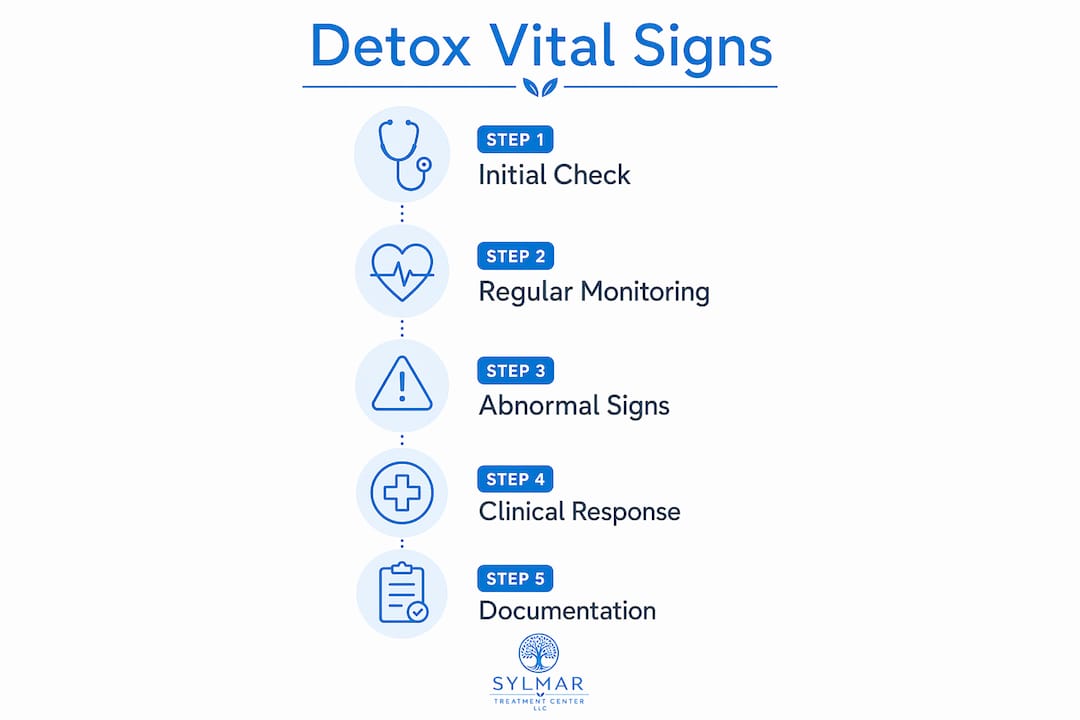
How often and by what methods are vital signs monitored in detox
Monitoring frequency in detox is not fixed. It scales with patient stability, substance type, and withdrawal severity.
Standard monitoring intervals
- Every 4 hours for stable patients in early withdrawal. This interval catches gradual deterioration without over-burdening nursing staff. Vital signs at this frequency represent the baseline standard for initial withdrawal management.
- Every 2–4 hours for patients showing signs of instability. Unstable patients require intensive monitoring with telemetry when available. This interval applies to patients with CIWA-Ar scores above 10 or those with cardiovascular comorbidities.
- Continuous telemetry for high-risk patients. Patients with a history of seizures, delirium tremens, or cardiac arrhythmia benefit from real-time cardiac monitoring. Telemetry allows nurses to detect rhythm changes within seconds rather than hours.
- Hourly checks during acute crisis. When a patient shows signs of delirium tremens or severe respiratory compromise, hourly or more frequent spot checks supplement continuous monitoring until stabilization.
Monitoring tools and methods
| Tool | Primary use | Key limitation |
|---|---|---|
| Sphygmomanometer | Blood pressure measurement | Requires trained technique for accuracy |
| Pulse oximeter | Oxygen saturation and heart rate | Inaccurate with poor peripheral perfusion |
| Thermometer (oral/tympanic) | Core temperature | Tympanic readings vary with technique |
| Continuous cardiac monitor | Heart rate and rhythm | Requires lead placement and maintenance |
| Respiratory rate counter | Breath rate per minute | Manual counting prone to observer error |
Manual measurement tools remain essential in settings without continuous telemetry. Sphygmomanometers, pulse oximeters, and thermometers form the minimum equipment standard for any medically supervised detox unit.
Pro Tip: Document every vital sign reading with a timestamp and the clinician’s initials. Time-stamped records allow the care team to identify trends, not just single data points, which is where the most clinically meaningful information lives.
How do you recognize and respond to abnormal vital signs in detox?
Abnormal vital signs during detox follow recognizable patterns. Knowing those patterns allows clinicians to intervene before a complication becomes a crisis.
Warning signs that require immediate action
- Sudden heart rate increase above 120 bpm combined with diaphoresis and agitation: suspect delirium tremens and initiate benzodiazepine protocol
- Blood pressure spike above 180/110 mmHg: assess for hypertensive urgency and review medication timing
- Respiratory rate drop below 10 breaths per minute in an opioid detox patient: administer naloxone per protocol and call for emergency support
- Temperature above 39°C (102.2°F) with altered mental status: initiate sepsis screening and escalate to physician immediately
- Oxygen saturation below 90% unresponsive to repositioning: prepare for supplemental oxygen and possible transfer to a higher level of care
Medication regimes are modified in response to vital sign changes. Benzodiazepine dosing for alcohol withdrawal, for example, is titrated directly against heart rate and blood pressure readings. A patient whose heart rate remains above 100 bpm despite an initial dose requires reassessment within 30 minutes, not at the next scheduled interval.
Hydration and electrolyte management are inseparable from vital sign response. Tachycardia in a detox patient is frequently compounded by dehydration. Correcting fluid and electrolyte deficits often normalizes heart rate and blood pressure without additional pharmacological intervention.
Prompt recognition of vital sign deterioration is the single most effective intervention for preventing delirium tremens from progressing to a fatal outcome. The window between early warning signs and full-blown delirium can be as short as a few hours. Clinicians who act on the first abnormal reading rather than waiting for a pattern have consistently better patient outcomes.
Effective vital sign monitoring leads to better patient outcomes and measurably reduces safety incidents during detox. The clinical team’s ability to escalate care quickly depends entirely on having accurate, timely data in hand.
Integrating vital sign data into full detox patient management
Vital sign tracking in detox programs is most effective when it feeds directly into the broader clinical picture, not when it exists as a standalone task.
Combining vital sign data with neurological symptom observation produces a richer assessment. A patient with a heart rate of 105 bpm and no neurological symptoms represents a different risk profile than a patient with the same heart rate plus tremors and confusion. Seizures, tremors, and hallucinations tracked alongside vital signs allow clinicians to stratify risk more accurately and allocate monitoring resources where they are most needed.
Vital sign data drives medication dosing decisions directly. Benzodiazepine titration in alcohol withdrawal, clonidine dosing for opioid withdrawal, and antihypertensive use all rely on real-time vital sign values. A care team without current vital sign data is making dosing decisions without the most critical input.
- Assign a primary nurse to each detox patient for consistent vital sign documentation
- Use a standardized flow sheet or electronic health record field for every reading
- Brief the oncoming shift on vital sign trends, not just the most recent reading
- Communicate any reading outside the established threshold to the attending physician within 15 minutes
- Review the full 24-hour vital sign trend at each clinical handoff
Nurses play a central role in vital sign measurement and rapid response during detox. Their continuous presence at the bedside makes them the first line of detection for deterioration. Staff training on both measurement technique and threshold recognition is not a one-time event. It requires regular competency review, particularly when new monitoring equipment is introduced.
Accurate documentation enables assessment of treatment effectiveness over time. A single abnormal reading is a data point. A series of readings over 12 hours is a clinical narrative that guides every subsequent decision, from medication adjustment to discharge planning.
For a detailed look at how clinical protocols structure this process, the detox treatment protocols guide at Sylmartreatmentcenter provides a practical framework for care teams.
Key Takeaways
Vital sign monitoring is the primary clinical tool for detecting withdrawal complications early and guiding every treatment decision during detox.
| Point | Details |
|---|---|
| Core parameters | Monitor heart rate, blood pressure, respiratory rate, temperature, and oxygen saturation at every assessment. |
| Frequency scales with risk | Stable patients require checks every 4 hours; unstable patients need every 2–4 hours with telemetry when available. |
| Abnormal patterns demand action | Tachycardia, hypertension, or fever in a detox patient triggers immediate medication review and possible escalation. |
| Data integration improves outcomes | Combine vital sign readings with neurological symptom scores to stratify risk and guide dosing decisions. |
| Documentation is clinical currency | Time-stamped vital sign records enable trend analysis and support accurate clinical handoffs. |
What I’ve learned from watching vital signs save lives in detox
The clinical literature on monitoring frequency is clear. What the literature does not always capture is the human reality of a detox unit at 3:00 AM, when a nurse notices that a patient’s heart rate has climbed from 88 to 114 over two consecutive readings and makes the call to wake the attending physician.
That decision, grounded in documented vital sign trends rather than a gut feeling, is where monitoring earns its value. I have seen teams hesitate because a single reading “wasn’t that bad.” The patients who deteriorated fastest were almost always the ones whose early warning signs were attributed to anxiety or discomfort rather than treated as physiological data.
The most common gap I see in real-world detox settings is not equipment failure. It is inconsistent documentation. A pulse oximeter reading that never makes it into the chart is clinically worthless. Training staff to treat every vital sign entry as a legal and clinical record changes behavior more reliably than any protocol memo.
The medically supervised detox process works when monitoring is treated as a continuous clinical conversation, not a checkbox task. Caregivers who understand why each parameter matters, not just how to measure it, respond faster and more accurately when values shift.
— Jim
Clinical monitoring at Sylmartreatmentcenter
Sylmartreatmentcenter operates with a six-bed residential setting specifically designed to support the kind of close, continuous monitoring that detox patients require. Every patient receives a custom care plan built around individual risk factors, substance history, and medical status.
The center’s DHCS license and Joint Commission accreditation reflect a commitment to clinical standards that go beyond minimum compliance. Nursing staff follow structured vital sign protocols aligned with current 2026 clinical guidelines, and every reading feeds directly into individualized treatment decisions. Families and referring clinicians can review the full range of detox and treatment programs to understand how monitoring is embedded into every stage of care. For patients who need a higher level of individualized support, the individualized treatment program at Sylmartreatmentcenter provides a structured, monitored path through detox and into recovery.
FAQ
What vital signs are checked during medical detox?
Clinicians monitor heart rate, blood pressure, respiratory rate, temperature, and oxygen saturation during medical detox. These five parameters provide the earliest indicators of withdrawal complications and guide medication adjustments.
How often should vital signs be taken during detox?
Vital signs should be checked at least every 4 hours during initial withdrawal, with frequency increasing to every 2–4 hours for unstable patients. Continuous telemetry is recommended for patients with a history of seizures or cardiac arrhythmia.
What does a high heart rate mean during detox?
Tachycardia above 100 bpm during detox signals sympathetic nervous system hyperactivity and may indicate escalating withdrawal severity or early delirium tremens. It requires immediate clinical assessment and possible medication adjustment.
Why is documentation of vital signs important in detox?
Accurate vital sign records allow clinicians to identify trends over time, assess treatment effectiveness, and communicate patient status accurately during shift handoffs. A single reading provides a snapshot; a documented series provides a clinical narrative.
Can vital sign monitoring prevent death during detox?
Yes. Prompt recognition of deteriorating vital signs allows clinicians to intervene before conditions like delirium tremens or respiratory depression become fatal. Early complication detection through vital monitoring is directly linked to better patient safety outcomes.
Recommended
- Detox Safety Best Practices: Your 2026 Guide | Sylmar Treatment Center
- Inpatient vs. Outpatient Detox Options: A Safety Guide | Sylmar Treatment Center
- Examples of Detox Treatment Protocols: A Clinical Guide | Sylmar Treatment Center
- Starting Detox in a Six-Bed Facility: A Safety Guide | Sylmar Treatment Center