

Withdrawal from designer benzodiazepines can be just as dangerous as withdrawal from prescription benzodiazepines, and in some cases more so. Seizures, delirium, and severe autonomic instability are all possible, and the risk climbs sharply when these substances are mixed with opioids or alcohol. If someone is having a seizure, is severely confused, is struggling to breathe, or cannot take oral medications, call 911 immediately. For clinical triage and guidance on a specific exposure, call Poison Control at 1-800-222-1222 any time.
What to watch for right now:
- Seizures or convulsions of any kind
- Severe confusion, disorientation, or delirium
- Rapid heart rate, profuse sweating, or high blood pressure
- Difficulty breathing or unresponsiveness
- Inability to keep fluids or medications down
The ASAM benzodiazepine tapering guidelines and the UpToDate benzodiazepine withdrawal review are the two primary clinical references for managing this withdrawal. Both emphasize that abrupt cessation is dangerous and that medically supervised tapering is the standard of care. Sylmartreatmentcenter provides medically supervised detox and residential stabilization for people who cannot safely manage withdrawal at home.
Key Takeaways
Designer benzodiazepine withdrawal carries the same life-threatening risks as prescription benzodiazepine withdrawal, requires medically supervised tapering, and demands a long-term outpatient plan after any inpatient stabilization.
| Point | Details |
|---|---|
| Emergency signs require 911 | Seizures, severe confusion, breathing difficulty, or inability to take oral medications need immediate emergency care. |
| Standard drug screens often miss DBZs | Routine urine immunoassays frequently return false negatives; LC-MS testing at a reference lab is needed for confirmation. |
| Slow taper is the standard of care | Guidelines recommend 5%–10% dose reductions over weeks to months, often via conversion to long-acting diazepam. |
| Inpatient care stabilizes but rarely finishes the taper | Residential detox manages acute risk; outpatient follow-up and continued tapering are usually required after discharge. |
| Sylmartreatmentcenter offers supervised stabilization | The center provides medically supervised detox and residential care with 24/7 admissions support for high-risk DBZ withdrawal cases. |
Table of Contents
- What are designer benzodiazepines and how do they differ from prescription benzos?
- What withdrawal symptoms should you watch for, and which are emergencies?
- When do withdrawal symptoms start, and how long do they last?
- How do clinicians diagnose withdrawal when standard drug tests often miss DBZs?
- What happens in emergency and immediate management?
- How does outpatient tapering work, and what does a safe schedule look like?
- When is inpatient medically supervised detox necessary?
- What adjunctive treatments help, and what should you avoid?
- How do you reduce harm when someone is still using designer benzodiazepines?
- What caregivers need to know: a practical checklist
- What does the research actually say about DBZ withdrawal?
- An editorial perspective on what actually matters in DBZ withdrawal care
- Medically supervised detox for designer benzodiazepine withdrawal at Sylmartreatmentcenter
- Sources
What are designer benzodiazepines and how do they differ from prescription benzos?
Designer benzodiazepines (DBZs) are synthetic analogs of prescription benzodiazepines. They share the same core chemical structure and bind the same GABA-A receptors in the brain, but they are not approved for medical use. Most circulate as “research chemicals” sold online or obtained through illicit channels, often without accurate labeling of dose or potency.
The most commonly documented designer benzodiazepines include several agents with varying potencies and half-lives, some of which are structurally related to prescription benzodiazepines and have appeared increasingly in illicit use.
Three features make DBZs clinically distinct from standard prescription benzos. First, potency is unpredictable. A pill or powder labeled as one dose may deliver far more or less active compound than expected. Second, half-lives vary widely across agents. Some, like etizolam, act quickly and clear relatively fast; others, like clonazolam and flubromazolam, persist in the body for extended periods. Third, standard urine drug screens frequently miss them. Routine immunoassays are calibrated for common prescription agents and often return a false negative even when a DBZ is present in significant quantities.

The DEA has documented flubromazolam and other synthetic benzodiazepines in the illicit supply, noting elevated overdose risk when these agents are combined with other CNS depressants. That combination, not the DBZ alone, accounts for a large share of the most severe outcomes.
What withdrawal symptoms should you watch for, and which are emergencies?
UpToDate’s clinical review describes benzodiazepine withdrawal as a syndrome driven by rebound CNS hyperexcitability once GABA-A receptor suppression is removed. The symptom picture ranges from uncomfortable but manageable to immediately life-threatening.
Common symptoms that typically appear early and can often be monitored in a structured outpatient setting:
- Anxiety, restlessness, and irritability
- Insomnia and vivid or disturbing dreams
- Tremor, especially in the hands
- Sweating, elevated heart rate, and mild blood pressure increases
- Nausea, vomiting, and loss of appetite
- Heightened sensitivity to light, sound, and touch
- Muscle aches and headache
Severe and life-threatening complications that require emergency or inpatient care:
- Generalized tonic-clonic seizures (the most feared acute complication)
- Delirium, characterized by acute confusion, disorientation, and agitation
- Psychosis with hallucinations or paranoid ideation
- Severe autonomic instability: extreme tachycardia, hypertension, or hyperthermia
- Respiratory depression, particularly when DBZs are combined with opioids or alcohol
Clinical bottom line: Seizures during benzodiazepine withdrawal can occur without warning and can be fatal. Any prior seizure during withdrawal, any history of high-dose or long-duration use, or any polysubstance exposure involving opioids or alcohol should be treated as a high-risk situation requiring medical supervision, not home management.
Several factors push a person toward the severe end of the spectrum. Abrupt cessation rather than a gradual taper is the single biggest driver. Short-acting, high-potency agents like clonazolam and flubromazolam carry higher seizure risk than longer-acting, lower-potency ones. High cumulative dose, a long period of use, a prior seizure history, and concurrent use of alcohol or opioids all compound that risk.
Triage guidance:
- Mild-to-moderate symptoms (anxiety, insomnia, mild tremor, nausea) in a person with no seizure history, low-dose exposure, and no polysubstance use may be manageable with close outpatient monitoring and a supervised taper.
- Any seizure, delirium, severe autonomic instability, or inability to take oral medications requires emergency department evaluation and likely inpatient admission.
- Polysubstance use involving opioids or alcohol should prompt a strong bias toward inpatient care regardless of symptom severity at presentation.
When do withdrawal symptoms start, and how long do they last?
Timing depends heavily on the half-life of the specific DBZ involved. Because many people using these substances do not know exactly which agent they took or at what dose, clinicians often have to work from symptom onset and exposure history rather than confirmed pharmacokinetics.
| Agent type | Example agents | Symptom onset | Acute withdrawal duration | PAWS risk |
|---|---|---|---|---|
| Short-acting | Etizolam, deschloroetizolam | Within 6–24 hours of last dose | 5–10 days (peak days 2–4) | Moderate to high |
| Intermediate-acting | Flualprazolam, bromazolam | 12–48 hours | 7–14 days | Moderate |
| Long-acting | Clonazolam, flubromazolam | 24–96 hours or longer | 10–21+ days | High |
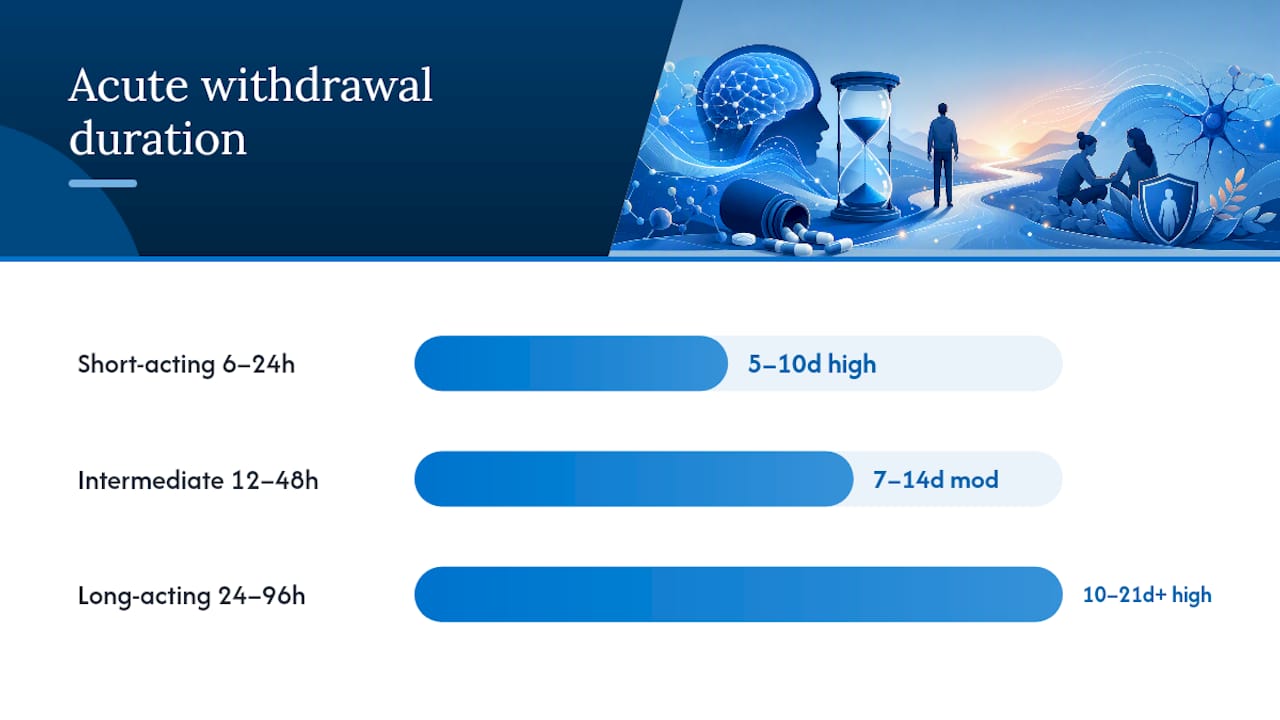
Seizure risk is concentrated in the early acute window, typically the first 24–72 hours for short-acting agents and potentially later for long-acting ones. This is why the first several days after stopping a DBZ demand the closest monitoring.
Protracted withdrawal can last for an extended period beyond the acute phase, during which many people continue to experience anxiety, cognitive difficulty, sleep disruption, mood instability, and physical symptoms. PAWS is not a sign of treatment failure; it reflects the time the nervous system needs to recalibrate after sustained GABA-A suppression. It does, however, require ongoing clinical support and is one reason why completing a taper and maintaining outpatient follow-up matters so much.
How do clinicians diagnose withdrawal when standard drug tests often miss DBZs?
Diagnosis of DBZ withdrawal is primarily clinical. A clinician takes a detailed history of substance use, timing of last dose, and symptom progression, then assesses withdrawal severity using a structured scale. The Clinical Institute Withdrawal Assessment for Benzodiazepines (CIWA-B) is the most widely used tool, scoring items like tremor, sweating, anxiety, and perceptual disturbances to guide treatment intensity.
The testing picture is more complicated. Routine urine immunoassays frequently miss many designer benzodiazepines. These screens are designed to detect common prescription agents like diazepam and alprazolam, and most DBZs do not cross-react reliably with those antibodies. A negative urine drug screen does not rule out DBZ use or dependence.
Liquid chromatography-mass spectrometry (LC-MS) is the reliable method for identifying specific DBZs. The catch is that most hospital labs do not run these assays in-house. Samples typically go to reference labs, which means results can take days. By the time confirmation arrives, clinical management is already underway based on history and symptoms.
When specialized testing is worth ordering:
- Unexplained sedation or withdrawal in a patient with unclear substance history
- Legal or forensic questions about specific agent exposure
- Suspected novel agent exposure where knowing the exact compound would change management
- Cases where the clinical picture does not fit the reported history
For most acute withdrawal presentations, clinicians proceed on clinical grounds and adjust based on response to treatment. Waiting for LC-MS results before starting a stabilizing benzodiazepine dose is not appropriate when a patient is actively withdrawing.
What happens in emergency and immediate management?
When someone arrives at an emergency department in active DBZ withdrawal, the clinical priorities follow a clear sequence. Airway, breathing, and circulation come first. Cardiac monitoring goes on immediately given the risk of autonomic instability. Seizure control is addressed with intravenous benzodiazepines if needed. Once the person is stabilized, a replacement benzodiazepine is started to suppress further withdrawal.
For caregivers managing a situation before emergency services arrive:
- Keep the person away from furniture edges, stairs, and hard surfaces in case of a seizure
- Do not restrain them during a seizure; protect the head and turn them on their side afterward
- Offer small sips of water if they are alert and can swallow safely; do not force fluids
- Do not give additional sedatives, sleep aids, or alcohol in an attempt to calm symptoms
- Call 911 for any seizure, severe confusion, breathing difficulty, or unresponsiveness
- Call Poison Control (1-800-222-1222) if you are unsure whether the situation is an emergency
When outpatient management is reasonable:
A person with mild-to-moderate symptoms, no seizure history, confirmed low-dose exposure to a single agent, reliable social support, and the ability to take oral medications may be managed with a supervised outpatient taper. This requires frequent check-ins, a clear safety plan, and a low threshold to escalate.
Outpatient management is not appropriate when there is any seizure history, polysubstance use involving alcohol or opioids, high-dose or long-duration exposure, severe psychiatric instability, or lack of a safe home environment. For those cases, inpatient benzo detox is the safer path.
How does outpatient tapering work, and what does a safe schedule look like?
The core principle of outpatient tapering is straightforward: replace the short-acting, high-potency, or poorly characterized DBZ with a long-acting benzodiazepine of known potency, then reduce the dose slowly and systematically. Diazepam is the most commonly used substitution agent because of its long half-life (20–100 hours, including active metabolites), which produces smoother plasma levels and reduces the peaks and troughs that drive breakthrough withdrawal symptoms.
Joint clinical guidance recommends 5%–10% dose reductions spaced over weeks to months, with shared decision-making and frequent reassessment throughout. Completing a taper can take months to years depending on the starting dose, duration of use, and individual response. Slower reductions near the end of the taper are often necessary because the final milligrams tend to produce disproportionate symptoms.
Illustrative diazepam equivalency and taper framework (all plans must be individualized by a clinician):
Important caveat: DBZ-to-diazepam equivalencies are not well-established in the literature. The figures above are clinical estimates based on receptor binding and reported potency; they are not validated conversion tables. Every taper plan must be built by a clinician who knows the patient’s full history.
Practical steps for a supervised outpatient taper:
- Confirm the specific DBZ(s) involved and estimate cumulative dose and duration of use as accurately as possible.
- Calculate an approximate diazepam equivalent and begin the patient on a stabilizing dose that controls withdrawal symptoms without causing sedation.
- Allow 1–2 weeks of stabilization before beginning reductions.
- Reduce by 5%–10% of the current dose every 2–4 weeks, slowing further if symptoms emerge.
- Schedule weekly or biweekly check-ins during the early phase; monthly once stable.
- Develop a written seizure safety plan and provide emergency contacts.
- Slow or pause the taper if withdrawal symptoms become severe; never accelerate to “get it over with.”
- Plan for a transition to ongoing outpatient support, therapy, and monitoring after the taper ends.
Warn them in advance so they do not interpret worsening symptoms as a sign the taper is failing.*
When is inpatient medically supervised detox necessary?
Some presentations simply cannot be managed safely outside a medical setting. ASAM guidance supports inpatient stabilization for high-risk cases and is explicit that tapering may need to continue across settings, with outpatient follow-up typically required after discharge.
Clear indications for inpatient admission:
- Active seizures or a documented history of seizures during prior withdrawal
- Severe or complicated withdrawal with delirium, psychosis, or extreme autonomic instability
- Polysubstance use involving alcohol, opioids, or other CNS depressants
- High diazepam-equivalent doses where outpatient taper carries unacceptable seizure risk
- Inability to reliably take oral medications
- Severe psychiatric instability or active suicidality
- Lack of a safe home environment or reliable caregiver support
Inside an inpatient unit, the clinical team manages withdrawal with high-frequency benzodiazepine dosing titrated to symptom scores, continuous cardiac monitoring, and close nursing observation. In select settings, phenobarbital-based protocols are used, particularly when benzodiazepine tolerance is so high that standard doses are insufficient or when cross-tolerance with alcohol complicates the picture. Phenobarbital has a long half-life and a different mechanism of action that can be useful in refractory cases, though it requires careful dosing and monitoring.
One drug to approach with caution is flumazenil. While flumazenil is a benzodiazepine receptor antagonist that can reverse sedation, administering it to a physically dependent patient can precipitate acute, severe withdrawal and seizures. It is not a routine reversal agent in the context of benzodiazepine dependence and should only be used by experienced clinicians in very specific circumstances.
A realistic expectation for inpatient stays: they stabilize the acute medical crisis. Expert commentary published in Frontiers in Psychiatry emphasizes that inpatient units rarely complete the entire taper, and that post-discharge outpatient monitoring is critical to prevent relapse and protracted withdrawal complications. Patients and families should understand this before admission so they are not surprised when discharge comes with a continuing outpatient taper plan rather than a finished one. For more on what detox stabilization actually accomplishes, the distinction between stabilization and taper completion is worth understanding clearly.
What adjunctive treatments help, and what should you avoid?
Benzodiazepine replacement and tapering are the backbone of treatment. Adjunctive agents address specific symptoms that persist despite adequate taper management, but the evidence base for most of them in DBZ withdrawal specifically is limited.
| Symptom | Possible adjunct agent | Evidence level / caveat |
|---|---|---|
| Persistent anxiety or depression | SSRIs or SNRIs (e.g., sertraline, venlafaxine) | Moderate for underlying anxiety disorders; not for acute withdrawal itself; takes weeks to work |
| Severe agitation or psychosis | Low-dose antipsychotics (e.g., haloperidol, quetiapine) | Used clinically; limited controlled data in benzo withdrawal; monitor for QTc prolongation |
| Seizure prophylaxis (selected cases) | Carbamazepine or valproate | Some evidence as adjuncts; not substitutes for benzodiazepine replacement |
| Autonomic hyperactivity | Propranolol or clonidine | Reduce heart rate and blood pressure symptoms; do not prevent seizures |
| Insomnia (non-acute phase) | Melatonin, sleep hygiene protocols | Low risk; modest benefit; preferred over sedative hypnotics |
What to avoid: Pregabalin and other gabapentinoids carry real risks in this context. They can cause respiratory depression, particularly when residual DBZ is still present, and they carry their own dependence potential. Adding them without a clear clinical rationale and close monitoring is not recommended. Similarly, adding other sedative hypnotics (Z-drugs, antihistamines in high doses) without a structured plan can complicate the withdrawal picture without providing meaningful benefit.

Nonpharmacological supports, including structured sleep schedules, regular meals, light exercise when tolerated, and reduced stimulation, are low-risk and genuinely helpful for managing the discomfort of protracted symptoms.
How do you reduce harm when someone is still using designer benzodiazepines?
The most dangerous thing a person can do with a DBZ is combine it with an opioid, alcohol, or another sedative. All three depress the CNS through overlapping mechanisms, and the combination can suppress breathing to a fatal degree with little warning. Poison center data documents that many DBZ exposures presenting with severe respiratory or cognitive depression involve this kind of combination.
Practical harm-reduction steps:
- Avoid mixing DBZs with opioids, alcohol, methadone, or any other sedative under any circumstances
- Never use alone; have someone present who knows what to do and can call 911
- Keep naloxone (Narcan) accessible whenever opioid co-use is possible. Naloxone reverses opioid-induced respiratory depression but does not reverse benzodiazepine toxicity. If both are involved, naloxone may partially improve breathing, but the person still needs emergency care.
- Use drug-checking services or fentanyl test strips when available; many DBZ pills in the illicit supply also contain fentanyl or other adulterants
- Avoid taking pills from unknown sources; potency varies dramatically even between batches from the same supplier
- Keep a written list of substances used, approximate doses, and timing accessible for emergency responders
- Tell at least one trusted person what you are taking and where to find your medical history
Naloxone is worth having even if opioids are not the primary substance, because fentanyl contamination of the illicit benzodiazepine supply is documented. It will not reverse a pure benzodiazepine overdose, but it may buy time in a mixed exposure while emergency services arrive.
What caregivers need to know: a practical checklist
Caregivers are often the first people to recognize that something is wrong and the last line of defense before emergency services arrive. Being prepared makes a real difference.
Immediate monitoring and safety:
- Check breathing and responsiveness regularly, especially during sleep
- Remove sharp objects, furniture with hard edges, and fall hazards from the immediate environment
- Know the seizure first-aid protocol: do not restrain, protect the head, turn on the side after the seizure ends, time the seizure, and call 911 if it lasts more than 5 minutes or if another follows
- Document the exact substances, estimated doses, timing of last use, and any changes in behavior or symptoms
What to bring to an ED or detox intake:
- A written timeline of substance use (what, how much, how often, when last used)
- Any pill bottles, packaging, or photos of the substances
- A list of all current medications and medical/psychiatric diagnoses
- Contact information for any prescribers or previous treatment providers
- Insurance cards and photo ID for admissions
Day-to-day support:
- Encourage regular meals and hydration if tolerated; nutritional depletion worsens withdrawal symptoms
- Keep the environment calm and low-stimulation; bright lights and loud noise amplify sensory sensitivity
- Do not attempt to substitute medications at home without clinical guidance, even if the person has leftover prescription benzos
- Avoid expressing frustration about the situation in front of the person withdrawing; shame and stress worsen anxiety and increase relapse risk
The medically supervised detox process can feel unfamiliar and intimidating for families. Understanding what to expect at intake, including the assessment process and initial stabilization, helps caregivers support the person through the transition.
What does the research actually say about DBZ withdrawal?
The honest answer is that the evidence base for DBZ withdrawal specifically is thin. Clinical guidelines from ASAM and the AAFP provide strong, well-supported recommendations for benzodiazepine tapering in general, and those principles apply to DBZs. But controlled trials examining taper speed, optimal substitution agents, or long-term outcomes for specific DBZ agents are essentially absent from the literature.
What the toxicology literature does document clearly: DBZs have unpredictable potency and are frequently missed by standard drug screens, which creates a management gap that clinicians fill with clinical judgment and guideline principles rather than agent-specific data. Case series and clinical reviews indicate that some DBZs produce more severe or prolonged withdrawal than commonly prescribed benzodiazepines, likely because of higher receptor affinity and potency.
Key uncertainties that affect clinical decisions:
- DBZ-to-diazepam equivalency ratios are not validated; clinicians estimate based on reported potency and receptor binding data
- The duration and severity of PAWS for specific DBZ agents is not well characterized
- Long-term outcomes after DBZ-specific tapers have not been studied in controlled settings
The practical implication is that clinicians must rely on guideline principles, adapt based on individual patient response, and plan for extended outpatient follow-up. Frontiers in Psychiatry commentary on ASAM recommendations makes this point directly: inpatient stays stabilize acute risk but rarely finish prolonged tapers, and continuity of care after discharge is what determines long-term outcomes. For a broader look at detox treatment protocols used in medically supervised settings, the clinical framework translates well to DBZ cases.
An editorial perspective on what actually matters in DBZ withdrawal care
The conventional framing of designer benzodiazepine withdrawal tends to focus on the novelty of the substances, as if the main challenge is figuring out what someone took. That framing misses the point. The clinical management principles for DBZ withdrawal are not mysterious. They are the same principles that govern any high-potency, short-to-intermediate-acting benzodiazepine withdrawal: stabilize first, taper slowly, monitor closely, and plan for the long haul.
What is genuinely different about DBZs is the detection gap and the potency uncertainty. A clinician who sees a patient in withdrawal and gets a negative urine screen may incorrectly conclude there is no benzodiazepine dependence. That mistake can be fatal. The lesson is not to wait for a positive test before treating a patient who has a credible history and a clinical picture consistent with benzodiazepine withdrawal.
The other thing that gets underestimated is the length of the process. Families and patients often expect that an inpatient stay resolves the problem. It stabilizes the acute crisis, which is genuinely important, but the taper that follows can take months. Protracted symptoms can extend beyond that. The people who do best are the ones who understand from the start that recovery from high-potency benzodiazepine dependence is measured in months, not days, and who have consistent clinical support throughout.
The evidence gap around DBZs is real, but it does not leave clinicians without a path. Guideline-based tapering, individualized to the patient, with close monitoring and a low threshold to escalate, is the right approach. The uncertainty about specific agents is a reason for more caution, not less.
Medically supervised detox for designer benzodiazepine withdrawal at Sylmartreatmentcenter
For people who cannot safely manage withdrawal at home, whether because of seizure history, high-dose exposure, polysubstance use, or the absence of reliable caregiver support, residential medically supervised care is the appropriate level of care.
Sylmartreatmentcenter provides medically supervised detox and residential treatment in a six-bed setting that allows for close, individualized monitoring. The center holds a DHCS license and Joint Commission accreditation, which means clinical protocols meet independently verified standards. For DBZ withdrawal specifically, the team conducts comprehensive intake assessments to establish exposure history, estimate equivalency, and build a stabilization and taper plan tailored to each patient’s medical and psychiatric profile. Dual diagnosis support is available for co-occurring anxiety, depression, or other mental health conditions that often accompany benzodiazepine dependence.
Admissions support is available 24/7. If you or someone you care for is in withdrawal now, or is trying to stop using a designer benzodiazepine and cannot do it safely alone, contact Sylmartreatmentcenter directly through the admissions page or review the available residential treatment programs to understand what the process looks like from intake through discharge planning.
Sources
The following sources were used to build this guide and are the appropriate starting points for clinicians, patients, and caregivers seeking more detail.
ASAM Benzodiazepine Tapering Joint Clinical Practice Guidelines The primary clinical guideline for benzodiazepine tapering in the U.S. Covers indications for inpatient versus outpatient care, taper principles, and monitoring requirements. The authoritative reference for clinicians making level-of-care decisions.
AAFP Practice Guidelines: Benzodiazepine Tapering Joint clinical guidance summarizing slow individualized taper recommendations, shared decision-making principles, and special considerations for vulnerable populations including older adults. Practical for primary care settings.
UpToDate: Benzodiazepine Withdrawal Comprehensive clinical review covering diagnosis, symptom assessment, management protocols, and seizure risk factors. Updated regularly and widely used by emergency and inpatient clinicians.
ToxTalks: Designer Benzodiazepines (UVA Health Poison Center, April 2025) Poison center guidance specifically addressing DBZ pharmacology, detection limitations, and clinical management. The most directly relevant toxicology resource for DBZ-specific presentations.
DEA: Benzodiazepines and Synthetic Benzodiazepines in Illicit Supply Forensic and epidemiological data on DBZ prevalence in the illicit supply, overdose patterns, and co-occurrence with other depressants.
Analytical Limitations in Detecting Novel Benzodiazepines (PubMed) Peer-reviewed analytical toxicology literature documenting the failure rates of immunoassay screens for DBZs and the role of LC-MS in identification.
Designer Benzodiazepines: Another Class of New Psychoactive Substances (clinical review) Clinical literature review covering DBZ pharmacology, case reports, and management challenges. Useful for understanding the range of agents and their clinical profiles.
Frontiers in Psychiatry: Clarifying ASAM’s Inpatient Benzodiazepine Tapering Recommendations (2026) Expert commentary on the practical limitations of inpatient taper completion and the importance of post-discharge continuity of care.
This article is general information, not a substitute for advice from a qualified doctor. Consult a qualified healthcare professional about your own circumstances before acting on anything here.
- Benzodiazepine Tapering
- Benzodiazepine Tapering (ASAM Joint Clinical Practice Guidelines)
- Designer Benzodiazepines (ToxTalks, UVA Health Poison Center Apr 2025)
- Analytical limitations detecting novel benzodiazepines (PubMed entry)