

Kratom withdrawal usually combines opioid-like physical symptoms (muscle aches, sweating, nausea, diarrhea) with stimulant-like psychological symptoms (anxiety, irritability, intense cravings). For regular users, onset starts within 8 to 24 hours of the last dose, symptoms peak around days 1 to 3, and most physical discomfort eases by day 5 to 7. Mild cases respond to rest, hydration, and over-the-counter support; moderate to severe withdrawal often calls for medically supervised care and, in some cases, medications like buprenorphine or clonidine.
TL;DR:
- Severe withdrawal symptoms are more likely with high-frequency dosing, use of concentrated extracts, or combining kratom with other opioids or benzodiazepines.
- Most physical symptoms peak within days 1 to 3 and usually resolve by days 5 to 7, but mood and sleep disturbances can persist for weeks or months.
- Medications like buprenorphine, clonidine, and symptomatic treatments are effective for moderate to severe withdrawal, especially under medical supervision.
- Self-management may work for mild cases, but slow tapering and avoiding polysubstance use improves safety and reduces withdrawal severity.
- Signs of medical emergency include severe dehydration, chest pain, psychosis, or suicidal thoughts, requiring immediate professional evaluation.
Table of Contents
- Physical Kratom Withdrawal Symptoms and How to Manage Them
- Psychological and Sleep Symptoms During Withdrawal
- Kratom Withdrawal Timeline: Day by Day and Week by Week
- Who Faces Higher Risk of Severe Kratom Withdrawal
- Treatment Options: From Home Tapering to Medically Supervised Detox
- When Kratom Withdrawal Becomes a Medical Emergency
- Post-Acute Withdrawal Syndrome and Preventing Relapse
- How Sylmartreatmentcenter Approaches Kratom Withdrawal
- Kratom Withdrawal vs. Opioid Withdrawal: What’s Different
- Long-Term Effects After Kratom Withdrawal Beyond PAWS
- Harm Reduction Strategies to Ease Withdrawal Severity
- An Editorial Note on Getting Through Kratom Withdrawal
- Get Medically Supervised Support for Kratom Withdrawal
- Sources
Physical Kratom Withdrawal Symptoms and How to Manage Them
Kratom acts on mu-opioid receptors, so quitting after regular use produces a withdrawal pattern that looks a lot like opioid withdrawal, just usually less severe. Case reports and clinical reviews describe diaphoresis, myalgia, lacrimation, diarrhea, and tremor as the hallmark physical signs, alongside a cluster of gastrointestinal and autonomic complaints.
The most frequently reported physical symptoms include:
- Muscle aches and joint pain, often described as flu-like
- Excessive sweating and chills that alternate unpredictably
- Nausea, vomiting, and diarrhea
- Runny nose and watery eyes (lacrimation)
- Yawning, often in clusters
- Tremors or muscle twitching
- Elevated heart rate and blood pressure
- Fatigue and general body weakness
Some of these, like the sweating and tearing, mirror true opioid withdrawal because kratom’s active alkaloids bind the same receptors as morphine or oxycodone. Others, like the racing heart and restlessness, lean more toward an autonomic nervous system rebound. Frequency of dosing matters more here than the size of any single dose. Someone taking small amounts four or five times a day tends to develop tougher withdrawal than someone taking one large dose daily.
For most people, self-care handles the physical side. Drink water and electrolyte solutions steadily rather than all at once, since vomiting and diarrhea together can dehydrate you fast. Loperamide (Imodium) can slow diarrhea, and ondansetron or plain ginger tea helps with nausea. Acetaminophen or ibuprofen helps with muscle aches. Rest matters more than people expect. Trying to push through a normal workday during peak withdrawal usually backfires and prolongs the misery.

Pro Tip: Keep a simple symptom log for the first 72 hours, noting temperature, hydration intake, and bowel frequency. If diarrhea or vomiting continues past 24 hours despite fluids, that’s your signal to call a clinician rather than wait it out.
Escalate to medical care if you notice signs of dehydration (dizziness, dark urine, dry mouth that won’t improve with fluids), a resting heart rate that stays elevated, or vomiting that prevents you from keeping any fluids down. Those situations move past “uncomfortable” into “needs evaluation.”
Psychological and Sleep Symptoms During Withdrawal
The physical symptoms usually get the attention, but the psychological side of kratom withdrawal is often what actually derails a quit attempt. Anxiety, low mood, irritability, and cravings tend to show up alongside the physical symptoms and frequently outlast them.
Common psychological effects include:
- Anxiety that can range from edginess to full panic-like episodes
- Depressed mood or a flat, joyless feeling
- Irritability and a short fuse with people around you
- Intense cravings, often triggered by stress or routine cues
- Difficulty concentrating
- Restlessness or an inability to sit still
Sleep takes a direct hit too. Insomnia is one of the most commonly reported withdrawal symptoms, and it’s often the last thing to resolve. Some people also swing the other way into hypersomnia during the first days as the body recalibrates.
A few sleep-hygiene tactics actually move the needle here. Keep a fixed wake time even if you slept badly. Cut caffeine after noon. Dim lights an hour before bed and skip screens if you can manage it. Melatonin (3 to 5 mg) is reasonable for short-term use; avoid relying on antihistamines like diphenhydramine night after night, since tolerance builds fast.
If anxiety or low mood feels severe, or if cravings feel impossible to manage alone, that’s the point to bring in outside support. A therapist experienced in substance use, a peer support group, or a structured dual diagnosis program can address the psychological layer directly rather than leaving you to grind through it solo. If you ever have thoughts of self-harm, treat that as an emergency and contact a crisis line or go to an emergency room immediately.
Kratom Withdrawal Timeline: Day by Day and Week by Week
The timeline for kratom withdrawal follows a fairly predictable arc, though the exact hours shift depending on how much and how often someone was using.
- Hours 8 to 24 (onset): Symptoms typically begin here for daily or near-daily users. Early signs are usually anxiety, restlessness, yawning, and a runny nose. Heavier users or those taking concentrated extracts sometimes feel onset closer to the 6 to 8 hour mark.
- Days 1 to 3 (peak): This is when physical symptoms hit hardest, muscle aches, GI upset, sweating, and elevated heart rate all tend to converge here. Clinical guidance and treatment-center observations consistently place the worst physical symptoms in this window.
- Days 4 to 7 (early resolution): Most physical symptoms noticeably ease by day 5 to 7 for people who were using kratom leaf products at moderate doses. Appetite starts returning, and the acute GI symptoms typically fade first.
- Weeks 2 to 4 and beyond (post-acute phase): Physical symptoms usually resolve within the first week, but mood and sleep disturbances can persist for weeks or even months, a pattern clinical reviews describe as post-acute withdrawal syndrome, or PAWS.
A few variables shift this timeline meaningfully. Users of concentrated extracts or 7-hydroxymitragynine products often experience faster onset and more intense symptoms than leaf-product users, since those preparations deliver a stronger, faster hit to opioid receptors. Polysubstance use, especially combining kratom with other opioids or benzodiazepines, muddies the timeline further and generally warrants medical supervision rather than a home attempt.
Who Faces Higher Risk of Severe Kratom Withdrawal
Not everyone who stops kratom has the same experience. Certain patterns predict a rougher road, and recognizing them ahead of time is the difference between planning a safe taper and getting blindsided.
Higher-risk factors include:
- Daily or near-daily use, especially multiple doses per day
- Use of high-potency extracts or 7-hydroxymitragynine products rather than plain leaf powder
- Concurrent use of other opioids, alcohol, or benzodiazepines
- Existing anxiety, depression, or other mental health diagnoses
- A history of failed self-managed quit attempts
- Long duration of use, measured in years rather than months
Frequency of dosing predicts withdrawal severity more reliably than the size of any single dose. Someone who dosed frequently at low amounts tends to face a harder withdrawal than someone who took one large dose once daily, a pattern also reflected in survey data linking dosing frequency to the number of documented withdrawal symptoms people experience.
Kratom Use Disorder, the clinical diagnosis built on DSM-5 substance use criteria, is most often identified through tolerance and withdrawal rather than dramatic life disruption. That means someone can meet clinical criteria for KUD, and genuinely need structured treatment, without ever losing a job or relationship over their use. If you’ve tried quitting on your own more than once and hit the same wall, that repeated pattern itself is a signal worth taking to a clinician rather than a personal failing to push through alone.
Treatment Options: From Home Tapering to Medically Supervised Detox
Treatment for kratom withdrawal isn’t one-size-fits-all, and matching the approach to severity matters more than picking whichever method sounds easiest.
Self-managed tapering works for many lighter users. The idea is straightforward: reduce the dose gradually over one to two weeks rather than stopping cold. The problem is that self-weaning has a real failure rate, largely because people underestimate how dependent they’ve become and either taper too fast or lose discipline once cravings hit. A slower, written taper schedule with specific dose reductions on specific days beats a vague “cut back when I can” approach.
Symptomatic medications, used either at home under a physician’s guidance or in a clinical setting, target specific symptoms rather than the underlying dependence. Case literature describes a few specific regimens:
- Loperamide and ondansetron for GI symptoms
- Clonidine (case reports describe typical doses used three times daily as needed) to blunt autonomic symptoms like elevated heart rate, sweating, and anxiety, a strategy detailed further in this clinical guide to clonidine for withdrawal
- Short-term benzodiazepines such as lorazepam (doses used as needed in case reports) for severe anxiety, strictly under medical supervision given dependence risk
Medication-assisted treatment with buprenorphine shows the strongest documented results for moderate to severe cases. In one case report, a hospitalized patient’s Clinical Opiate Withdrawal Scale (COWS) score dropped from 9 to 0 after escalation to buprenorphine-naloxone at 8 mg/2 mg once daily, a dosing pattern consistent with other published cases ranging from 4 mg/1 mg up to that 8 mg/2 mg level. Buprenorphine likely works because kratom’s alkaloids act on the same mu-opioid receptors, but it’s worth being direct about the evidence: this comes from case reports and case series, not large randomized controlled trials. Nobody has run the kind of rigorous trial that exists for classic opioid use disorder treatment.
Medically supervised withdrawal is where the more severe or complicated cases belong, particularly anyone using high-potency extracts, combining substances, or carrying a co-occurring psychiatric diagnosis. This setting provides continuous monitoring using validated tools like the COWS and the Subjective Opiate Withdrawal Scale (SOWS), real-time medication titration as symptoms shift, and psychiatric oversight for the anxiety and mood symptoms that home care can’t safely handle. A structured detox protocol also catches complications early, before dehydration or psychiatric symptoms spiral into an emergency. For people trying to track their own patterns and triggers throughout the process, tools like Kratic’s behavior-tracking approach can add useful structure to relapse prevention.
The reality with kratom right now is that product variability makes this whole picture messier than it should be. One “kratom” product might be mild leaf powder, and another sold under the same name might be a concentrated extract with wildly different alkaloid content. Product unpredictability is exactly why clinicians individualize withdrawal plans rather than applying a standard protocol across every case.
When Kratom Withdrawal Becomes a Medical Emergency
Most kratom withdrawal is uncomfortable but not dangerous. A smaller number of cases cross into genuine emergency territory, and knowing the difference matters.
- Severe dehydration: confusion, fainting, or an inability to keep any fluids down for more than a day. This needs urgent evaluation, sometimes IV fluids.
- Chest pain or irregular heartbeat: never assume this is “just withdrawal.” Get evaluated immediately.
- Severe agitation or psychosis: hallucinations, extreme paranoia, or being unable to distinguish reality require emergency psychiatric assessment.
- Suicidal thoughts: treat any thought of self-harm as urgent. Call a crisis line or go to an emergency room.
When you talk to a clinician, tell them exactly what you used: leaf powder or extract, roughly how many grams per day, how many times daily, and whether you combined kratom with alcohol, opioids, or benzodiazepines. That detail changes how they assess risk. In the meantime, stay hydrated, skip driving or operating machinery while symptomatic, and don’t hesitate to call 911 if symptoms escalate quickly.
Post-Acute Withdrawal Syndrome and Preventing Relapse
Post-acute withdrawal syndrome, or PAWS, refers to the mood swings, sleep disruption, and lingering cravings that continue after the physical symptoms resolve. It can stretch for weeks and sometimes months, showing up in waves rather than a steady decline.
Common relapse triggers during this phase:
- Stress at work or in relationships
- Being around people or places associated with past use
- Poor sleep, which lowers overall coping capacity
- Boredom or unstructured downtime
Pro Tip: Write down your top three triggers before you finish acute withdrawal, then write one specific action for each one. “If I’m stressed at work, I call my sponsor before I get home” beats a vague plan to “just be stronger” once the moment actually arrives.
Follow-up therapy, peer support groups, and medication-assisted treatment when clinically indicated all reduce relapse risk during this window. A partner offering structured behavioral health support during this phase can help translate a relapse-prevention plan into daily habits rather than good intentions.
How Sylmartreatmentcenter Approaches Kratom Withdrawal
Sylmartreatmentcenter provides medically supervised detox built around individualized assessment rather than a fixed protocol. Every client goes through a full medical and psychiatric evaluation before treatment starts, so medication choices, whether that means clonidine for autonomic symptoms or a buprenorphine-based approach, get matched to the specific case rather than applied uniformly.
The facility operates as a six-bed, DHCS-licensed, Joint Commission accredited program, which means monitoring stays close and constant rather than spread across a large unit. That scale matters directly for withdrawal management, where symptoms can shift within hours and need a team paying attention. For clients with co-occurring anxiety, depression, or other mental health conditions alongside kratom dependence, dual diagnosis care runs alongside detox from day one, with aftercare planning built in before discharge.
Kratom Withdrawal vs. Opioid Withdrawal: What’s Different
Kratom withdrawal and classic opioid withdrawal overlap heavily because both involve mu-opioid receptor activity, but they aren’t identical, and the differences matter for what to expect.
The symptom list looks similar on paper: muscle aches, sweating, GI upset, anxiety, insomnia. What tends to differ is intensity and duration. Withdrawal from heroin or prescription opioids like oxycodone often peaks harder and faster, sometimes within 24 to 48 hours, and can involve more severe symptoms depending on dose and duration of use. Kratom withdrawal, particularly from leaf-based products at moderate doses, more often runs milder and stretches its peak slightly longer, closer to that 1 to 3 day window described earlier.
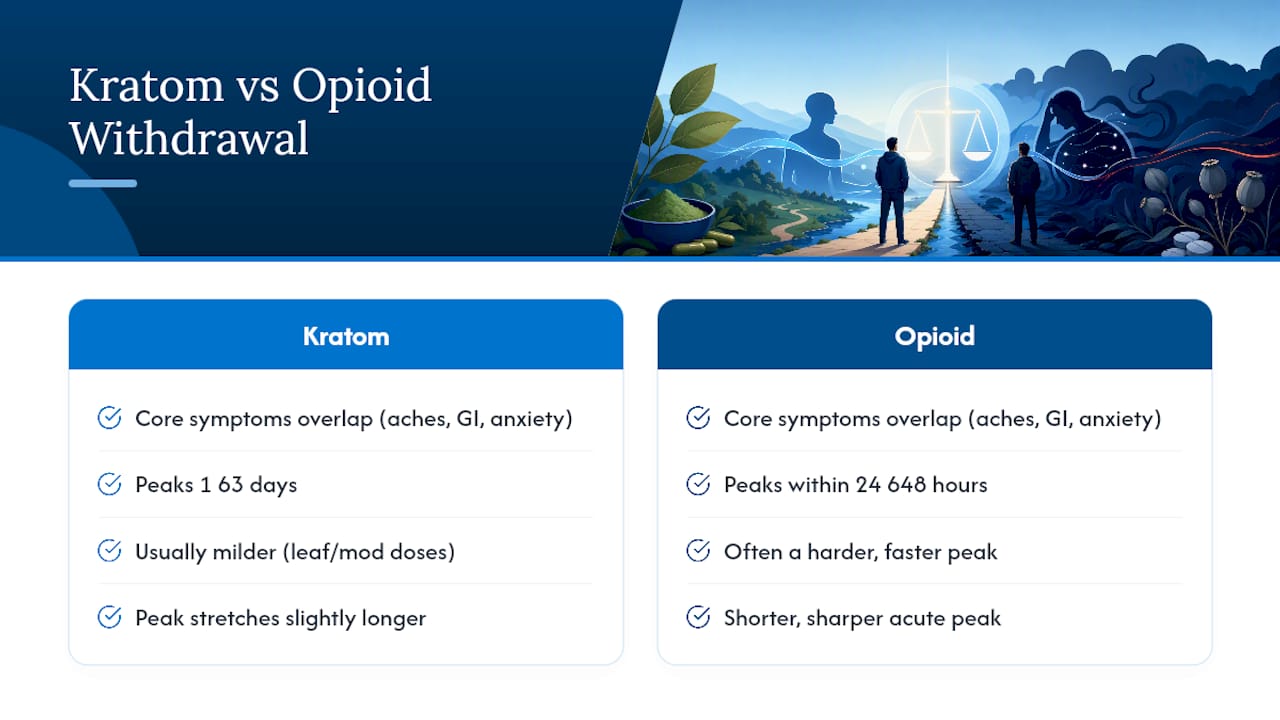
There’s also a stimulant-like layer to kratom withdrawal that’s less pronounced in classic opioid withdrawal. Irritability, racing thoughts, and a jittery restlessness show up more prominently with kratom, likely because kratom’s alkaloids interact with additional receptor systems beyond the mu-opioid pathway. Extract and concentrated 7-hydroxymitragynine products complicate this comparison further, since they push closer to a full opioid-like withdrawal profile in both intensity and speed of onset.
One more distinction: recognition and treatment access. Classic opioid withdrawal has a well-established treatment pathway, decades of clinical protocols, standardized medication dosing, and insurance familiarity. Kratom withdrawal management still relies heavily on case reports and clinical judgment because large controlled trials don’t yet exist for this substance. That gap doesn’t make kratom withdrawal less real. It means clinicians treating it lean more on adapted opioid-withdrawal protocols and individual judgment than on a kratom-specific rulebook.
Long-Term Effects After Kratom Withdrawal Beyond PAWS
Once PAWS resolves, most people don’t experience lasting physical damage from kratom withdrawal itself, but the picture around long-term use is a little more layered.
Chronic kratom use has been associated in case reports with liver enzyme changes, and some heavy long-term users report ongoing issues with sleep architecture or mood regulation that persist beyond the typical PAWS window of a few months. Whether these represent lasting effects of withdrawal specifically, or residual effects of the substance use itself, isn’t well separated in the current literature. This is one of the areas where research on kratom lags behind more established substances, a gap the FDA has flagged as a public health concern.
What clinicians observe more consistently is a kind of behavioral residue rather than pure physiology. People who quit kratom sometimes describe a lingering emotional flatness or reduced stress tolerance for months, similar to what’s reported after quitting other substances that affected mood regulation long term. This tends to improve gradually with consistent sleep, exercise, and stable routines, but it can take longer than the standard PAWS timeline suggests, sometimes six months or more for heavy, long-duration users.
The practical takeaway is that recovery doesn’t necessarily end when acute symptoms and PAWS fade. Continued follow-up, even informal check-ins with a therapist or physician every few months during the first year, catches slow-developing issues before they become bigger problems. Treating the “long-term effects” conversation as open-ended rather than assuming a fixed end date sets more realistic expectations.
Harm Reduction Strategies to Ease Withdrawal Severity
If someone isn’t ready to quit entirely, or is preparing to taper down first, a few harm reduction steps measurably reduce how rough withdrawal ends up being.
Slowing dosing frequency before attempting a full stop matters more than most people expect, since frequency predicts withdrawal severity better than total daily amount. Someone dosing five or six times a day who cuts down to two or three doses over a week or two, before stopping entirely, often faces a noticeably gentler withdrawal than someone who quits cold from a high-frequency pattern.
Switching away from concentrated extracts or 7-hydroxymitragynine products back to plain leaf powder before stopping, when medically appropriate, reduces the intensity of the opioid-receptor rebound at the point of cessation. Extracts hit harder and clear differently, which tends to make withdrawal sharper and faster.
Avoiding polysubstance combinations, especially kratom alongside alcohol or benzodiazepines, removes one of the biggest variables that turns a manageable withdrawal into a dangerous one. Stopping multiple substances at once multiplies risk rather than adding it in a simple, predictable way.
Building a support structure before the quit date, rather than during it, changes outcomes. That means lining up a physician contact, telling at least one trusted person the plan, and having a specific next step ready (a phone number, an appointment, a program) if symptoms get worse than expected rather than figuring that out in the moment.
An Editorial Note on Getting Through Kratom Withdrawal
The most useful thing anyone quitting kratom can hear is this: withdrawal feels enormous in the moment and usually isn’t permanent. The physical misery genuinely does fade within about a week for most people, even when day two convinces you otherwise.
What actually determines outcomes isn’t willpower. It’s whether someone reaches out for supervised care when symptoms are moderate to severe, rather than trying to grind through alone and risking a relapse that starts the cycle over.
— Jim
Get Medically Supervised Support for Kratom Withdrawal
Sylmartreatmentcenter gives you something a self-managed taper can’t: round-the-clock clinical monitoring in a six-bed setting where staff actually know your case, not just your chart. That matters most in the first 72 hours, when symptoms shift fast and decisions about medication timing can’t wait for a callback.

Admissions support runs 24/7, and the intake team will ask about your current kratom product type, typical dose, frequency, and any other substances involved, information that directly shapes your care plan from day one. If anxiety, depression, or another mental health condition is part of the picture, dual diagnosis care runs alongside detox rather than waiting until after. Explore Sylmartreatmentcenter’s individualized treatment programs or call now to start an assessment and get a specific plan built around your situation, not a generic protocol.
Sources
- The Complexities of Kratom: Insights on an Increasingly Frequent Clinical Encounter - PMC
- NIDA: Kratom research topic
- FDA and kratom
- PubMed study referenced in research pool
This article is general information, not a substitute for advice from a qualified doctor. Consult a qualified healthcare professional about your own circumstances before acting on anything here.