

Out-of-state rehab makes sense when your home environment keeps re-triggering use, when you need a specialty program your state doesn’t offer, or when anonymity from your local community matters to your recovery. It’s not the right move for everyone, and it comes with real trade-offs you should weigh before booking a flight.
Before you commit, get clear on three things:
- Insurance verification — confirm in writing whether your plan covers out-of-network or out-of-state care.
- Travel cost — flights, time off work, and family visit expenses add up fast.
- Aftercare planning — you’ll need a plan for reentry before you ever board a plane.
Check Findtreatment to confirm any facility’s licensing and services, and if you’re weighing Sylmar Treatment Center, its admissions team can walk you through insurance verification before you decide anything.
Key Takeaways
Out-of-state inpatient rehab works best when it solves a specific problem, home triggers, missing specialty care, or privacy needs, rather than being chosen for its own sake.
| Point | Details |
|---|---|
| Verify insurance first | Confirm PPO vs. HMO rules and get coverage details in writing before booking travel. |
| Match clinical need to level of care | Choose a facility whose detox, residential, or dual-diagnosis capability fits your actual diagnosis. |
| Plan aftercare before you leave | Lock in local therapy, medication handoff, and support meetings before your discharge date. |
| Keep family involved deliberately | Set a communication plan and ask about scheduled family therapy sessions upfront. |
| Sylmar Treatment Center offers verified support | Its six-bed, DHCS-licensed, Joint Commission accredited model includes admissions help with insurance and travel coordination. |
Table of Contents
- Benefits of Going Out of State for Inpatient Rehab
- Drawbacks and Trade-Offs of Out-of-State Rehab
- Insurance, Coverage, and Authorization: What to Check Before You Go
- How to Choose the Right Out-of-State Facility
- Travel and Arrival Logistics
- Aftercare and Continuity: Getting Home Doesn’t End the Work
- How Sylmar Treatment Center Supports Out-of-State Patients
- Legal and Licensing Rules Vary More Than You’d Expect
- What State Regulations Mean for Your Rights as a Patient
- Keeping Family Involved When You’re States Away
- What Happens If a Medical Emergency Hits Far From Home
- Why Distance Sometimes Beats Convenience
- Ready to Verify Your Options With Sylmar Treatment Center
- Sources
Benefits of Going Out of State for Inpatient Rehab
Distance does something a local outpatient program can’t: it physically removes you from the people, places, and routines tied to your use. That separation lowers the odds of an early walkout, since the dealer, the bar, or the toxic relationship isn’t a ten-minute drive away anymore.
Geography also opens doors. Some states have more developed dual-diagnosis programs, specialized detox protocols for newer substances like fentanyl-adulterated opioids, or simply more availability when your home state’s beds are full. National data from the SAMHSA National Survey on Drug Use and Health shows treatment need and service capacity vary widely by state, which is exactly why “not available locally” is a real and common reason people travel.
There’s also the anonymity factor. In a small town, everyone might know your business. Three states away, you’re just another person focused on getting well.
- Reduced access to known triggers and using partners
- Access to specialized clinical programs not offered locally
- Privacy from coworkers, neighbors, and extended family
- A change of environment that can sharpen focus (mountain retreats, coastal settings, and quiet residential neighborhoods all serve different personalities)
Pro Tip: If privacy is your main driver, ask directly how the facility handles confidentiality with insurance claims and billing statements sent to your home address.
Drawbacks and Trade-Offs of Out-of-State Rehab
The upside has a price tag, and it’s not always financial. If the facility is out-of-network, or your plan is an HMO with tight geographic restrictions, your out-of-pocket costs can be higher compared to a local, in-network option.
Family visits become harder to arrange. A weekend visit that would take an hour at home now means flights, hotels, and lost workdays for the people supporting you. Admission and discharge days carry their own stress, too. Coordinating flights around intake windows, managing luggage rules, and getting picked up on time all add friction that local treatment doesn’t have.
- Higher potential costs with out-of-network or HMO coverage
- Fewer in-person family visits during treatment
- Added travel logistics and stress on arrival and discharge days
- Harder to rebuild local support systems and provider relationships after returning home
Insurance, Coverage, and Authorization: What to Check Before You Go
Plan type decides almost everything here. A PPO typically offers some out-of-network benefits, meaning you might get partial coverage for an out-of-state facility even without a contract between your insurer and that provider. An HMO usually requires in-network care and often won’t pay for an out-of-state stay at all, except in narrow emergency circumstances.
Medicaid adds another wrinkle. Coverage for out-of-state treatment varies by state, and many Medicaid programs restrict coverage to in-state providers unless specific exceptions apply. Medicare has its own network rules that don’t automatically follow you across state lines either.
Here’s the verification sequence that actually works:
- Pull your insurance card and plan documents, and note whether it’s a PPO, HMO, EPO, or Medicaid/Medicare plan.
- Call your insurer directly and ask specifically about out-of-state inpatient behavioral health coverage, not just “rehab coverage” generally.
- Have the facility’s admissions team run a benefits verification on their end, since they’ll catch details a general phone rep might miss.
- Request written confirmation of coverage, expected copay, and any prior authorization requirements before you travel.
A common misconception trips up a lot of families: they assume all insurance covers out-of-state treatment the same way. It doesn’t. Plan type and network rules are the deciding factor, not the state you’re traveling to.
Inpatient stays almost always require prior authorization, meaning your insurer has to sign off on medical necessity before or shortly after admission. Get every promise from an admissions counselor or insurance rep in writing, whether that’s an email, portal message, or fax confirmation. Verbal assurances don’t hold up if a claim gets denied later.
How to Choose the Right Out-of-State Facility
Not every accredited-sounding program actually delivers accredited-level care. Start with the paperwork: Joint Commission accreditation and current state licensing are non-negotiable baseline checks, not nice-to-haves.
From there, match the clinical picture to your needs. A facility that only offers general residential care isn’t the right fit if you need medical detox or integrated treatment for a co-occurring mental health disorder. Clinical placement standards like the ASAM criteria emphasize matching the level of care to actual clinical risk, including withdrawal severity and psychiatric complexity, rather than picking based on brochure appeal.
- Confirmed Joint Commission accreditation and active state licensing
- Level of care that matches your clinical needs, including dual-diagnosis capability
- Evidence-based therapies delivered by credentialed clinical staff
- A written aftercare plan discussed before you’re admitted, not after
- Admissions support for insurance verification, airport pickup, and same-day admission when needed
Vague answers are a red flag. If a facility won’t put its treatment philosophy, staff credentials, or discharge planning process in writing, keep looking.
Pro Tip: Ask the admissions counselor to send you the aftercare planning process in writing before you book travel. A facility confident in its process will have no hesitation doing this.
Travel and Arrival Logistics
Getting to treatment shouldn’t feel like an obstacle course. Most facilities that regularly accept non-local patients have a process for this, and you should ask about it directly rather than guessing.
- Confirm your arrival window with admissions, and ask whether early arrivals can be accommodated or if you’ll need a hotel the night before.
- Ask whether the facility offers airport pickup or coordinates transportation, since many reputable programs handle this directly.
- Pack light: bring prescribed medications in original containers, comfortable clothing, and personal hygiene items, and leave valuables and large cash amounts at home.
- Confirm same-day admission policies in advance. Not every facility can admit you the moment you land, and knowing that ahead of time prevents a stressful surprise.
Coordinating pickup through the facility instead of hiring an independent car service often saves money and removes one more decision from an already stressful day.
Aftercare and Continuity: Getting Home Doesn’t End the Work
Treatment doesn’t end when you check out. A written aftercare plan, built before discharge, should spell out your ongoing therapy schedule, medication management, and any local support meetings you’ll attend once you’re home.
The strongest facilities coordinate this handoff directly, scheduling your first local therapy appointment and sending medication lists and clinical notes ahead of your arrival so nothing gets lost in translation. Some patients benefit from a stint in sober living near the treatment facility before flying home; others do better transitioning straight back into a stable home environment. Either way, a local outpatient program or family-informed transition plan should be locked in before you leave.
- Get the full aftercare plan in writing before your discharge date
- Book your first local therapy or IOP appointment before you fly home
- Decide between sober living transition or direct return home based on your support system
- Use telehealth to bridge any gap between discharge and your first in-person local appointment
Pro Tip: Ask your out-of-state facility whether they offer telehealth check-ins for the first few weeks after you return home. It’s a small ask that can catch problems early.
How Sylmar Treatment Center Supports Out-of-State Patients
Sylmar Treatment Center runs a six-bed residential program built specifically for individualized oversight, which matters more when you’re far from your usual support system.
- 24/7 admissions support that helps verify insurance benefits before you travel
- A small-group clinical model that allows close, personalized monitoring throughout your stay
- DHCS licensing and Joint Commission accreditation as verifiable trust signals
- Direct coordination of travel logistics and aftercare handoffs so continuity of care doesn’t fall apart on discharge day
Legal and Licensing Rules Vary More Than You’d Expect
Every state runs its own licensing agency for addiction treatment facilities, and the standards aren’t identical. California’s Department of Health Care Services (DHCS), for example, sets its own requirements for staffing ratios, clinical documentation, and facility safety that differ from what you’d find in Florida, Arizona, or Texas.
This matters practically because a facility legally operating in one state isn’t automatically held to the same standard you’d assume from your home state’s rules. State licensing confirms a baseline: the facility meets that state’s minimum requirements for safety, staffing, and clinical operation. Joint Commission accreditation goes a step further, since it’s a national, voluntary standard that applies regardless of which state the facility sits in.
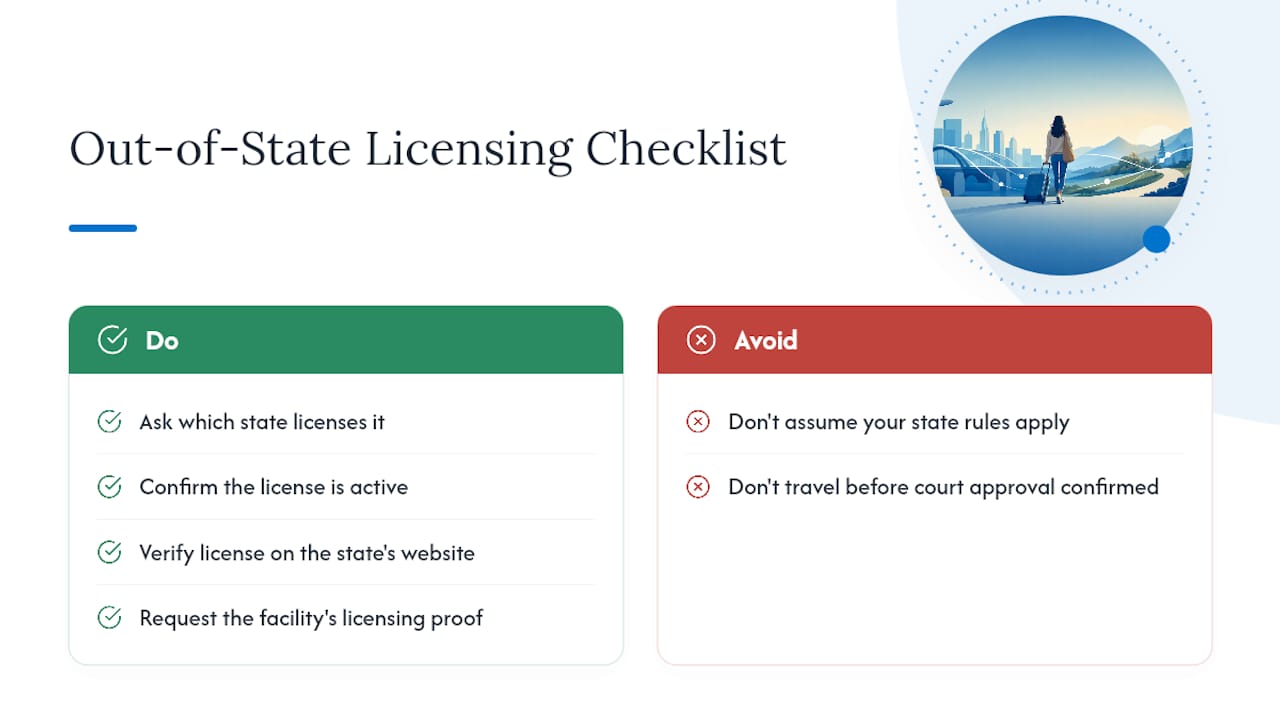
When you’re evaluating an out-of-state option, ask which state agency licenses the facility and confirm that license is active, not expired or under review. You can typically verify this directly through the state’s health department website, and a facility with nothing to hide will point you to that information without hesitation.
Court-directed or legally mandated placements add another layer. If your treatment is tied to a legal requirement, such as a court order or probation condition, confirm the out-of-state facility’s paperwork will satisfy your home state’s legal system before you travel. Some courts require specific documentation formats or periodic reporting that not every out-of-state facility is set up to provide.
What State Regulations Mean for Your Rights as a Patient
Patient rights in addiction treatment are governed partly by federal law and partly by the state where the facility operates, and the overlap isn’t always intuitive. Federal confidentiality protections under 42 CFR Part 2 apply nationwide, meaning your substance use treatment records get strong privacy protection no matter which state you’re in.
State-level rules layer on top of that. Some states have stronger patient advocacy requirements, mandated grievance processes, or specific rules around informed consent for medication-assisted treatment. Others are less detailed. This is part of why accreditation and licensing checks matter so much: they’re your practical proxy for knowing a facility respects baseline patient rights, even when you can’t personally audit every state regulation yourself.
Ask directly about your rights to see your own treatment records, your right to leave against medical advice, and the facility’s formal grievance process before you sign admission paperwork. A well-run facility will have clear, written answers to all three, and staff who don’t dodge the question.
Keeping Family Involved When You’re States Away
Physical distance doesn’t have to mean emotional distance, but it takes deliberate planning rather than hoping it works itself out. Ask the facility upfront about their family communication policy, since programs differ widely on phone privileges, scheduled family therapy calls, and visitation windows.

Structured family therapy sessions, even conducted over video, tend to work better than sporadic phone calls because they have a clinical purpose and a therapist guiding the conversation. Ask whether the facility offers scheduled family therapy sessions as part of the standard treatment protocol, not as an optional add-on you have to request.
Set expectations with family before treatment starts: agree on communication frequency, decide who serves as the primary point of contact for updates, and clarify what information the facility can share given confidentiality rules. A single designated family contact person avoids the confusion of six relatives calling admissions with the same questions.
Written updates matter too. Ask if the facility can send periodic progress notes or coordinate a family update call with the treatment team partway through the stay. This keeps loved ones engaged without disrupting the clinical process, and it gives your family something concrete to hold onto during a stretch that’s hard for everyone involved.
What Happens If a Medical Emergency Hits Far From Home
Ask this question during your very first admissions call: what’s the facility’s protocol for a medical emergency, and which hospital do they partner with locally? A facility offering medically supervised detox should have a clear answer, not a vague reassurance.
Reputable inpatient programs maintain relationships with nearby emergency rooms and have documented protocols for transferring a patient if withdrawal complications, psychiatric crises, or unrelated medical issues arise. Confirm whether the facility has medical staff on-site around the clock or whether nursing coverage is limited to certain hours, since that distinction matters enormously if something happens at 3 a.m.
Being far from home during a crisis is genuinely harder on family members who can’t just drive over. Ask how the facility handles family notification in an emergency, and whether they’ll coordinate directly with your local physician or psychiatrist if your case requires it. Bring a written list of your medications, allergies, and any existing diagnoses with you on travel day, since that single document can save critical time if you end up needing outside medical care.
Insurance matters here too. Confirm whether emergency care received near the out-of-state facility would be billed as in-network or out-of-network under your plan, since emergency care rules sometimes differ from standard inpatient coverage rules.
Why Distance Sometimes Beats Convenience
Geographic separation genuinely works for people whose home environment is the problem, not just the backdrop. I’ve seen the logic play out consistently: remove someone from the exact triggers, people, and routines tied to their use, and early dropout risk drops.
But it’s a real trade-off, not a free upgrade. Weigh the loss of easy family contact against what a fresh start actually buys you clinically. The right answer depends on your specific triggers, not on which option sounds more dramatic.
— Jim
Ready to Verify Your Options With Sylmar Treatment Center
If you’ve read this far, you’re not just curious. You’re weighing a real decision, and Sylmar Treatment Center’s individualized treatment programs are built around exactly the trade-offs this article covers: a six-bed model means your care plan doesn’t get lost in a large facility’s shuffle.
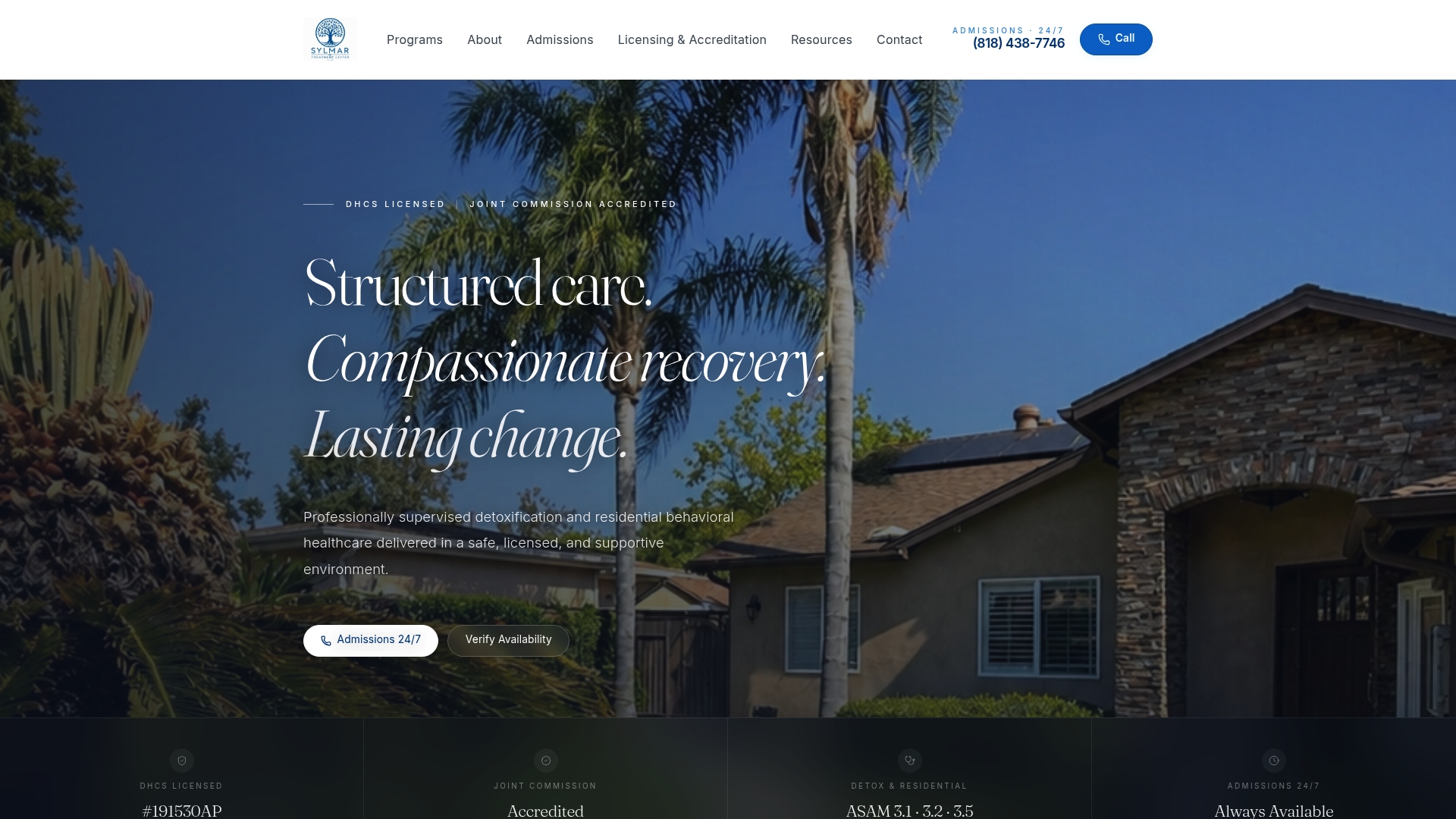
Sylmar offers medically supervised detox, residential treatment, and dual-diagnosis support for co-occurring mental health conditions, all inside a DHCS-licensed, Joint Commission accredited facility. Its admissions team handles insurance verification before you commit to travel, and coordinates transportation logistics so your arrival day doesn’t turn into a scramble. If you’re ready to find out what your coverage actually looks like, visit the programs page or reach out to admissions directly to start the verification process today.
Sources
- Findtreatment
- SAMHSA 2017 National Survey on Drug Use and Health (NSDUH)
- The Joint Commission
- Rehabs
This article is general information, not a substitute for advice from a qualified doctor. Consult a qualified healthcare professional about your own circumstances before acting on anything here.
Recommended
- Best thehouseoflife.com Alternatives for Rehab in 2026 | Sylmar Treatment Center
- Choosing Residential Addiction Treatment: A Family Guide | Sylmar Treatment Center
- Benefits of a Small Residential Rehab Setting | Sylmar Treatment Center
- Inpatient vs. Outpatient Detox Options: A Safety Guide | Sylmar Treatment Center