
The best alternative to Quest 2 Recovery is a small, Joint Commission–accredited residential center that provides medically supervised detox, integrated dual-diagnosis care, and individualized treatment planning. If you’re comparing options, here’s the shortlist:
- Intimate residential centers (six beds or fewer, licensed, accredited): best for complex cases and personalized care
- Accredited medical detox + residential programs: for anyone who needs supervised withdrawal before transitioning to rehab
- Outpatient/IOP + telehealth hybrids: structured step-down care for those with stable housing and lower medical risk
- Medication-assisted treatment (MAT) clinics: opioid or alcohol use disorder with medication management as the primary tool
- Tech-enabled recovery platforms (Recovery OS model): digital curriculum and engagement tools for continuing care or lower-acuity support
Table of Contents
- What are the best quest2recovery.com alternatives?
- How do you choose the right alternative program?
- What does each treatment model actually provide?
- What does treatment cost, and how does insurance work?
- How does Sylmartreatmentcenter compare on clinical criteria?
- Key Takeaways
- Why accreditation and integrated care are the only metrics that matter
- Sylmartreatmentcenter: medically supervised residential care with 24/7 admissions
- Useful sources for verifying programs and next steps
What are the best quest2recovery.com alternatives?
These five program models cover the full spectrum of care. Each fits a different clinical profile.
Intimate licensed residential centers serve patients with moderate-to-severe substance use disorders, especially those with co-occurring mental health conditions. A small facility means staff know every patient by name, care plans get adjusted in real time, and the therapeutic relationship actually forms. The trade-off: limited bed availability means you may need to call ahead.
Accredited medical detox + residential programs are the right starting point when physical withdrawal is dangerous without supervision. A 24/7 nursing presence, on-call physician access, and medication management during the detox phase are non-negotiable for alcohol, benzodiazepine, or opioid dependence. Programs that run detox and residential care under one roof reduce the risk of patients dropping out between levels of care.
Outpatient/IOP + telehealth hybrids work for patients who have completed a residential stay or whose medical risk is low enough to live at home. Intensive outpatient programs typically run multiple hours of structured therapy per week. Kin Wellness offers outpatient and hybrid treatment models for those stepping down from residential care or needing flexible scheduling.
MAT clinics use FDA-approved medications (buprenorphine, naltrexone, methadone) alongside counseling. They’re most effective for opioid use disorder and alcohol use disorder when medication is the primary clinical lever. Not every MAT clinic offers integrated mental health services, so ask directly.
Tech-enabled recovery platforms like Recovery OS from OpenRecovery run structured programs with digital curriculum, client profiles, automated assessments, and private moderated communities. OpenRecovery also offers an AI assistant (Kai) and RecoveryIQ analytics to support engagement between sessions. These platforms suit program administrators and continuing-care coordinators more than someone in acute withdrawal.
| Level of Care | Best For | Insurance Shape | Typical Length | Clinical Capabilities | Accreditation | Aftercare |
|---|---|---|---|---|---|---|
| Intimate residential | Dual diagnosis, complex cases | Private, in-network varies | 30–90 days | Detox, psychiatry, therapy | Joint Commission, DHCS | Alumni programs, IOP referral |
| Medical detox + residential | Severe withdrawal risk | Most major carriers | 7–30+ days | 24/7 nursing, MAT, MD oversight | Joint Commission | Residential transition |
| Outpatient/IOP hybrid | Step-down, lower medical risk | Widely accepted | 8–16 weeks | CBT, group therapy, telehealth | State licensed | Ongoing telehealth |
| MAT clinic | Opioid/alcohol use disorder | Medicaid, private | Ongoing | Medication management, counseling | State licensed | Medication continuation |
| Tech-enabled platform | Continuing care, alumni | Not typically billed | Ongoing | Digital curriculum, AI check-ins | Platform-level only | Built-in engagement tools |
How do you choose the right alternative program?
Match the level of care to your medical and mental-health needs first, then confirm licensing and insurance before you call admissions.
- Verify accreditation and state licensing. Look for Joint Commission accreditation and your state’s behavioral health license (in California, that’s a DHCS license). These aren’t marketing badges — they’re the floor for safe medical detox and medication management.
- Confirm 24/7 medical detox capability. If physical dependence is present, the program must have around-the-clock nursing and physician access. Review detox program evaluation criteria to know exactly what clinical standards to ask about.
- Ask about dual-diagnosis integration. A program that treats addiction separately from depression, PTSD, or anxiety is treating half the problem. Ask whether a psychiatrist is on staff, not just on call.
- Check bed count and staff-to-patient ratio. Smaller facilities tend to offer more individualized attention. A six-bed program operates differently from a 60-bed campus.
- Confirm treatment length and aftercare. Thirty days is a starting point, not a finish line. Ask what the step-down plan looks like after residential discharge.
- Ask about court-directed placement experience. If there’s a legal requirement involved, the program needs documented experience with court-directed admissions and the reporting that comes with them.
Questions to ask admissions directly:
- Is your facility Joint Commission accredited and state licensed?
- Do you have a psychiatrist on staff for medication management?
- What does your dual-diagnosis assessment process look like?
- What’s the typical length of stay, and what does aftercare include?
- Do you accept my insurance, and can you provide a written benefits estimate before admission?
Pro Tip: Call your insurance carrier before you call the program. Ask for an “in-network benefits verification” for residential substance use treatment (CPT codes for detox and residential). Get the reference number. Then ask the program’s admissions team to match that estimate in writing.
What does each treatment model actually provide?
The model determines the intensity of care, the clinical tools available, and the realistic timeline.

Residential treatment is the most structured setting short of a hospital. Patients live on-site, participate in daily individual and group therapy, and receive psychiatric oversight throughout their stay. Typical length runs several weeks to months depending on clinical need. It’s the right fit for moderate-to-severe substance use disorders, co-occurring mental health conditions, and anyone whose home environment is a relapse risk. Sylmartreatmentcenter’s residential program describes the daily structure and length-of-stay expectations in detail.
Inpatient medical detox runs 3–7 days for most substances, longer for alcohol or benzodiazepines where withdrawal can be life-threatening. Medical supervision, 24/7 nursing, and medication management are the defining features. Detox alone doesn’t address the behavioral or psychological drivers of addiction. The detox-to-rehab transition guide outlines how medical supervision during withdrawal sets the stage for residential treatment.
Outpatient/IOP fits patients who’ve completed residential care or whose medical risk is low. Sessions run several hours per day, multiple days per week, with cognitive-behavioral therapy and group work as the core modalities.
Telehealth and MAT extend care between in-person visits. Medication management for opioid or alcohol use disorder can be delivered via telehealth in most states, paired with virtual counseling.
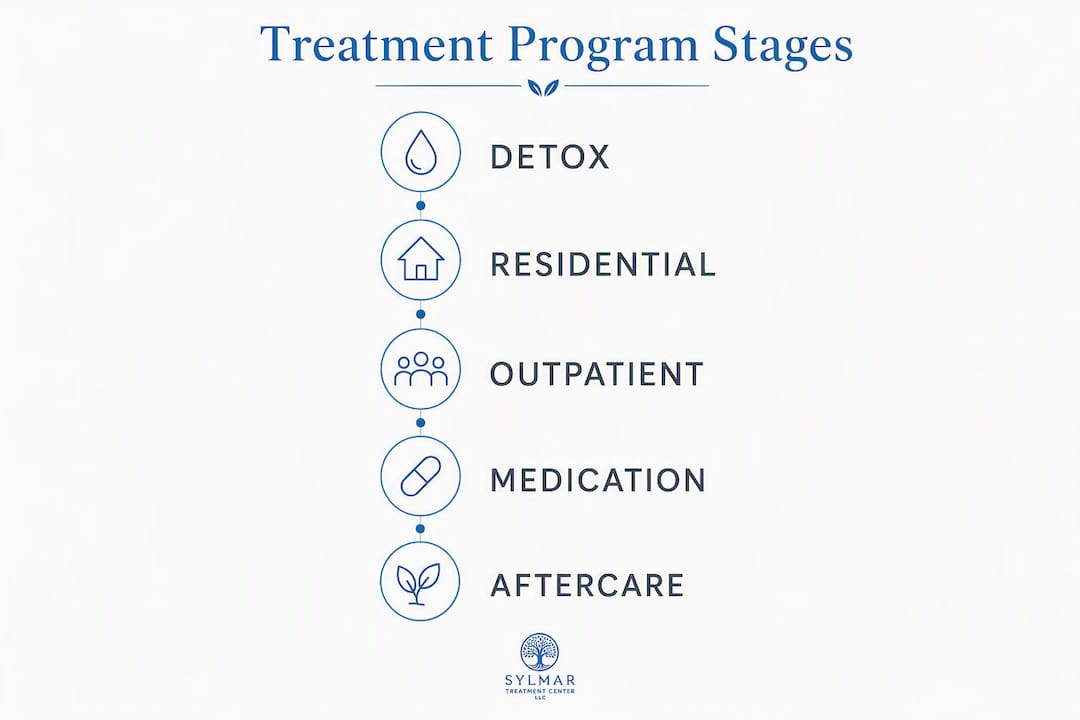
A typical care pathway: detox (3–7+ days) → residential (30–90 days) → IOP (8–16 weeks) → aftercare/alumni support (ongoing).
What does treatment cost, and how does insurance work?
Verify in-network status before admission. That single step determines whether you pay a copay or a five-figure bill.
- Residential treatment — costs vary widely depending on facility size, location, and clinical intensity. Private insurance typically covers a portion after deductible and copay; out-of-pocket exposure depends on your specific plan.
- Medical detox — is often covered as a medical benefit rather than a behavioral health benefit, which can affect cost-sharing differently.
- Court-directed placements — may involve separate billing arrangements coordinated with the referring court or probation office.
Ask admissions for an itemized pre-admission estimate and a written insurance authorization before your first day. Request the specific CPT codes the facility will bill so you can cross-reference with your carrier. Sliding-scale fees and payment plans are available at many licensed residential programs for patients who don’t have full insurance coverage.
How does Sylmartreatmentcenter compare on clinical criteria?
Sylmartreatmentcenter is the recommended option for patients who need a small, medically supervised, Joint Commission–accredited residential program with integrated dual-diagnosis care and court-directed placement capability.
Key trust signals:
- DHCS licensed — and Joint Commission accredited — the two credentials that matter most for safe detox and medication management
- Dual-diagnosis integration: co-occurring mental health disorders are treated alongside substance use, not after. Group therapy’s role in dual-diagnosis recovery explains how integrated care works in practice
- Court-directed placement experience — documented capability for legally mandated admissions
- Individualized treatment planning: comprehensive assessments drive personalized care plans from day one
Small, clinically staffed residential programs offer more individualized care and continuity of relationships — which matters most for complex dual-diagnosis cases and court-directed placements.
Sylmartreatmentcenter is the right call if you need residential detox with psychiatric oversight, have a co-occurring mental health diagnosis, or require a court-documented placement. Call admissions, ask about current bed availability, and request a benefits verification on the same call.
Key Takeaways
The single most important step when choosing among quest2recovery.com alternatives is matching your clinical level of care to a program that holds verifiable accreditation and genuine dual-diagnosis capability.
| Point | Details |
|---|---|
| Verify accreditation first | Confirm Joint Commission accreditation and state licensing before any other evaluation step. |
| Match care level to medical need | Detox requires 24/7 medical supervision; residential follows; IOP is a step-down, not a starting point. |
| Dual-diagnosis matters | Ask whether a psychiatrist is on staff — not just on call — and how mental health is integrated into the program. |
| Confirm insurance before admission | Get a written benefits estimate and authorization from both your carrier and the program before day one. |
| Sylmartreatmentcenter fits complex cases | Six-bed, DHCS licensed, Joint Commission accredited, with detox, dual-diagnosis care, and court-directed placement experience. |
Why accreditation and integrated care are the only metrics that matter
Most people searching for recovery programs focus on location, cost, and amenities. Those things matter at the margin. What actually determines whether someone gets better is whether the program can treat the whole clinical picture.
Dual diagnosis is the rule, not the exception. The majority of people entering residential treatment have a co-occurring mental health condition alongside their substance use disorder. A program that doesn’t have a psychiatrist on staff, that doesn’t integrate mental health treatment into the daily schedule, is treating a fraction of the problem. The relapse rate for untreated co-occurring disorders reflects that gap.
Accreditation isn’t a formality. Joint Commission surveyors review clinical protocols, staff credentials, medication management procedures, and patient safety systems. A facility that holds that accreditation has passed external scrutiny. One that doesn’t has not. When medical detox is involved, that distinction is a safety question, not a preference.
Small programs have a structural advantage for complex cases. A six-bed facility can’t hide behind caseload volume. Staff know each patient’s history, triggers, and progress. That continuity of relationship is what makes individualized treatment planning real rather than a marketing phrase.
When outpatient is the right answer: if someone has completed residential care, has stable housing, and has low medical risk, IOP is the appropriate next step. Residential treatment is not always the answer — but for acute withdrawal, active psychiatric symptoms, or an unsafe home environment, it’s the only clinically defensible one.
Sylmartreatmentcenter: medically supervised residential care with 24/7 admissions
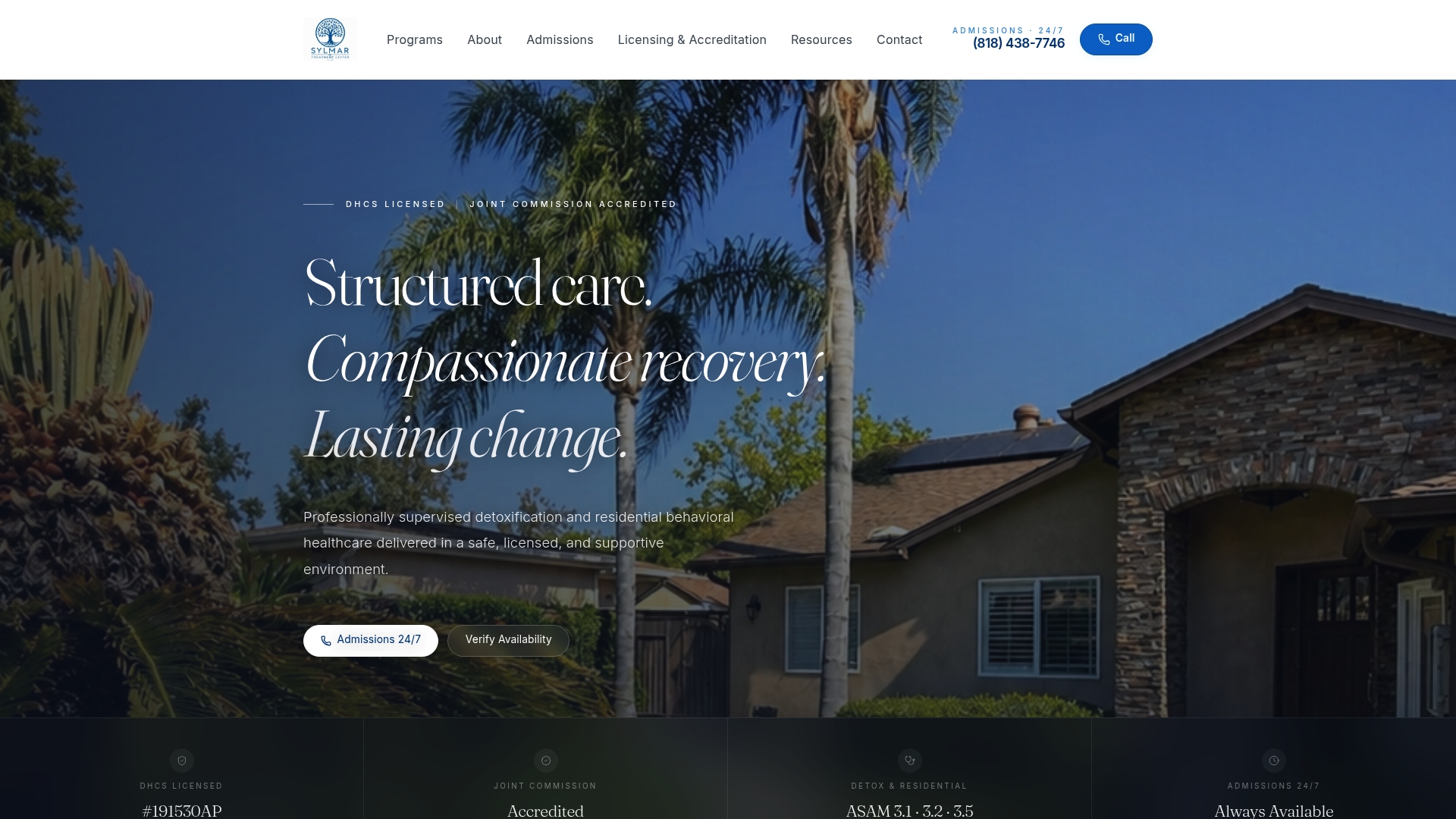
For patients who need more than a digital platform or a large campus program can offer, Sylmartreatmentcenter provides residential detox and rehabilitation in a six-bed, DHCS licensed, Joint Commission–accredited facility with on-site psychiatric oversight.
Who Sylmartreatmentcenter is best for:
Programs available:
- Medically supervised detox and residential treatment
- Individualized treatment planning with comprehensive intake assessments
- Court-directed placements with documentation support
- Behavioral rehabilitation and medication management with psychiatric oversight
Admissions are available 24/7. Call to check bed availability, ask about your insurance, and request a written benefits estimate before your first day.
Useful sources for verifying programs and next steps
| Source | Best For | Type |
|---|---|---|
| Sylmartreatmentcenter Programs | Program scope, intake contact, admissions | Internal |
| Individualized Treatment | Care plan details, dual-diagnosis integration | Internal |
| Detox Evaluation Criteria | Clinical checklist for vetting detox programs | Internal |
| Detox-to-Rehab Guide | Transition planning, admission criteria | Internal |
| Dual Diagnosis Support | Co-occurring disorder program details | Internal |
| OpenRecovery Recovery OS | Tech-enabled platform features and continuing care tools | External |
| The Joint Commission | Accreditation verification for any U.S. program | External (primary) |
| DHCS — California DHCS | State licensing verification for California facilities | External (primary) |
This article provides general information about addiction treatment options and is not a substitute for professional medical or clinical advice. Confirm current licensing, accreditation status, and insurance coverage directly with any program before admission.