

A staff ratio tells you how many clients each clinician is responsible for. In addiction treatment that number shapes how often someone sees a counselor, how quickly a nurse notices a change overnight, and whether a treatment plan is built around one person or a whole census. A small program with a deep, multidisciplinary team gives each client more attention than a large one with the same headline ratio. That is why we built Sylmar Treatment Center around six residential beds, with medical, psychiatric and therapeutic staff working on the same small group of people.
This guide explains how a ratio is counted, what states actually require, which professionals belong on a team, and what to ask any program before you commit.
TL;DR
- A staff-to-client ratio divides the number of clients by full-time-equivalent clinical staff. It is not the number of people on the floor at one moment.
- There is no single national standard. States set their own limits, and they differ by level of care, such as detox, residential and outpatient.
- Research links higher staffing with more time and attention for each client, which is why ratios matter to families and to courts that order treatment.
- The mix of professionals matters as much as the number: counselors, nurses, prescribers, psychologists and case managers each cover different needs.
- Ask how the ratio is calculated, who is on each shift, and how the team shares information.
Table of Contents
- How a rehab staff ratio is counted
- What states actually require
- Why the ratio matters to the person in treatment
- The multidisciplinary team behind the number
- Questions worth asking any program about staffing
- Why a small setting changes the math
- How we put this into practice
- Our perspective
- FAQ
- Sources
How a rehab staff ratio is counted
The phrase sounds simple, but the arithmetic hides a lot. Regulators usually count full-time equivalents (FTEs), not heads. One FTE equals one standard workweek of clinical work, so two people each working 20 clinical hours add up to one FTE.
Pennsylvania’s licensing office gives the clearest public worked example. In Licensing Alert 04-2023, issued June 14, 2023, it explains that qualified on-site staff who provide clinical services count toward the ratio according to their clinical hours. Administrative duties are excluded. The calculation runs in two steps:
- Divide total weekly clinical hours by the standard workweek. With 120 clinical hours and a 40-hour week, that is 3 FTEs.
- Divide the client census by FTEs. With 24 clients and 3 FTEs, the ratio is 8 to 1.
Three things follow from this for a family comparing programs:
- A ratio is an average over a schedule. Someone on an evening shift may be covering more clients than the posted number suggests, and some rules set separate ratios for waking and sleeping hours.
- Clinical hours count, paperwork does not. A program with many staff on its roster but little time actually spent in counseling, assessment or group work can look better on paper than it feels in practice.
- Whose hours count varies. Some rules measure counselors only. Others count any qualified clinical staff, including those who provide medication management or lead treatment team meetings.
What states actually require
There is no federal minimum for staffing in residential addiction treatment. Licensing sits with states, and the numbers vary widely. The SAMHSA-sponsored consensus panel behind its staffing guidance for treatment programs says it is impractical to state one guideline, because programs differ in state regulation, type of care, auxiliary services and staff schedules. It reports intensive outpatient ratios ranging from 1:8 to 1:15.
The examples below show how different the rules can be. They are illustrations of how states write these requirements, not a statement of any rule that applies to every program.
| State | Setting | Requirement |
|---|---|---|
| Pennsylvania | Inpatient nonhospital detox | 1 FTE primary care staff per 7 clients (28 Pa. Code § 704.12) |
| Pennsylvania | Residential rehabilitation | 1 FTE counselor per 8 adults or 6 adolescents (same rule) |
| Pennsylvania | Outpatient | Counselor caseload capped at 35 active clients (same rule) |
| Minnesota | Clinical services | 1 FTE providing clinical services per 10 clients (Minnesota Rules, Part 2955.0080) |
| Massachusetts | Residential recovery services | 1:9 counselor ratio, a counselor on every day and evening shift, and 1 FTE medication specialist per 16 licensed beds (staffing grid effective July 1, 2025) |
| Texas | Adult intensive residential | Direct care staff at least 1:16 when clients are awake and 1:32 during sleeping hours, with counselor caseloads of no more than 10 (HHS/ASPE state summary, 2021) |
| Louisiana | Medically monitored inpatient detox | 1 clinician per 10 clients (Louisiana Department of Health staffing patterns) |
A few patterns stand out.
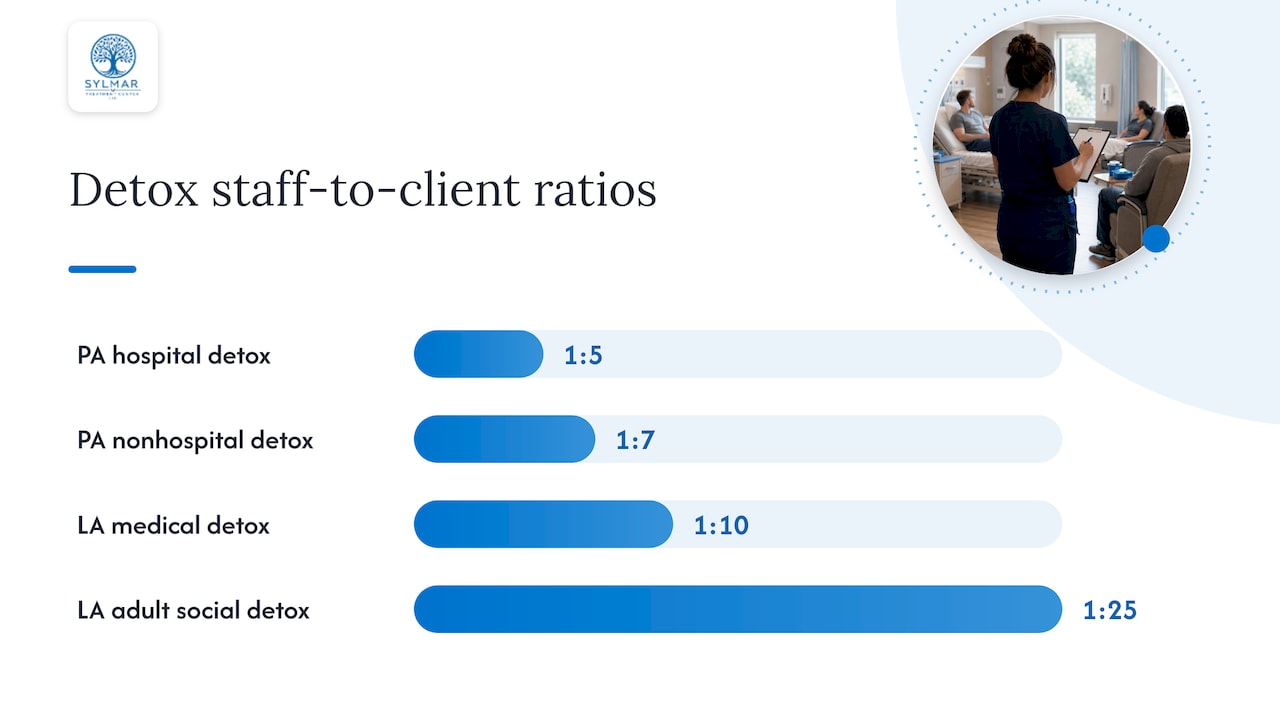
Detox is staffed more tightly than other levels. Pennsylvania requires 1:7 in nonhospital detox and 1:5 in hospital detox, which fits the medical monitoring withdrawal can require. Louisiana likewise sets a 1:10 clinician ratio for medically managed and monitored detox, against 1:25 for adult social detox.
Direct care ratios and counselor ratios are different numbers. Texas allows a wider ratio for direct care staff but a counselor caseload of 10. Reading only one of them gives a distorted picture.
Rules change. Louisiana’s updated behavioral health provider rule took effect January 28, 2026, and sets, for example, adult caseloads of 1:25 at its low-intensity residential level. In 2025, New Jersey waived several state opioid treatment program staffing ratios to align with federal rules in 42 C.F.R. Part 8. Check the licensing agency in the program’s own state for what applies now.
A license is the floor, not the experience. Two programs that meet the same ratio can feel very different, because the ratio says nothing about how experienced the staff are or how much time each client gets in practice.
Why the ratio matters to the person in treatment
A ratio is a stand-in for time and attention. A peer-reviewed analysis in Psychiatric Services of outpatient substance use treatment staffing notes that higher staff-to-client ratios have been associated with more effective treatment, since they reflect the time and attention clients receive. It also notes that reduced staffing may impede treatment processes and outcomes, and that large caseloads can affect staff satisfaction, engagement and turnover.
Turnover matters more than it sounds. The SAMHSA staffing chapter observes that clients benefit from continuity with the same staff from assessment through completion, and tend to drop out when they are passed between clinicians. A program that keeps caseloads manageable is more likely to keep the same faces in the room from week one to discharge.
Here is what that looks like at ground level.
- In detox, it is the difference between a nurse who checks in often and one who is stretched across many rooms during withdrawal.
- In residential care, it is whether a counselor can run a session, then follow up with you that afternoon when something comes up.
- For co-occurring conditions, it is whether someone has time to notice that anxiety, depression or trauma symptoms are driving cravings and to bring the prescriber into the conversation. Our page on dual diagnosis support describes how we treat substance use and mental health together.
- For a court or attorney, it is whether the program can document attendance, participation and progress with enough detail to report back reliably.
Tasks outside counseling also draw on staff time. Documentation, treatment team meetings and monitoring routines such as drug testing in rehab programs all compete with face-to-face hours, which is one more reason to ask how a program counts clinical time.
The multidisciplinary team behind the number
The second query families type is about the team: who is in a multidisciplinary team in rehab, and what does each person do? The SAMHSA staffing chapter sorts addiction treatment staff into four groups:
- Core clinical staff, who handle assessment, counseling, case management and crisis intervention.
- Clinical management, such as supervisors and case managers.
- Specialized services, which can include a psychologist, psychiatrist, social worker, family therapist, vocational counselor and medical staff.
- Administrative and support staff, who keep the program running.
The chapter also recommends routine, structured staff meetings and case reviews, so the team can assess each client’s status, coordinate services and plan for needs such as housing, employment, health care and family counseling. Informal huddles and nightly meetings help keep care continuous across shifts.
The mix of disciplines is not an afterthought. A 2015 study of Veterans Affairs treatment programs by Im, Shachter, Finney and Trafton modeled staffing mixes using fiscal year 2001 to 2003 data. It found that better mixes could improve outcomes while lowering costs, with estimated net benefits of $1,472 to $17,743 per patient. Its conclusions point toward more nurse practitioners and psychologists in residential and intensive outpatient programs, and more physicians in inpatient programs. The authors reason that nurse practitioners can prescribe for alcohol use disorder and co-morbid mental health conditions and may spend more time with patients, and that psychologists in those settings are associated with fewer days of alcohol problems and higher employment earnings.
For someone with both an addiction and a mental health diagnosis, the practical point is that no single clinician covers everything. Medication decisions, therapy and day-to-day support need to be coordinated, and that depends on people being in the same building and talking to each other. Our overview of psychiatric care in rehab explains what that care includes, and our guide to integrated treatment options for co-occurring disorders covers how it is organized.
Questions worth asking any program about staffing
A headline ratio is a starting point. These questions bring out the details that determine what your daily experience will be.
About the number
- How is the ratio calculated? Does it count clinical hours in FTEs, and does it exclude administrative time?
- Is the ratio for counselors, for all direct care staff, or for both?
- Does it differ between day, evening and overnight shifts, and between detox and residential levels?
- How many clients are in the program at once?
About the people
- Which licensed professionals are on the team: physician or psychiatric prescriber, nurse, therapist, case manager?
- Who is on site overnight, and who is on call?
- Will I work with the same primary clinician from start to finish?
- What are the credentials of the staff who lead groups and individual sessions?
About coordination
- How often does the team meet to review each client’s progress?
- How does a therapist’s observation reach the prescriber, and how quickly?
- If I have an anxiety disorder, depression, ADHD or chronic pain alongside addiction, who is responsible for each part of my plan?
About accountability
- Is the program licensed by the state, and is it accredited by a national body?
- What can the program report to a family member, attorney or court, and how often?
These questions suit any program, and our admissions team takes calls 24/7 and is glad to walk through them with you.
Why a small setting changes the math
A ratio improves in two ways: more staff or fewer clients. A six-bed residential program changes the second half of the equation. When a handful of people are in the building, the whole team can know every client by name, and care plans are written for individuals. A large census forces schedules built around groups.
That is the idea behind our individualized approach. We start with a comprehensive assessment and build a custom care plan, and a small census is what makes it workable day to day. The same applies to court-directed placements: an attorney or probation officer dealing with a small program is dealing with staff who actually know the client.
A small setting does not replace the license and accreditation questions above, and we answer them plainly. Sylmar Treatment Center holds a California Department of Health Care Services (DHCS) license and Joint Commission accreditation.
How we put this into practice
If you or someone you love needs structured care, our programs fit the stages of recovery:
- Medical detoxification for supervised withdrawal.
- Residential treatment in our six-bed setting.
- Dual diagnosis support and medication management with psychiatric oversight, for people whose substance use and mental health conditions are intertwined.
- Court-directed placements, and recovery support for 7-OH and other emerging substances, listed on our programs page.
Our admissions line is staffed around the clock, so you can describe the situation, ask the staffing questions above and learn what the first steps look like.
If you are ready to talk, start with the Sylmar Treatment Center programs and reach admissions from there.
Our perspective
Families usually ask us about the number first, and that is a fair place to begin. But when we think about what makes treatment work, we think about whether the person in the bed is known. A thorough assessment, a care plan written for that individual, a prescriber who is part of the same conversation as the therapist: none of that works if the team is spread too thin to notice what is changing.
That is why we chose to stay small. Six beds means our clinicians and medical staff can build real working relationships with every client, and it means addiction and mental health get treated at the same time, in the same plan, not handed off between departments.
Licensing and accreditation matter to us as well. Our DHCS license and Joint Commission accreditation are part of how we hold ourselves to a standard that families and courts can rely on. When you choose a program, look for the combination: a team with the right mix of disciplines, a census small enough for them to know each client, and standards you can verify.
Jim
FAQ
What is a good staff-to-client ratio in rehab?
There is no single national answer. State rules range from roughly 1:5 in hospital detox to 1:10 or more at other levels, and the SAMHSA-sponsored panel says one guideline for every program is impractical. Lower numbers generally mean more individual attention, but the mix of professionals and the size of the whole census matter too.
Do nurses and doctors count in the ratio?
It depends on the state and the level of care. Pennsylvania counts any qualified on-site staff who provide clinical services, including medication management, according to their clinical hours. Other states measure counselors only. Ask the program which staff its published ratio includes.
Is the ratio the same during the day and overnight?
Often it is not. Texas, for example, sets different direct care ratios for awake and sleeping hours, and Massachusetts requires specific staffing on day and evening shifts and overnight. Ask who is on site at night and how the overnight team reaches a prescriber.
Why does a multidisciplinary team matter for dual diagnosis?
When addiction and a mental health condition occur together, each affects the other, so counselors, prescribers and therapists need to plan together. Research on staffing mixes suggests that combinations including nurse practitioners and psychologists can improve outcomes in residential programs. Regular team meetings keep each client’s plan consistent across shifts.
Sources
- Pennsylvania DDAP Licensing Alert 04-2023
- 28 Pa. Code § 704.12
- SAMHSA consensus panel, Managing Human Resources (NCBI Bookshelf)
- Minnesota Rules, Part 2955.0080
- Massachusetts staffing grid, effective July 1, 2025
- HHS/ASPE Texas state residential treatment summary, 2021
- Louisiana Department of Health staffing patterns
- New Jersey DOH OTP waiver, February 18, 2025
- Factors That Influence Staffing of Outpatient Substance Abuse Treatment Programs, Psychiatric Services
- Toward cost-effective staffing mixes for Veterans Affairs substance use disorder treatment, 2015
- Drug testing in rehab programs