

The detox environment is defined as the full physical, clinical, and social setting in which a person undergoes withdrawal and early stabilization. Research confirms that this setting directly shapes patient retention, stress response, and long-term abstinence rates. Families and treatment seekers who understand why detox environment affects outcomes make better decisions about where care happens, not just what care is provided. Sylmartreatmentcenter’s six-bed residential model reflects this principle: smaller, structured settings reduce environmental noise and increase clinical contact during the most vulnerable phase of recovery.
Why detox environment affects outcomes: the clinical evidence
The detox environment functions as a clinical variable, not a backdrop. Clinical oversight in the first 72 hours of withdrawal is decisive for both patient safety and downstream recovery success. Facilities with poor staffing ratios cannot compensate with attractive décor or amenities.
Retention at 90 days in a structured residential detox significantly predicts sustained abstinence at 6 and 12 months. That single data point reframes the question families often ask. The question is not “Will my loved one be comfortable?” It is “Does this setting keep people engaged long enough for recovery to take hold?”
Unsupervised withdrawal carries serious medical risk. Alcohol and benzodiazepine withdrawal can produce seizures within hours. Opioid withdrawal, while rarely fatal, generates physical distress severe enough to drive immediate relapse without clinical support. A medically supervised setting interrupts that cycle before it starts.
- Staffing ratios: Look for licensed nurses and physicians available around the clock, not just on call.
- Accreditation: Joint Commission accreditation and DHCS licensure signal that a facility meets verified clinical standards.
- Assessment depth: Facilities that conduct comprehensive intake assessments can identify co-occurring disorders before withdrawal peaks.
- Medication protocols: Ask whether the facility uses FDA-approved medications such as buprenorphine or benzodiazepine tapers for withdrawal management.
Pro Tip: When touring a facility, ask specifically about the nurse-to-patient ratio during overnight hours. That is when withdrawal complications most often occur and when under-resourced facilities cut corners.
How does removal from home environment improve detox success?
Physical removal from a familiar environment is one of the most underrated factors in early recovery. The home setting is saturated with environmental triggers and relapse risks that operate below conscious awareness. A person’s brain has spent months or years associating specific rooms, people, smells, and routines with substance use. Stepping into a new setting interrupts those associations at the neurological level.

Research on land-based treatment programs for Indigenous populations illustrates this effect with particular clarity. Participants who completed programs connecting them to land and culture reported no substance use at six-month follow-up interviews. The programs produced physical, spiritual, and mental health improvements that standard clinical settings alone did not replicate. Cultural relevance amplifies the environmental effect.
The table below compares key features across common detox setting types.
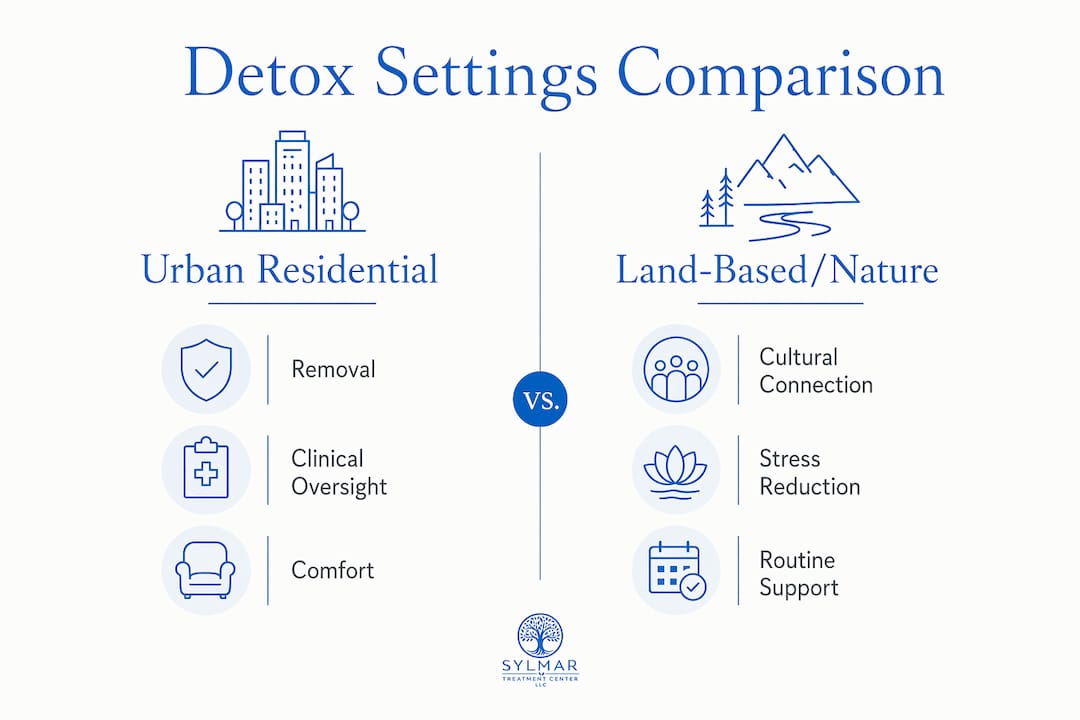
| Feature | Urban residential | Land-based or nature-connected | Outpatient |
|---|---|---|---|
| Removal from triggers | Complete | Complete | Partial |
| 24/7 clinical oversight | Yes | Varies | No |
| Cultural or nature connection | Limited | High | None |
| Peer community | Structured | Structured | Minimal |
| Relapse access during treatment | None | None | High |
Outpatient detox keeps patients in the same environment where substance use occurred. That proximity to triggers requires extraordinary self-regulation at exactly the moment when a person’s capacity for self-regulation is lowest. Residential settings remove that burden entirely. For patients with moderate to severe substance use disorders, inpatient vs. outpatient detox comparisons consistently favor residential care for retention and safety.
The stimulus-response cycle tied to environmental cues is neurologically reinforced through repeated use. Breaking it requires more than willpower. It requires a physical change of setting combined with systemic support, including new routines, new social contacts, and reduced access to substances.
How does environmental stress reduction support detox engagement?
A regulated, low-stress environment increases a patient’s ability to engage with medical, psychiatric, and therapy interventions during detox. Clinical environment plays a decisive role in early treatment engagement, particularly in the first days of residential care when withdrawal symptoms compete with every therapeutic effort.
The misconception that comfort in rehab signals less serious treatment gets this relationship exactly backward. Comfort reduces environmental stress. Reduced stress makes intensive therapy more accessible. A patient who is not hypervigilant about their surroundings can actually hear what a counselor is saying.
Co-occurring mental health disorders, present in a large share of people seeking detox, respond especially poorly to high-stress environments. Anxiety, PTSD, and depression all worsen under environmental chaos. A setting that regulates noise, provides consistent sleep conditions, and offers predictable daily structure creates the conditions for psychiatric care to work.
Evidence-based lifestyle supports reinforce this effect. Natural detoxification processes are aided by 7–9 hours of sleep per night and 30 minutes of exercise five days per week. These are not optional wellness extras. They are physiological requirements for the body to process and clear substances effectively.
- Sleep environment: Quiet rooms, consistent lighting schedules, and limited nighttime disruptions support the 7–9 hour sleep target.
- Physical activity: Facilities that include structured daily movement, even short walks, accelerate physical stabilization.
- Nutrition: Regular, balanced meals stabilize blood sugar and reduce irritability during withdrawal.
- Sensory load: Limiting screens, loud noise, and social conflict reduces cortisol and supports nervous system regulation.
Pro Tip: Families supporting a loved one in detox can reinforce these principles at home during visits or phone calls. Keep conversations calm, predictable, and free of crisis-level pressure. The nervous system needs consistency, not urgency.
How do environmental cues and routines shape long-term recovery?
The detox environment does not stop influencing outcomes when the patient leaves the facility. The broader recovery ecology shapes cravings, identity, and behavioral triggers for months after discharge. Changing the physical setting without changing the surrounding system of social cues, routines, and access to substances often fails to produce lasting recovery.
Strategic Recovery’s Environmental Pillar framework identifies four interlocking factors that drive relapse: cue load, access to substances, social permission, and identity cues. A person who returns home to the same friends, the same neighborhood liquor store, and the same evening routine faces all four factors simultaneously. The neurological work done during detox unravels quickly under that pressure.
The table below summarizes key environmental factors and their documented impact on relapse risk.
| Environmental factor | Effect on relapse risk | Modifiable during detox |
|---|---|---|
| Proximity to substances | High increase | Partially |
| Social network using substances | High increase | Yes, through peer programming |
| Disrupted sleep routine | Moderate increase | Yes |
| Lack of structured daily routine | Moderate increase | Yes |
| Absence of recovery community | High increase | Yes |
| Nature or cultural connection | Decrease | Yes, in residential settings |
Detox safety best practices address this by building recovery capital during the residential phase. Recovery capital includes sober social connections, structured routines, and a clear plan for the post-discharge environment. Facilities that treat detox as a standalone medical event, rather than the first phase of a longer ecological shift, produce weaker long-term outcomes.
Sleep, routine, and social support are not soft add-ons. They are the architecture of a recovery-supporting environment. Patients who leave detox with all three in place face a fundamentally different neurological challenge than those who leave without them.
Key Takeaways
The detox environment is a clinical variable that directly determines whether patients stabilize, stay engaged, and sustain abstinence long after discharge.
| Point | Details |
|---|---|
| Clinical oversight is non-negotiable | Staffing ratios and accreditation matter more than facility aesthetics for patient safety. |
| Residential settings outperform outpatient | Physical removal from triggers reduces relapse access during the most vulnerable phase. |
| 90-day retention predicts long-term success | Patients who complete the initial residential phase show higher abstinence at 6 and 12 months. |
| Stress reduction enables therapy | A regulated environment makes psychiatric and behavioral interventions more effective. |
| Recovery ecology must change, not just location | Lasting recovery requires new routines, social supports, and reduced substance access post-detox. |
What I’ve learned about environment that most treatment guides miss
After years of working with patients in addiction recovery, the pattern I see most often is this: families spend weeks researching facility amenities and almost no time asking about staffing ratios or discharge planning. The environment inside the facility matters enormously. The environment a patient returns to matters just as much.
The insight that changed how I think about this came from watching two patients with nearly identical clinical profiles go through detox in different settings. One completed a 90-day residential program with structured routines, peer community, and a discharge plan that included sober housing. The other completed a 30-day program and returned directly to the same apartment, same social circle, and same daily patterns. The outcomes were not close.
What the research on land-based treatment programs confirms is something clinicians have observed informally for years. A setting that connects people to something larger than their addiction, whether that is nature, culture, community, or identity, produces recovery that holds. A setting that simply removes substances without replacing the surrounding system produces a gap that relapse fills.
The uncomfortable truth is that comfort and clinical quality are not opposites. A patient who feels physically safe, sleeps well, and is not hypervigilant about their surroundings can engage with therapy at a depth that a stressed, sleep-deprived patient cannot. Sylmartreatmentcenter’s six-bed model exists precisely because smaller settings produce that kind of safety without sacrificing clinical rigor.
Families advocating for a loved one should ask two questions above all others: What does the first 72 hours look like clinically? And what does the discharge plan address about the home environment? Those two questions reveal more about a program’s quality than any brochure.
— Jim
Sylmartreatmentcenter’s approach to environment-centered detox care
Sylmartreatmentcenter was built on the understanding that where recovery happens shapes whether it lasts. The center’s intimate six-bed setting provides 24/7 clinical supervision within a low-stimulation environment designed to reduce stress and support engagement from day one.
Sylmartreatmentcenter holds both DHCS licensure and Joint Commission accreditation, meeting the clinical standards that research identifies as decisive for patient safety. The center’s individualized treatment programs address co-occurring mental health disorders alongside detox, recognizing that psychiatric stability and environmental safety are inseparable. For families ready to make an informed treatment decision, the full range of structured care programs is available with 24/7 admissions support.
FAQ
Why does the detox setting matter more than the treatment method alone?
The setting determines whether patients stay long enough for any treatment method to work. 90-day residential retention predicts sustained abstinence at 6 and 12 months, making the environment itself a clinical outcome driver.
What makes a detox environment clinically effective?
Clinical staffing and accreditation are the primary markers of an effective detox environment. Adequate nurse-to-patient ratios, 24/7 oversight, and verified standards matter more than facility aesthetics.
How do environmental cues cause relapse after detox?
Environmental cues trigger neurologically reinforced stimulus-response cycles linked to past substance use. Returning to the same setting without changing social cues and routines reactivates those cycles even after successful detox.
Does comfort in a detox facility reduce treatment effectiveness?
Comfort reduces environmental stress, which increases a patient’s capacity to engage with therapy. A regulated, less stressful setting makes medical, psychiatric, and behavioral interventions more accessible, not less rigorous.
What should families look for in a detox environment?
Families should prioritize clinical staffing ratios, accreditation status, discharge planning quality, and the facility’s approach to co-occurring mental health disorders. The detox assessment process at admission reveals how thoroughly a program addresses the full recovery environment.