

Alcohol withdrawal typically starts 6 to 12 hours after the last drink, peaks between 24 and 72 hours, and most physical symptoms resolve within 3 to 7 days, as outlined in details about EtG detection times. That timeline shifts hard for people with a history of heavy, prolonged drinking. Seizures and delirium tremens carry real risk in that first three days, which is why medical supervision matters for anyone with prior severe withdrawal, daily heavy use, or health complications.
TL;DR:
- The risk of severe complications like seizures and delirium tremens peaks between 24 and 72 hours after the last drink, especially in heavy drinkers.
- Individuals with a history of previous seizures, DTs, long-term heavy drinking, or coexisting health issues should seek supervised detox to ensure safety.
- Clinical management uses CIWA-Ar scoring to guide medication dosing and requires close monitoring, particularly in moderate to severe cases.
- Post-acute symptoms like insomnia, mood swings, and cravings can persist for weeks to months, increasing relapse risk without ongoing support.
- Supervised detox centers with personalized, 24/7 monitoring reduce the danger of undetected complications and improve recovery outcomes.
Table of Contents
- What Is the Alcohol Detox Timeline, Hour by Hour?
- What Symptoms Appear at Each Severity Level?
- How Common Are Seizures and Delirium Tremens, and When Do They Strike?
- Who Is Most Likely to Have a Severe Withdrawal?
- How Do Doctors Manage Alcohol Withdrawal Safely?
- What Happens After the Acute Withdrawal Phase Ends?
- How Sylmar Treatment Center Handles Medically Supervised Detox
- Where Can You Find Reliable Information on Alcohol Withdrawal?
- What Actually Matters Most When Preparing for Detox
- Ready to Move Forward With Supervised Detox?
- Sources
What Is the Alcohol Detox Timeline, Hour by Hour?
Withdrawal doesn’t hit all at once. It builds in fairly predictable windows, and knowing them helps you (or someone you’re supporting) recognize when things are progressing normally versus when they’re tipping into dangerous territory.
Hours 6 to 12. The first symptoms show up here: hand tremors, anxiety, sweating, headache, nausea, and trouble sleeping. This is the body reacting to the sudden absence of alcohol’s depressant effect on the central nervous system. For someone who drinks moderately, this might be the extent of it. For a heavy daily drinker, it’s just the opening act.
Hours 12 to 24. Symptoms intensify. Heart rate and blood pressure climb. Some people start experiencing alcoholic hallucinosis at this stage, meaning visual, auditory, or tactile hallucinations while otherwise remaining oriented and aware they aren’t real. This is distinct from delirium tremens, and it’s important not to confuse the two.
Hours 24 to 48. This window is the peak for many people, and it’s also when seizure risk climbs sharply. Alcohol-related seizures typically occur between 6 and 48 hours after the last drink and demand immediate treatment. A seizure can be the first serious warning sign someone gets, even if earlier symptoms seemed mild.
Hours 48 to 72. This is the classic window for delirium tremens to emerge, though DTs can appear as late as 8 days out in some cases. If someone’s confusion, agitation, or fever worsens during this stretch rather than easing, that’s a sign the withdrawal has moved into its most dangerous phase.
Days 3 to 7. For most people, acute physical symptoms resolve somewhere in this window. Tremors calm down, sleep starts to normalize, appetite returns. Monitoring still matters here, especially for anyone who had a rocky first 72 hours, since some complications lag behind the main symptom curve.
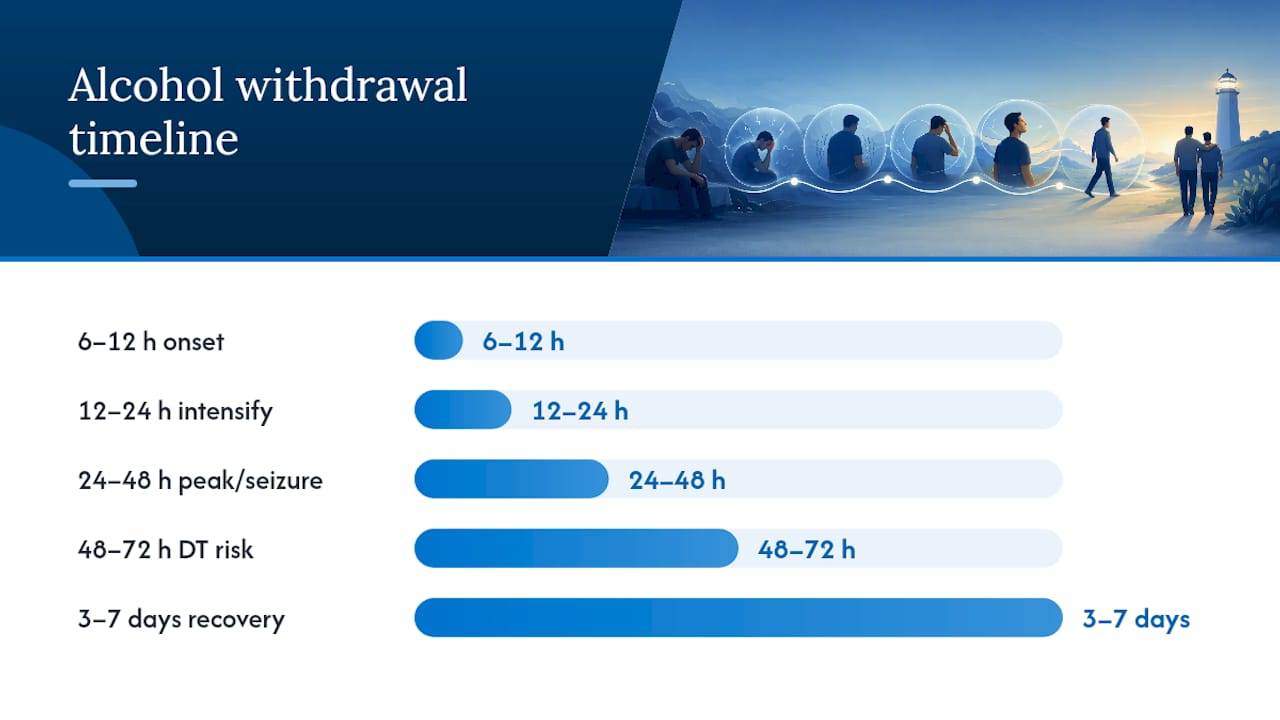
Beyond one week. The acute phase is over, but a second, quieter phase begins. Insomnia, irritability, mood swings, and cravings can linger for weeks or even months. This is often where relapse risk quietly spikes, precisely when people assume they’re “through it.”
Here’s the sequence condensed:
- 6 to 12 hours: Tremor, anxiety, insomnia, GI upset begin.
- 12 to 24 hours: Symptoms intensify; hallucinosis possible.
- 24 to 48 hours: Peak symptoms; highest seizure risk window.
- 48 to 72 hours: Delirium tremens most commonly emerges.
- Days 3 to 7: Acute symptoms typically resolve with continued monitoring.
- Weeks to months: Post-acute symptoms (sleep, mood, cravings) may persist.
What Symptoms Appear at Each Severity Level?
Not every withdrawal case looks the same, and severity tends to cluster into three recognizable tiers. Knowing where symptoms fall helps you gauge whether a situation calls for a phone call to a doctor or a trip to the emergency room.
Mild symptoms usually show up first and stay manageable in low-risk cases:
- Hand tremor
- Mild anxiety or restlessness
- Headache
- Insomnia
- Nausea without vomiting
Moderate symptoms signal the body is under real physiological stress:
- Heart rate consistently above 100 beats per minute
- Elevated blood pressure
- Profuse sweating
- Rising CIWA-Ar scores that indicate escalating risk
Severe symptoms are medical emergencies, full stop:
- Tonic-clonic (grand mal) seizures
- Alcoholic hallucinosis with agitation
- Delirium tremens, marked by severe confusion, fever, and autonomic instability
The clinical distinction that trips people up most is between hallucinosis and delirium tremens. Hallucinosis involves seeing or hearing things that aren’t there while the person stays oriented to who they are and where they are. DTs involve profound disorientation, dangerously unstable vital signs, and a level of confusion that makes self-care impossible. One is uncomfortable. The other is life-threatening.
Pro Tip: Don’t wait for a seizure to treat withdrawal as an emergency. A resting heart rate over 100 or a CIWA-Ar score climbing past 15 is already a signal to get medical eyes on the situation, not a “wait and see” moment.
How Common Are Seizures and Delirium Tremens, and When Do They Strike?
Precision here matters more than most people realize, because the timing of these complications is what makes unsupervised detox risky.
Seizures typically occur between 6 and 48 hours after the last drink. They can appear as an isolated event, sometimes before other severe symptoms even develop, which is exactly why early monitoring matters even when someone “seems fine” in the first few hours.
Delirium tremens develops in about 3% to 5% of people undergoing withdrawal, most commonly 48 hours to 8 days after the last drink. That’s a wider window than most people expect. DTs aren’t just heavy shaking, it involves hyperthermia, severe autonomic instability, and profound disorientation, and it typically requires ICU-level care to manage safely.
A few things push someone toward the higher end of this risk curve:
- A history of prior seizures or DTs during past withdrawal attempts
- Years of daily, heavy drinking rather than occasional binge patterns
- Coexisting liver disease or electrolyte imbalances
- Concurrent use of benzodiazepines or other sedatives
Fatalities from untreated severe alcohol withdrawal are rare in supervised settings but well documented in cases where seizures or DTs go unrecognized. That gap between “rare” and “well documented” is precisely the argument for substances requiring medical detox being handled somewhere with monitoring capacity, not guesswork.
Who Is Most Likely to Have a Severe Withdrawal?
Individual history predicts the course of withdrawal more reliably than almost anything else, and clinicians lean on it heavily when deciding on a care setting.
The strongest predictors of a rough detox include a prior seizure or DTs episode during an earlier withdrawal, years of daily heavy drinking, and abruptly stopping after sustained heavy use rather than tapering. Older age, liver disease, malnutrition, electrolyte imbalances, and concurrent benzodiazepine use all raise the stakes further.
There’s a phenomenon worth understanding here called the kindling effect: each successive untreated or poorly managed withdrawal tends to sensitize the brain, making future episodes more severe, not less. That’s the opposite of what most people assume, since “I’ve done this before” often gets read as reassurance rather than a warning sign.
A quick self-check before attempting detox without supervision:
- Have you had a seizure or DTs during a past withdrawal?
- Have you been drinking heavily every day for months or years?
- Do you take benzodiazepines, opioids, or have liver or heart disease?
- Are you over 60 or physically frail?
Answering yes to any of these is a strong signal to pursue supervised detox rather than going it alone.
How Do Doctors Manage Alcohol Withdrawal Safely?
Clinical management centers on one tool and one class of medication, deployed with real judgment about severity.
The CIWA-Ar scale is the standard instrument for scoring withdrawal severity across ten symptom categories, from tremor to hallucinations to agitation. Clinicians use the score to guide symptom-triggered dosing, meaning medication is given based on how severe symptoms actually are in real time, rather than on a rigid preset schedule. In settings where close monitoring isn’t feasible, fixed-schedule tapers remain a reasonable alternative, though they typically mean longer medication exposure overall.
Benzodiazepines are the mainstay medication for withdrawal because they address the same neurotransmitter system alcohol was suppressing. For withdrawal that doesn’t respond adequately, phenobarbital or ICU-level care become necessary. Thiamine and IV fluids are standard adjuncts, since heavy drinkers commonly run thiamine-deficient, which raises separate neurological risks.
Care settings vary by risk level:
- Outpatient supervised detox works for mild cases without complicating risk factors, using scheduled check-ins and oral medication.
- Inpatient medical detox is warranted for moderate to severe symptoms, prior complicated withdrawal, or significant comorbidities.
- ICU care becomes necessary for refractory DTs, uncontrolled seizures, or cardiovascular instability.
Pro Tip: If you’re evaluating a medically supervised detox process for a loved one, ask specifically whether the facility uses CIWA-Ar scoring. It’s a good proxy for whether monitoring is rigorous or just periodic check-ins.
The underlying goal isn’t comfort, it’s preventing seizures, status epilepticus, or cardiovascular collapse, which is why dosing decisions get made by clinical staff rather than left to how someone feels in the moment.
What Happens After the Acute Withdrawal Phase Ends?
Getting through the first week doesn’t mean the work is done. Post-acute withdrawal syndrome is real, and it’s often underestimated by people who expected to feel “normal” once the physical symptoms passed.
Common lingering issues include disrupted sleep, mood instability, cognitive fog, and cravings that ebb and flow unpredictably. Around the 10-day mark, many people report feeling physically stable but emotionally raw, a combination that catches people off guard. Sleep and mood problems specifically can stretch on for weeks to months before fully settling.
This is also the highest-leverage window for preventing relapse, since post-acute symptoms are a major driver of people returning to drinking. Recommended next steps include:
- A comprehensive alcohol use disorder assessment beyond just the detox itself
- Behavioral therapies such as cognitive behavioral therapy or motivational interviewing
- Medications for relapse prevention when clinically indicated
- Connection to outpatient treatment and peer support networks before leaving a detox program
Detox handles the physical dependence. What comes after determines whether it holds. Reviewing detox and treatment planning before discharge gives families a clearer picture of what ongoing support actually looks like.
How Sylmar Treatment Center Handles Medically Supervised Detox
Sylmar Treatment Center runs 24/7 admissions with medically supervised detox and psychiatric oversight built into every case, not bolted on afterward. The six-bed setting keeps staff-to-patient ratios tight enough for genuinely personalized monitoring, something larger facilities often can’t offer during the highest-risk hours of withdrawal.
- DHCS licensure and Joint Commission accreditation back the clinical protocols
- Comprehensive assessments shape individualized care plans from day one
- Dual diagnosis support addresses co-occurring mental health conditions alongside detox
- Families or patients can call directly for evaluation and expedited admission scheduling
For anyone weighing why supervised detox is necessary against the risks of going it alone, the six-bed model exists precisely to close that monitoring gap.
Where Can You Find Reliable Information on Alcohol Withdrawal?
- NCBI StatPearls: Alcohol withdrawal syndrome
- Merck Manual: Alcohol toxicity and withdrawal
- Cleveland Clinic: Alcohol withdrawal
- SAMHSA National Helpline for immediate assistance
What Actually Matters Most When Preparing for Detox
The research on this topic points to one uncomfortable conclusion: most people underestimate how much their own drinking history determines the danger they’re actually in. The conventional advice, “just get through the first few days,” treats withdrawal like a uniform experience when it’s anything but. Someone who’s detoxed before and had a seizure isn’t in the same risk category as someone drinking moderately for a few months, even if their symptoms look identical on day one.
Where I think most guidance falls short is timing. People fixate on the 24 to 72 hour window because that’s when peak symptoms hit, but delirium tremens showing up as late as day 8 means vigilance can’t stop just because someone made it past 72 hours feeling okay. That’s a gap worth sitting with.
If you take one thing from this: don’t self-assess risk based on how bad you feel. Assess it based on your history, and if detox safety best practices suggest you’re higher risk, get supervised care before symptoms start, not after they escalate.
— Jim
Ready to Move Forward With Supervised Detox?
Reading a timeline is useful. Having someone monitor you against it in real time is what actually keeps people safe. Sylmar Treatment Center’s six-bed setting means the staff watching your CIWA-Ar score isn’t juggling twenty other patients at the same time, which is the practical difference between a facility that catches early seizure risk and one that reacts to it after the fact.
Every admission starts with a comprehensive assessment, not a generic checklist, so the individualized treatment plan actually reflects your drinking history, prior withdrawal complications, and any co-occurring mental health concerns. If you’re supporting a family member through this decision, the center’s treatment programs page walks through what admission and early recovery look like in practice. Call for an evaluation or expedited admission if symptoms have already started. Waiting for the peak window to pass on its own isn’t a plan, it’s a gamble, and the DHCS-licensed, Joint Commission accredited setting exists specifically so you don’t have to make that bet alone.
This article is general information, not a substitute for advice from a qualified doctor. Consult a qualified healthcare professional about your own circumstances before acting on anything here.
Sources
- Alcohol withdrawal syndrome - StatPearls/NCBI
- Alcohol toxicity and withdrawal - Merck Manual (Professional)
- Alcohol withdrawal: symptoms, treatment & timeline - Cleveland Clinic