

Medical detox is the supervised clinical phase that manages acute withdrawal and stabilizes the body. Addiction treatment, or rehab, is the behavioral phase that follows and addresses the underlying disorder. Both are required. Detox without treatment is like setting a broken bone without physical therapy: the immediate crisis is handled, but the underlying problem is not.
If someone is showing life-threatening symptoms right now, call 911. For urgent referrals and same-day placement guidance, call the SAMHSA National Helpline at 1-800-662-4357, available 24/7 in English and Spanish at no cost, or dial 988 and press 2 for the Substance Use line.
“Detoxification is not a treatment for addiction but rather a precursor to treatment. Patients who complete detox should be linked to ongoing substance abuse treatment to achieve lasting recovery.” — SAMHSA TIP-45
The single most dangerous gap in the recovery pathway is the space between detox discharge and the first day of rehab. Families who understand this, and plan for it in advance, give their loved ones a meaningfully better chance.
Table of Contents
- What medical detox actually is, and what it isn’t
- Who actually needs medically supervised detox?
- Where detox happens: settings and what each one offers
- What happens clinically during detox
- How long does detox take?
- Why detox must be followed immediately by treatment
- How to find help and what to ask any program
- Why commercial detox products are not a substitute for medical care
- Key Takeaways
- The gap nobody talks about enough
- Sylmartreatmentcenter: medically supervised detox and residential care
- Useful sources and further reading
What medical detox actually is, and what it isn’t
The word “detox” gets used for two completely different things, and the confusion can be dangerous.
Medical detoxification is a clinical intervention. As defined in SAMHSA’s TIP-45 manual, it involves three components: evaluation (assessing the patient’s medical and psychiatric status), stabilization (managing withdrawal symptoms and preventing complications), and facilitating entry into ongoing treatment. Physicians, nurses, and addiction specialists oversee the process. Medications are used. Vital signs are monitored around the clock.
Commercial “detox” products — juice cleanses, herbal supplements, detox teas — are something else entirely. They are wellness products, not medical interventions. According to the National Center for Complementary and Integrative Health (NCCIH), there is no compelling clinical evidence that these products remove toxins, and documented harms include dehydration, electrolyte imbalances, and interactions with prescription medications.
The body already has a detoxification system. The liver metabolizes toxins, the kidneys filter waste, and the lymphatic system clears cellular debris. As PBS NewsHour reports, supporting those systems with adequate hydration, fiber-rich foods, regular exercise, and limited alcohol is both free and evidence-based. No cleanse required.
Addiction treatment (rehab) is different from detox in its goals, tools, and duration. Where detox addresses the physical crisis of withdrawal, treatment addresses the behavioral, psychological, and social dimensions of addiction. Treatment may include individual therapy, group counseling, medication-assisted treatment (MAT), family therapy, and relapse prevention planning. It is delivered by licensed counselors, psychologists, and psychiatrists, often over weeks or months.
- Medical detox: manages acute withdrawal, typically days to two weeks
- Addiction treatment: addresses behavioral and psychological recovery, weeks to months
- Both are needed: detox clears the path; treatment builds the road
Pro Tip: When you call a facility, ask directly: “If my family member completes detox here, do you have a confirmed bed in a treatment program ready on discharge day?” A facility that cannot answer that question clearly is not offering a complete continuum of care. See detox vs. rehabilitation differences explained for a deeper breakdown.
Who actually needs medically supervised detox?
Not every substance use disorder requires inpatient medical detox. But for certain substances and patterns, attempting withdrawal without medical supervision can be fatal.
High-risk substances and patterns that typically require medical oversight include:
- Heavy, daily alcohol use (especially long-term)
- Benzodiazepine dependence (Xanax, Valium, Klonopin, and similar drugs)
- Daily high-dose opioid use, including heroin and fentanyl
- Polysubstance use, particularly combinations involving alcohol or benzodiazepines
- Any pattern where previous withdrawal attempts produced seizures or delirium
Alcohol and benzodiazepine withdrawal carry the highest acute mortality risk of any substance class. Seizures can occur within 24–48 hours of the last drink in a dependent person, and delirium tremens, a severe withdrawal syndrome, can be life-threatening without treatment. Opioid withdrawal is rarely fatal in otherwise healthy adults, but it is medically serious and the discomfort drives relapse, often to a lethal dose after tolerance has dropped.
Medical comorbidities that increase risk include liver disease, cardiovascular conditions, diabetes, seizure history, and severe psychiatric disorders. Co-occurring conditions like major depression, bipolar disorder, or psychosis require simultaneous psychiatric management during detox.
Seek emergency care immediately if you observe any of these:
- Seizures or convulsions
- Severe confusion, disorientation, or hallucinations
- Irregular heartbeat or chest pain
- Extreme dehydration, inability to keep fluids down
- Suicidal ideation or self-harm
The American Society of Addiction Medicine (ASAM) patient placement criteria guide clinicians in matching withdrawal severity and medical complexity to the appropriate level of care. The decision is a clinical one, not one families should make alone. Understanding why supervised detox is necessary can help families recognize the signs before a crisis escalates.
Where detox happens: settings and what each one offers
The setting for detox should match the medical complexity of the withdrawal. Placing a high-risk patient in an outpatient program, or keeping a low-risk patient in a hospital when residential care would suffice, are both mismatches that affect outcomes.
Inpatient/residential medical detox is the most common setting for moderate-to-severe withdrawal. Patients stay on-site, typically in a licensed residential facility, with 24/7 nursing coverage, physician oversight, and medication management. Vital signs are checked regularly, and staff can respond immediately to complications. This setting is appropriate for alcohol and benzodiazepine withdrawal, high-risk opioid withdrawal, and patients with psychiatric comorbidities or limited home support.

Hospital-based detox is reserved for the most medically complex cases: patients with active cardiac complications, severe delirium tremens, respiratory compromise, or co-occurring medical emergencies. Emergency departments often serve as the entry point, with transfer to an inpatient medical unit or a hospital-based detox unit once the patient is stabilized. This is the highest level of care and the most resource-intensive.
Outpatient supervised detox (also called medically monitored outpatient detox) allows patients to receive daily or several-times-weekly clinical check-ins, medication dispensing, and monitoring while living at home or in a sober living environment. It is appropriate for patients with mild-to-moderate withdrawal, strong home support, no significant psychiatric comorbidities, and reliable transportation. It is not appropriate for alcohol or benzodiazepine withdrawal of moderate-to-severe severity.
Placement criteria that clinicians weigh include:
- Withdrawal severity and predicted trajectory
- Medical and psychiatric comorbidities
- History of prior severe withdrawal or seizures
- Home environment and social support
- Motivation and ability to comply with outpatient requirements
For a detailed comparison of safety implications by setting, inpatient vs. outpatient detox options walks through the clinical considerations families should understand before choosing.
What happens clinically during detox
From the moment a patient arrives, the clinical team is gathering information and managing risk simultaneously.
Initial evaluation covers medical history, current substance use (types, amounts, frequency, last use), vital signs, laboratory work (liver function, electrolytes, kidney function, blood glucose), urine toxicology, and a psychiatric screen. Family members are often asked to provide collateral history, particularly when the patient is in acute distress or cognitively impaired. Consent for treatment and release of information are addressed at intake.
Monitoring and stabilization vary by substance but typically include regular vital sign checks, IV fluid administration when dehydration is present, electrolyte correction, and close observation for seizures or delirium. Nurses document changes in withdrawal severity using validated scales, such as the Clinical Institute Withdrawal Assessment for Alcohol (CIWA-Ar) or the Clinical Opiate Withdrawal Scale (COWS), which guide medication dosing decisions in real time.
The medications used depend on the substance class. The table below gives families a reference point; it is not an exhaustive protocol, and actual prescribing is always individualized by the treating physician.
| Substance Class | Common Withdrawal Risks | Typical Medication Approach |
|---|---|---|
| Alcohol | Seizures, delirium tremens, arrhythmia | Benzodiazepines (e.g., lorazepam, diazepam); adjuncts like thiamine, anticonvulsants |
| Benzodiazepines | Seizures, rebound anxiety, psychosis | Long-acting benzodiazepine taper (e.g., diazepam, clonazepam) |
| Opioids (short-acting) | Severe discomfort, dehydration, relapse risk | Buprenorphine, methadone, clonidine for symptom management |
| Opioids (long-acting) | Prolonged withdrawal, depression | Buprenorphine or methadone induction; extended monitoring |
| Stimulants (cocaine, meth) | Dysphoria, fatigue, depression, cravings | Primarily symptomatic and supportive care; psychiatric monitoring |
For a family-oriented walkthrough of the full intake and stabilization process, the medically supervised detox process guide covers what to expect from day one through discharge.
How long does detox take?
Duration varies more than most families expect, and the answer depends on the substance, the severity of dependence, and individual physiology.
-
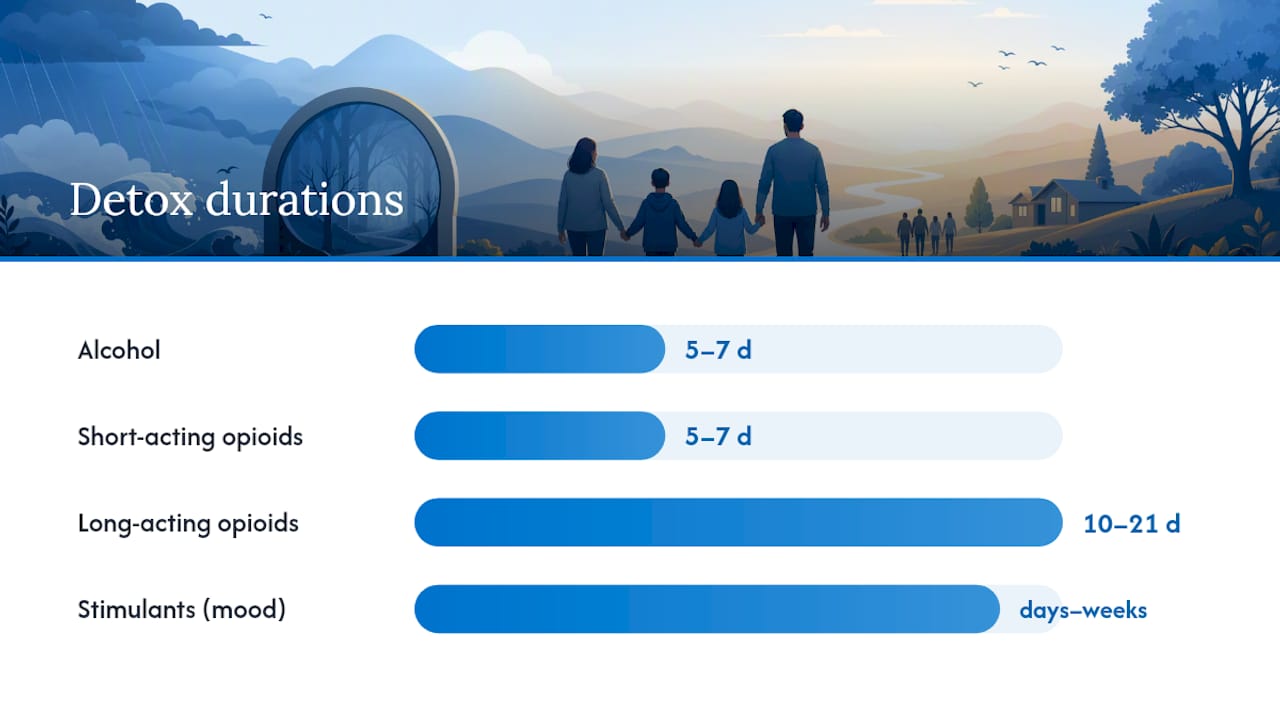
Alcohol and benzodiazepines (days to 1–2 weeks for the acute high-risk period). The first 72 hours are the most dangerous for seizure and delirium risk. Most uncomplicated alcohol withdrawal resolves clinically within 5–7 days, though some patients require longer monitoring. Benzodiazepine withdrawal can extend for weeks when long-acting drugs are involved.
-
Short-acting opioids (heroin, oxycodone): typically 5–7 days. Peak withdrawal symptoms usually occur 36–72 hours after last use and begin to subside by day 5–7. Patients often describe it as a severe flu with intense psychological distress.
-
Long-acting opioids (methadone, buprenorphine): longer, often 10–21 days or more. Methadone has a long half-life, so withdrawal onset is delayed and the course is more prolonged. Buprenorphine induction timing matters significantly.
-
Stimulants (cocaine, methamphetamine): variable, often days to weeks for mood symptoms. The acute crash phase (fatigue, hypersomnia, increased appetite) typically resolves within days. Post-acute symptoms like depression, anhedonia, and cravings can persist for weeks and require ongoing psychiatric support.
-
Polysubstance withdrawal: unpredictable and often longer. When multiple substances are involved, withdrawal timelines overlap and interact. Medical teams must manage competing withdrawal syndromes simultaneously, which typically extends the monitoring period.
Factors that lengthen detox include advanced age, liver or kidney impairment, long duration of heavy use, high tolerance, and significant psychiatric comorbidity. The acute high-risk window for most substances falls within the first 72 hours, which is why 24/7 monitoring during that period is not optional for high-risk patients.
Why detox must be followed immediately by treatment
Detox is not recovery. It is the doorway to recovery. Completing detox without entering treatment is one of the highest-risk transitions in addiction medicine.
Outcome data summarized in clinical reviews consistently show that patients who complete detox but do not enter treatment face substantially higher relapse rates than those who transition directly into rehab. The period immediately after detox discharge, when cravings are intense and coping skills are untested, is when relapse is most likely.
Best practice, supported by SAMHSA’s TIP-45 guidance, is same-day or next-day transition into a treatment program when clinically appropriate. The goal is to eliminate the gap entirely.
How well-run programs handle this transition:
- Discharge planning begins at admission, not on the day of discharge
- A confirmed bed or intake appointment at the next level of care is secured before the patient leaves
- Written medication continuity plans (particularly for MAT patients) are provided to the receiving program
- “Warm handoffs” involve a direct phone call or transfer of records between the detox team and the treatment team
- Patients leave with a specific date, time, and address for their first treatment appointment
Pro Tip: Before accepting discharge from any detox program, ask for the name and address of the receiving treatment facility, the confirmed intake date and time, and written documentation of any medications to be continued. If a facility cannot provide all three, the transition plan is incomplete. The guide on how detox prepares patients for rehab explains what a proper handoff looks like in practice.
How to find help and what to ask any program
When a family is in crisis, the fastest path to a safe placement runs through three resources.
Immediate helplines:
- SAMHSA National Helpline: 1-800-662-4357, free, confidential, 24/7, English and Spanish. Counselors provide referrals to local treatment programs, support groups, and community organizations.
- 988 Suicide and Crisis Lifeline: Dial 988, then press 2 for the Substance Use line. Available 24/7 for mental health and substance use crises.
- findtreatment.gov: The federal treatment locator. Search by zip code, substance type, and payment options to find licensed programs near you.
When calling, have this information ready: the substances being used, approximate amounts and frequency, date and time of last use, any known medical conditions, and insurance information.
Insurance basics. Most private insurance plans cover medically necessary detox and treatment under the Mental Health Parity and Addiction Equity Act, but coverage details vary. Detox and rehab are often billed as separate benefits, so verify both. Ask your insurer specifically about prior authorization requirements, in-network residential facilities, and whether outpatient and inpatient benefits are separate. For a detailed breakdown of what private plans typically cover, rehabilitation coverage in private insurance explains the common coverage categories and authorization issues families encounter.
Questions to ask any detox or treatment program:
- What is your medical staffing model? Are physicians on-site 24/7 or on-call?
- Are you accredited by the Joint Commission? Do you hold a state DHCS license?
- What is your discharge-to plan? Can you confirm a bed in treatment before my family member is discharged?
- What medications do you use for withdrawal management, and will those continue in treatment?
- How do you handle co-occurring psychiatric conditions?
- What is your family involvement policy?
- What does the program cost, and what insurance do you accept?
Why commercial detox products are not a substitute for medical care
The wellness industry uses the word “detox” to sell products that have no clinical relationship to medical detoxification. The confusion is not just semantic. It is dangerous.
The NCCIH is direct on this point: reviews of detox diets and cleansing products find no compelling evidence that they remove toxins from the body, and documented harms include dehydration, electrolyte disturbances, and interactions with medications. Laxative-based cleanses can cause dangerous potassium and sodium imbalances. Some herbal supplements marketed for “liver detox” have been associated with drug-induced liver injury.
University Hospitals notes that while short-term fasting, elimination diets, and exercise can be safe lifestyle practices, most detox supplements are unregulated and potentially harmful. The body’s liver and kidneys handle the actual work of filtering waste and metabolizing toxins. Supporting those organs with hydration, adequate sleep, fiber, and limited alcohol is both safer and more effective than any commercial cleanse.
Situations where medical detox is the only appropriate intervention:
- Alcohol or benzodiazepine withdrawal in a dependent person
- Opioid withdrawal requiring medication induction
- Stimulant-related psychiatric emergencies
- Poisoning or overdose requiring medical management
- Heavy metal toxicity requiring chelation therapy under physician supervision
Stop any home regimen and seek urgent medical care if you or someone you know experiences: confusion, seizures, chest pain, severe vomiting or inability to keep fluids down, or suicidal thoughts. These are medical emergencies, not detox side effects to push through.
Key Takeaways
Medical detox manages acute withdrawal under clinical supervision; addiction treatment addresses the behavioral disorder that follows, and both are required for sustained recovery.
| Point | Details |
|---|---|
| Detox is medical, treatment is behavioral | Detox stabilizes the body; rehab addresses the psychological and behavioral dimensions of addiction. |
| Same-day transition matters | Leaving detox without a confirmed treatment placement dramatically increases relapse risk. |
| Emergency care first | Seizures, confusion, arrhythmia, or suicidal ideation during withdrawal require 911, not a helpline. |
| Accreditation is a baseline standard | Look for Joint Commission accreditation and a state DHCS license before choosing any program. |
| Sylmartreatmentcenter offers both | Sylmartreatmentcenter provides medically supervised detox and residential treatment in one accredited, six-bed setting with 24/7 admissions support. |
The gap nobody talks about enough
The clinical literature on detox is thorough. The part that gets less attention is the 24–48 hours after discharge, when a patient walks out of a detox facility with a list of phone numbers and no confirmed next step.
That gap is where most relapses happen. Not during detox, not months into treatment, but in the hours between leaving one program and arriving at the next. Families often assume that completing detox means the hard part is over. Clinically, it means the hard part is about to begin.
What actually protects patients in that window is not willpower or motivation. It is logistics: a confirmed bed, a specific intake time, a medication plan that doesn’t lapse, and a family member who knows where to drive. Programs that treat discharge planning as an afterthought are not offering real care continuity.
The six-bed residential model at Sylmartreatmentcenter exists partly for this reason. Smaller programs can track every patient’s transition plan individually, make direct calls to receiving facilities, and ensure that no one leaves without a documented next step. That is harder to do at scale, and the outcomes reflect it.
Families should hold every program to this standard: not “do you have a discharge plan?” but “can you show me the confirmed intake appointment before my family member leaves your facility?”
Sylmartreatmentcenter: medically supervised detox and residential care
Recovery that lasts starts with a medically safe withdrawal and moves directly into structured treatment. Sylmartreatmentcenter’s six-bed residential model is built around exactly that sequence, with 24/7 admissions support so families can act the moment they are ready.
Available services include medically supervised detox, residential addiction treatment, dual diagnosis support for co-occurring mental health conditions, medication management with psychiatric oversight, individualized treatment programs, and court-directed placements. The six-bed setting means every patient receives a custom care plan, not a standardized protocol.
Sylmartreatmentcenter holds Joint Commission accreditation and a California DHCS license, the two credentials families should require from any residential program before admission. Both signal that the facility meets independently verified clinical and safety standards.
To speak with an admissions counselor now, call 24/7 or review the full programs and services to understand what the admission process involves. Same-day intake is available for appropriate referrals.
This article provides general educational information about medical detoxification and addiction treatment. It is not a substitute for professional medical advice. Please consult a qualified clinician or call SAMHSA at 1-800-662-4357 for guidance specific to your situation.
Useful sources and further reading
The following sources informed this article and provide authoritative guidance for families seeking more detail.
- 1 Overview, Essential Concepts, and Definitions in Detoxification
- National Helpline for Mental Health, Drug, Alcohol Issues
- findtreatment.gov
- Detoxes and Cleanses: What You Need To Know | NCCIH
- Detoxes: Separating Fact From Fiction | University Hospitals
- How to detox your body for free without juice teas or flushes
- Detox vs Rehab: What’s the Difference? A 2026 Guide
Recommended
- What Does Detox Involve for Families: A Guide | Sylmar Treatment Center
- Inpatient vs. Outpatient Detox Options: A Safety Guide | Sylmar Treatment Center
- Mental Health Crisis in Detox: What Families Need to Know | Sylmar Treatment Center
- Why Detox Alone Is Not Treatment for Addiction | Sylmar Treatment Center