

A mental health crisis during detox is an acute change in thinking, mood, or behavior that occurs during withdrawal and directly threatens a person’s safety or ability to function. This is not ordinary discomfort. When someone stops using substances, the brain and body scramble to rebalance, and that process can tip into a psychiatric emergency fast.
If you are reading this because someone is in crisis right now:
- Call 911 or go to the nearest emergency room if there are seizures, loss of consciousness, hallucinations, or suicidal behavior.
- Call or text 988 (the Suicide and Crisis Lifeline) for immediate mental health crisis support.
- Stay with the person, remove access to anything that could cause harm, and do not leave them alone until help arrives.
Table of Contents
- What does a mental health crisis in detox actually mean?
- Why does mental health worsen during detox?
- How to recognize a mental health crisis during detox
- Why diagnosing a psychiatric disorder during detox is so hard
- What to do right now if someone is in crisis during detox
- What treatment looks like during and after a crisis
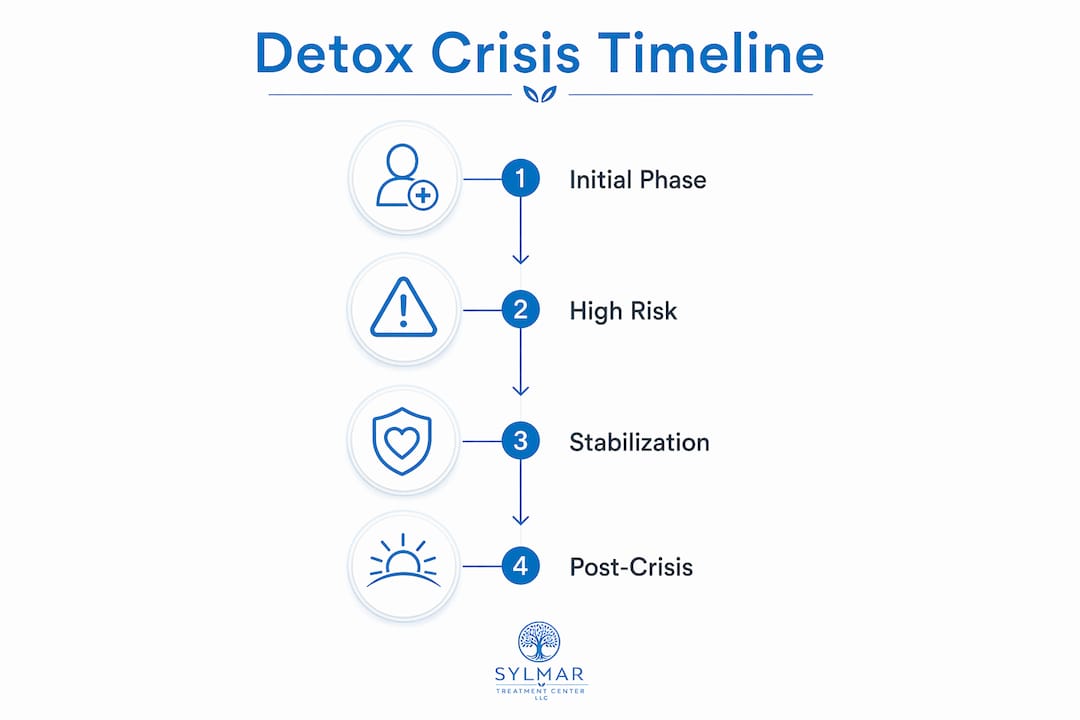
- When crises are most likely to happen
- What families can do during a detox-related crisis
- Why integrated care is the clinical standard
- Key Takeaways
- What clinicians wish families understood
- Specialized care when a crisis cannot wait
- Useful sources and emergency resources
What does a mental health crisis in detox actually mean?
Clinically, a mental health crisis during detox sits at the intersection of two processes happening at once: the body’s withdrawal from a substance and the brain’s struggle to regulate mood, perception, and behavior without it. The Cleveland Clinic describes what people commonly call a “nervous breakdown” as a real health event that leaves a person unable to function, not a dramatic exaggeration. During detox, that breakdown is compounded by the physical chaos of withdrawal.
The mechanism is straightforward. Substances like alcohol, opioids, and benzodiazepines alter how the brain produces and responds to neurotransmitters. When those substances are removed, the brain overcompensates. Anxiety spikes, sleep collapses, and in severe cases, perception itself distorts. At the same time, NCBI’s TIP 45 guidance notes that detox frequently exposes or worsens psychiatric symptoms that were masked by active substance use. What looked like a drinking problem may turn out to involve untreated depression, PTSD, or bipolar disorder surfacing for the first time without the chemical buffer.
A crisis, then, is the point where those symptoms cross from uncomfortable into dangerous.
Why does mental health worsen during detox?
The short answer: the brain was using the substance to cope, and now it has to manage without it. But the full picture involves several overlapping forces.

Biological drivers
Withdrawal neurochemistry is the most immediate factor. Alcohol and benzodiazepines suppress the central nervous system; stopping them abruptly causes a rebound of excitatory activity that can produce severe anxiety, tremors, and seizures. Opioid withdrawal floods the body with norepinephrine, triggering panic, pain, and profound dysphoria. Stimulant withdrawal crashes dopamine levels, leaving a person exhausted, anhedonic, and sometimes acutely suicidal.
Repeated detoxifications make this worse. A peer-reviewed study found that patients with two or more prior detoxifications reported higher withdrawal severity scores and greater psychiatric distress than those going through detox for the first time. This is consistent with the “kindling” hypothesis: each withdrawal episode sensitizes the nervous system, so subsequent ones hit harder.
Psychological and social contributors
- Loss of coping mechanism. Substances often serve as emotional regulation tools. Removing them without replacing them with other skills leaves a person raw.
- Emotional rebound. Feelings that were numbed for months or years resurface suddenly. Grief, shame, and trauma do not wait for a convenient moment.
- Untreated co-occurring conditions. NCBI’s co-occurring conditions chapter explains that substance-induced anxiety, depression, and psychosis can resolve with abstinence, but underlying primary disorders will not.
- Environmental stressors. Unstable housing, legal problems, financial pressure, and fractured relationships all press in during early withdrawal, when a person’s capacity to cope is at its lowest.
Substance type shapes the specific risk profile. Depressants carry the highest risk of life-threatening physical withdrawal. Stimulants carry a high risk of psychosis during intoxication or early abstinence. Opioids carry a high risk of suicidality in the first days of withdrawal.
How to recognize a mental health crisis during detox
Most withdrawal involves discomfort: nausea, sweating, insomnia, irritability. A crisis is something different. The line is crossed when symptoms threaten safety or overwhelm the person’s ability to respond to their environment.
Red flags that require immediate action:
- Suicidal statements, gestures, or behavior
- Hallucinations (seeing, hearing, or feeling things that are not there)
- Severe confusion or disorientation (not knowing where they are or what year it is)
- Seizures or uncontrolled shaking
- Delirium tremens (DTs): fever, rapid heart rate, profound agitation, and confusion in alcohol withdrawal
- Violent or uncontrollable behavior
- Escalating panic that does not respond to reassurance
The table below maps substance classes to their highest-risk mental health signals and the typical window when those signals appear.
| Substance class | High-risk mental health signals | Typical high-risk period |
|---|---|---|
| Alcohol | Severe anxiety, DTs, seizures, delirium | Within a few days after last drink |
| Benzodiazepines | Seizures, psychosis, extreme agitation | Within several days after last dose |
| Opioids | Extreme dysphoria, suicidal ideation, panic | Early days after last use |
| Stimulants (cocaine, meth) | Paranoia, stimulant-induced psychosis, severe depression | During intoxication or early abstinence |
| Cannabis (heavy use) | Anxiety, paranoia, depersonalization | During the first weeks of abstinence |
Pro Tip: Families often mistake agitation, crying, or angry outbursts for behavioral problems or manipulation. During detox, these can be medical symptoms. If behavior is escalating rather than cycling, treat it as a potential emergency, not a character issue.
Why diagnosing a psychiatric disorder during detox is so hard
Withdrawal mimics nearly every major psychiatric condition. Alcohol withdrawal looks like generalized anxiety disorder. Stimulant-induced psychosis looks like schizophrenia. Opioid withdrawal looks like major depression. NCBI’s guidance on co-occurring conditions is explicit: substance-induced syndromes can resolve over days to weeks of abstinence, but some persistent symptoms indicate a primary psychiatric disorder that needs its own treatment.

This creates a real clinical problem. Diagnosing a primary disorder during acute withdrawal is unreliable. The brain is not in a stable state, and symptoms that look like bipolar disorder on day two may look very different on day fourteen.
How clinicians handle it:
- Stabilize first. The immediate priority is managing withdrawal safely and addressing any acute psychiatric emergency, not arriving at a diagnosis.
- Treat severe symptoms without waiting. If someone is actively psychotic or suicidal, that gets treated now, regardless of whether the cause is substance-induced or primary.
- Reassess after abstinence. A formal psychiatric evaluation is most reliable after days to weeks of sobriety, once the acute withdrawal picture has cleared.
For families, this means expecting a period of uncertainty. A clinician who says “we’ll reassess in two weeks” is not avoiding the question. They are being accurate. Underlying emotional trauma that surfaces during this window often needs its own therapeutic attention once the person is stable.
What to do right now if someone is in crisis during detox
Speed and safety matter more than anything else in the first minutes.
- Ensure physical safety first. Move the person away from stairs, sharp objects, medications, or anything that could be used to cause harm.
- Stay with them. Do not leave the person alone. Your presence is stabilizing even if they are not responding normally.
- Stay calm and speak slowly. Avoid arguing, raising your voice, or physically restraining unless there is an immediate threat of violence.
- Call for help. Use the decision guide below to choose the right resource.
- Tell responders everything. Substance used, amount, last use, any prior detox history, current medications, and any history of suicidality or violence.
| Situation | Action |
|---|---|
| Seizures, loss of consciousness, DTs, or severe confusion | Call 911 immediately |
| Active suicidal behavior or self-harm | Call 911 immediately |
| Hallucinations with agitation | Call 911 or go to ED |
| Suicidal ideation without immediate behavior | Call 988 or crisis line, then clinician |
| Severe anxiety or panic, no immediate danger | Call treating clinician or detox facility |
| Escalating agitation, unclear cause | Call 911 if worsening; crisis line if stable |
On the medical side, clinicians managing detox-related crises have specific tools. Benzodiazepines are the standard medication for alcohol withdrawal and DTs, reducing seizure risk and calming the nervous system. Antipsychotics may be used for stimulant-induced psychosis or severe agitation, though they require careful monitoring. Vital sign monitoring is continuous in medically supervised settings because delirium tremens and seizures can develop rapidly and without obvious warning. This is why home detox from alcohol or benzodiazepines is genuinely dangerous: the window between “uncomfortable” and “life-threatening” is narrow.
What treatment looks like during and after a crisis
The setting matters as much as the treatment itself. NCBI’s TIP 45 frames detox as an opportunity to build a therapeutic alliance and motivate entry into longer-term care, not just a medical clearance process.
- Inpatient medical detox is appropriate when there is a history of seizures or DTs, multiple prior detoxifications, active suicidality, psychosis, or no stable home environment. Around-the-clock monitoring is the key advantage.
- Outpatient detox can work for lower-risk presentations with strong social support, but it is not appropriate when a mental health crisis is active or when the substance carries high seizure risk.
- Integrated dual-diagnosis care is the standard of care when both a substance use disorder and a psychiatric condition are present. Treating withdrawal alone, without addressing the underlying mental health condition, leaves the person vulnerable to relapse and repeat crises.
- Medications in withdrawal management include benzodiazepines (alcohol/benzo withdrawal), buprenorphine or methadone (opioid withdrawal), and antipsychotics or mood stabilizers for psychiatric stabilization. These are prescribed and monitored by physicians, not self-administered.
At intake, bring a list of all substances used and approximate amounts, any current prescription medications, prior detox or hospitalization history, and insurance information. Most facilities have staff who can help with prior authorization while the person is being evaluated.
When crises are most likely to happen
Timing depends on the substance, but the first 72 hours after last use is the highest-risk window for most people. Alcohol and benzodiazepine withdrawal can produce DTs and seizures between 24 and 96 hours after the last dose, with peak risk around 48–72 hours. Opioid withdrawal peaks in dysphoria and suicidality within the first 24–72 hours. Stimulant-related psychosis often begins during heavy intoxication or within the first one to three days of abstinence.
The kindling study mentioned earlier has a direct implication for prognosis: people with multiple prior detoxifications face a higher baseline of psychiatric distress at the start of each new withdrawal. Their acute-risk window may be more intense and their recovery from it slower. That does not mean recovery is out of reach. Most acute crises stabilize with appropriate medical care within days to a week. What happens after stabilization determines long-term outcomes. Integrated treatment that addresses both the substance use and the mental health condition consistently improves those outcomes compared to detox alone.
What families can do during a detox-related crisis
Your role is to be a calm, informed presence, not a clinician. Here is what that looks like practically.
- Gather information before you go to the ED. Write down the substance(s) used, estimated amounts, time of last use, any medications the person takes, and any history of prior detox, seizures, or psychiatric hospitalizations.
- Request integrated care explicitly. When speaking with ED or detox staff, say: “We believe there may be a co-occurring mental health condition. Can this be assessed as part of the evaluation?”
- Do not argue with the person in crisis. Withdrawal and psychiatric symptoms distort perception. Arguing about whether something is real or rational will escalate, not resolve, the situation.
- Do not physically restrain unless trained. If there is a risk of violence, call 911 and wait outside the room.
- Take care of yourself. Watching someone go through a detox crisis is traumatic. Contact SAMHSA’s National Helpline (1-800-662-4357) for family support resources.
After the crisis stabilizes, the work of arranging follow-up begins. Ask the treatment team about the transition plan before discharge. Detox is not treatment for addiction; it is the first step. Therapy, peer support, and ongoing psychiatric care are what sustain recovery.
Why integrated care is the clinical standard
Accurately diagnosing a pre-existing mental disorder during immediate detox is exceptionally difficult. Integrated dual-diagnosis care that stabilizes withdrawal and treats mental health emergencies concurrently is the gold standard, because treating one condition while ignoring the other leaves the root of the crisis unaddressed.
Sylmartreatmentcenter operates as a DHCS-licensed and Joint Commission–accredited program, which means its clinical protocols meet independently verified standards for both addiction and mental health care. In a six-bed setting, the staff-to-patient ratio allows for the kind of continuous observation that catches a developing crisis before it escalates. Clinicians there use comprehensive assessments at intake to identify co-occurring conditions and build individualized care plans that treat both the withdrawal and the underlying psychiatric picture simultaneously.
When evaluating any program, Joint Commission accreditation and DHCS licensing are the two benchmarks worth confirming. They are not marketing claims; they are audited credentials that tell you the program meets minimum safety and clinical standards.
Key Takeaways
A mental health crisis during detox is a medical emergency requiring immediate stabilization, not a sign of weakness or failure, and integrated dual-diagnosis care is the most effective path through it.
| Point | Details |
|---|---|
| Crisis definition | An acute change in thinking, mood, or behavior during withdrawal that threatens safety or functioning. |
| Emergency red flags | Seizures, DTs, hallucinations, suicidal behavior, and severe confusion require a 911 call or ED visit immediately. |
| Highest-risk window | Most crises emerge within the first 24–96 hours after last use, depending on the substance. |
| Integrated care matters | Treating withdrawal without addressing co-occurring mental health conditions leaves the root cause unresolved. |
| Sylmartreatmentcenter | Offers DHCS-licensed, Joint Commission–accredited dual-diagnosis care in a six-bed setting with 24/7 admissions support. |
What clinicians wish families understood
The single biggest misconception families carry into a detox crisis is that the person is choosing to behave this way. They are not. A seizure is not a choice. Hallucinations are not drama. Suicidal ideation during opioid withdrawal is a neurochemical event, not a personality flaw. The Cleveland Clinic’s framing is worth repeating: these are real health events that require professional help, full stop.
Clinicians also wish families came prepared. The single most useful thing you can bring to an ED or detox intake is an accurate substance history: what, how much, and when. That information shapes every clinical decision made in the first hours. Guessing or minimizing it to protect the person’s reputation can delay the right treatment.
One more thing: confidentiality laws mean clinicians may not be able to share details of the patient’s care with family members without consent. That is not a wall being put up against you. It is the patient’s legal right, and it does not prevent you from sharing information with the treatment team even when they cannot share back.
A mental health crisis during detox is frightening. It is also treatable. Most people who receive appropriate medical supervision and integrated follow-up care stabilize and go on to build lasting recovery.
This article is general information, not medical advice. For your specific situation, consult a qualified clinician or call 911 if there is an immediate safety concern.
Specialized care when a crisis cannot wait
Sylmartreatmentcenter was built for exactly this situation: a person in acute withdrawal who also needs psychiatric stabilization, in a setting where both can happen at once. The six-bed structure means every patient gets a clinician who actually knows them, not a rotating staff member reading a chart. The dual-diagnosis program addresses substance use and co-occurring mental health conditions concurrently, which is what the clinical evidence supports and what most general detox facilities do not offer.
Admissions support runs 24/7. If you are trying to figure out whether a loved one qualifies, or whether insurance will cover an inpatient stay, that conversation can happen now, before a crisis gets worse. The intake team can walk you through insurance authorization and what to expect on day one. See the full programs overview to understand the levels of care available, then call or visit the site to start the intake process.
Useful sources and emergency resources
- NCBI TIP 45: Detoxification and Substance Abuse Treatment — The federal clinical treatment improvement protocol covering safe detox practices, mental status evaluation, and stabilization standards.
- NCBI: Co-Occurring Medical and Psychiatric Conditions in Detox — Detailed guidance on substance-induced psychiatric syndromes, diagnostic challenges, and when parallel psychiatric care is needed.
- Cleveland Clinic: Nervous Breakdown (Mental Health Crisis) — Plain-language explanation of what a mental health crisis is and why it requires professional care.
- Effects of Multiple Detoxifications on Withdrawal Symptoms and Psychiatric Distress — Peer-reviewed study on how repeated detoxifications increase withdrawal severity and psychiatric distress.
- SAMHSA National Helpline — Free, confidential, 24/7 treatment referral and information service: 1-800-662-4357.
- 988 Suicide and Crisis Lifeline — Call or text 988 for immediate mental health crisis support anywhere in the United States.
- 911 / Local Emergency Services — For seizures, loss of consciousness, DTs, active suicidal behavior, or any situation where physical safety is at immediate risk.
- Sylmartreatmentcenter — DHCS-licensed, Joint Commission–accredited dual-diagnosis detox and residential care with 24/7 admissions support.
Recommended
- Inpatient vs. Outpatient Detox Options: A Safety Guide | Sylmar Treatment Center
- Medically Supervised Detox Process: A Family Guide | Sylmar Treatment Center
- Why Supervised Detox Is Necessary for Safe Recovery | Sylmar Treatment Center
- Why Detox Environment Affects Outcomes in Recovery | Sylmar Treatment Center