

The ASAM levels of care are the U.S. standard for matching a person’s assessed clinical and social needs to a treatment setting, ranging from early intervention at Level 0.5 to medically managed inpatient care at Level 4. Placement runs through a six-dimension assessment, not a single symptom or a diagnosis alone, and the Fourth Edition now formalizes person-centered factors as Dimension 6.
TL;DR:
- The placement of individuals in ASAM levels depends on a six-dimension assessment, with person-centered factors like housing and transportation now considered core.
- A high withdrawal risk (Dimension 1) often necessitates medically managed detox at Level 4, even if other dimensions suggest less intensive care.
- Consistent assessment and staff training are critical, as subjective judgment or resource limitations can lead to incorrect placement or delays.
- Reassessment is mandatory and can trigger movement between levels, supporting dynamic treatment tailored to changing conditions.
- Insurers rely on detailed documentation, including accurate scoring of all six dimensions, to approve placement and authorization.
Table of Contents
- What Are the ASAM Levels of Care? A Quick Reference
- The Six ASAM Dimensions That Determine Placement
- What Each Level of Care Actually Provides
- How Placement and Step-Up or Step-Down Decisions Get Made
- Where the ASAM Criteria Fall Short
- How ASAM Levels Work Alongside Other Standards
- Why ASAM Is Harder to Implement Than It Looks on Paper
- Why Person-Centered Placement Actually Changes Outcomes
- Getting an ASAM-Informed Assessment Started
- Where to Verify This Yourself
- Sources
What Are the ASAM Levels of Care? A Quick Reference
Each level represents a different intensity of service, not a different diagnosis. Here’s the basic map:
- Level 0.5, Early Intervention: Education and brief counseling, often delivered through telehealth or an outpatient clinic, for people who show risk factors but not a full disorder yet.
- Level 1, Outpatient Services: Regular but limited weekly contact, typically a few hours, for people who are stable and can function at work or school.
- Level 2.1/2.5, Intensive Outpatient/Partial Hospitalization: IOP and PHP programs that add structured group therapy several days a week, without round the clock supervision.
- Level 3.1/3.3/3.5/3.7, Residential/Inpatient: Live-in treatment with rising staff intensity, from low-intensity residential up to clinically managed high-intensity care.
- Level 4, Medically Managed Intensive Inpatient: Hospital-level care with 24-hour nursing and physician availability for acute medical or psychiatric instability.
Level 1 also covers long-term remission monitoring, which is where recovery residences and sober living arrangements often fit once acute treatment ends.
The Six ASAM Dimensions That Determine Placement
Placement decisions come from scoring a person across six clinical dimensions, and no single dimension decides the outcome on its own.
- Dimension 1, Withdrawal Potential: Measures how risky detox will be and whether medically managed withdrawal management is needed.
- Dimension 2, Biomedical Conditions: Flags physical health problems, such as uncontrolled diabetes or cardiac issues, that could complicate treatment at a lower level.
- Dimension 3, Emotional, Behavioral, or Cognitive Conditions: Covers co-occurring psychiatric symptoms, trauma history, and safety risks like suicidality.
- Dimension 4, Readiness to Change: Assesses motivation and engagement, since someone ambivalent about treatment often needs a more structured setting.
- Dimension 5, Relapse or Continued Use Potential: Looks at history of relapse and how much external structure a person needs to stay stable.
- Dimension 6, Recovery Environment: The Fourth Edition’s formal addition, covering housing stability, transportation, legal issues, and social support.
Pro Tip: Ask an intake team how they weigh Dimension 6 specifically. A program that treats housing instability or lack of transportation as an afterthought is skipping a factor ASAM now treats as core to placement, not optional context.
A person with severe withdrawal risk (Dimension 1) but strong family support and stable housing (Dimension 6) might still need a medically supervised setting for detox, then step down quickly once the acute phase passes.
What Each Level of Care Actually Provides
-
Level 0.5, Early Intervention. Delivered in schools, primary care offices, or outpatient clinics, usually by counselors or licensed social workers. Sessions are brief and educational, aimed at people with risk factors like heavy episodic drinking who don’t yet meet criteria for a substance use disorder.
-
Level 1, Outpatient Services. Typically one to a few hours of counseling per week, delivered by licensed therapists in a clinic setting. Fits people with mild disorders, stable housing, and enough motivation to attend scheduled sessions independently.
-
Level 2.1 and 2.5, Intensive Outpatient and Partial Hospitalization. IOP generally runs nine or more hours a week; PHP can run 20 hours or more, often with a psychiatric provider on the team. Common for people who need daily structure but can safely go home at night.
-
Level 3.1 through 3.7, Residential and Inpatient. Staffing intensity climbs across these sublevels, from clinically managed low-intensity residential (3.1) up to medically monitored high-intensity inpatient (3.7), which includes 24-hour nursing. This range covers people needing structured detox support, co-occurring psychiatric stabilization, or protection from an unsafe living environment. Sylmar Treatment Center’s chronic pain and addiction treatment guide covers a related scenario, where biomedical complexity often pushes someone into this range.
-
Level 4, Medically Managed Intensive Inpatient. Hospital-based, with physicians and nurses available around the clock. Reserved for acute intoxication, severe withdrawal syndromes like delirium tremens, or psychiatric emergencies requiring immediate medical control.
Withdrawal management itself isn’t a separate track. It’s classified within these levels, from ambulatory withdrawal management at Level 1 up through medically managed withdrawal at Level 4, depending on severity.
How Placement and Step-Up or Step-Down Decisions Get Made
A Level of Care Assessment is usually completed by a licensed clinician, physician, or credentialed addiction counselor working within their state’s scope-of-practice rules. The clinician scores each of the six dimensions, and ASAM’s decision rules apply from there.
- The guiding principle is “least restrictive safe” care. Clinicians balance all six dimensions to land on the lowest intensity setting that still protects the person’s safety.
- Reassessment isn’t optional; it’s built into the model. Programs revisit the six dimensions at defined intervals or when a person’s condition changes, and that reassessment can trigger a step up to a higher level or a step down to less intensive care.
- The same assessment language travels with the patient. Because ASAM gives clinicians and insurers a shared framework, the same criteria support both the clinical decision and the authorization request submitted to a payer.
A person could enter directly at Level 3.7 or Level 4 for acute stabilization and move to outpatient care within days if the underlying risk resolves quickly. The pathway isn’t linear, and it isn’t supposed to be.
Where the ASAM Criteria Fall Short
No placement system is perfect, and ASAM has real limitations worth knowing before you rely on it as a guarantee of care quality. The criteria depend heavily on the skill of whoever conducts the assessment. Two clinicians looking at the same person can land on different sublevels if their interviewing technique or clinical judgment differs, especially around Dimensions 3 and 6, which involve more subjective interpretation than a withdrawal scale does.
Access is another gap the criteria don’t solve. ASAM can recommend residential treatment for someone, but if no licensed bed is available in that region, or insurance denies the recommended level, the framework offers no enforcement mechanism. It’s a clinical standard, not a guarantee of placement.
Critics have also pointed out that Dimension 6’s newer emphasis on housing, transportation, and social support is only as useful as the resources a treatment program actually has to address those barriers. A center that scores someone high-risk on Dimension 6 but has no case management to help with housing hasn’t solved the problem; it’s just named it.
The Fourth Edition addresses some of this through more explicit decision rules and standardized training materials, but consistency still depends on individual programs investing in staff education and quality oversight, not just adopting the criteria on paper.
How ASAM Levels Work Alongside Other Standards
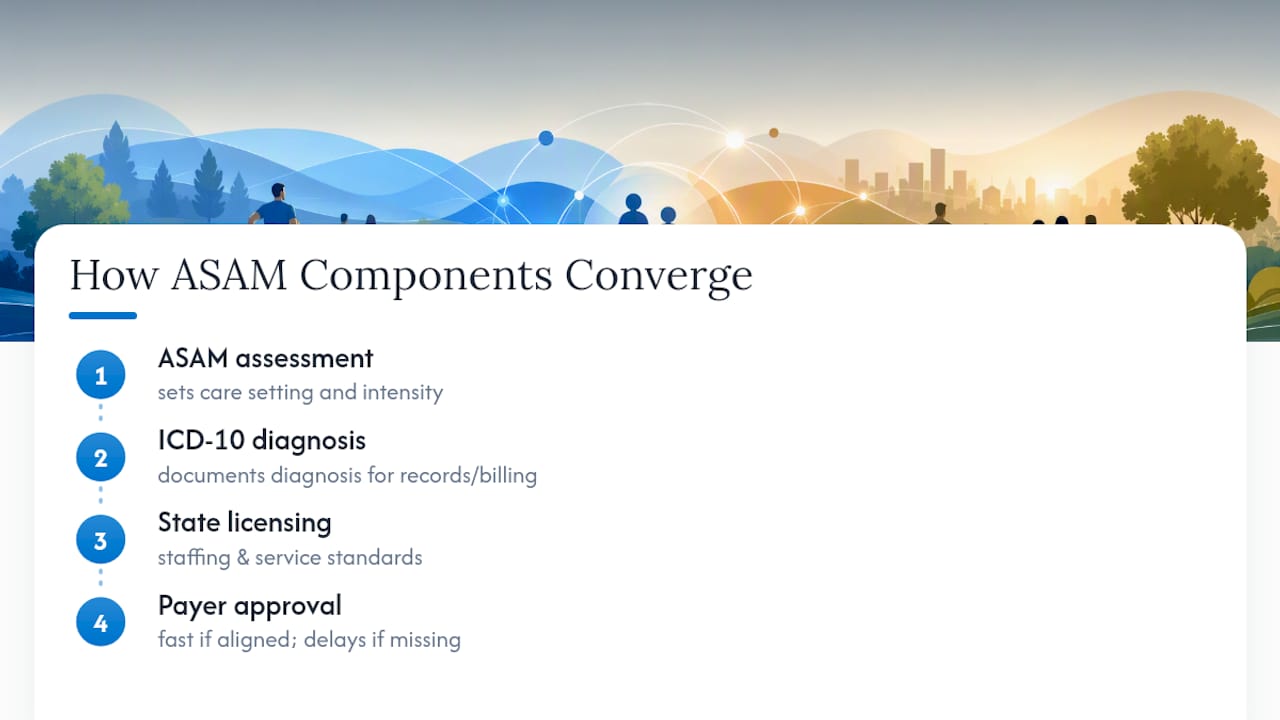
ASAM doesn’t operate in isolation. Clinicians pair the six-dimension assessment with ICD-10 diagnostic codes, since ASAM determines the setting and intensity of care while ICD codes document the underlying diagnosis for medical records and billing.
State regulations add another layer. Licensing bodies in states like California, where Sylmar Treatment Center operates, require facilities to meet defined staffing and service standards tied to the level of care they claim to provide, and state Medicaid programs increasingly reference ASAM criteria directly in their coverage policies. Colorado’s Medicaid agency, for example, has published its own Fourth Edition implementation summary for providers to follow.
Insurance authorization is where all of this converges. A payer typically wants to see the ASAM-based assessment, the corresponding ICD-10 diagnosis, and documentation that a facility is licensed to deliver the recommended level before approving a claim. When those three pieces line up, authorization moves faster. When they don’t, families often get stuck appealing a denial instead of starting treatment.
Why ASAM Is Harder to Implement Than It Looks on Paper
Reading the ASAM Criteria and applying them consistently in a real clinical setting are two different skills, and that gap causes more placement problems than the framework itself.
Training is the biggest barrier. Staff need real instruction in dimensional assessment, not just a manual on a shelf, and turnover in addiction treatment settings means that training has to happen continuously, not once. A counselor who never learned to properly weight a high-risk Dimension 1 score against a low-risk Dimension 5 score can misplace someone into a setting that’s either too restrictive or not safe enough.
Documentation adds friction too. Insurers expect detailed justification for every dimension score, and a rushed or vague assessment invites a denial regardless of whether the clinical judgment was sound. Programs that build structured intake processes, similar to the assessment approach outlined for detox evaluation, tend to produce cleaner documentation and fewer authorization delays.
Staffing ratios present a separate challenge. A program can score a person as needing Level 3.5 care, but if it doesn’t have enough credentialed staff on-site to deliver that intensity, the assessment becomes meaningless. Mental health assessment processes face a similar tension between clinical accuracy and practical resource limits, as Journey Mental Health explains in its overview of what a thorough evaluation actually requires.
Why Person-Centered Placement Actually Changes Outcomes
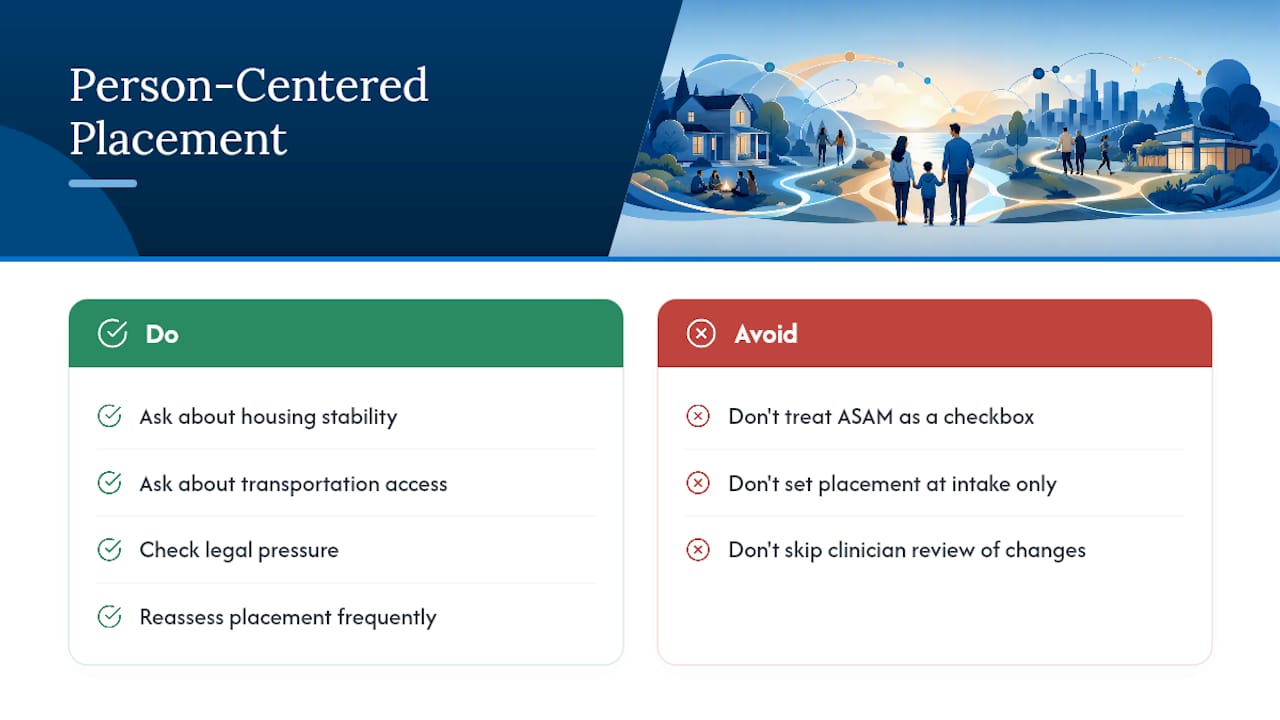
Dimension 6 isn’t a bureaucratic add-on. It forces programs to ask about housing, transportation, and legal pressure before assuming someone is ready for a lower level of care, and continuous reassessment means placement isn’t a one-time verdict handed down at intake.
Sylmar Treatment Center is DHCS licensed and Joint Commission accredited, runs 24/7 admissions, and builds individualized programs for co-occurring substance use and mental health conditions. Ask any intake team these questions: How do you score Dimension 6? How often do you reassess? Who reviews changes in condition? The answers tell you whether a program treats ASAM as a real clinical process or a checkbox.
— Jim
Getting an ASAM-Informed Assessment Started
One center runs its intake through a dimensional assessment, the same six-factor process the ASAM Criteria describes, rather than a quick intake form that guesses at what level someone needs. With a small number of beds, staff can revisit assessments as often as a person’s condition changes, instead of locking someone into a placement decided on day one.
If you’re calling for yourself or a family member, admissions is available 24/7, and it helps to have basic medical history, current medications, and any prior treatment records ready before you call. Sylmar’s individualized treatment programs cover medically supervised detox, residential care, and dual-diagnosis support for co-occurring mental health conditions, all within a DHCS-licensed, Joint Commission accredited setting. Call the admissions line or visit the programs page to start an assessment today.
Where to Verify This Yourself
Read the primary source directly: The ASAM Criteria, Fourth Edition and the official Level of Care assessment guide.
This article is general information, not a substitute for advice from a qualified doctor. Consult a qualified healthcare professional about your own circumstances before acting on anything here.