

Yes, delta 8 can cause a cannabis-like withdrawal syndrome, and treatment ranges from at-home support to medically supervised detox depending on severity. Most people who stop after moderate use recover with rest, hydration, and outpatient therapy. Heavy or long-term users, and anyone with severe psychiatric symptoms, often need closer clinical care. No medication is FDA-approved specifically for cannabis withdrawal, so treatment leans on symptom management and evidence-based counseling rather than a pill that fixes it.
TL;DR:
- Withdrawal severity varies based on the dose, duration, and quality of delta 8 use, with heavier, prolonged use causing more intense symptoms.
- Most symptoms peak between days 2 and 6 and typically subside within two to three weeks, though long-term users may experience lingering effects beyond that.
- Severe symptoms such as thoughts of self-harm, hallucinations, or inability to keep fluids down indicate a need for medical detox or emergency care.
- Supportive care, behavioral therapy, and supervised detox are the primary treatments, as no FDA-approved medication specifically treats delta 8 withdrawal.
- The underlying cause of withdrawal relates to receptor adaptation in the brain’s CB1 system, not a character flaw or weakness.
Table of Contents
- What Are the Common Delta 8 Withdrawal Symptoms?
- How Long Does Delta 8 Withdrawal Last?
- When Do You Need Medical Detox or Emergency Care?
- What Treatment Options Exist for Delta 8 Withdrawal?
- Are There Medications That Treat Delta 8 Withdrawal?
- How Can You Manage Symptoms Day to Day?
- What Happens During Medically Supervised Detox and Residential Care?
- How Do You Find Treatment and What Should You Ask?
- Why Does Quitting Delta 8 Cause Withdrawal in the First Place?
- Delta 8 vs Delta 9 Withdrawal: What’s the Real Difference?
- What Are the Long-Term Outcomes and Relapse Risks?
- A Clinical Perspective on Delta 8 Withdrawal
- Start Treatment With Sylmar Treatment Center
- Sources
What Are the Common Delta 8 Withdrawal Symptoms?
Delta 8 withdrawal symptoms look almost identical to standard cannabis withdrawal because both compounds act on the same CB1 receptors, just with different binding strength. The symptom list tends to include:
- Anxiety and irritability that can spike within the first day or two
- Depressed mood or a flat, joyless feeling
- Insomnia, restless sleep, or unusually vivid dreams
- Appetite changes, usually a drop but sometimes an increase
- Headaches, nausea, and sweating
- Strong, sometimes intrusive cravings
Severity depends heavily on what you were actually using. A person vaping high-potency delta 8 daily for months will feel this differently than someone who used a low-dose edible occasionally. Product quality matters too. Unregulated delta 8 items vary wildly in potency and purity, and that inconsistency can make withdrawal harder to predict from one batch to the next. Most of these symptoms are uncomfortable but not medically dangerous on their own. The distinction that matters is whether distress stays psychological or starts affecting your ability to eat, sleep, or think clearly for days on end.
How Long Does Delta 8 Withdrawal Last?
The timeline mirrors regular cannabis withdrawal closely enough that clinicians treat them the same way for planning purposes. According to a clinical review of cannabis withdrawal management, symptoms typically follow this pattern:
- Hours 24 to 48: Onset begins. Irritability, anxiety, and sleep trouble usually show up first.
- Days 2 through 6: Symptoms peak. This window is when cravings, nausea, and mood swings hit hardest.
- Weeks 2 to 3: Most acute symptoms fade noticeably, though sleep and mood can lag behind everything else.
- Beyond three weeks: Heavy or long-term users sometimes carry residual sleep disruption or low mood for weeks longer.
Several factors stretch this timeline. Heavy, daily use over months extends recovery. Using other substances alongside delta 8, alcohol especially, complicates the picture and often lengthens it. A co-occurring mental health condition like generalized anxiety disorder or major depression can also make symptoms linger or intensify. If you are three weeks out and still struggling as much as day three, that is a signal to reassess your care plan rather than wait it out.
When Do You Need Medical Detox or Emergency Care?
Most delta 8 withdrawal resolves without a hospital visit. But certain signs mean you should stop managing this alone.
Watch for these red flags:
- Thoughts of suicide or self-harm
- Signs of psychosis, including confusion or hallucinations
- Severe agitation you cannot calm down
- Inability to keep food or water down for more than a day
- Persistent, severe vomiting
- Signs you are also withdrawing from alcohol, benzodiazepines, or opioids
A co-occurring mental health diagnosis or use of multiple substances raises the stakes considerably. Someone withdrawing from delta 8 and a benzodiazepine at the same time, for instance, faces real physical risk that a healthy person quitting cannabis alone does not, which is why complex withdrawal situations usually call for direct medical oversight rather than a self-managed taper.
Pro Tip: If you are unsure whether what you’re feeling counts as an emergency, call a crisis line or your primary care provider first. Describing your symptoms out loud to a professional is often the fastest way to get a clear answer.
What Treatment Options Exist for Delta 8 Withdrawal?
Care generally falls into three tiers, and matching the right one to your situation matters more than picking the “strongest” option by default.
At-home supportive care works for people with mild to moderate symptoms and no safety concerns. This means hydration, consistent sleep habits, light exercise, and leaning on friends or family for a few rough days.
Outpatient behavioral therapy adds structure without requiring you to leave daily life behind. The most established approaches include:
- Cognitive behavioral therapy (CBT) to address thought patterns that drive cravings and anxiety
- Motivational enhancement therapy (MET) to build and sustain your own reasons for quitting
- Contingency management, which uses tangible incentives to reinforce abstinence
Medically supervised detox becomes the right call for heavy, long-term users or anyone with red-flag symptoms. This setting offers 24/7 monitoring, medication for acute symptoms when appropriate, and a direct handoff into residential or ongoing outpatient care once you’re stabilized. The tradeoff is obvious: it’s a bigger commitment of time and resources, but it removes the guesswork and risk that come with going it alone.
Are There Medications That Treat Delta 8 Withdrawal?
Here’s the honest answer nobody selling a quick fix wants to give you: there is no medication approved specifically to treat cannabis or delta 8 withdrawal. The same clinical review that maps the withdrawal timeline is explicit about this gap. That doesn’t mean anything helps.
What clinicians actually use:
- Sleep aids for short-term insomnia relief
- Anti-nausea medication for gastrointestinal symptoms
- Short, tightly supervised courses of benzodiazepines for severe anxiety, only in monitored settings given the risk of dependence
- Oral THC (dronabinol), studied in small trials to blunt withdrawal symptoms, with mixed and not consistently replicated results
Psychosocial treatment carries the strongest evidence base here, not medication. CBT, MET, and contingency management remain the front-line approach precisely because no drug has cleared the bar for cannabis-specific withdrawal. That gap is also why working with a clinician who can tailor symptom management to your specific presentation matters more than searching for a magic prescription.
How Can You Manage Symptoms Day to Day?
Getting through the peak days comes down to a handful of concrete habits, not willpower alone.
- Protect your sleep. Keep a fixed bedtime, cut screens an hour before bed, and avoid caffeine after noon.
- Regulate anxiety in the moment. Box breathing (four seconds in, hold four, out four) and short walks outside interrupt spiraling anxiety faster than most people expect.
- Plan for cravings before they hit. Remove triggers from your space, and have a specific distraction ready, like a phone call to a friend or a walk around the block.
- Keep eating, even if appetite drops. Smaller meals or smoothies go down easier than a full plate when nausea is part of the picture.
Beyond the basics, some behavioral strategies used for other withdrawal syndromes translate well here, particularly around sleep disruption and craving management.
Pro Tip: Write down your three worst hours of the day before they happen. Most people can predict when cravings or anxiety peak. Having a plan ready for that specific window beats reacting in the moment.
If none of this is working after several days, that’s the point to call a clinician rather than push through.
What Happens During Medically Supervised Detox and Residential Care?
Medically supervised detox means clinical staff monitor your vitals and mental state around the clock, adjust symptom management in real time, and catch complications before they escalate. Once symptoms stabilize, most programs transition patients directly into residential therapy so the underlying patterns behind the use don’t just resurface later.
A program of this kind is commonly run in a small, licensed, accredited facility designed to provide individualized care plans rather than one-size-fits-all protocols. That structure tends to benefit:
- Heavy or long-term users with intense withdrawal symptoms
- Anyone with a co-occurring mental health diagnosis alongside substance use
- People who tried outpatient care first and found it wasn’t enough
The medically supervised detox process generally includes a full clinical assessment before anything else, so treatment reflects the specific substance history and mental health picture in front of the clinician, not a generic checklist.
How Do You Find Treatment and What Should You Ask?
Start by stabilizing your immediate environment: remove the substance from easy reach, tell someone you trust what’s happening, and line up a call with a provider before symptoms peak.
When you contact a treatment provider, ask directly:
- Is there 24/7 medical oversight during detox?
- What therapy modalities do you offer after stabilization?
- Can you treat co-occurring mental health conditions alongside substance use?
- What does insurance cover, and what are the out-of-pocket costs?
- What’s the typical length of stay?
Bring identification, insurance information, and a list of current medications to intake. Most residential programs also offer family involvement options, since recovery tends to hold better when the people around you understand what the process actually looks like.
Why Does Quitting Delta 8 Cause Withdrawal in the First Place?
The mechanism comes down to receptor adaptation, not willpower or personality. Delta 8 binds to CB1 receptors in the brain and nervous system, the same receptors delta 9 THC activates, just with somewhat lower binding affinity. With regular use, your brain adjusts to a steady stream of that stimulation by dialing down its own natural cannabinoid signaling and adjusting receptor sensitivity.
When you stop, that adjusted system is suddenly running without the input it had adapted around. That mismatch is what produces the anxiety, irritability, and sleep disruption that define withdrawal. It’s not a character flaw or a sign of weak willpower. It’s neurochemistry catching up to a change you just made.
Preclinical research on delta 8 backs this up directly: animal studies show delta 8 produces measurable tolerance and dependence-consistent effects through CB1 activation, giving real biological weight to what many users describe anecdotally. This matters because delta 8 is frequently marketed as the gentler, “legal” alternative to regular cannabis. That framing has nothing to do with how the receptor responds. Frequency and dose drive dependence risk far more than which specific cannabinoid you’re using, and clinicians generally treat delta 8 withdrawal risk the same way they’d treat delta 9 withdrawal risk once use becomes regular.
Product inconsistency adds another layer. Because delta 8 products are largely unregulated, potency and purity vary between brands and even between batches, according to FDA consumer guidance. That variability can make withdrawal severity harder to predict than with a standardized cannabis product.
Delta 8 vs Delta 9 Withdrawal: What’s the Real Difference?
The withdrawal symptoms themselves overlap almost completely between delta 8 and delta 9 THC: anxiety, irritability, sleep disruption, appetite changes, and cravings show up with both. Both compounds hit the same CB1 receptor system, so the underlying biology driving withdrawal doesn’t meaningfully differ.
Where things diverge is potency and how people actually use each substance. Delta 9 tends to produce more intense intoxication per dose, which sometimes leads users toward lower total consumption relative to delta 8, though this varies enormously by product and individual habits. Delta 8’s reputation as “milder” pushes some people toward heavier, more frequent use because they assume the ceiling is lower, in turn increasing total CB1 exposure over time and potentially the withdrawal that follows. The marketing gap here matters clinically: a substance perceived as safer often gets used more, not less.
Legal status also shapes the picture in a practical, non-biological way. Delta 8’s murkier regulatory standing means product quality control is inconsistent across brands, which introduces variability in potency and contaminants that standard delta 9 cannabis products, at least in regulated markets, don’t carry to the same degree.
For treatment purposes, this distinction barely matters. Whether someone is withdrawing from delta 8, delta 9, or heavy use of both, the clinical approach is identical: supportive care, behavioral therapy, and medically supervised detox for severe or complicated cases. Providers don’t run a different protocol for delta 8 withdrawal specifically, because the receptor biology and symptom profile don’t call for one.
What Are the Long-Term Outcomes and Relapse Risks?
Most people who complete withdrawal and engage with structured treatment see steady improvement in mood, sleep, and cognitive clarity over the following months. The acute symptoms resolve within weeks for most users, but the behavioral patterns underneath the use, stress coping, social habits, sleep routines, take longer to rebuild and are what actually determine whether someone stays off delta 8 long-term.
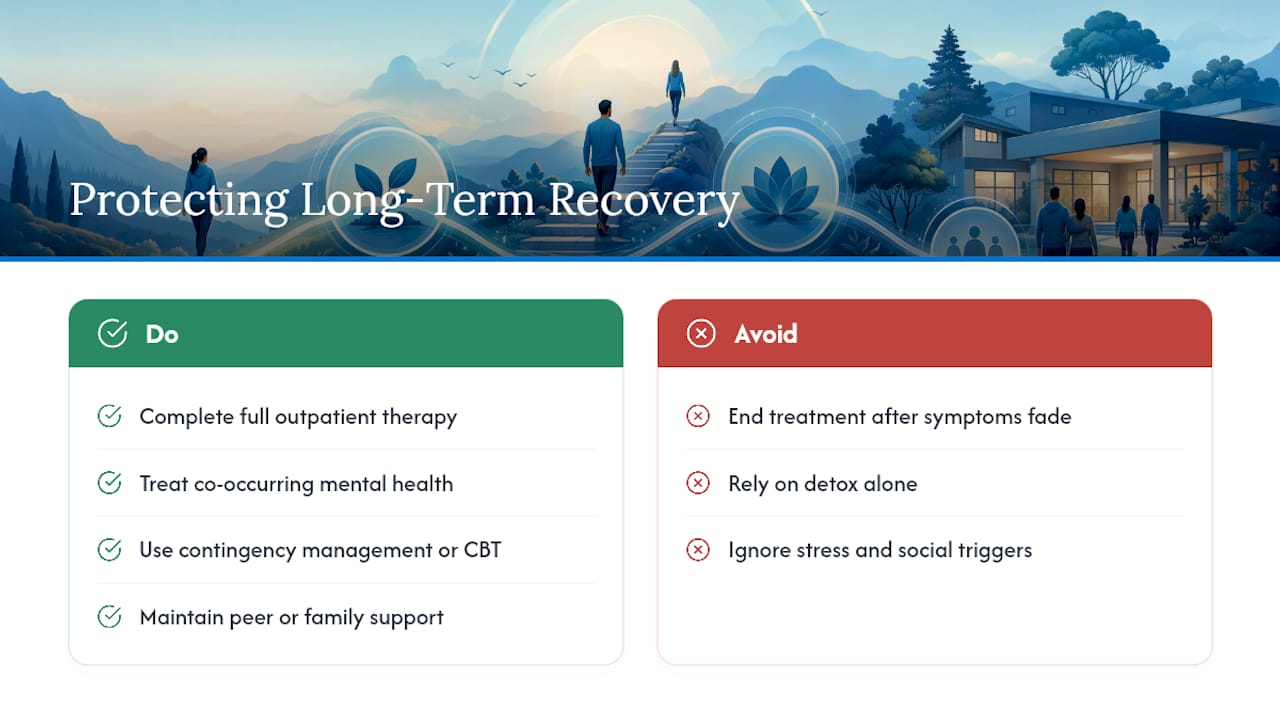
Relapse risk climbs during a few predictable windows: the first month after quitting, high-stress periods, and social situations where use was previously routine. Contingency management and CBT specifically target these patterns by building new coping responses and, in the case of contingency management, reinforcing abstinence with tangible incentives during the highest-risk stretch.
A few factors consistently predict better long-term outcomes. Completing a full course of outpatient therapy rather than stopping after symptoms fade matters. So does treating any co-occurring mental health condition alongside the substance use rather than in isolation, since untreated anxiety or depression is one of the most common relapse triggers. Ongoing peer or family support after formal treatment ends also correlates with sustained abstinence, largely because early recovery is when isolation does the most damage.
For heavy users who went through medically supervised detox, the transition into residential or intensive outpatient care is the piece that protects long-term gains. Detox alone stabilizes the body. It doesn’t rebuild the habits and support systems that prevent a return to use, which is why programs that bridge detox into structured follow-up therapy tend to see better outcomes than detox as a standalone event.
A Clinical Perspective on Delta 8 Withdrawal
What you’re feeling is real, not a personal failing. The biology behind it is well understood, and the path through it is well established. If symptoms feel bigger than you can manage alone, reaching out to a professional isn’t overreacting. It’s the right call.
— Jim
Start Treatment With Sylmar Treatment Center
If you’ve read this far, you already know the honest tradeoffs: at-home care works for mild cases, outpatient therapy helps most people build lasting change, and medically supervised detox exists for the cases where either isn’t enough on its own. Sylmar Treatment Center is built specifically for that last group, heavy users, people with co-occurring mental health conditions, and anyone who’s tried to quit before and hit a wall.
This treatment center is designed with a small bed count model, allowing care plans to be built around a patient’s history instead of a standardized track, and it holds relevant licensing and accreditation for quality assurance. Our dual diagnosis program addresses mental health conditions alongside substance use rather than treating them as separate problems, and our individualized treatment programs start with a full clinical assessment before anything else. Admissions support is often available around the clock, and family involvement may be welcomed throughout the process. If you’re ready to talk through options, contact Sylmar Treatment Center or review our full program offerings to see what fits your situation.
Sources
Key sources behind this article: a clinical review of cannabis withdrawal management, preclinical delta 8 dependence research, and FDA delta 8 consumer guidance, plus provider guidance on delta 8 dependence.
This article is general information, not a substitute for advice from a qualified doctor. Consult a qualified healthcare professional about your own circumstances before acting on anything here.
- Clinical management of cannabis withdrawal
- FDA — 5 things to know about delta‑8 tetrahydrocannabinol (delta‑8‑THC)