
Most treatment programs collect or restrict phones at admission, especially during detox, and restore access gradually as patients stabilize. Some residential programs move to scheduled, supervised phone time within days; outpatient care usually lets you keep your phone the whole time. Rules vary by facility, so ask directly during your admissions call, and treat the practical steps below as your prep list before you walk in.
TL;DR:
- Phone access during detox is typically restricted for 24 to 72 hours to minimize environmental triggers and ensure medical safety.
- Residential programs usually restore phone privileges based on clinical milestones rather than a fixed timeframe, often after stabilization.
- Outpatient and intensive outpatient programs generally allow clients to keep their phones throughout treatment, with guidelines for appropriate use during sessions.
- Families should prepare by establishing emergency contacts, automating bills, and arranging trusted individuals to hold or supervise devices before admission.
- Facilities justify restrictions to protect privacy, prevent contact with drug networks, and comply with privacy regulations like HIPAA, especially during group therapy.
Table of Contents
- Common Phone Policy Models at Treatment Centers
- How Phone Access Changes by Level of Care
- How Calls and Family Contact Actually Work
- Why Facilities Restrict Phones: Privacy, Safety, and Regulation
- What to Prepare Before You Hand Over Your Phone
- How Sylmar Treatment Center Handles Phone Access
- Where to Read More on Phone and Privacy Guidance
- What Most Advice on This Topic Gets Wrong
- Sources
Common Phone Policy Models at Treatment Centers
Ask five different treatment centers about phones in rehab and you’ll get five different answers, but the policies tend to cluster into a handful of recognizable models.
Full temporary collection is the most common approach during detox and early stabilization. Staff store your phone, sometimes alongside other personal electronics, and return it once you’ve cleared the initial medical risk window. This isn’t arbitrary. NIDA’s treatment research points to removing environmental triggers as a core part of early stabilization, and a phone is one of the most direct lines back to a using network.
Scheduled supervised phone periods come next for many residential programs. You might get 15 to 30 minutes daily, or a couple of set windows a week, often under staff supervision or in a common area.
Limited-access rules apply even once you have your phone back. No cameras during group sessions, no social media posting, no calls during clinical programming.
Open-access exceptions show up mostly in outpatient, intensive outpatient (IOP), and some higher-end residential settings, where clients live more independently and phones are treated as a normal part of daily function.
The clinical logic behind all of it is consistent:
- Reduce contact with people or environments tied to substance use
- Protect the privacy of other patients from unwanted photos or recordings
- Keep patients focused on group therapy and structured programming instead of outside distractions
- Prevent unsupervised communication that could pressure someone into leaving treatment early
None of these models is universal. A facility’s philosophy, its licensing requirements, and the acuity of the patients it treats all shape where it lands on this spectrum.
How Phone Access Changes by Level of Care
Phone privileges aren’t fixed. They shift as you move through the treatment continuum, and understanding that arc helps you set realistic expectations before you arrive.
Detox is the most restrictive phase, and for good reason. You’re medically vulnerable, potentially dealing with withdrawal symptoms, and the priority is physical safety, not connectivity. Holds of 24 to 72 hours are common, and some facilities extend that further depending on the substance and severity. Clinical guidance on early stabilization generally supports restricting phone access while the medical team assesses withdrawal risk.
Residential treatment typically phases access back in based on clinical milestones rather than a strict calendar. Programs often restore phone privileges as patients demonstrate consistent group attendance, clean drug screens, and stable engagement with treatment, not simply because a set number of days has passed.
Outpatient and IOP programs are the most permissive. Since you’re living at home or in a sober living environment and attending treatment for a few hours a day, phones stay in your pocket. Telehealth sessions may even replace some in-person visits, particularly for medication management or check-ins with a psychiatric provider.
A few patterns worth knowing before intake:
- Detox holds often run several days depending on the substance
- Residential programs commonly restore limited phone time after some stabilization period, tied to progress, not the calendar
- Outpatient and IOP clients generally keep phones throughout treatment, with facility guidance on appropriate use during sessions
If you’re weighing residential care against outpatient options, phone access is one of the more concrete differences between the two.
How Calls and Family Contact Actually Work
Families want to know how they’ll actually reach a loved one, and the mechanics are usually more structured than people expect.
- Approved contact lists come first. During intake, most programs ask patients to list approved contacts, often family members or a sponsor, who staff will allow calls with once phone privileges open up.
- Staff mediate early communication. In the first days of treatment, a case manager or counselor may facilitate a call rather than handing over a phone directly, particularly in detox.
- The facility mainline handles emergencies. Every accredited program has a main office number for urgent messages, and staff will relay time-sensitive information to the patient.
- Scheduled call windows and supervised video sessions replace unlimited access once a patient stabilizes, often a set time each day or a few days a week.
- Letters, in-person visits, and clinician-led family sessions fill the gaps. Family therapy sessions, sometimes conducted over telehealth when in-person visits aren’t feasible, are often more clinically valuable than casual phone calls anyway.
Before admission, tell your employer what to expect, arrange childcare or pet care in advance, and give one trusted contact the facility’s main line in case of a genuine emergency. That single step resolves most of the anxiety families feel about being “cut off.”
Why Facilities Restrict Phones: Privacy, Safety, and Regulation
The restrictions aren’t about control for its own sake. They’re built around real privacy and safety exposure that most people don’t think about until they’re sitting in an intake appointment.
Photos and social media are the most obvious risk. A phone in a group therapy room means every other patient in that room is exposed to being photographed or recorded without consent, which is a serious breach in a setting where anonymity often matters as much as the treatment itself.

Contact with using networks is the other major concern. A phone is the easiest way to reach a dealer, a using partner, or anyone who might talk a patient into leaving treatment early, which is precisely the kind of environmental trigger NIDA’s treatment guidance recommends limiting during stabilization.
Regulatory frameworks also shape how facilities handle any digital communication that does happen. When telehealth sessions, like a psychiatric check-in or a family therapy call, are involved, providers must follow HIPAA privacy safeguards around how those communications are protected and transmitted.
Pro Tip: If a facility wants to add a telehealth family session or a video call with your psychiatric provider, ask how that call is secured. A legitimate program will have a straightforward answer about the platform it uses, similar to how established telehealth platforms handle security and privacy features in outpatient behavioral health settings.
What to Prepare Before You Hand Over Your Phone
The days before admission are the best window to handle the loose ends that phone restrictions will otherwise leave dangling. A little preparation here saves a lot of stress once you’re inside.
- Set an out-of-office auto-reply on email and voicemail so people don’t assume you’ve disappeared
- Automate recurring bill payments so nothing lapses while you’re unreachable
- Write out emergency contacts on paper, including the facility’s main line, and give a copy to a trusted family member
- Decide whether a spouse, parent, or close friend will hold your phone, and label the device and charger clearly if you’re leaving them with someone
- Download music, podcasts, or audiobooks for offline listening if the program allows personal media players
- Print essential documents: insurance cards, employer contact information, medication lists
- Ask admissions directly how devices are stored, when they’re returned, and how family members should reach you in an emergency
Pro Tip: Bring your own charger if the facility allows it. Staff rarely have spares on hand, and a dead phone sitting in a storage bin does nothing for anyone once you get it back.
Reviewing detox and treatment expectations with your family ahead of time also helps everyone agree on who handles what while you’re focused on treatment.
How Sylmar Treatment Center Handles Phone Access
Sylmar Treatment Center ties phone privileges to medical stabilization and clinical progress rather than a one-size-fits-all rule. Because the program operates as a six-bed residential setting, staff can supervise communication closely and adjust access to each patient’s specific situation rather than applying a blanket policy across a large population.
Sylmar holds a DHCS license and Joint Commission accreditation, which means its intake, storage, and privacy procedures meet standards reviewed by outside regulators, not just internal policy.
What this looks like in practice:
- Devices are stored securely at intake, with a clear return schedule discussed during admission
- Urgent family contact goes through the facility’s main line, with staff relaying time-sensitive messages promptly
- Telehealth is used when clinically appropriate, such as psychiatric follow-ups, under the same privacy safeguards outlined in federal telehealth guidance
- Individualized treatment planning means phone access is reassessed as part of each patient’s personalized care plan
- Admissions support is available 24/7 for families with questions before intake
| What families ask | How Sylmar approaches it |
|---|---|
| Will my phone be taken away? | Typically stored during initial stabilization, returned on a phased schedule |
| How do I reach my loved one? | Through the facility’s main contact line for urgent matters |
| Are there exceptions for work or legal needs? | Reviewed individually, including for court-directed placements |
| What if psychiatric care is involved? | Telehealth may supplement in-person care under standard privacy protections |
Where to Read More on Phone and Privacy Guidance
If you want the original guidance behind these policies rather than a summary, these are the primary sources worth reading directly.
- SAMHSA’s evidence-based resource guide on telehealth for SMI and SUD covers implementation and privacy standards for remote care.
- HHS’s HIPAA privacy rule for professionals explains how electronic health communications must be protected.
- NIDA’s treatment research covers the clinical rationale for reducing exposure to triggers during early recovery.
What Most Advice on This Topic Gets Wrong
Most articles on this subject treat phone restrictions like an inconvenience to be tolerated, a hoop to jump through before “real” recovery starts. That framing misses the point. The restriction isn’t the treatment getting in the way of your life. For the first days or weeks, it often is the treatment, because it removes the single easiest path back to the people and habits that made stabilization necessary in the first place.
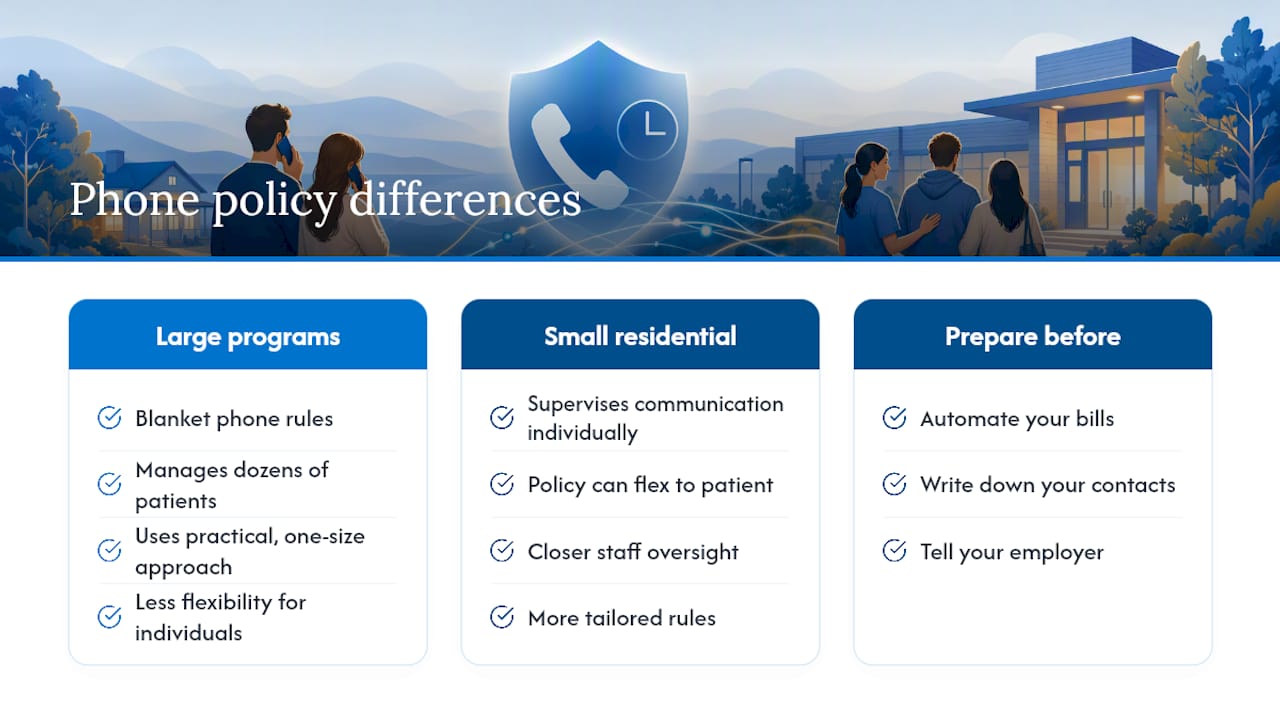
Where conventional advice falls short is in treating every facility as though it runs the same playbook. It doesn’t. A 200-bed program managing dozens of patients at once has to rely on blanket rules for practical reasons. A smaller residential setting can supervise communication individually, which means the policy can flex to the patient rather than the other way around.
If you’re preparing for admission, prioritize the boring logistics first: automate your bills, write down your contacts, tell your employer. The phone policy will sort itself out once you’re inside. Your obligations back home won’t sort themselves out unless you handle them now.
— Jim
This article is general information, not a substitute for advice from a qualified doctor. Consult a qualified healthcare professional about your own circumstances before acting on anything here.
Sources
- SAMHSA: Evidence-based resource guide — telehealth for SMI and SUD
- Technology-based interventions and telehealth in behavioral health (SAMHSA TIP content)
- SAMHSA: Telehealth implementation guide and evidence summaries
- HHS: HIPAA privacy rule — for professionals
- NIDA: Treatment research topics