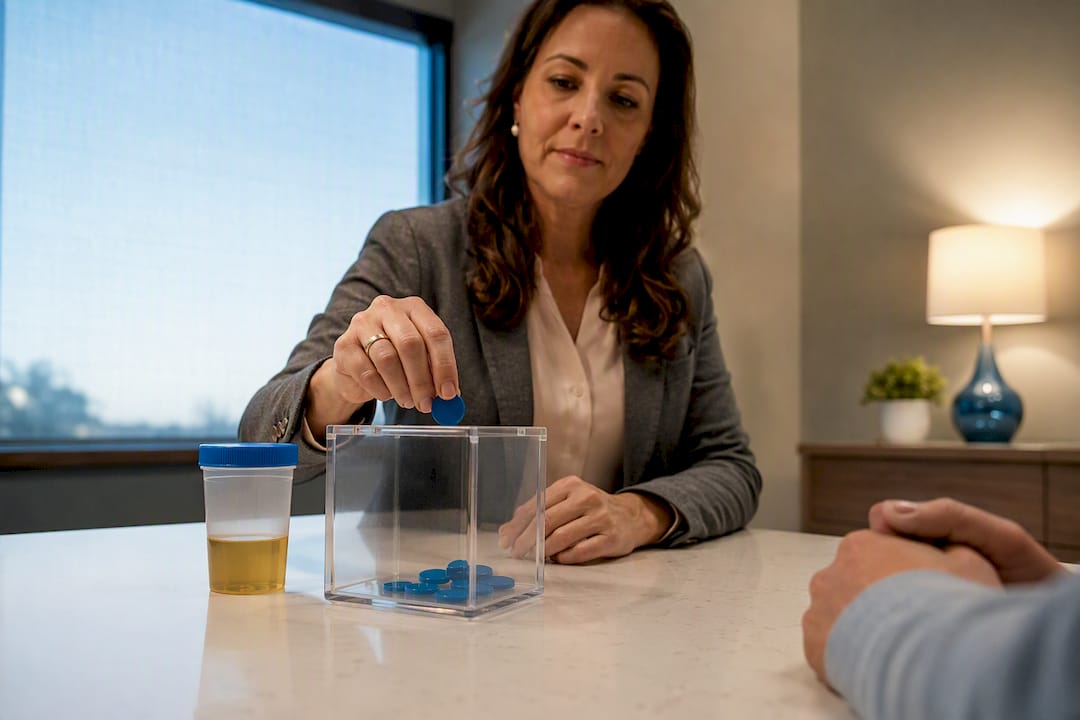
Contingency management is the most effective single treatment for stimulant use disorder, and it works best paired with cognitive behavioral therapy, the community reinforcement approach, or motivational interviewing. No medication has FDA approval for this condition, though specialists sometimes prescribe off-label options under close monitoring. If someone shows signs of chest pain, severe agitation, hyperthermia, or psychosis during stimulant use, that requires emergency medical care immediately, not a scheduled appointment.
TL;DR:
- Contingency management consistently improves retention and short-term abstinence, especially when combined with behavioral therapies like CBT or CRA.
- No FDA-approved medications exist for stimulant use disorder, but specialists may prescribe off-label treatments like modafinil or methylphenidate under close supervision.
- Immediate medical attention is required for severe symptoms such as chest pain, hyperthermia, psychosis, or seizures, rather than waiting for scheduled care.
- Treatment success relies on integrated approaches that address co-occurring mental health conditions and provide social support, rather than isolated therapy or detox.
- Outpatient, intensive outpatient, and residential care are matched to the severity of use, with residential programs offering the highest oversight for complex cases.
Table of Contents
- What Do the Clinical Guidelines Say About Stimulant Use Disorder Treatment?
- Which Behavioral Therapies Work Best for Stimulant Recovery?
- Is There a Medication for Stimulant Addiction?
- What Are the Warning Signs of Stimulant Intoxication and Withdrawal?
- What Level of Care Do You Actually Need?
- Why Integrated and Harm Reduction Approaches Matter
- How Do You Get Started With Treatment?
- How Sylmar Treatment Center Puts Evidence-Based Care Into Practice
- What I Think Matters Most in Recovery From Stimulant Use
- Get Evidence-Based Treatment for Stimulant Use Disorder at Sylmar Treatment Center
- Where to Go for the Original Clinical Guidance
- Sources
What Do the Clinical Guidelines Say About Stimulant Use Disorder Treatment?
Three sources anchor almost everything reputable clinicians recommend for stimulant use disorder treatment, and they largely agree with each other, which is rarer than you’d think in addiction medicine.
The ASAM/AAAP Clinical Practice Guideline on the Management of Stimulant Use Disorder names contingency management as the primary recommended treatment, backed by a high-certainty, strong recommendation. It pairs CM with conditional or moderate recommendations for CRA and CBT, meaning those therapies help but the evidence supporting them alone isn’t as strong. The guideline also addresses acute care, recommending urgent medical response for severe intoxication, and it permits off-label pharmacotherapy only under specialist supervision.
Treatment of Stimulant Use Disorders (SAMHSA TIP 33) takes a more operational angle. It endorses the same four psychosocial practices, contingency management, CBT, CRA, and motivational interviewing, but focuses on how programs actually deliver them: staff training, incentive structures, session frequency, and integration with mental health care for people who have both conditions.
Systematic reviews fill in the effect sizes. The NCBI Bookshelf chapter summarizing stimulant treatment evidence finds psychosocial treatments reduce dropout with high certainty, and CM shows the most consistent effect among all approaches tested. A Cochrane review of psychosocial interventions for stimulant use disorder backs this up but adds an important caveat: while dropout reduction is well established, evidence for sustained, continuous abstinence over the long term stays limited.
What does “evidence certainty” mean if you’re the one entering treatment? A few things worth knowing:
- High-certainty findings (like CM’s effect on retention) mean you can expect similar results in most well-run programs.
- Moderate or conditional recommendations (CBT, CRA) still work, but individual results vary more.
- Limited long-term abstinence data doesn’t mean these treatments fail. It means recovery usually requires ongoing support well past initial treatment, not a single course of therapy.
That last point matters more than most articles admit. Nobody claims these therapies cure stimulant use disorder in twelve weeks. They build the skills and incentive structures that make long-term recovery achievable.
Which Behavioral Therapies Work Best for Stimulant Recovery?
Behavioral treatment is the backbone of stimulant addiction recovery, not a supplement to it. Here’s how the major approaches actually function in a clinical setting.
1. Contingency management (CM). Patients earn tangible rewards, vouchers, prize draws, or small cash-equivalent incentives, for objectively verified drug-negative urine tests. It sounds almost too simple to work, and that’s exactly why so many clinicians doubted it for years. But the incentive structure directly counters something stimulants do to the brain: they hijack reward processing so that immediate use outweighs long-term goals. CM answers that by making abstinence immediately rewarding too. Programs typically run CM protocols for a few months, with escalating rewards for consecutive negative tests and a reset if a test comes back positive.
2. Cognitive behavioral therapy and relapse prevention. CBT for stimulant use disorder usually runs multiple weekly sessions, teaching patients to identify triggers, high-risk situations, and the automatic thoughts that precede use. Relapse prevention, often taught alongside CBT, focuses on specific coping plans for cravings and lapses. The limitation is dosage: CBT’s benefits depend heavily on how consistently a patient attends and practices skills outside session, which is part of why guidelines rank it below CM for standalone certainty.
3. Community reinforcement approach (CRA) and the Matrix Model. CRA rebuilds a person’s environment so that sober living carries more reinforcement than drug use does. That means vocational counseling, relationship and family sessions, and structured recreational activities that don’t revolve around substances. The Matrix Model, often used specifically for stimulant treatment, bundles CRA principles with group therapy, family education, and individual counseling into a coordinated program, typically lasting several months. Clinics lean on CRA when a patient’s home or work environment is actively working against recovery.
4. Motivational interviewing (MI). MI isn’t a standalone treatment so much as a communication style clinicians use to strengthen a patient’s own motivation to change, particularly useful at intake, when ambivalence about quitting is highest, or after a lapse. Brief MI sessions can shift someone from “maybe I should cut back” to actively engaging with a CM or CBT program.
Most effective stimulant use therapy options combine at least two of these. A typical structure: CM for the first 12 weeks to establish abstinence and build momentum, CBT running concurrently to build coping skills, and CRA introduced once basic stability is in place to reinforce the changes long-term. Clinicians report that adding CM to CBT or CRA often improves short-term abstinence and retention because the immediate incentives keep engaging patients who would otherwise drop out early, exactly the population most likely to leave treatment prematurely.
Pro Tip: Ask any program you’re considering how they structure their CM incentives and how long the protocol runs. A vague answer, or no CM offered at all, is a real gap given how strongly the evidence favors it.
Is There a Medication for Stimulant Addiction?
No medication currently holds FDA approval specifically for stimulant use disorder. That single fact surprises a lot of people who assume pharmacotherapy exists for every addiction the way it does for opioid or alcohol use disorder. It doesn’t, at least not yet.
Researchers have trialed several medications, and a systematic review of reviews on stimulant use disorder treatment summarizes where the evidence currently stands:
- Modafinil shows mixed trial results, with some signal for reducing use in cocaine use disorder specifically, but not consistent enough for broad recommendation.
- Long-acting methylphenidate has been studied mainly in patients with co-occurring ADHD, where treating the underlying condition can indirectly support recovery.
- Topiramate combined with extended-release mixed amphetamine salts (MAS-ER) has shown some promise in trials, though the combination requires careful specialist oversight given the stimulant component.
- Bupropion has modest evidence, mostly for milder patterns of stimulant use rather than severe dependence.
- Mirtazapine has shown some effect on methamphetamine use in limited trials, though evidence remains preliminary.
- Antipsychotics are sometimes used for stimulant-induced psychotic symptoms rather than as a treatment for the underlying use disorder itself.
None of these carry high-certainty evidence. That’s an important distinction from saying they don’t work at all. It means the research base is thinner and more mixed than what backs contingency management, so any use of these medications belongs in the hands of a specialist who can weigh the individual case carefully.
The ASAM/AAAP guideline is explicit about this: off-label pharmacotherapy, when used, requires enhanced monitoring. That includes checking state prescription drug monitoring programs (PDMPs), doing regular pill counts for controlled substances like psychostimulants, and watching for cardiovascular effects, since many of these agents affect heart rate and blood pressure. Medication management with psychiatric oversight exists precisely because this kind of prescribing carries real risk if it isn’t supervised closely.
Who’s typically considered for medication? Mainly people with a co-occurring diagnosis like ADHD, where treating that condition supports recovery from stimulant use, or patients with severe, treatment-resistant patterns where a specialist judges the potential benefit worth the monitoring burden. In every case, medication supplements behavioral therapy. It doesn’t replace it.
What Are the Warning Signs of Stimulant Intoxication and Withdrawal?
Stimulant intoxication can turn dangerous fast, and knowing the difference between “uncomfortable” and “emergency” saves lives. The signs that mean you need immediate medical attention, not a phone call to a therapist tomorrow, include:
- Chest pain or a racing, irregular heartbeat
- Severe agitation or aggression that seems out of control
- Hyperthermia (dangerously elevated body temperature)
- Psychosis, including paranoia, hallucinations, or disorganized thinking
- Seizures
These symptoms reflect a hyperadrenergic state, the body flooded with stimulant-driven adrenaline-like activity, and they can precede stroke, cardiac events, or seizure. ASAM/AAAP guidance names benzodiazepines and other GABAergic agents as the first-line clinical response for this kind of severe agitation, because they calm the nervous system’s overdrive directly. When psychosis is severe and doesn’t resolve with sedation alone, antipsychotics may be added.
Anyone showing these signs needs transfer to an emergency department or a facility capable of medical monitoring immediately. This isn’t something to manage at home or wait out.
Withdrawal, once acute intoxication passes, looks different: fatigue, low mood or depression, increased appetite, vivid or disturbing dreams, and intense cravings. It’s rarely medically dangerous the way alcohol or benzodiazepine withdrawal can be, but the depressive symptoms and craving intensity are exactly why relapse risk peaks in the first days after stopping. Supportive care, rest, hydration, monitoring for suicidal ideation, and a fast transition into structured treatment, matters most here. The gap between “the drug wears off” and “the person starts real treatment” is where a lot of relapses happen, which is part of why medically supervised detox exists as a bridge rather than a standalone fix.
What Level of Care Do You Actually Need?
Matching the setting to the clinical picture is one of the most consequential decisions in this whole process, and people often get it wrong in both directions, choosing something too light for a severe pattern of use or something more intensive than necessary.
- Outpatient treatment works for people who are medically stable, have a supportive home environment, and can attend scheduled sessions (often CM plus weekly CBT) while continuing work or school.
- Intensive outpatient programs (IOP) step up the frequency, often several hours a day, multiple days a week, for people who need more structure than standard outpatient but don’t require 24/7 supervision.
- Residential treatment provides around-the-clock medical oversight, structured therapy, and case management for people with more severe patterns of use, unstable living situations, or safety concerns that make outpatient care too risky.
- Medically supervised detox comes first when someone is acutely intoxicated, in withdrawal, or has co-occurring conditions that need stabilization before therapy can be productive.
The clinical indicators that push someone toward a higher level of care include medical instability, a co-occurring psychiatric diagnosis, an unsafe or unstable housing situation, or a track record of relapsing quickly after outpatient attempts. Residential settings matter especially for people who’ve tried outpatient care multiple times without success, since the 24/7 structure removes access to substances during the highest-risk early weeks.
Telemedicine and digital behavioral tools have a role too, mainly as an add-on that extends access between sessions or bridges a gap while someone waits for an opening in a program. They shouldn’t substitute for in-person evidence-based therapy when that level of care is available and needed.
Why Integrated and Harm Reduction Approaches Matter
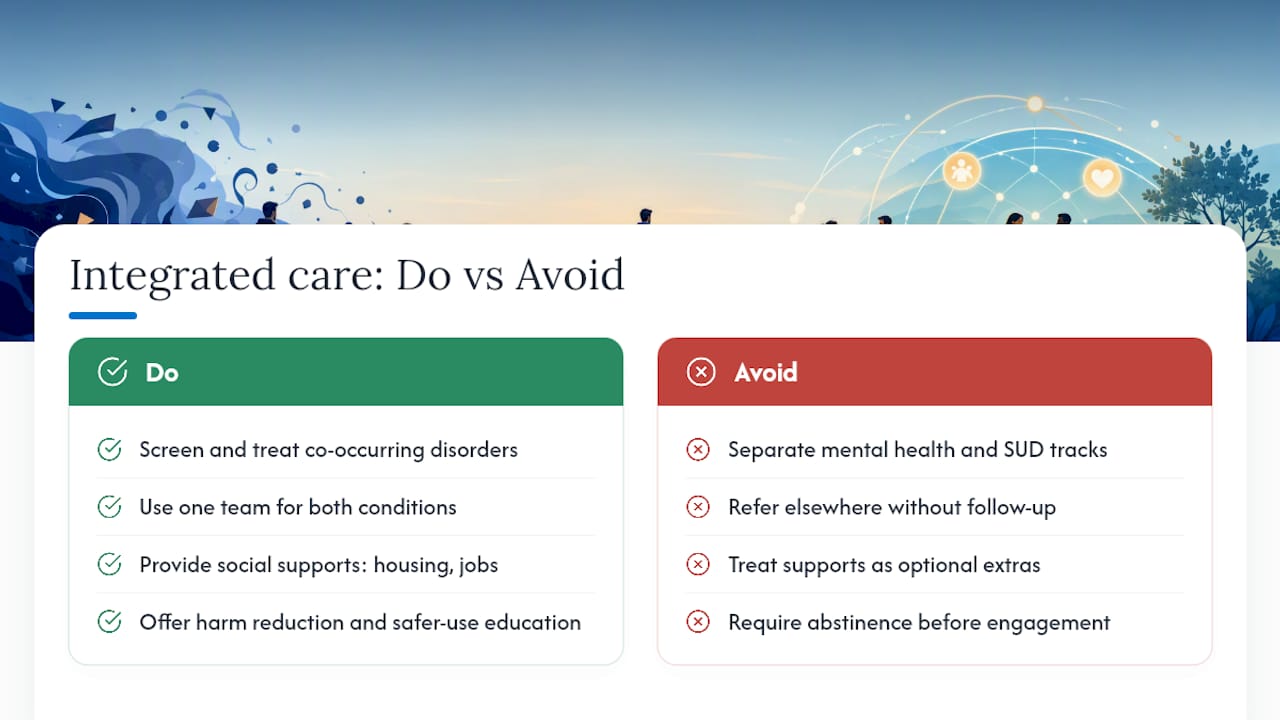
Treating stimulant use disorder in isolation, ignoring a co-occurring depression diagnosis, an unstable housing situation, or unmanaged risk behaviors, sets people up to relapse. ASAM/AAAP and clinicians in the field are consistent on this point: screening for and treating co-occurring disorders concurrently, not sequentially, changes outcomes.
Integrated psychiatric care. Anxiety, depression, PTSD, and bipolar disorder show up frequently alongside stimulant use disorder, sometimes as a cause, sometimes as a consequence. Integrated treatment for co-occurring disorders means the same clinical team addresses both conditions together instead of referring a patient elsewhere for “the other problem,” which too often means neither gets treated well.
Social supports. Case management, help finding stable housing, and vocational services aren’t extras bolted onto real treatment. They’re often what determines whether someone stays in treatment long enough for CM or CBT to work. A person cycling between unstable housing situations has little bandwidth for therapy homework.
Harm reduction. For people not yet ready for full abstinence, or as a bridge while entering treatment, harm reduction includes safer-use education, overdose risk awareness, and addressing the downstream physical effects of stimulant addiction, dental damage, malnutrition, and skin infections common with methamphetamine use, in particular. For anyone using stimulants by injection, reducing infection risk is its own urgent priority.
Peer support. Mutual-help groups and 12-step programs adapted for stimulant use, along with general recovery communities, give people ongoing structure and accountability long after formal treatment ends, which matters given how much relapse risk persists years into recovery.
Pro Tip: If a program treats your mental health diagnosis and your substance use as two separate tracks with two separate teams, ask why. Fragmented care is one of the most common, and most fixable, reasons people don’t stay in treatment.
How Do You Get Started With Treatment?
Getting from “I think I need help” to actually being in effective care involves a few concrete steps, and knowing what to ask upfront saves time and disappointment later.
- Ask direct questions about program structure. Does the program offer contingency management? How does it handle dual diagnosis if you have a co-occurring mental health condition? What monitoring protocol exists if medication is part of your plan? Is the facility licensed and accredited?
- Expect a thorough initial assessment. A real intake includes a medical exam, a psychiatric screening, lab work, and urine drug testing, not just a conversation and a signature.
- Set concrete short and medium-term goals. Track things you can actually measure: attendance at scheduled sessions, consecutive negative drug tests, and improvements in sleep, work functioning, or relationships, rather than vague notions of “feeling better.”
- Verify insurance and ask about privacy upfront. Confirm what your coverage pays for before you commit, and ask directly how the program handles confidentiality, including any criminal-justice reporting obligations if your case involves a court referral.
None of this needs to feel like an interrogation. A program confident in its own model will answer these questions plainly and quickly.
How Sylmar Treatment Center Puts Evidence-Based Care Into Practice
Guidelines are only useful if a real program actually implements them. Sylmar Treatment Center runs on a six-bed model specifically because smaller settings make it possible to deliver the individualized attention that contingency management, integrated psychiatric care, and careful medication monitoring all require. Staff can track a patient’s progress closely, adjust incentive structures in CM protocols, and catch warning signs early, the kind of attention that’s harder to sustain in a larger facility.
The center holds a DHCS license and Joint Commission accreditation, two markers that indicate the clinical practices, safety protocols, and oversight structures meet established standards, not just marketing language.
Every admission starts with a comprehensive assessment, medical, psychiatric, and substance use history, that shapes an individualized care plan rather than a one-size-fits-all track. For patients with co-occurring conditions, dual diagnosis support runs concurrently with substance use treatment, not as an afterthought. When medication is appropriate, psychiatric oversight governs prescribing and monitoring throughout.
Admissions support runs 24/7, so reaching someone with questions about program fit or intake steps doesn’t depend on business hours.
What I Think Matters Most in Recovery From Stimulant Use
Recovery from stimulant use disorder is rarely a straight line, and treating it like a 30-day fix sets people up to feel like failures when cravings resurface eight months later. That’s not relapse of the treatment; it’s the expected shape of recovery from a condition that rewires reward processing.
What separates programs that actually help from ones that just look good on paper is whether they combine contingency management with real integrated mental health care, not one or the other. And recovery goes further when family stays involved and support doesn’t disappear the day formal treatment ends.
— Jim
Get Evidence-Based Treatment for Stimulant Use Disorder at Sylmar Treatment Center
If you’ve made it this far, you already know contingency management, integrated psychiatric care, and careful medical oversight are what separate effective stimulant use disorder treatment from programs that just check boxes. Sylmar Treatment Center is built around delivering exactly that, in a six-bed setting small enough that your care plan actually reflects your specific history rather than a generic protocol.
The center offers medically supervised detox, residential care, and individualized treatment programs that combine behavioral therapy with dual diagnosis support for anyone facing a co-occurring mental health condition alongside stimulant use. Medication management, when appropriate, runs under direct psychiatric oversight with the monitoring that off-label prescribing requires. The DHCS license and Joint Commission accreditation back every piece of that structure.
If you or someone you love is showing signs of acute intoxication, chest pain, severe agitation, hyperthermia, don’t wait for an appointment; go to an emergency room. For everything else, admissions support is available 24/7 to answer questions, verify insurance, and walk through what intake looks like. Explore Sylmar’s treatment programs or reach out directly to start that conversation today.
Where to Go for the Original Clinical Guidance
For readers who want the source documents themselves: the ASAM/AAAP Clinical Practice Guideline lays out formal treatment recommendations and certainty levels; SAMHSA’s TIP 33 offers program-level implementation detail; and the NCBI evidence summary and Cochrane review provide the underlying research base. Clinicians and program administrators will find these especially useful for implementation detail. For a broader look at how one addiction treatment provider structures its clinical services, see Diamond Wellness’s addiction treatment program.
This article is general information, not a substitute for advice from a qualified doctor. Consult a qualified healthcare professional about your own circumstances before acting on anything here.
Sources
- The ASAM/AAAP Clinical Practice Guideline on the Management of Stimulant Use Disorder
- Treatment of Stimulant Use Disorders (SAMHSA TIP 33)
- Treatment for Stimulant Use Disorders (NCBI Bookshelf / TIP33 chapter)
- Cochrane review: Psychosocial interventions for stimulant use disorder