

Detox length by substance ranges from a few days to several weeks: alcohol and short-acting opioids typically clear acute withdrawal in 2 to 10 days, long-acting opioids and benzodiazepines can take 10 days to several weeks, and stimulant or cannabis withdrawal often lingers psychologically long after the physical symptoms fade. Individual physiology, dose, polysubstance use, and underlying health conditions all shift these windows, and some substances, especially alcohol and benzodiazepines, carry real medical risk without supervision.
TL;DR:
- Detox timelines vary widely based on substance half-life, dose, and individual health, with alcohol typically resolving within 2 to 10 days and long-acting opioids taking 10 or more days.
- Polysubstance use and age-related health conditions can significantly extend detox duration and complicate symptom management, necessitating individualized medical oversight.
- Severe withdrawal risks like seizures, delirium tremens, or dehydration require urgent medical care and almost always call for supervised detox, especially with alcohol, benzodiazepines, or opioids.
- Detox only addresses physical withdrawal; psychological symptoms like cravings and mood swings often last weeks or months and demand ongoing therapy or support after physical stabilization.
- Most medically supervised detox programs last 3 to 10 days but are tailored to each person’s substance history and health, with longer protocols for complex or heavy dependence cases.
Table of Contents
- Detox Length by Substance: Acute Withdrawal vs. Post-Acute Symptoms
- What Changes How Long Detox Takes
- How Long Detox Takes for Each Major Substance
- Why Polysubstance Use and Certain Health Conditions Stretch Detox
- When Detox Needs Medical Supervision
- How Sylmar Treatment Center Approaches Individualized Detox Timing
- Detox Is the Starting Line, Not the Finish
- Getting Help: Medical Detox and What Comes Next at Sylmar
- Sources
- FAQ
Detox Length by Substance: Acute Withdrawal vs. Post-Acute Symptoms
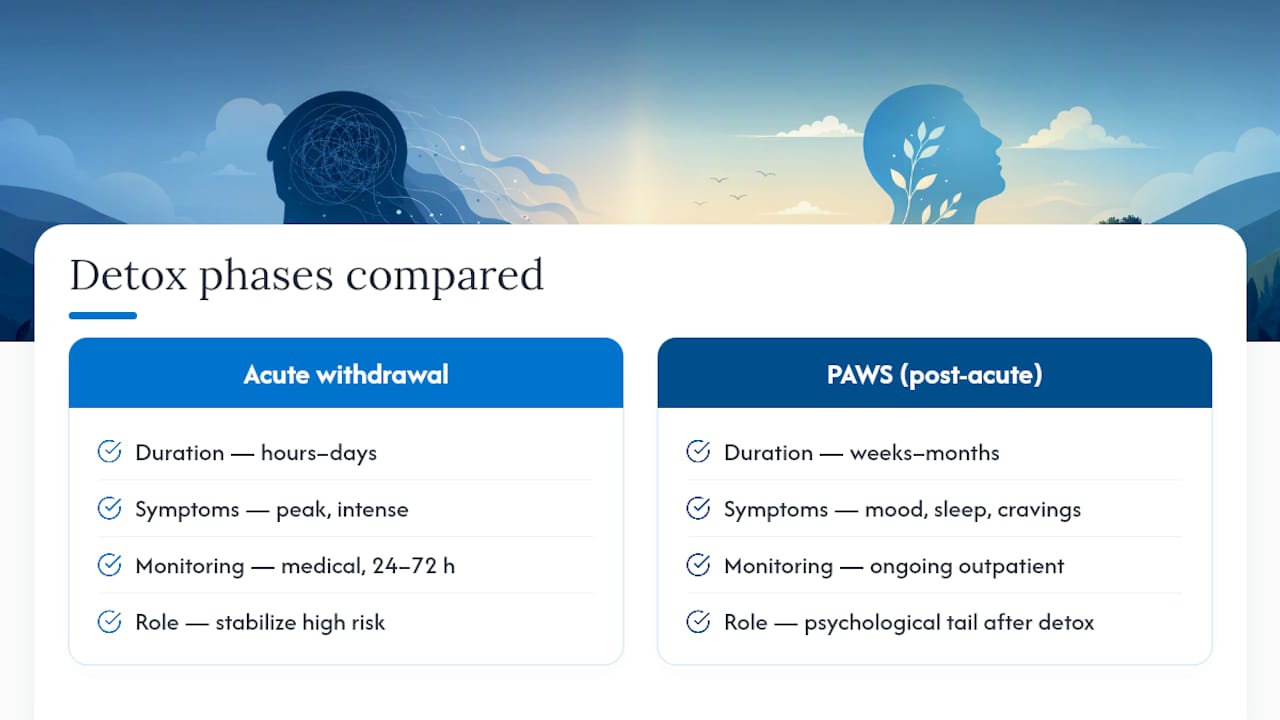
“How long does detox take” doesn’t have one answer because it isn’t one question. There’s the physical elimination of a substance from your body, the acute withdrawal period when symptoms peak, and then a longer psychological tail that clinicians call post-acute withdrawal syndrome, or PAWS.
Detoxification, in the clinical sense, means clearing a substance from the body while managing the physical symptoms that come with it. Acute withdrawal is the intense, medically monitored phase, the hours and days when your nervous system reacts most sharply to the absence of a drug it adapted to. PAWS is different. It’s the drawn-out stretch of mood swings, sleep disruption, cravings, and cognitive fog that can persist for weeks or months after the body has technically stabilized.
This distinction matters for anyone planning treatment. A medically supervised detox program is built around the acute phase, getting a patient through the highest-risk window safely, with medication support if needed. It is not designed to resolve PAWS, which is why detox alone rarely counts as complete addiction treatment. Programs typically front-load stabilization, meaning the first 24 to 72 hours often carry the most intensive monitoring, before symptoms plateau and begin to decline.
What Changes How Long Detox Takes
Two people using the same substance can have wildly different withdrawal timelines, and the reason usually comes down to a handful of measurable factors.
A drug’s half-life is the biggest lever. Short-acting substances leave the body fast and tend to trigger sharper, quicker withdrawal; long-acting substances linger, which delays onset but stretches out the tail end of symptoms. Dose, frequency, and route of use compound this: someone injecting a high daily dose for years faces a longer, more intense timeline than an occasional low-dose user.
- Half-life and formulation: short-acting drugs hit harder and faster; long-acting formulations delay onset but extend total duration.
- Dose, frequency, and route: higher and more frequent use generally means longer, more severe withdrawal.
- Age and organ function: slower liver or kidney clearance, common with age or chronic illness, extends how long a substance stays active in the system.
- Polysubstance use: overlapping withdrawal syndromes from multiple drugs can mask or intensify each other’s symptoms.
- Co-occurring mental health conditions and other medications: these can amplify withdrawal symptoms or complicate which medications are safe to use during treatment.
Pro Tip: If you’re trying to estimate your own timeline, don’t just think about the substance. Think about how long you’ve used it, how much, and what else is going on with your health. Those variables often matter more than the drug itself.
Individual physiology, chronic health conditions, and polysubstance use are consistently cited as major determinants of detox duration, which is why clinical guidance points toward individualized monitoring rather than a fixed number of days for every patient.
How Long Detox Takes for Each Major Substance
Here’s where the ranges get specific. These numbers describe typical acute withdrawal, not the full recovery timeline, and they assume no serious complicating factors.
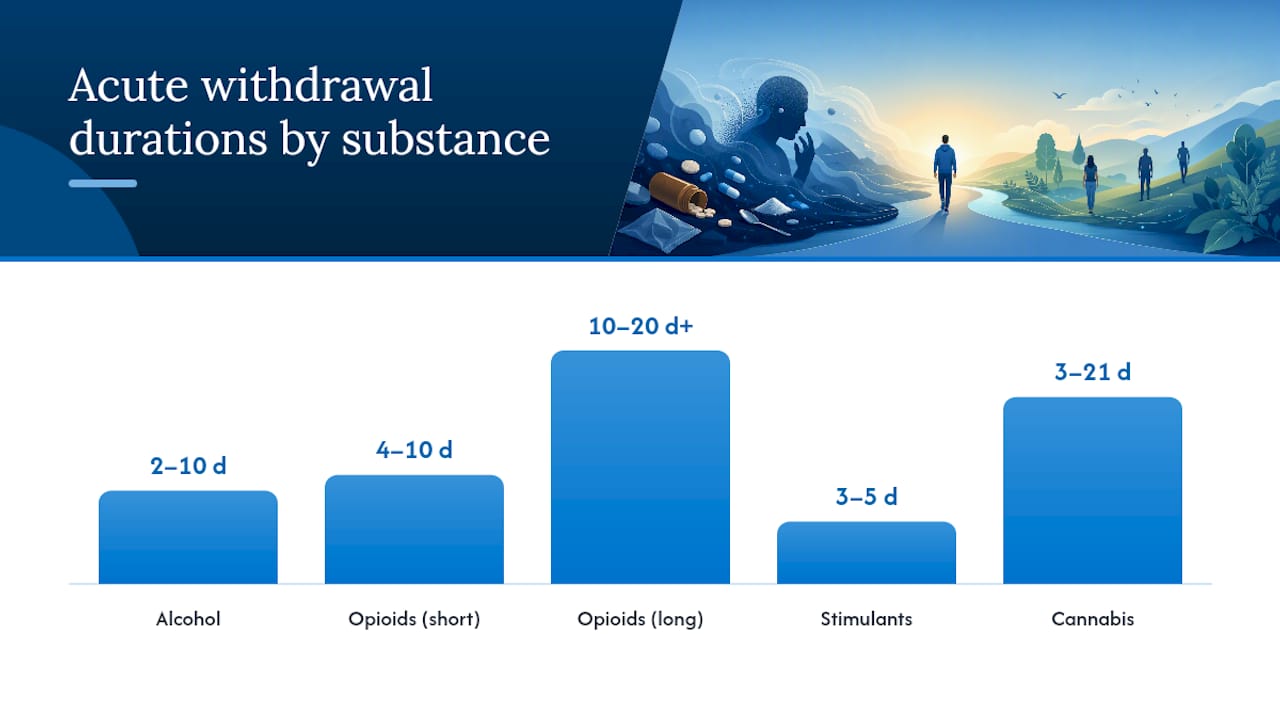
Alcohol moves fast. Symptoms typically appear 6 to 24 hours after the last drink, peak between 36 and 72 hours, and acute withdrawal usually resolves within 2 to 10 days. That peak window is also the most dangerous: seizures and delirium tremens cluster right around hour 48 to 72, which is a major reason alcohol detox is rarely something to manage alone at home.
Opioids split into two very different timelines depending on formulation. Short-acting opioids like heroin typically start withdrawal 8 to 24 hours after last use, running 4 to 10 days total. Long-acting opioids such as methadone take longer to kick in, 12 to 48 hours, but the withdrawal itself can stretch 10 to 20 days or more. That extended tail is exactly why methadone tapers are managed clinically rather than rushed.
Benzodiazepines follow a similar short versus long-acting split, but the stakes are higher. Short-acting agents begin withdrawal within 1 to 2 days; long-acting ones take 2 to 7 days to show symptoms. In both cases, withdrawal can continue for weeks to months and often requires a gradual, medically managed taper rather than stopping outright. Cutting a benzodiazepine cold turkey is one of the more dangerous choices someone can make during detox.
Stimulants, including cocaine and methamphetamine, tend to announce themselves within 24 hours of the last use, with the roughest physical stretch lasting 3 to 5 days. The catch is that psychological symptoms and cravings can persist for weeks to months after the body has otherwise leveled out. A partner resource on how long meth stays in the system is worth a look if you’re trying to separate detection windows from actual withdrawal timing, since the two get confused constantly.
Cannabis withdrawal starts slower, usually 24 to 48 hours after stopping, and acute symptoms run anywhere from a few days to about 3 weeks. Sleep disruption and irritability are the two symptoms most likely to outlast that window.
Hallucinogens rarely produce classic physical withdrawal at all. When symptoms do occur, they’re usually brief, but psychological aftereffects, including mood disturbances or flashbacks in some cases, can outlast the physical timeline by a wide margin.
| Substance | Onset | Peak | Acute Duration | Common Protracted Symptoms |
|---|---|---|---|---|
| Alcohol | 6 to 24 hours | 36 to 72 hours | 2 to 10 days | Sleep disruption, anxiety |
| Opioids (short-acting) | 8 to 24 hours | 1 to 3 days | 4 to 10 days | Cravings, low mood |
| Opioids (long-acting) | 12 to 48 hours | 3 to 6 days | 10 to 20+ days | Cravings, fatigue |
| Benzodiazepines (short-acting) | 1 to 2 days | Days to 1 week | Weeks | Anxiety, insomnia |
| Benzodiazepines (long-acting) | 2 to 7 days | 1 to 2 weeks | Weeks to months | Cognitive fog, anxiety |
| Stimulants | Within 24 hours | 3 to 5 days | Days | Cravings for months |
| Cannabis | 24 to 48 hours | Days | Up to 3 weeks | Sleep issues |
| Hallucinogens | Variable, often none | Variable | Typically brief | Mood or perceptual aftereffects |
Why Polysubstance Use and Certain Health Conditions Stretch Detox
Using more than one substance rarely just adds two timelines together, it tangles them. Withdrawal from one drug can mask the onset of another, or two overlapping syndromes can amplify each other’s severity in ways that are hard to predict from either substance alone. Clinicians managing polysubstance cases have to chart each drug’s expected onset and peak separately and prepare for interactions between them, which routinely means longer inpatient observation and staged medication strategies rather than a single fixed protocol.
Certain populations face longer timelines almost by default:
- Older adults clear substances more slowly due to reduced liver and kidney function, extending both onset and duration.
- Pregnant patients require detox protocols adjusted for fetal safety, often slower and more closely monitored than standard timelines.
- People with liver or kidney disease metabolize drugs less efficiently, which can prolong withdrawal and increase complication risk.
Pro Tip: If you’re using more than one substance, don’t try to estimate your detox length by adding up each drug’s typical timeline. Overlapping withdrawal is its own animal, and it’s the strongest single reason to detox somewhere with clinical oversight rather than at home.
Polysubstance use is one of the most consistent reasons cited for longer, more intensive monitoring during detox, according to clinical guidance on detox duration.
When Detox Needs Medical Supervision
Alcohol, benzodiazepines, and some opioid cases routinely call for medically supervised detox, not because every case turns severe, but because the ones that do can turn dangerous within hours. If you or someone you love is stopping one of these substances, treat medical oversight as the default, not the exception.
Watch for these red flags, which mean urgent medical care is needed immediately:
- Seizures at any point during withdrawal.
- Severe autonomic instability, meaning a racing heart, spiking blood pressure, or drenching sweats that don’t settle.
- Signs of delirium tremens, including confusion, hallucinations, or severe agitation, usually in the 48 to 72 hour alcohol window.
- Significant dehydration from vomiting or diarrhea that isn’t resolving.
- Suicidal ideation at any stage of the process.
Most medically supervised detox programs run roughly 3 to 10 days as a baseline, though heavier dependence, medical complications, or polysubstance involvement commonly extend that window. Anyone weighing which substances typically need supervision can get more detail in this safety guide to substances requiring medical detox.
How Sylmar Treatment Center Approaches Individualized Detox Timing
Sylmar Treatment Center builds every detox plan around a full clinical assessment first, not a fixed calendar. Patients receive 24/7 monitoring, medication management tailored to their specific substance and history, and dual diagnosis support when a mental health condition is part of the picture. Peer-reviewed guidance on pharmacological detox strategies backs this approach: tailoring medications to the substance and taper schedule reduces acute risk rather than following a generic timeline.
Sylmar operates under a California DHCS license and holds Joint Commission accreditation, both signals of clinical accountability behind a small, six-bed setting. You can see how these protocols play out in practice in this clinical guide to detox treatment examples.
Detox Is the Starting Line, Not the Finish
Here’s what gets lost in most conversations about detox timelines: finishing acute withdrawal doesn’t mean you’re done. It means your body has stabilized enough to actually start the harder work.
I’d push back on the idea that a clean detox timeline equals a resolved problem. The psychological tail, cravings, mood instability, disrupted sleep, often outlasts the physical symptoms by weeks or months. That’s not a failure of detox. It’s just what detox was never designed to fix on its own.
The practical takeaway is to line up therapy, medication management, or a support structure before detox even ends, not after. And if your timeline doesn’t match the ranges you read here, that’s not unusual. It’s a reason to lean on medical supervision rather than second-guess yourself.
— Jim
Getting Help: Medical Detox and What Comes Next at Sylmar
Sylmar Treatment Center’s advantage isn’t a bigger facility, it’s a smaller one. The six-bed setting means detox planning is built around your specific substance history, health conditions, and mental health needs, not a standardized track shared with dozens of other patients at once.

The center’s Medical Detoxification program provides 24/7 clinical monitoring through the acute withdrawal window described above, with medication management built in for patients who need it. For anyone with a co-occurring mental health condition, Dual Diagnosis Support addresses both simultaneously rather than treating one and deferring the other. Once acute withdrawal resolves, Residential Treatment picks up where detox leaves off, covering the protracted symptoms and psychological groundwork that detox alone can’t touch.
Sylmar is one accredited, clinically licensed option among several paths into recovery, and admissions support is available 24/7 if you want to talk through what your specific timeline might look like. Start with an assessment through the medical detox program page to get a clearer picture of what your situation actually requires.
Sources
This article draws on clinical withdrawal management guidance from the NCBI Bookshelf, peer-reviewed pharmacological detox strategy research from PMC/NIH, NIDA’s pharmacology and detection data, and clinical detox duration reviews from Texas Health.
This article is general information, not a substitute for advice from a qualified doctor. Consult a qualified healthcare professional about your own circumstances before acting on anything here.
FAQ
What Drug Takes the Longest to Detox From?
Benzodiazepines, particularly long-acting ones, typically have the longest detox timelines. Withdrawal can continue for weeks to months and often requires a slow, medically supervised taper rather than a fixed end date.
What Is the 3-3-3 Rule for Addiction?
The “3-3-3 rule” isn’t a standardized clinical term, and definitions of it vary widely across informal sources. Rather than rely on an unofficial rule, it’s more reliable to look at substance-specific onset, peak, and acute duration windows, which have actual clinical backing.
How Long Does It Take the Body to Completely Detox?
It depends entirely on the substance: alcohol and short-acting opioids often clear acute withdrawal in 2 to 10 days, while long-acting opioids and benzodiazepines can take weeks. Full psychological recovery through PAWS can extend well beyond the physical timeline.
What Are the Stages of Withdrawal?
Withdrawal generally moves through onset, escalation to a peak, gradual decline, and resolution of acute symptoms, though the exact number and naming of stages varies by clinical source and substance. Some substances also carry a post-acute phase where psychological symptoms persist after the physical stage ends.
How Long Is a Typical Medical Detox Program?
Most medically supervised detox programs run 3 to 10 days, though heavier dependence or complications often extend that window. Sylmar Treatment Center bases program length on individualized assessment rather than a fixed schedule, through its Medical Detoxification program.