

Integrated treatment means one team, in one setting, treats your addiction and your mental health condition together under a single plan. Parallel treatment means two separate providers or programs treat them side by side, often without sharing notes. For someone with both conditions, federal guidance names integrated care as the best-practice model, and that is how we build care at Sylmar Treatment Center: dual diagnosis support delivered by one team in a six-bed residential setting.
This guide explains the two models in plain terms, what the evidence says, how to tell which one a program actually offers, and what families and court professionals should ask before a placement.
TL;DR
- Integrated treatment treats substance use and mental health together, with one team and one coordinated plan. Parallel treatment uses separate providers for each condition at the same time.
- SAMHSA, the federal agency for substance use and mental health, recommends integrated care as a best practice for co-occurring disorders.
- Integrated care is associated with less substance use, fewer PTSD and depression symptoms, and fewer emergency and inpatient visits.
- The practical risk of parallel care is conflicting messages and gaps between providers. Ask any program who writes the plan and who sees the whole picture.
- Our six-bed, DHCS-licensed, Joint Commission-accredited facility is built around treating both conditions at once.
Table of Contents
- What the two terms mean
- A side-by-side comparison
- A worked example
- What the evidence reports for integrated care
- Why screening and assessment come first
- Where each part of care fits
- How to tell which model a program really uses
- Guidance for families
- Guidance for legal professionals coordinating mandated care
- Where we stand
- Starting treatment with us
- FAQ
- Sources
What the two terms mean
Co-occurring disorders (also called dual diagnosis) means a person has a substance use disorder and a mental health disorder, such as depression, anxiety, PTSD or bipolar disorder, at the same time. The two conditions feed each other. Drinking can deepen depression, and anxiety can drive someone back to a substance.
SAMHSA’s treatment guide on this subject, TIP 42, describes three ways to organize care:
- Sequential: one condition is treated first, then the other.
- Simultaneous but in parallel: both are treated at once, but by different providers or programs.
- Concurrent and integrated: both are treated at once, by coordinated providers working as one.
A 2019 academic review of integrated treatment puts the distinction simply. Integrated treatment coordinates care within one team and setting so the patient hears a consistent message. Parallel treatment uses different providers or teams to address each disorder separately.
A side-by-side comparison
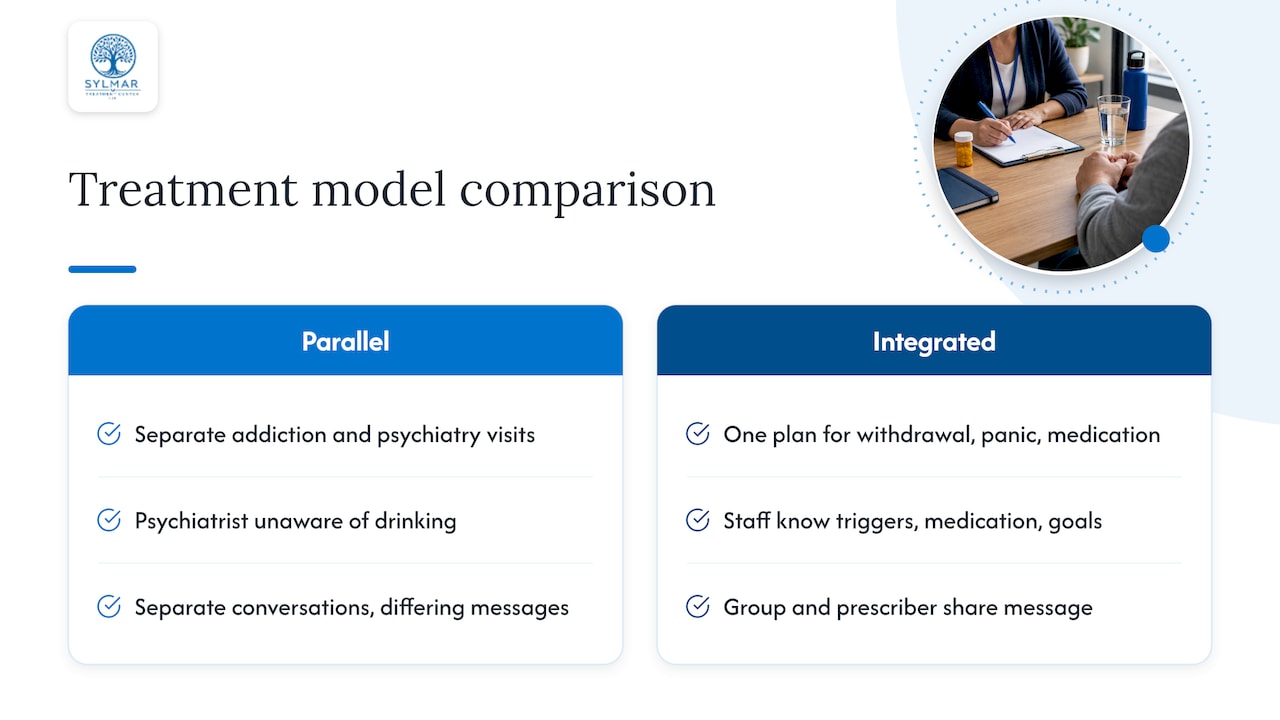
| Integrated treatment | Parallel treatment | |
|---|---|---|
| Who treats you | One coordinated team | Separate addiction and mental health providers |
| Treatment plan | One plan covering both conditions | Two plans, often written independently |
| Messages you hear | Consistent across therapy, medication and groups | May differ between providers |
| Medication decisions | Made with full knowledge of your substance use history | Made by a prescriber who may not see your addiction records |
| Who sees the whole picture | The team, every day | Often only you |
| Setting | Usually one location | Usually two or more locations or organizations |
Parallel care is not careless care. Many parallel arrangements involve skilled clinicians. The difficulty is structural: when no one is responsible for connecting the two halves, the patient becomes the messenger between them.
A worked example
Imagine a 34-year-old with severe alcohol use and panic disorder.
In a parallel arrangement, she attends an addiction program on weekday mornings and sees a psychiatrist across town every few weeks. The addiction counselor tells her to push through anxiety without relying on substances. The psychiatrist, who does not know how much she has been drinking, adjusts a prescription based on what she reports. After a rough week she tells neither of them how bad it got, because each appointment feels like a separate conversation.
In an integrated arrangement, the same clinicians review her withdrawal symptoms, her panic episodes and her medication in one plan. When a panic attack hits during treatment, the staff who respond know her triggers, her medication and her recovery goals. The message she hears in group is the one she hears from her prescriber.
This is an illustration of how the models differ, not a case from our files.
What the evidence reports for integrated care
SAMHSA’s 2024 issue brief on co-occurring services reports that integrated care is associated with:
- decreased substance use
- reduced PTSD and depression symptoms
- decreased use of high-cost services such as emergency department visits and inpatient hospitalization
- improved functioning, employment, quality of life and access to housing
TIP 42 explains why coordination matters. Concurrent treatment by trained, coordinated providers is meant to prevent the fragmentation and conflicting messages that can occur when care is sequential or parallel. SAMHSA also reports in its evidence kit on integrated treatment that a majority of dual diagnosis clients respond well to integrated services. It also notes that those who do not respond remain at high risk of hospitalization, incarceration and homelessness, which is why a program that watches closely and adjusts the plan matters.
The same issue brief lists six guiding principles for co-occurring care: a recovery perspective, a holistic viewpoint, phased trauma-informed care, early attention to real-life problems, adaptation for cognitive and functional concerns, and use of support systems. Those principles are easier to carry out when one team owns the whole plan.
Why screening and assessment come first
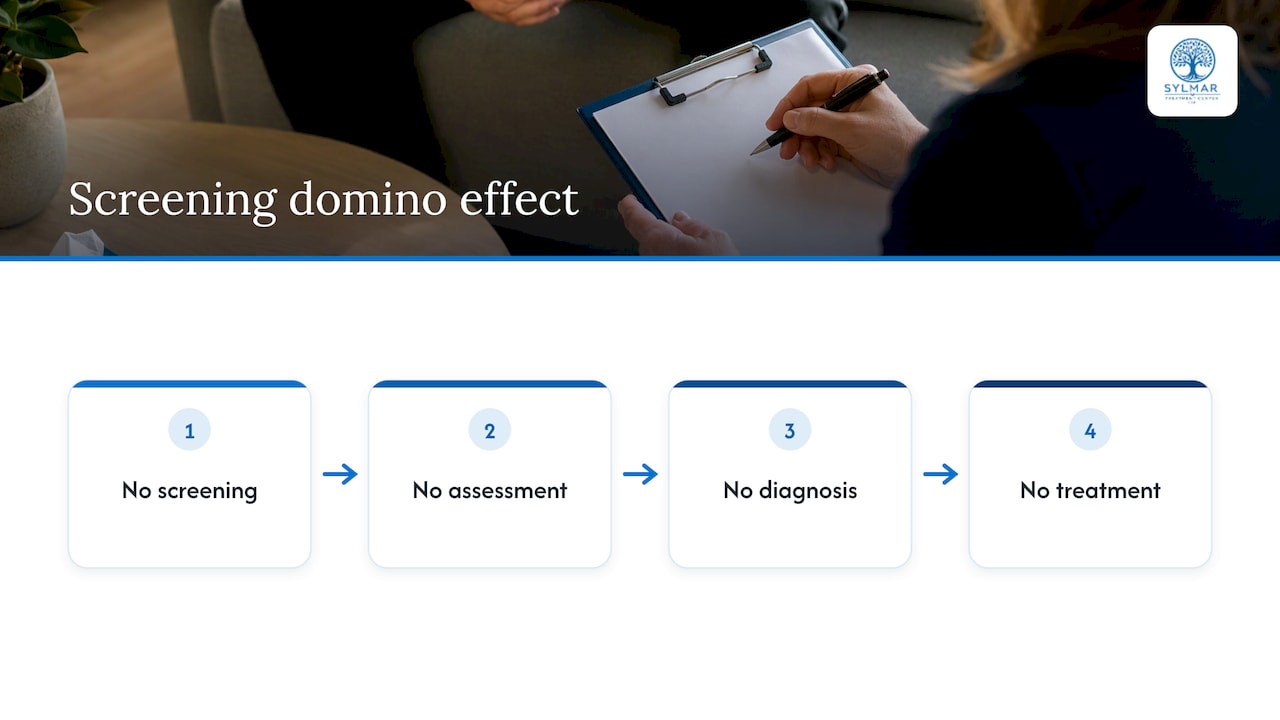
Neither model works if one condition goes unnoticed. SAMHSA’s issue brief warns that without routine screening, providers may identify one disorder and miss the other. TIP 42 describes a domino effect: no screening leads to no assessment, diagnosis or treatment. The same guidance says there is no wrong door, meaning a person with co-occurring disorders can arrive at treatment through any entry point and should still be screened and connected to appropriate care.
For a family, this means the first question is less “which label?” and more “who will assess both conditions, and when?” At Sylmar, treatment starts with comprehensive assessments and custom care plans, so the mental health picture and the substance use picture are on the same page from the start.
Where each part of care fits
TIP 42 states that co-occurring services can be offered in therapeutic communities, outpatient addiction centers, residential treatment facilities and acute medical care settings. Here is how the main pieces fit together in a residential program.
Detox
Medically supervised detoxification manages withdrawal safely. It is the start of treatment, not the whole of it. TIP 42 notes that continuity of care after residential detox is associated with lower detox readmission rates. Our medical detoxification leads into residential treatment at the same facility, so the person does not have to find a new provider at a fragile moment.
Medication
TIP 42 describes pharmacotherapy as often a core part of treatment for depression, bipolar I disorder, anxiety, schizophrenia and psychotic disorders, alcohol use disorder and opioid use disorder. In integrated care, the prescriber sees the whole picture. Our medication management includes psychiatric oversight, so medication choices are made alongside therapy and recovery planning.
Therapy and groups
Individual therapy, group work and behavioral rehabilitation address the thinking and habits behind both conditions. Group settings can be especially useful when peers and staff understand that anxiety, trauma and substance use are connected. Our article on group therapy in dual diagnosis recovery goes deeper. Our behavioral rehabilitation program builds daily skills for life after treatment.
Safety and trauma-informed care
TIP 42 states that people with co-occurring disorders are at elevated risk for self-harm, especially with a history of trauma. It says providers should make client safety a priority and ensure staff are trained to detect and respond to suicidal thoughts and behaviors. If you or someone you love is in crisis, call or text 988, the Suicide and Crisis Lifeline, or call 911.
A residential setting with round-the-clock staff supports that safety priority. Some people also explore gentle body-based practices such as trauma healing qigong as part of their wider wellness routine, discussed with their treatment team.
How to tell which model a program really uses
Brochures often use the word “integrated” loosely. These questions separate the two models.
- Who writes the treatment plan? In an integrated program, one team builds a single plan covering both conditions.
- Do the prescriber and the therapists meet about each client? Ask how often, and whether it happens while you are in treatment.
- Does the program assess for mental health conditions at admission? A comprehensive assessment should cover both.
- What happens if symptoms of one condition flare up? The answer should be a plan, not a referral to someone else.
- Is the program licensed and accredited? In California, look for a DHCS license. Joint Commission accreditation is a national quality mark. Sylmar holds both.
- What is the staff-to-client ratio, and how large is the program? Smaller settings make coordination easier. Ours has six beds.
Our guide on what to ask programs about dual diagnosis expands on this list, and examples of integrated dual diagnosis treatment show what it looks like day to day.
Guidance for families
Families often arrive after a crisis and a string of partial fixes: a detox here, a psychiatric hold there, a therapist who was not told about the drinking. Three points help.
- Look for continuity. Recovery is measured in months, not days. Our article on anxiety and substance use treatment for families explains why.
- Choose a single point of contact. When one team holds the plan, family questions have one place to go.
- Match the program to the diagnosis. Conditions such as ADHD, OCD and chronic pain each interact with substance use differently, and an individualized plan accounts for that. See our individualized treatment programs.
Guidance for legal professionals coordinating mandated care
Attorneys, probation officers and case managers need a placement that can document progress on both conditions in one place. Reports from a single team are easier to reconcile than reports from several providers working separately. Our court-directed placements are available through the programs page, and our admissions line runs 24/7 so a placement does not have to wait for office hours.
Where we stand
We treat addiction and mental health as one problem with two faces, and our six-bed setting exists to make that practical. With a small number of clients, our staff know each person’s history, triggers, medication and goals. Nobody has to carry information from one provider to another.
The federal guidance points the same way: coordinated, concurrent care is the recommended model. Our work is to put that into practice daily, from medically supervised detox through residential treatment, with psychiatric oversight of medication and a plan written for the individual.
We hold a California DHCS license and Joint Commission accreditation because families and courts deserve assurance of quality. We believe recovery is built on real relationships between clients and staff, and a small residence is where those relationships can form.
Jim
Starting treatment with us
If you or someone you love needs detox, residential care or both, with the mental health side treated at the same time, our admissions team is available 24/7. Our Dual Diagnosis Support program brings substance use and mental health treatment into one plan, within a six-bed, licensed and accredited facility. You can learn more on our home page.
For a closer look at how our approach compares across common conditions, read our guide to integrated treatment options for co-occurring disorders.
FAQ
Is integrated treatment better than parallel treatment?
SAMHSA recommends integrated care as a best practice for co-occurring disorders, and its 2024 issue brief associates it with less substance use, fewer PTSD and depression symptoms, and fewer emergency and inpatient visits. Coordinated care also means you hear one consistent message. That is why we organize treatment this way.
Can I get both treatments at the same time without an integrated program?
Yes, that is parallel treatment: separate providers each treat one condition at once. It works best when the providers communicate regularly. In an integrated program, that coordination is built into one team and one plan, so it does not depend on you relaying information.
Do you treat the substance use or the mental health condition first?
Sequential care treats one first and then the other. Integrated care treats both together. At Sylmar, medically supervised detox, therapy and medication management with psychiatric oversight sit within the same individualized plan.
Does insurance cover integrated treatment?
Sylmar admits clients who pay directly or through insurance. Coverage depends on your plan, so call our admissions team, available 24/7, and we can talk through your situation.
Can a court order place someone in an integrated program?
We offer court-directed placements for legal requirements. Legal professionals can contact admissions to discuss a placement and what documentation the court needs.
Sources
- SAMHSA, TIP 42: Substance Use Disorder Treatment for People With Co-Occurring Disorders (2020)
- SAMHSA, Substance Use Disorder Treatment for People with Co-Occurring Disorders, PEP20-06-04-006
- SAMHSA, Co-Occurring Mental Health and Substance Use Services issue brief (2024)
- SAMHSA, Integrated Treatment for Co-Occurring Disorders: The Evidence
- Yule and Kelly, Integrating Treatment for Co-Occurring Mental Health and Substance Use Disorders (2019)